1993 GMC SIERRA clutch
[x] Cancel search: clutchPage 297 of 436

Cleaning Your Diesel Engine
you spray or pour water or any other liquid on your engine when it is
arm or hot,
or when it is running, you could cause serious damagl o it.
you ever clean the engine, clean it only when it is cold.
Noise Control System
The following information relates to compliance with Federal noi\
se emission
standards for vehicles with a Gross Vehicle Weight Rating (GVW\
R) of more
than 10,000 pounds
(4 536 kilograms). See your maintenance schedule for
information on maintaining the noise control system to minimize degradation
of
the noise emission control system during the life of your vehicle. The noise
control system warranty is given in your Warranty booklet.
These standards apply only to vehicles sold in the United States.
Tampering With Noise Control System Prohibited
Federal law prohibits the following acts or the causing thereof:
1. The removal or rendering inoperative by any person, other t\
han for purposes of maintenance, repair or replacement, of any device
or
element of design incorporated into any new vehicle for the purpose of
noise control, prior to its sale or delivery to the ultimate purchaser or
while it is in use;
or
2. The use of the vehicle after such device or element of design has been
removed or rendered inoperative by any person.
Among those acts presumed to constitute tampering are the acts listed below.
Insulation:
Removal of noise shields or underhood insulation.
Engine:
Removal or rendering engine speed governor, if so equipped, inoperative
so as to allow engine speed to exceed manufacturer specifications.
Fan and Drive:
Removal of fan clutch, if so equipped, or rendering clutch inoperative.
Removal of fan shroud, if so equipped.
Air Intake:
Removal of air cleaner silencer.
Reversing air cleaner cover.
6-1
9
ProCarManuals.com
Page 315 of 436

How to Add Fluid:
Here’s how to add fluid. Refer to the Maintenance Schedule to determine
what kind of fluid to use. See “Recommended Fluids and Lubricants” in the
Index.
1. Remove the filler plug.
2. Add fluid at the filler plug hole. Add only enough fluid to \
bring the fluid
3. Install the filler plug. Be sure that the filler plug is full\
y seated.
level up
to the bottom
of the filler plug hole.
Hydraulic Clutch
112” to
K2376
The hydraulic clutch in your vehicle is self-adjusting. A slight amount of play
(112 inch to an inch) in the pedal is normal.
6-37
ProCarManuals.com
Page 316 of 436

Service & Amearance Care
-
When to Check and What to Use;
Refer to the Maintenance Schedule to determine how often you should check
the fluid level in your clutch master cylinder reservoir and what to add. See
“Owner Checks and Services” and “Recommended Fluids and \
Lubricants” in
the Index.
How to Check:
K2344
The proper fluid should be added if the level does not reach the bottom of
the diaphragm when it’s in place in the reservoir. See the instructions on the
reservoir cap.
6-38
ProCarManuals.com
Page 317 of 436

Hydraulic Clutch Grease Fitting
A grease fitting is on the clutch housing for lubricating the clutch fork ball
stud. See your Maintenance Schedule for when to lubricate the clutch
housing. See “Recommended Fluids and Lubricants” in the Index for the
proper lubricant to use.
Be sure not to over-fill because you could damage your clutch.
Four- Wheel Drive
Most lubricant checks in this section also apply to four-wheel-drive vehicles.
However, they have two additional systems that need lubrication.
Transfer Case
When to Check Lubricant:
Refer to the Maintenance Schedule to determine how often to check the
lubricant. See “Periodic Maintenance Inspections” in the Index.
How to Check and Add Lubricant:
I
PO230
If the level is below the bottom of the filler plug hole, you’ll need to add
some lubricant. Add enough lubricant to raise the level to the bottom of the
filler plug hole.
What to Use:
Refer to the Maintenance Schedule to determine what kind of lubricant to
use. See “Recommended Fluids and Lubricants” in the Index.
639
ProCarManuals.com
Page 398 of 436

Scheduled Maintenance Services
Explanation Of Scheduled Maintenance Services
Below are explanations of the services listed in the maintenance charts.
The proper fluids and lubricants to use are listed in this section. Make sure
whoever services your vehicle uses these. All parts should be \
replaced and
all necessary repairs done before you or anyone else drives the ve\
hicle.
1.
ENGINE OIL AND OIL FILTER CHANGE* -ALWAYS USE SG OR
SGKE QUALITY, ENERGY CONSERVING II OILS OF THE PROPER
VISCOSITY. To determine the preferred viscosity oil for your vehicle’s
engine (e.g. SAE 5W-30 or 10W-30), see “Engine Oil” in the Index.
2. CHASSIS LUBRICATION -Lubricate the front suspension, king pin
bushings, steering linkage, transmission, and transfer case shift\
linkage,
parking brake cable guides, propshaft splines (2 wheel drive), brake
pedal springs, and clutch pedal springs at the intervals specified.
If you have a 3500 HD, lubricate the king pins and king pin bushings
every 1,500 miles
(2500 km) for Maintenance Schedule 1, or every 3,000
(5000 km) for Maintenance Schedule 2.
Ball joints and king pin bushings should not be lubricated unless their
temperature is
10°F (-12”C), or higher. When the weather is cold, let
them warm up before lubrication or they could be damaged.
Also, be sure to check
all the vehicle fluid levels at this time.
3.
CLUTCH FORK BALL STUD LUBRICATION -Lubricate the clutch fork
ball stud through the fitting on the clutch housing. Lubricant must be
added “sparingly” to the fitting, as only.
0066 Ib. (.003 kg) is required to
lubricate the ball stud surface.
Do not add lubricant more often than the
intervals in the Maintenance Charts.
Too much lubricant will damage
the clutch assembly.
4. ENGINE IDLE SPEED ADJUSTMENT (DIESEL ENGINES)* -Adjust to
the specifications shown on the underhood label. You must use
calibrated test equipment.
5. COOLING SYSTEM SERVICE* -Drain, flush and refill system with new
coolant. See “Engine Coolant’’ in the Index for the proper coolant and
mixture to use in your vehicle.
Also inspect the hoses and replace them
if they are cracked, swollen, or
deteriorated. Tighten all hose clamps (except constant tension \
clamps).
Remove debris and clean the outside
of the radiator and air conditioning
condenser. Wash the radiator neck.
To ensure proper operation, pressure
test the radiator and cap.
* An Emission Control Service
7-1
8
ProCarManuals.com
Page 402 of 436

Scheduled Maintenance Sewices
When the wheels are removed for rotation, inspect disc brake pads f\
or wear
and rotors for surface condition.
Also inspect drum brake linings for wear and
cracks. Inspect other brake parts, including drums, wheel cylind\
ers, parking
brake, etc., at the same time. Remove any rust
or dirt from the wheel and
mounting surfaces before mounting the wheel.
Inspect brakes more often if driving habits or conditions resull In
frequent braking.
Owner Checks and Services
Listed below are owner checks and services which should be mad\
e at the
time period specified
to help ensure proper safety, emission performance, and
dependability of your vehicle.
Be sure any necessary repairs are completed at once. Whenever \
any fluids
or lubricants are added to your vehicle, make sure they are the proper ones,
as shown
in this Section.
At Least Once a Month
Tire inflation pressure check -Check the tires for proper inflation. If they
are low, inflate them
to the level specified on the certification label or on the
tire inflation charts. See “Loading Your Vehicle’’ or “Inflation-Tire Pressure” in
the Index.
At Least Once a Year
Key lock cylinder lubrication -Lubricate key lock cylinders with engine oil.
See the “Recommended Fluid and Lubricants’’ chart in this section.
Transmission neutral or clutch start switch operation
CAUTION
~
1. Before you start, be sure you have enough room around the veh\
icle.
2. Firmly apply both the manual parking brake and the regular brake. See
“Brakes” and “Parking Brake” in the Index.
Do not use the accelerator
pedal.
3. Be ready to turn off the engine immediately if it starts.
4. On automatic transmission vehicles, try to start the engine in each gear.
The starter should work only in
P (Park) or N (Neutral).
7-22
ProCarManuals.com
Page 403 of 436

On manual transmission vehicles, put the shift lever in N (Neutral), push the
clutch down halfway, and try to start the engine. The starter should work only
when the clutch is pushed down all the way to the floor.
Steering column lock operation -While parked, try to turn the key to Lock
in each gear shift position.
With an automatic transmission, the key should turn to
Lock only when the
gear shift is in
P (Park).
On vehicles with a key release lever, try to turn the key to
Lock without
pressing the lever. The key should turn to
Lock only with the key lever
depressed.
On all vehicles, the key should come out only in
Lock.
Parking brake and transmission
P (PARK) mechanism operation -
CAUTION I
4 When you are doing this check, your vehicle could begin to move.
You
or others could be injured and property could be damaged.
Make sure there is
room in front of your vehicle in case you begin
to
roll. Be ready to apply the regular brake at once should the
vehicle begin to move.
IW
Park on a fairly steep hill, with the vehicle facing downhill.\
Keeping your foot
on the regular brake, set the manual parking brake.
To check the parking brake: With the engine running and the
transmission in
N (Neutral), slowly remove foot pressure from the regular
brake pedal.
Do this until the vehicle is held by the parking brake only.
To check the “Park” mechanism’s holding ability: Apply the \
regular brake
and shift to
P (Park). Release the manual parking brake, then slowly
release the regular brake.
Lap and shoulder belts condition and operation -Inspect belt system,
including: webbing, buckles, latch plates, retractors, guide loop\
s and anchors.
Have a belt assembly replaced
if the webbing has been cut or otherwise
damaged.
Body
Lubrication Service -Lubricate all body door hinges with engine oil.
Also lubricate the tailgate, tailgate handle pivot points, and tailga\
te mounted
spare tire carrier
(if equipped). Lubricate the body hood, fuel door and rear
compartment hinges, latches and locks including interior glove
box and
console
doors, and any folding seat hardware. Lubricate the hood safety lever
pivot and prop
rod pivot. More frequent lubrication may be required when
exposed to a corrosive environment.
7-23
ProCarManuals.com
Page 405 of 436
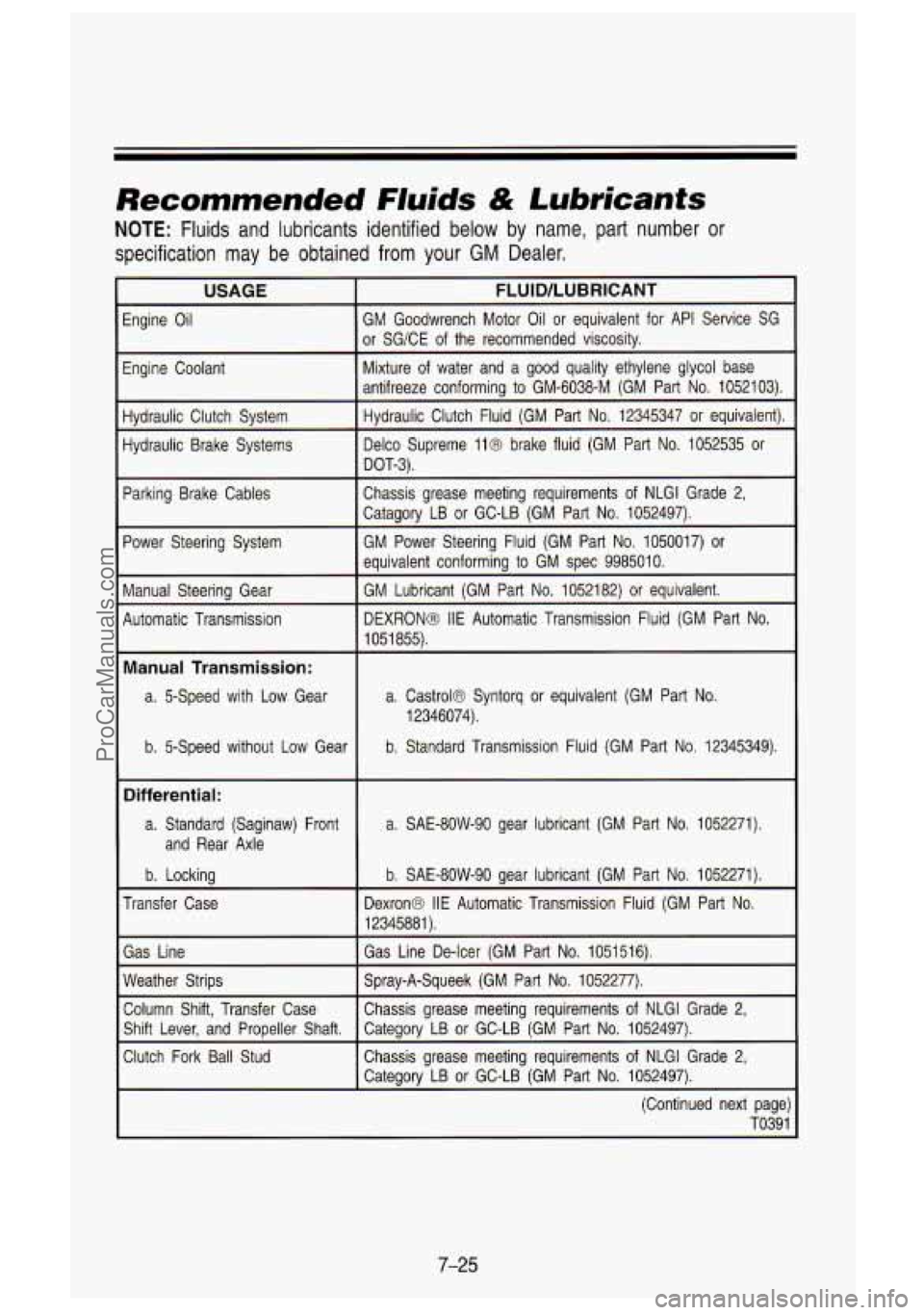
Recommended Fluids & Lubricants
NOTE: Fluids and lubricants identified below by name, part number or
specification may be obtained from your
GM Dealer.
USAGE I FLUID/LUBRICANT
Engine Oil
I
GM Goodwrench Motor Oil or equivalent for API Service SG
or SGlCE of the recommended viscositv.
Engine Coolant Mixture
of water and a good quality ethylene glycol base
antifreeze conforming
to GM-6038-M (GM Part No. 1052103).
Hydraulic Clutch System Hydraulic Clutch Fluid (GM Part
No. 12345347 or equivalent).
Hydraulic Brake Systems Delco Supreme
11
@ brake fluid (GM Part No. 1052535 or
DOT-3).
Parking Brake Cables
GM Lubricant (GM Part
No. 1052182) or equivalent.
Manual Steering Gear GM Power Steering
Fluid (GM Part
No. 1050017) or
Power Steering System Chassis grease meeting requirements of
NLGl Grade 2,
Automatic Transmission DEXRONB
HE Automatic Transmission Fluid (GM Part
No.
Catagory LB or GC-LB (GM Part No. 1052497).
equivalent conforming
to GM spec 9985010.
1051
855l.
Manual Transmission:
a. 5-Speed with Low Gear
b. Standard Transmission Fluid (GM Part
No. 12345349).
b. 5-Speed without Low Gear a.
CastrolB Syntorq or equivalent (GM Part
No.
1 2346074).
Differential:
a. Standard (Saginaw) Front
b. SAE-80W-90 gear lubricant (GM Part No. 1052271). b. Locking a.
SAE-80W-90 gear lubricant (GM Part
No. 1052271).
and Rear Axle
Transfer Case Gas Line De-lcer (GM Part
No. 1051516).
Gas Line DexronB
IIE Automatic Transmission
Fluid (GM Part No.
12345881).
Weather Strips
Category LB or GC-LB (GM Part
No. 1052497).
Chassis grease meeting requirements
of NLGl
Grade 2,
Clutch Fork Ball Stud Category
LB or GC-LB (GM Part
No. 1052497).
Shift Lever, and Propeller Shaft. Chassis grease meeting requirements
of NLGl Grade 2,
Column Shift, Transfer Case Spray-A-Squeek
(GM Part
No. 1052277).
(Continued next
page^
TO391
7-25
ProCarManuals.com