1993 GMC SIERRA headlights
[x] Cancel search: headlightsPage 152 of 436

Features & Controls
CHECK GAGES Light
This light will come on briefly when you are starting the engine. If the light
comes on and stays
on while you are driving, it could indicate a problem with
your vehicle. Check your various gages to see
if they are in the warning
zones.
K2330
Daytime Running Lights (DRL) Indicator Light (Canada On/y)
I-
K2318
If your vehicle was first sold, when new, in Canada, you will have this green
light on the instrument panel. It will light, just above the \
speedometer,
whenever the Daytime Running Lights are on. For more details a\
bout DRL,
see “Headlights and Vehicle Lighting” in this section.
2-84
ProCarManuals.com
Page 154 of 436

Features & Contmls
beam headlights. For more details about high beams, see “Hea\
dlight High-Low Beam Changer” earlier in this section.
Turn Signal and Lane Change Indicator
K2444
These lights, with the green arrows, are on each side of the instrument
cluster. The signal indicator will come on whenever
you signal a turn or lane
change. See “Turn and Lane Change Signal” earlier in this section,
2-86
ProCarManuals.com
Page 208 of 436

Your Driving and the Road
A Turning or driving across steep hills can be dangerous. You could
lose traction, slide sideways, and possibly roll over. You could be
seriously injured or
I 'I' ?d. When driving up hills, always try to go
I straight up.
Ease up on your speed as you approach the top of the hill.
Attach a flag to the vehicle to make you more visible to approaching
traffic on trails or hills.
Sound the horn as you approach the top of hill to let opposing traffic
know you're there.
Use your headlights even during the day. They make you more visible to
oncoming traffic.
I A Driving to the top (crest) of a hill at full speed can muse an
accident.
There could be a drop-off, embankment, cliff, or even
another vehicle. You buld be seriously injured or killed. .As you near
the
top of a hill, slow down and stay alert. I
Q: What should I do if my vehicle stalls, or is about to stall, and I can't
make it
up the hill?
A: If this happens, there are some things you should do, and there are some
things
you must not do. First, here's what you should do:
0
0
0
0
Push the brake pedal to stop the vehicle and keep it from rolling
backwards.
Also, apply the parking brake.
If your engine is still running, shift the transmission into reverse, release
the parking brake, and slowly back down the hill in reverse.
If your engine has stopped running, you'll need to restart it. With the
brake pedal depressed and the parking brake still applied, shift the
transmission to
P (Park) (or, shift to N (Neutral) if your vehicle has a
manual transmission) and restart the engine. Then, shift to Reverse,
release the parking brake, and slowly back down the hill in reverse.
As you are backing down the hill, put your left hand on the ste\
ering
wheel at the
12 o'clock position. This way, you'll be able to tell if your
wheels are straight or turned to the left or right as you back down.
4-30
ProCarManuals.com
Page 214 of 436

Your Driving and the Road
After Off-Road Driving
Remove any brush or debris that has collected on the underbody\
, chassis, or
under the hood. These accumulations can be a fire hazard.
After operation in mud or sand, have the brake linings cleaned\
and checked. These substances can cause glazing and uneven braking. Check th\
e body
structure, steering, suspension, wheels, tires, and exhaust syste\
m for damage.
Also, check the fuel lines and cooling system for any leakage.
Your vehicle will require more frequent service due
to off-road use. Refer to
Section
7 for additional information.
Driving at Night
I
--.
-
- AM450002 I
Night driving is more dangerous than day driving. One reason is that some
drivers are likely
to be impaired-by alcohol or drugs, with night vision
problems, or by fatigue.
Here are some tips on night driving.
Drive defensively. Remember, this is the most dangerous time.
Don’t drink and drive (See “Drunken Driving” in the Index for more on
this problem).
Adjust your inside rear view mirror to reduce the glare from headlights
Since you can’t see as well, you may need to slow down and keep
behind
you.
more space between you and other vehicles. It’s hard
to tell how fast
the vehicle ahead is going just
by looking at its taillights.
4-36
ProCarManuals.com
Page 215 of 436

Slow down, especially on higher speed roads. Your headlights ca\
n light
In remote areas, watch for animals.
If you’re tired, pull off the road in a safe place and rest.
up only
so much road ahead.
Night Vision
No one can see as well at night as
in the daytime. But as we get older
these differences increase.
A 50-year-old driver may require at least twice as
much light to see the same thing at night as a 20-year-old.
What you do in the daytime can also affect your night vision.\
For example, if
you spend the day in bright sunshine you are wise to wear sunglasses. Your
eyes will have less trouble adjusting to night.
But if you’re driving, don’t wear sunglasses at night. Th\
ey may cut down on
glare from headlights, but they also make a lot of things inv\
isible that should
remain visible-such as parked cars, obstacles, pedestrians, or e\
ven trains
blocking railway crossings. You may want
to put on your sunglasses after you
have pulled into a brightly-lighted service or refreshment area.\
Eyes shielded
from that glare may adjust more quickly to darkness back on t\
he road. But
be sure to remove your sunglasses before you leave the service\
area.
You can be temporarily blinded by approaching lights.
It can take a second or
two, or even several seconds, for your eyes to readjust to the dark. When
you are faced with severe glare (as from a driver who doesn’\
t lower the high
beams, or a vehicle with misaimed headlights), slow down a little. Avoid\
staring directly into the approaching lights. If there is a line of opposing
traffic, make occasional glances over the line of headlights to make certain
that one of the vehicles isn’t starting to move into your lane. Once you are
past the bright lights, give your eyes time to readjust before\
resuming speed.
High Beams
If the vehicle approaching you has its high beams on, signal by \
flicking yours
to high and then back to low beam. This is the usual signal to lower the
headlight beams.
If the other driver still doesn’t lower the beams, resist the
temptation to put your high beams on. This only makes
two half-blinded
drivers.
On a freeway, use your high beams only in remote areas where \
you won’t impair approaching drivers. In some places, like cities, using \
high beams is
illegal.
When you follow another vehicle on a freeway or highway, use \
low beams.
True, most vehicles now have day-night mirrors that enable the \
driver to
reduce glare. But outside mirrors are not
of this type and high beams from
behind can bother the driver ahead.
4-37
ProCarManuals.com
Page 216 of 436

Your Driving and the Road
A Few More Night Driving Suggestions
Keep your windshield and all the glass on your vehicle clean-i\
nside and out.
Glare at night is made much worse by dirt on the glass. Even\
the inside
of
the glass can build up a film caused by dust. Tobacco smoke \
also makes inside glass surfaces very filmy and can be a vision hazard
if it’s left there.
Dirty glass makes lights dazzle and flash more than clean glas\
s would,
making the pupils of your eyes contract repeatedly. You might even want to
keep a cloth and some glass cleaner in your vehicle
if you need to clean
your glass frequently.
Remember that your headlights light up far less of a roadway \
when you are
in a turn or curve.
Keep your eyes moving; that way, it’s easier to pick out d\
imly lighted objects.
Just as your headlights should be checked regularly for proper \
aim,
so should
your eyes be examined regularly. Some drivers suffer from night\
blindness-the inability to see in dim light-and aren’t even aware of
it.
Driving in the Rain
Rain and wet roads can mean driving trouble. On a wet road y\
ou can’t stop,
accelerate or turn as well because your tire-to-road traction i\
sn’t as
good as
on
dry roads. And, if your tires don’t have much tread left, you’ll get even
less traction.
It’s always wise to go slower and be cautious if rain starts to fall while you
are driving. The surface may get wet suddenly when your reflex\
es are tuned
for driving on
dry pavement.
4-38
ProCarManuals.com
Page 218 of 436

Your Driving and the Road
You might not be aware of hydroplaning. You could drive along for some time
without realizing your tires aren’t in constant contact with \
the road. You could
find out the hard way: when you have to slow, turn, move out to pass-or
if
you get hit by a gust of wind. You could suddenly find yourself out of control.
Hydroplaning doesn’t happen often. But it can
if your tires haven’t much tread
or if the pressure in one or more is low. It can happen if a lot of water is
standing
on the road. If you can see reflections from trees, telephone poles,
or other vehicles, and raindrops “dimple” the water’s surfa\
ce, there could be
hydroplaning.
Hydroplaning usually happens on higher speed roads. There just \
isn’t a hard
and fast rule about hydroplaning. The best advice is to slow \
down when it is
raining, and be careful.
Some Other Rainy Weather Tips
e
e
e
e
e
Turn on your headlights-not just your parking lights-to help ma\
ke you more visible to others.
Look for hard-to-see vehicles coming from behind. You may want to use
your headlights even in daytime
if it’s raining hard.
Besides slowing down, allow some extra following distance. And \
be
especially careful when you pass another vehicle.
Allow yourself more
clear
room ahead, and be prepared to have your view restricted by road
spray.
If the road spray is so heavy you are actually blinded, drop back.
Don’t pass until conditions improve. Going more slowly is be\
tter than
having an accident.
Use your defogger
if it helps.
Have good tires with proper tread depth. (See “Tires” in\
the Index.)
4-40
ProCarManuals.com
Page 219 of 436
Driving in Fog, Mist and Haze
AM459002
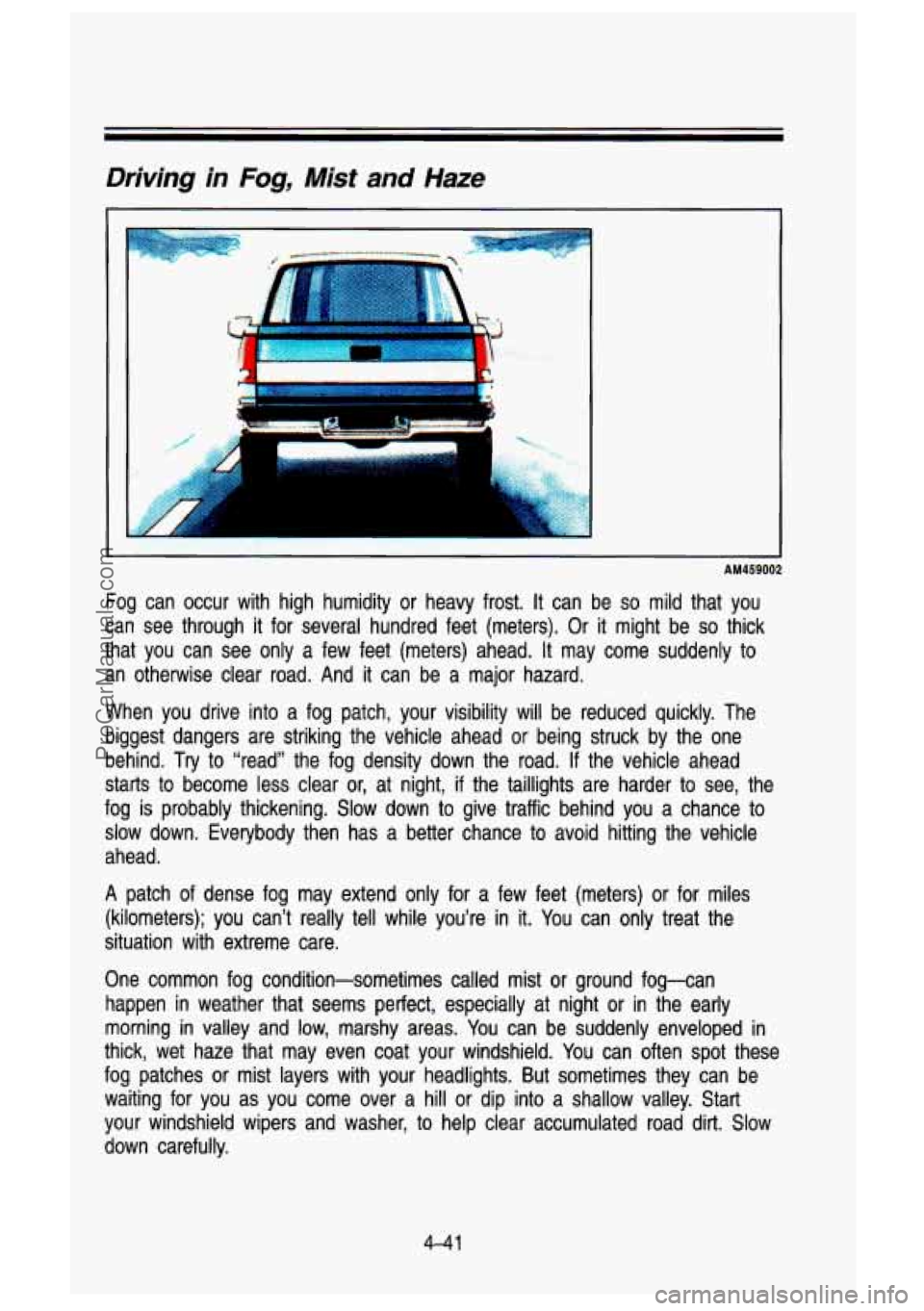
Fog can occur with high humidity or heavy frost. It can be so mild that you
can see through it for several hundred feet (meters). Or it might be
so thick
that you can see only a few feet (meters) ahead.
It may come suddenly to
an otherwise clear road. And it can be a major hazard.
When you drive into a fog patch, your visibility will be reduced quickly. The
biggest dangers are striking the vehicle ahead or being struck \
by the one
behind.
Try to “read” the fog density down the road. If the vehicle ahead
starts to become
less clear or, at night, if the taillights are harder to see, the
fog is probably thickening. Slow down to give traffic behind you a chance to
slow down. Everybody then has a better chance to avoid hitting the vehicle
ahead.
A patch of dense fog may extend only for a few feet (meters) or for miles
(kilometers); you can’t really tell while you’re in it. You can only treat the
situation with extreme care.
One common fog condition-sometimes called mist or ground fog-can
happen in weather that seems perfect, especially at night or i\
n the early
morning
in valley and low, marshy areas. You can be suddenly enveloped in
thick, wet haze that may even coat your windshield. You can often spot t\
hese
fog patches or mist layers with your headlights. But sometimes \
they can be waiting for you as you come over a hill or dip into a shallow valley. Start
your windshield wipers and washer, to help clear accumulated ro\
ad dirt.
Slow
down carefully.
4-41
ProCarManuals.com