Page 189 of 339
Make sure that the towing speed
dues not exceed 55 mph
(90 km/h), or your Geo could be
badly damaged.
Towing Your Geo from the Front
If your vehicle has automatic
I free-wheeling hubs or two-whet
drive, do not tow it
on all fa
I wheels. If you do, you transmission could be damaged.
I
If you have a four-wheel-drive vehicle
with manual free-wheeling hubs, it can
be towed from the front with all four
wheels on the ground. Follow these
steps:
1. Set the parking brake.
2. Turn the ignition key to ACC to
unlock the steering wheel.
ProCarManuals.com
Page 190 of 339
Your Driving and the Road
= - 9 188
3. Shift your automatic transmission
into
P (Park), or your manual
transmission into
2 (Second).
4. Shift the transfer case to N (Neutral).
5. Set the hubs to FREE. See
“Four-Wheel Drive” in the Index.
6. Release the parking brake. Stop towing every
200 miles (300 km)
and
start the engine. Leave the transfer
case shift lever in
N (Neutral). Shift
your automatic transmission
to
D (Drive); leave a manual transmission
in
2 (Second) and release the clutch.
Run the engine at medium speed for one
minute to circulate
the oil in the transfer
case. Turn
the ignition key to ACC.
Now, you can continue towing your
Geo
.
NU I Kt
Make sure that the towing speed
does not exceed
50 mph
(80 km/h), or your Geo could
badly damaged.
ProCarManuals.com
Page 194 of 339
Problems on the Road
To Jump Start Your Geo
1. Check the other vehicle. It must have
a 12-volt battery with a negative
ground system.
If the other system isn’t a 12-volt I
system with a negative ground,
both vehicles can
be damaged.
I I
2. Get the vehicles close enough so the
jumper cables can reach, but be sure
the vehicles aren’t touching each
other.
If they are, it could cause a
ground connection you don’t want.
You wouldn’t be able
to start your
Geo, and the bad grounding could
darnage the electrical systems.
CAUTION -1
A
You could be injured if the
vehicles roll. Set the parking
brake firmly on each vehicle. Put
an automatic transmission in
P (Park) or a manual transmission
in
N (Neutral). If you have a
four-wheel-drive vehicle, be sure
the transfer case
is not in
N (Neutral).
ProCarManuals.com
Page 199 of 339

That your vehicle has rear-wheel
drive, or that
it has the
four-wheel-drive option.
vehicle.
The make, model, and year of your
Whether you can still move the shift
levers for the transmission and
transfer case,
if you have one.
If there was an accident, what was
damaged.
When the towing service arrives, let the
tow operator know that this manual
contains detailed towing instructions and
illustrations. The operator may want to
see them.
* T- help avoid injury to you or
Never let passengers ride in a
vehicle that is being towed.
Never tow faster than safe or
posted speeds
Never tow with damaged parts
not fully secured.
0 Never get under your vehicle
after it
has been lifted by the
tow truck.
chains on each side when towing
a vehicle.
hooks instead.
* Always use separate safety
Never use T-hooks. Use “J”
When your vehicle is being towed, have
the ignition key off. The steering wheel
should be clamped
in a straight-ahead
position, with
a clamping device
designed for towing service.
Do not use
the vehicle’s steering column lock for
this. The transmission and transfer case,
if you have one, should be in Neutral
and the parking brake released.
ProCarManuals.com
Page 201 of 339
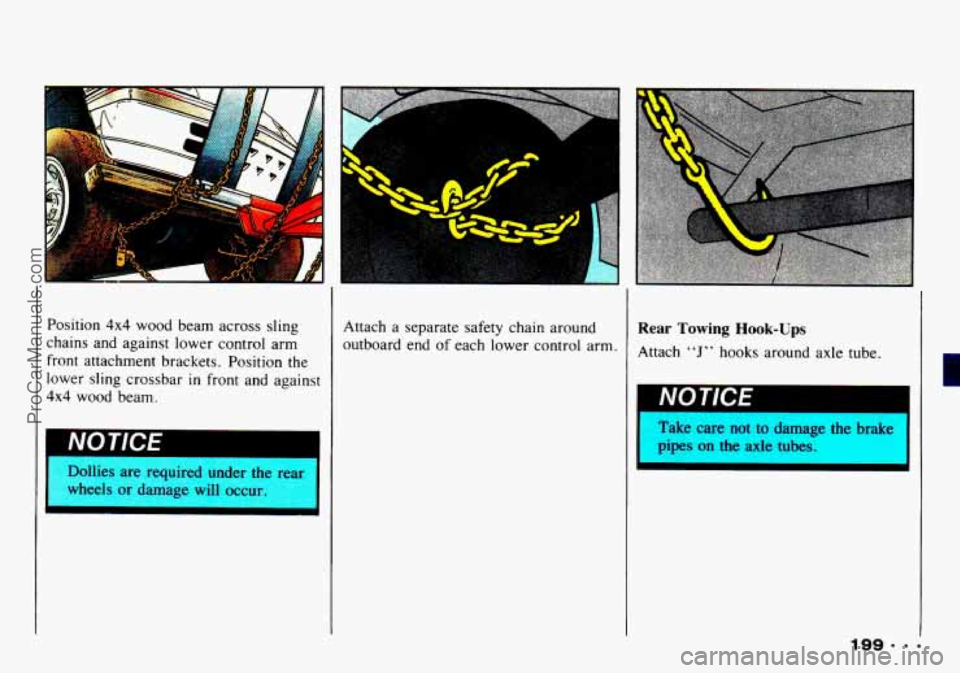
Position 4x4 wood beam across sling
chains and against lower control arm
front attachment brackets. Position the
lower sling crossbar
in front and against
4x4 wood beam. Attach a separate safety chain around
outboard end
of each lower
control arm.
Rear Towing Hook-Ups
Attach “J” hooks around axle tube.
I Take care not to damage the brake I
pipes on the axle tubes. 1
ProCarManuals.com
Page 210 of 339

Problems on the Road
Zf a Tire Goes Hut
Then replace the pressure cap. Be
sure
the ears on the pressure cap line
up like
this.
9 208
It’s unusual for a tire to “blow out’’
while you’re driving, especially
if you
maintain your tires properly. If air goes
out of a tire, it’s much more likely to
leak out slowly. But if you should ever
have a “blowout,
” here are a few tips
about what to expect and what to do:
If a front tire fails, the flat tire will
create a drag that pulls the vehicle
toward that side. Take your foot off the
accelerator pedal and grip the steering
wheel firmly. Steer to maintain lane
position, then gently brake to a stop well
out of the traffic lane.
A rear blowout, particularly on a curve,
acts much like a skid and may require
the same correction you’d use
in a skid. In any
rear blowout, remove your
foot
from the accelerator pedal. Get the
vehicle under control by steering
the
way you want the vehicle to go. It may
be
very bumpy and noisy, but you can
still steer. Gently brake to a stop, well
off the road
if possible.
If your tire goes flat, the next section
shows how to use your jacking
equipment to change a flat tire safely.
ChanginQ a Flat lire
If a tire goes flat, avoid further tire and
wheel damage by driving slowly to a
level place. Turn
on your hazard
warning flashers.
..
ProCarManuals.com
Page 211 of 339
CAUTION
A
Changing a tire can cause an injury. The vehicle can slip off the jack
and roll over you or other people. You and they could be badly injured.
Find a level place to change your tire.
To help prevent the vehicle from
moving:
1. Set the parking brake firmly.
2. Put the shift lever in P (Park).
3. Shift a manual transmission to 1 (First) or R (Reverse).
4. If you have a four-wheel-drive vehicle, be sure the transfer case is in a
5. Turn off the engine.
To be even more certain the vehicle won’t move, you can put chocks at the
front and rear of the tire farthest away from the one being changed. That
would be the tire on the other side of the vehicle, at the opposite end.
drive gear
- not in N (Neutral).
I The following steps will tell
you how to use the jack and change a tire. The
equipment you’ll need
is under the
front seats.
The jack and wheel wrench are under
the passenger’s seat.
209 =
ProCarManuals.com
Page 223 of 339

Part 6
Here you wit1 find information
about the care of your Geo
. This
part begins with service and fuel
information. and then it shows
how to check important fluid and
lubricant levels
. There is also
technical information about your
vehicle. and
a section devoted to
its appearance care
.
ii iervice & Appearance Care
Service ............................................................. 222
Fuel ............................................................... 223
Checking Things under the Hood ........................................ 227 .
HoodRelease 227
Engineoil ........................................................ 229
Aircleaner ........................................................ 233
Automatic Transmission Fluid ........................................ 234
Manual Transmission Fluid ........................................... 237
Clutch Adjustment .................................................. 238
RearAxle ......................................................... 238
Four-WheelDrive .................................................. 239
Enginecoolant ..................................................... 240
Power Steering Fluid ................................................ 243
Windshield Washer Fluid ............................................ 244
Brake Master Cylinder ............................................... 245
Battery ........................................................... 247
Bulb Replacement .................................................... 248
LoadingYourVehicle ................................................. 252
Tires ............................................................... 253
Appearancecare ..................................................... 261
Appearance Care and Maintenance Materials .............................. 271
Vehicle Identification Number .......................................... 272
Service Parts Identification Label ........................................ 272
Add-on Electrical Equipment ........................................... 272
Fuses and Circuit Breakers ............................................. 273
ReplacementBulbs ................................................... 276
Capacities and Specifications ........................................... 277
221 .
.
......................................................
ProCarManuals.com