Page 47 of 339

H Door Locks
Passengers - especially children
- can easily open the doors and
fall out. When a door is Iocked,
the inside handle won’t open it.
Outsiders can easily enter through
an unlocked door when you slow
down or stop your vehicle.
This may not be so obvious: You
increase the! chance of being
thrown out of the vehicle in a
crash if tbe doors aren’t locked.
Wear safety belts properly, lock
your doors, and you will be far
better off whenever yw drive your
vehicle. 1
I
There are several ways to lock and
unlock your vehicle:
From
the outside: Use your key. To
lock the door, turn the key clockwise as
far as
it will go.
The lock switch on the driver’s door
will not work when the door is open.
This prevents the driver from being
locked out.
From the inside, push down the button
on the door.
To unlock the door, pull up on the
button.
Leaving Your Vehicle
If you are leaving the vehicle, open the
door and set the locks from inside. Then
get out and close the door.
Pull
up on the outside door handle as
you close the door.
45. -
ProCarManuals.com
Page 48 of 339

Features & Controls
Tailgate
Use your key to lock or unlock your
tailgate.
If you have a convertible, be sure to
unzip
the rear plastic window before
opening
the tailgate. See “Opening and
Closing Your Rear Window” in the
Index. Open the tailgate with the bottom
of the window still attached to the
tailgate.
When closing the tailgate be sure:
Both lower corner canvas top flaps
are facing outward
so they do not get
caught
in the tailgate.
correctly or you could damage your
zipper.
The zipper connector is engaged
It can be dangerous to drive
with the tailgate window
open, Carbon monoxide (CO) gas
can come into your vehicle. You
can’t see or smell CO. It can cause
unconsciousness
and even death.
If you must drive with the taiIgate
window open:
0 Make sure all ather windows an
shut.
Tm the fan on your heating or
cooling system to its highest
speed with the setting on u.
That will force outside air into
your vehicle. See L4C~f~~
Controls” in the Index.
* If you have air vents on or
under tbc’instrument panel, open
them at1 the way*
I
ProCarManuals.com
Page 49 of 339
meft
Vehicle theft is big business, especially
in some cities. Although your Geo has a
number of theft-deterrent features, we
know that nothing we put on it can make
it impossible to steal. However, there
are ways you can help. Key in the Ignition: If you walk away
from your vehicle
with the key inside,
it’s
an easy target for joy riders or
professional thieves
- so don’t do it.
When you park your Geo and open the
driver’s door, you’ll hear a chime
reminding
you to remove your key from
the ignition and take it with you. Always
do this. Your steering wheel will be
locked,
and so will your ignition. If you
have an automatic transmission, taking
your key out also locks your
transmission. And remember to lock the
doors.
Parking at Night: Park in a lighted
spot, close all windows and lock your
vehicle. Remember
to keep your
valuables out
of sight. Put them in a
storage area, or take them with you.
47. =
ProCarManuals.com
Page 50 of 339

Features & Controls
New Vehicle
“Break-In ’’
Your modern Geo doesn’t need an
:laborate “break-in.” But it will
perform better in the long
1
1 follow these guideli~
A
m Ignition Switch
With the key in the ignition switch, you
can turn the switch to four positions:
LOCK (A): The only position in which
you can remove the key. This locks
your steering wheel, ignition and
automatic transmission. Press
in the
ignition switch as you turn the top of it
toward you.
If you have an automatic transmission,
the ignition switch cannot be turned to
LOCK unless the shift lever is in the
P (Park) position.
ACC (B): Position in which you can
operate your electrical power accessories. It unlocks the steering
wheel and ignition.
A warning chime
will sound if you open the driver’s door when the ignition is
in ACC or LOCK
and the key is in the ignition.
Use this
position if your vehicle must be pushed
or towed.
ON (C): Position to which the switch
returns after you start your engine and
release the switch. The switch stays in
the
ON position when the engine is
running. But even when the engine is not running, you can use
ON to operate
your electrical power accessories, and to
display some instrument panel warning
lights.
START (D): Starts the engine. When
the engine starts, release the key. The
ignition switch will return to
ON for
normal driving.
ProCarManuals.com
Page 53 of 339

r
Automatic Transmission
There are several different positions for
your shift lever.
P (Park)
This locks your rear wheels. It’s the
best position to use when you start your
engine because your vehicle can’t move
easily.
GAU I IUN I
It can be dangerous to get out
of your vehicle if the shift
lever is not
fully in P (Park) with
the parking brake firmly set. Your
vehicle could roll.
Don’t leave your vehicle when the
engine is running unless you have
to. If you have ieft the engine
running, the vehicle can move
suddenly. You or others could be
injured. To be sure your vehicle
won’t move, when you’re on fairly
level ground, always set your
parking brake and move the shift
lever
to P (Park).
If you have four-wheel drive, your
vehicle will be free to roll
- even
if your shift lever is in P (Park) - I
if your transfer case is in
N (Neutral). So, be sure the
transfer case is
in a drive gear -
not in N (Neutral).
See “Shifting into
P (Park)’’ in
the Index.
If you are parking on a
hill, or,
if you’re pulling a trailer,
also see “Parking
on Hills” or
“Towing a Trailer’’ in the Index.
I P (Park) range before starti& the
engine. Your Geo has a
brake-transmission shift interlock.
You
have to fully apply your regular brakes
before you can shift from P (Park)
when the ignition is in
the ON position.
If you cannot shift out of P (Park), ease
pressure on the shift lever
- push the
shift lever all the way into
P (Park) and
also release the shift lever button on
floor shift console models
- as you
maintain brake application. Then move
the shift lever into the gear you wish.
(Press the shift lever button before
moving the shift lever on floor shift
models.) See “Shifting Out of
P (Park)’’ in the Index.
51 ..=
ProCarManuals.com
Page 57 of 339

2 (Second Gear) - Press the clutch
pedal as you let up on the accelerator
pedal and shift into
2. Then, slowly
let up on the clutch pedal as you press
the accelerator pedal.
3, 4 and 5 (Third, Fourth and Fifth
Gears)
- Shift into 3, 4 and 5 the
same way
you do for 2. Slowly let up
on the clutch pedal
as you press the
accelerator pedal.
To Stop - Let up on the accelerator
pedal and press the brake pedal. Just
before the vehicle stops, press the
clutch pedal and the brake pedal, and
shift to
Neutral.
Neutral - Use this position when
R (Reverse) - To back up, press
you
start or
idle your engine.
down the clutch pedal and shift into
R. Let up on the clutch pedal slowly
while pressing the accelerator pedal.
You cannot go from 5 (Fifth Gear) into
R (Reverse). If you try, you will be
locked out.
You must first shift into
Neutral, move the lever to the left, back
to the right, and then shift into
R (Reverse). This is a safety feature.
Shift to R (Reverse) only after
your vehicle
is stopped. Shifting to
R (Reverse) while your vehicle is
moving could damage your
transmission.
Also, use Reverse along with the
parking brake, for parking your vehicle.
ProCarManuals.com
Page 59 of 339

Four-wheel Drive
CAUTION I
It can be dangerous to get out
4 b of your vehicle if the shift
rcyer is not fdly in P (Park)
(automatic transmission) or
R (Reverse) (manual transmission)
with the parking brake firmly set.
If you have four-wheel drive, also
be sure the transfer case is in a
drive gear. Your vehicle can roll.
If you have left the engine
running,
the vehicle can move
suddenly.
You or others could be
injured. To be sure your vehicle
won’t move, follow the step
below. If you are parking on a
hill’, or if you’re pulling a trailer,
see “Parking on Hills” cw
“Towing a Trailer” in the Index.
[f your vehicle has four-wheel drive,
you can send your engine’s driving
power to all four wheels for extra
traction.
To shift out of two-wheel drive
and into four-wheel drive, lock the
free-wheeling hubs and move
the
transfer case shift lever to 4H or 4L
(see the following). You should use 2H
for most normal driving.
Rear wheel anti-lock brakes
do not work
when you shift into four-wheel drive.
Your regular brakes will still work.
When
you shift back into two-wheel
drive, your rear wheel anti-lock brakes
will take over again. Driving
in 4H or 4L positions for
a long time on dry or wet
pavement could shorten
thP 1 nf
your vehicle’s drivetrain.
ProCarManuals.com
Page 60 of 339
Features & Controls
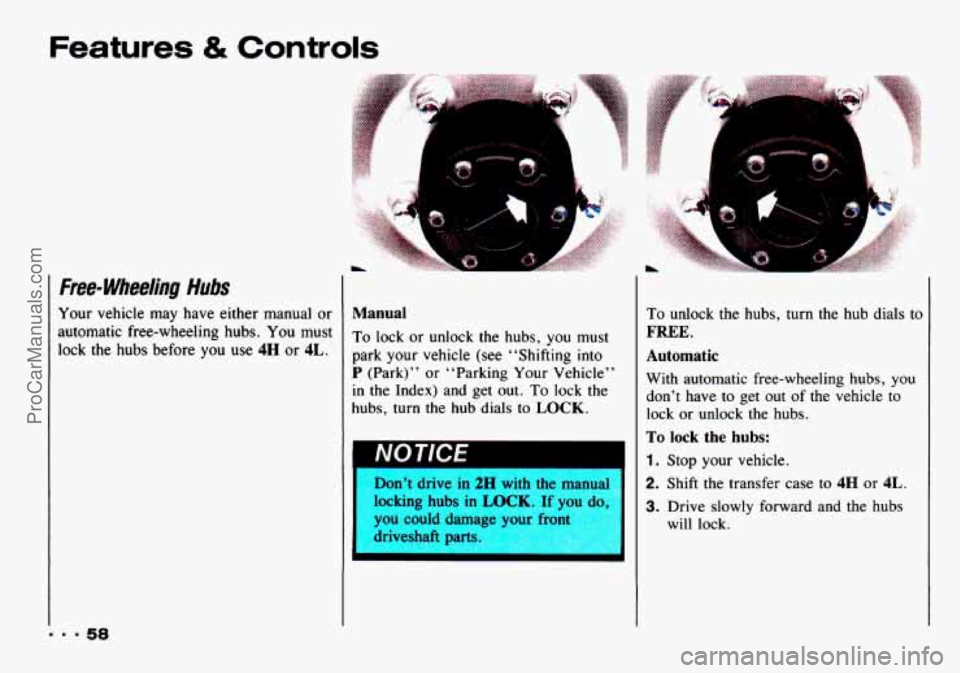
Free- Wheeling Hubs
Your vehicle may have either manual or
automatic free-wheeling hubs. You must
lock
the hubs before you use 4H or 4L.
Manual
To lock or unlock the hubs, you must
park your vehicle (see “Shifting into
P (Park)” or “Parking Your Vehicle”
in the Index) and get out. To lock the
hubs, turn
the hub dials to LOCK.
Don’t drive in 2H with the manual
locking hubs in
LOCK. If yo1
you could damage your front 7
driveshaft parts. I
To unlock the hubs, turn the hub dials to
FREE.
Automatic
With automatic free-wheeling hubs, you
don’t have to get out of the vehicle to
lock
or unlock the hubs.
To lock the hubs:
1. Stop your vehicle.
2. Shift the transfer case to 4H or 4L.
3. Drive slowly forward and the hubs
will lock.
ProCarManuals.com