1993 CHEVROLET LUMINA heater
[x] Cancel search: heaterPage 47 of 324
Downloaded from www.Manualslib.com manuals search engine Here you can learn about the
many standard and optional
features on your Chevrolet. and information
on starting. shifting and
braking
. Also explained are the
instrument panel and the warning
systems that tell you if everything is
working properly+ nd what to
do if
you have a problem .
Part 2
Features & Controls .
Keys ........................................................................\
................................................... 46
Locks
........................................................................\
................................................. 47
Glove Box
........................................................................\
......................................... 50
Ignition
........................................................................\
.............................................. 51
Starting Your Engine
........................................................................\
......................... 53
Engine Block Heater
........................................................................\
......................... 55
Shifting the Transaxle
........................................................................\
....................... 56
Parking Brake ........................................................................\
................................... 63
Shifting into Park
........................................................................\
............................... 64
Windows
........................................................................\
............................................ 69
Turn SignaVHeadlight Beam Lever ............................... : ......................................... 70
Cruise Control ........................................................................\
................................... 71
Windshield Wipers ........................................................................\
............................. 75
Windshield Washer
........................................................................\
........................... 76
Headlights
........................................................................\
......................................... 77
Interior Lights ........................................................................\
................................... 79
Mirrors ........................................................................\
.............................................. 80
Storage Compartments
........................................................................\
..................... 82
Ashtrays and Lighter
........................................................................\
......................... 82
Instrument Panel
........................................................................\
.............................. 85
Warning Lights, Gages and Indicators
..................................................................... 87
...
Page 57 of 324
Downloaded from www.Manualslib.com manuals search engine )riving Through Deep Standing
Vafer
If you drive too quickly through
deep puddles or standing water
water can come in through you
engine’s air intake and badly
damage your engine.
If you can’,
avoid deep puddles or standing
water, drive through them very
slowly.
c
Engine Block Heater (OPTION)
In very cold weather, 0°F (-18°C) or
colder, the engine block heater can help.
You’ll get easier starting and better fuel
economy during engine warm-up.
To Use the Block Heater:
1. Turn off the engine.
2. Open the hood and unwrap the
3. Plug it into a normal, grounded
electrical cord.
110-volt outlet.
CAUTION
Page 58 of 324
Downloaded from www.Manualslib.com manuals search engine Features & Controls
Engine Block Heater (CONT.)
I NOTICE
After you’ve used the block heater,
be sure to store the cord as it
before, to keep it away from
moving engine parts. If
you don’tA.:;
it could be damaged. ==~--K .-iii ~=>=== .~,~~:~ ~.. ~= ~~
~~ ~EI=i%~ ~= ~ .~= I ~, ~ ~.,~= L-,. ,., =.~ . ~ _,, , ,~, I. ’ , I ~;_,.l ~~ ~~. ~ .~ ~ ~~ , ~ ,~~~ ~ ~. ~ .~ ~~, ~ ,,
How long should you keep the engine
block heater plugged in? The answer
depends on the weather, the kind of oil
you have, and some other things. Instead of trying to list everything here,
we ask that
you contact a Chevrolet
dealer
in the area where you’ll be
parking your vehicle. The dealer can
give
you the best advice for that
particular area.
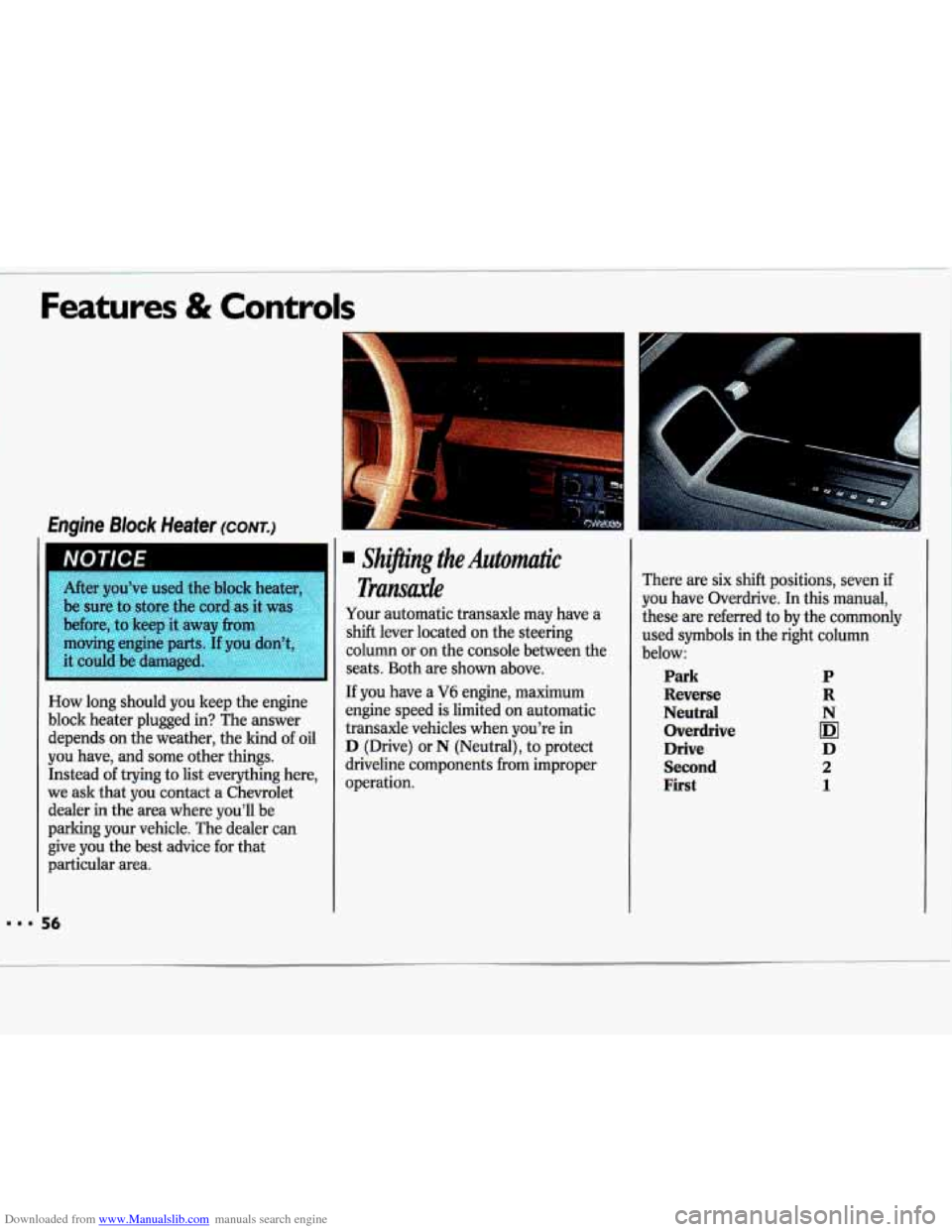
. Shiftins the Automatic
Transaxlk
Your automatic transaxle may have a
shift lever located on the steering
column or on the console between the
seats. Both are shown above.
If you have a
V6 engine, maximum
engine speed is limited on automatic
transaxle vehicles when you’re in
D (Drive) or N (Neutral), to protect
driveline components from improper
operation. There are six shift positions, seven
if
you have Overdrive. In this manual,
these are referred to by the commonly
used symbols in the right column
below:
Park
Reverse
Neutral
Overdrive
Drive
Second
First
P
R
N
IDI
D
2
1
Page 99 of 324
Downloaded from www.Manualslib.com manuals search engine 1 n this part you’ll find out how to
operate the comfort control systems and audio systems offered with your
Chevrolet
. Be sure to read about the
particular system supplied with your
vehicle
.
Heater Controls ........................................................................\
................................. 98
Air Conditioning ........................................................................\
................................ 99
Setting the Clock ........................................................................\
............................. 103
AM/FM Stereo Radio
........................................................................\
...................... 104
AM/FM Stereo Radio with Cassette Player
.......................................................... 106
AM/FM Stereo Radio with Cassette Player and BoseB Speakers ........................ 108
AM/FM Stereo with Compact Disc Player
............................................................. 110
Understanding Radio Reception
........................................................................\
..... 113
Care of Your Cassette Tape Player ........................................................................\
113
Care of Your Compact Discs ........................................................................\
........... 114
Fixed Mast Antenna ........................................................................\
....................... 114
Page 100 of 324
Downloaded from www.Manualslib.com manuals search engine Comfort Controls & Audio Systems
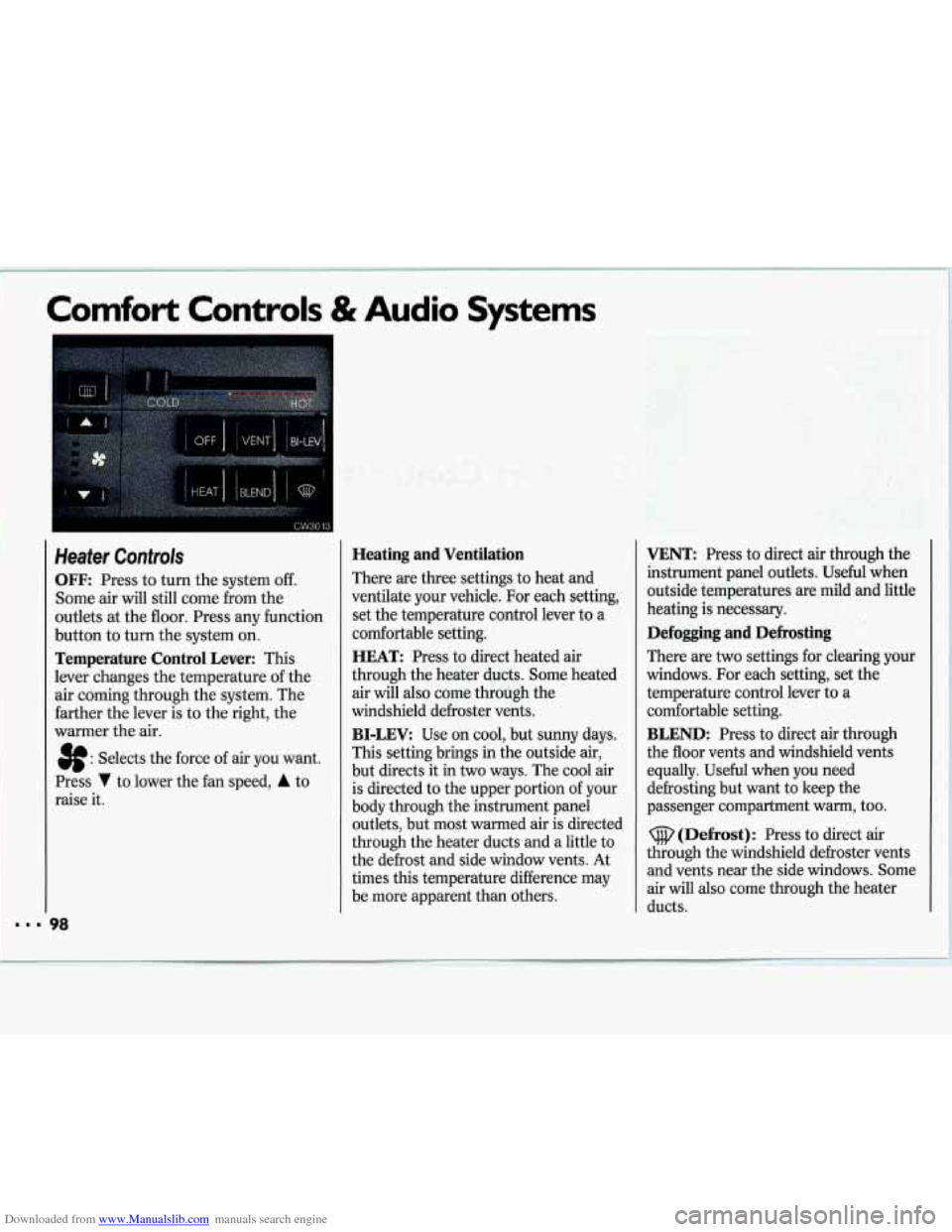
Heater Controls
OFF: Press to turn the system off.
Some air will still come from the
outlets at the floor. Press any function
button to turn the system on.
Temperature Control Lever: This
lever changes the temperature
of the
air coming through the system. The
farther the lever is to the right, the
warmer the air.
8: Selects the force of air you want.
Press
V to lower the fan speed, A to
raise it.
Heating and Ventilation
There are three settings to heat and
ventilate your vehicle. For each setting,
set the temperature control lever to a
comfortable setting.
HEAT: Press to direct heated air
through the heater ducts. Some heated
air will also come through the
windshield defroster vents.
BI-LEV: Use on cool, but sunny days.
This setting brings in the outside air,
but directs it in two ways. The cool air is directed to the upper portion of your
body through the instrument panel
outlets, but most warmed air is directed
through the heater ducts and
a little to
the defrost and side window vents. At
times this temperature difference may
be more apparent than others.
VENT: Press to direct air through the
instrument panel outlets. Useful when
outside temperatures are mild and little
heating is necessary.
Defogging and Defrosting
There are two settings for clearing your
windows. For each setting, set the
temperature control lever to a
comfortable setting.
BLEND: Press to direct air through
the floor vents and windshield vents
equally. Useful when you need defrosting but want to keep the
passenger compartment warm, too.
cifi, (Defrost): Press to direct air
through the windshield defroster vents
and vents near the side windows. Some
air will also come through the heater
ducts.
Page 101 of 324
Downloaded from www.Manualslib.com manuals search engine Air Conditioning (OPTION)
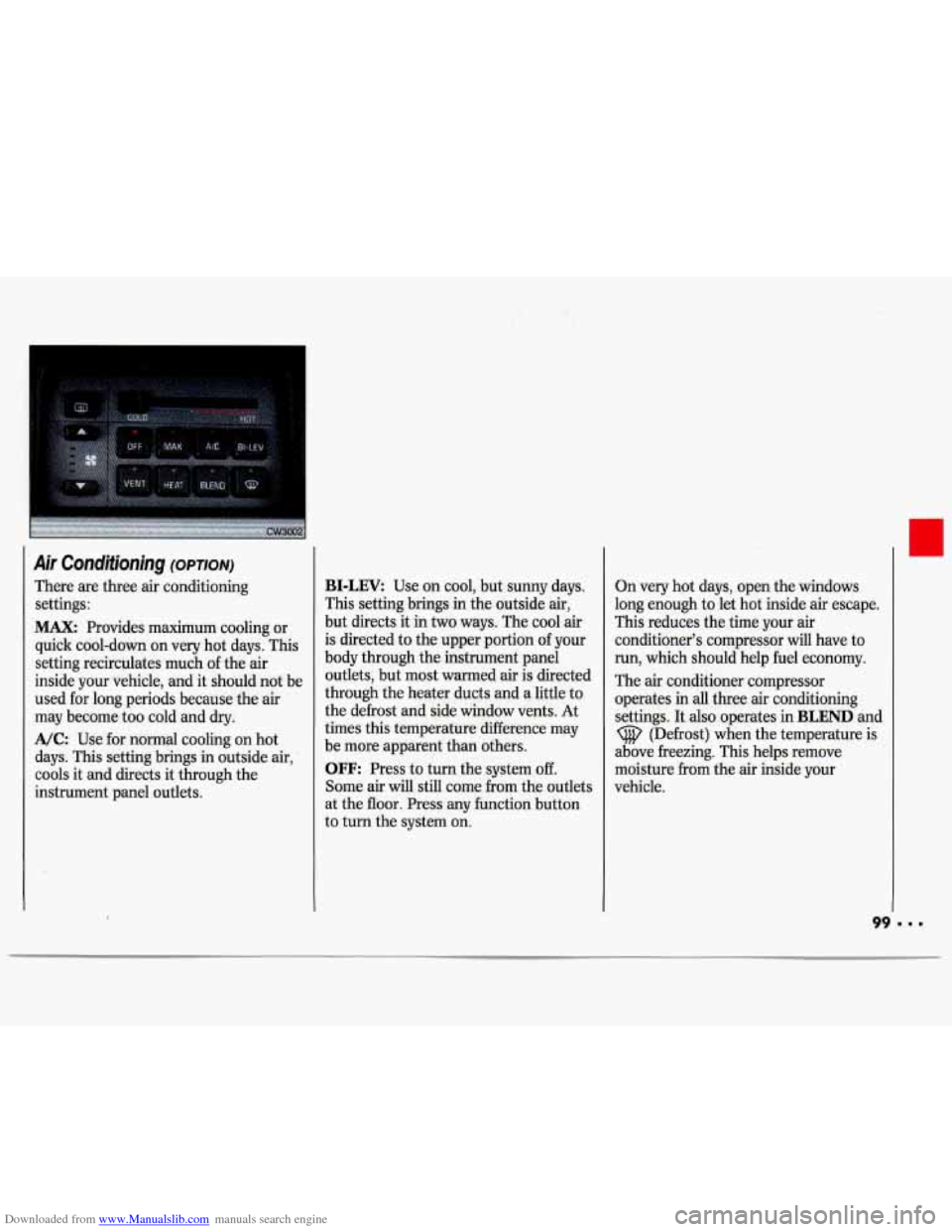
There are three air conditioning
settings:
MAX: Provides maximum cooling or
quick cool-down on very hot days. This
setting recirculates much of the
air
inside your vehicle, and it should not be
used for long periods because the air
may become too cold and dry.
A/C Use for normal cooling on hot .
days. This setting brings in outside air,
cools it and directs it through the
instrument panel outlets.
BI-LEV Use on cool, but sunny days.
This setting brings in the outside air,
but directs it in two ways, The cool
air
is directed to the upper portion of your
body through the instrument panel
outlets, but most warmed air is directed
through the heater ducts and a little to
the defrost and side window vents. At
times this temperature difference may
be more apparent
than others.
OFF: Press to turn the system off.
Some air will still come from the outlets
at the floor. Press any function button
to turn the system on. On
very hot days, open the windows
long enough to let hot inside air escape.
This reduces the time your air
conditioner’s compressor will have to
run, which should help fuel economy.
The air conditioner compressor operates in
all three air conditioning
settings.
It also operates in BLEND and
ljjjl (Defrost) when the temperqture is
above freezing. This helps remove
moisture from the air inside your
vehicle.
Page 102 of 324
Downloaded from www.Manualslib.com manuals search engine Comfort Controls & Audio Systems
Air Conditioning (CONT.)
Heating and Ventilation
When you don’t need to cool the
outside air, use these next settings.
You
can leave the air as it is or heat it.
The air conditioner compressor doesn’t
run in the
VENT and HEAT settings.
This reduces the engine load, resulting
in improved fuel economy (gas
mileage).
VENT: For mild outside temperatures,
when little heating or cooling is needed,
push
VENT. Air flow is through the
instrument panel outlets. Slide the
temperature control lever to a
comfortable level.
HEAT When outside temperatures are
cold, push
HEAT. This will send most
of the heated air through the ducts near
the floor. The rest will come out of the
defroster vents and side window
defogger vents.
Defogging and Defrosting
There are two settings for clearing your
windows. For each setting, adjust the
temperature control as desired. The air
conditioner compressor will run in
these settings to remove moisture from
the air when the temperature is above
freezing.
BLEND: This setting allows half of the
air to flow to the floor heater ducts, and
half to
go to the windshield and side
window vents located in the windshield
pillars. Use this setting to warm
passengers while keeping the
windshield clear.
The setting directs
90
through the defroster vents and the side
window vents, and
10% to the floor.
Page 104 of 324
Downloaded from www.Manualslib.com manuals search engine I
I..
Comfort Controls & Audio Systems
Rear Window Defogger (CONT.)
Don’t use a razor blade 0.
something else sharp on the insid
of the rear window. If you do, you
could cut
or damage the warming
grid, and the repairs wouldn’t be
covered by your warranty.
I02
cw3012
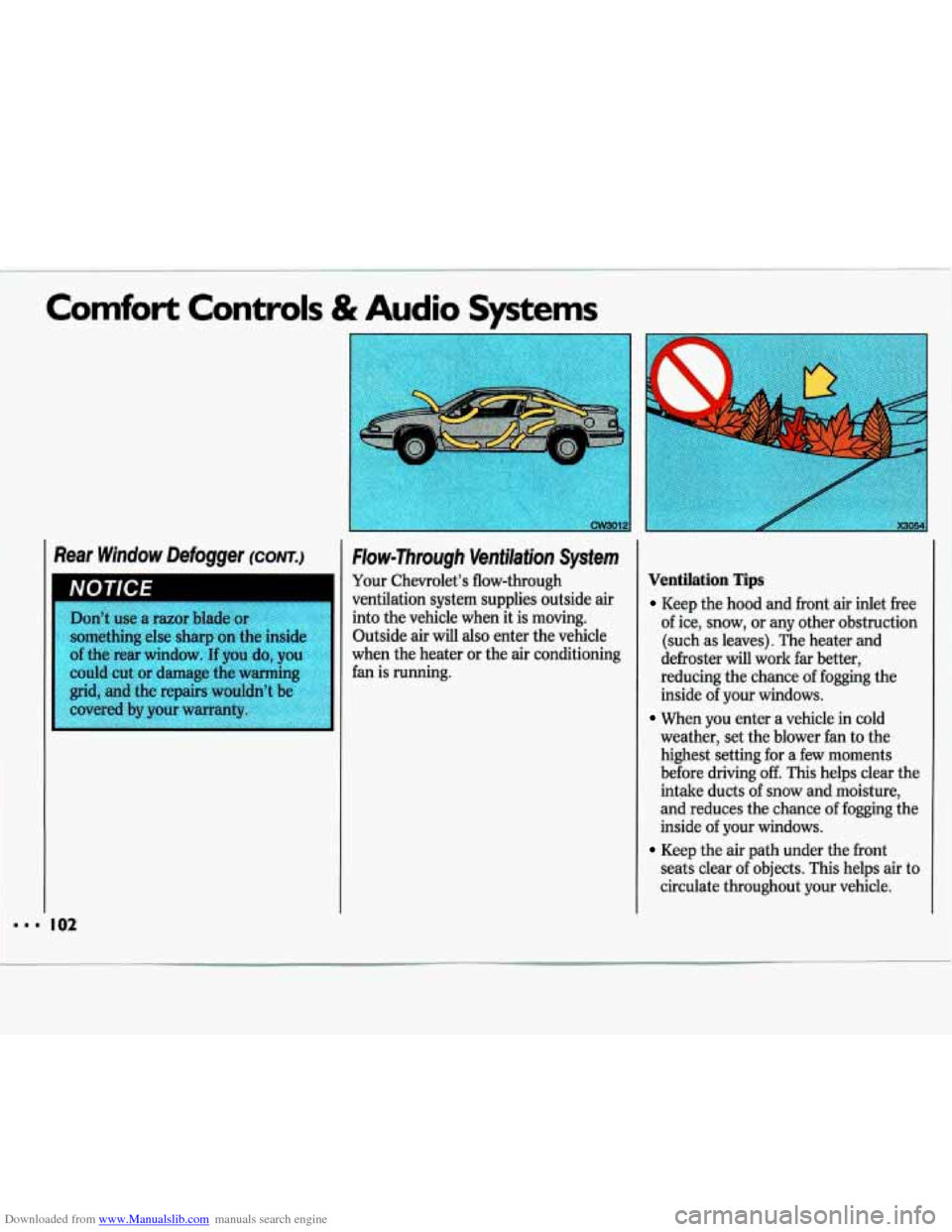
Flow-Through Ventilation System
Your Chevrolet’s flow-through
ventilation system supplies outside air
into the vehicle when it is moving.
Outside air will
also enter the vehicle
when the heater or the air conditioning
fan is running.
I
Ventilation Tips
Keep the hood and front air inlet free
of ice, snow, or any other obstruction
(such as leaves). The heater and
defroster will work far better,
reducing the chance of fogging the
inside of your windows.
When you enter a vehicle in cold
weather, set the blower fan to the
highest setting for a few moments
before driving
off. This helps clear the
intake ducts of snow and moisture,
and reduces the chance of fogging the
inside of your windows.
Keep the air path under the front
seats clear
of objects. This helps air to
circulate throughout your vehicle.