1993 CHEVROLET LUMINA check engine
[x] Cancel search: check enginePage 163 of 324

Downloaded from www.Manualslib.com manuals search engine Parking on Hills
You really should not park your vehicle,
with a trailer attached,
on a hill. If
something goes wrong, your rig could
start to move. People can be injured,
and both your vehicle and the trailer
can be damaged.
But if you ever have to park your rig
on
a hill, here’s how to do it:
1. Apply your regular brakes, but don’t
shift into
P (Park) yet.
2. Have someone place chocks under
the trailer wheels.
3. When the wheel chocks are in place,
release the regular brakes until the
chocks absorb the load.
4. Reapply the regular brakes. Then
apply your parking brake, and then
shift to
P (Park).
5. Release the regular brakes.
When You are Ready to Leave After
Parking on a
Hill
1. Apply your regular brakes and hold
the pedal down while you:
Start your engine;
Shift into a gear; and
Release the parking brake.
2. Let up on the brake pedal.
3. Drive slowly until the trailer is clear
4. Stop and have someone pick up and
of
the chocks.
store the chocks.
Maintenance When Trailer Towing
Your vehicle will need service more
often when you’re pulling a trailer. See
the Maintenance Schedule for more
on
this. Things that are especially
important in trailer operation are
automatic transaxle fluid (don’t
overfill), engine oil, belts, cooling
system, and brake adjustment. Each
of
these is covered in this manual, and the
Index will help you find them quickly. If
you’re trailering, it’s a good idea to
review these sections before you start
your trip.
Check periodically to see that all hitch
nuts and bolts are tight.
Page 167 of 324
Downloaded from www.Manualslib.com manuals search engine Jump Starting
If your battery has run down, you may
want to use another vehicle and some
jumper cables to start your Chevrolet.
But please follow the steps here to do it
safely.
CAUTION I
I
A Batteries can hurt you. They
They contain acid that can burn
They contain gas that can
They contain enough electricity
If you don't follow thest: steps
exactly, some or all
of these things
can hurt you.
r-' can be dangerous because:
you.
explode or ignite.
to burn you.
NOTICE To Jump Start Your Chevrolet:
1. Check the other vehicle. It must have
a 12-volt battery with a negative
ground system.
165
Page 169 of 324

Downloaded from www.Manualslib.com manuals search engine bHU 1 lUlY
Using a match near a battery
4 L can cause battery gas to
explode. Peopk have been hurt
doing this, and some have been
blinded. Use a flashlight if you need
more light.
Be sure the battery has enough
water. You don’t need to add water
to the Delco Freedom@ battery
installed in every new GM vehicle.
But if a battery has filler caps, be
sure the right amount of fluid is
there. lf it is low, add wafer to take
care of that first. If you don’t,
explcrsive gas could be present.
Battery fluid contains acid that can
burn you. Don’t get it on you. If
you accidentally get it in your eyes
or on your skin, flush the place
with water and get medical help
immediately.
5. Check that the jumper cables don’t
have loose or missing insulation.
If
they do, you could get a shock. The
vehicles could be damaged, too.
Before you connect the cables, here are
some things you should know. Positive
(+) will go to positive (+) and negative
(-) will go to negative (-) or a metal
engine part.
Don’t connect
(+) to (-) or you’ll get a
short that would damage the battery
and maybe other parts, too.
Fans or other moving engine
A parts can injure you badly.
Keep your hands away
from
moving parts once the engines are
running.
6. Connect the red positive (+) cable to
the positive
(+) terminal of the
vehicle with the dead battery.
Use a remote positive
(+) terminal if
the vehicle has one.
Page 182 of 324
Downloaded from www.Manualslib.com manuals search engine Problems on the Road
Engine Overheating (CONT.)
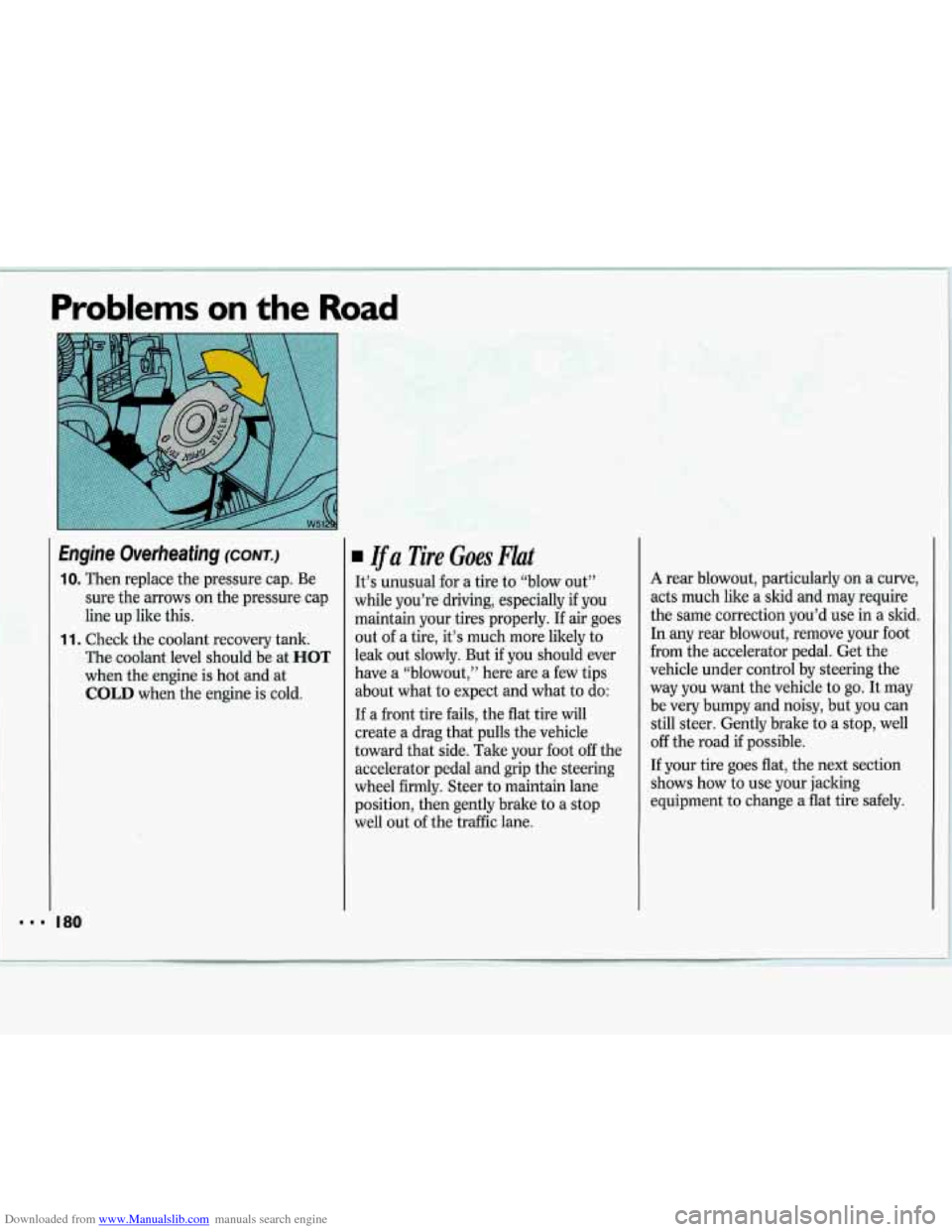
10. Then replace the pressure cap. Be
sure the arrows on the pressure cap
line up like this.
1 1. Check the coolant recovery tank.
The coolant level should be at
HOT
when the engine is hot and at
COLD when the engine is cold.
- i: .:-
Ifa Tire Goes Flat
It’s unusual for a tire to “blow OU~,)
while you’re driving, especially if you
maintain your tires properly. If air goes
out of a tire, it’s much more likely to
leak out slowly. But
if you should ever
have a “blowout,” here are a few tips
about what to expect and what to do:
If a front tire fails, the flat tire will
create a drag that pulls the vehicle
toward that side. Take your foot
off the
accelerator pedal and grip the steering
wheel firmly. Steer to maintain lane
position, then gently brake to a stop
well out of the traffic lane.
A rear blowout, particularly on a curve,
acts much like a
skid and may require
the same correction you’d use in a
skid.
In any rear blowout, remove your foot
from the accelerator pedal. Get the
vehicle under control by steering the
way you want the vehicle to go. It may
be very bumpy and noisy, but you can
still steer. Gently brake to a stop, well
off the road if possible.
If your tire goes flat, the next section
shows how
to use your jacking
equipment to change a
flat tire safely.
Page 189 of 324

Downloaded from www.Manualslib.com manuals search engine Compact Spare Tire
Although the compact spare was fully
inflated when your vehicle was new, it
can lose air after a time. Check the
inflation pressure regularly. It should be
60 psi (420 kPa). The compact spare is
made to go up to
3,000 miles
(5 000 Inn), so you can finish your trip
and have
your full-size tire repaired or
replaced where
you want. Of course, it’s
best to replace your spare with a full-
size tire as soon as you can. Your spare
will last longer and be in good shape in
case you need it again. Your anti-lock
brake system warning light may come
on when you are driving with a compact
spare. See the
Index under Anti-Lock
Brake System Warning Light.
Don’t use your compact spare on some
other vehicle.
And don’t
mix your compact spare or
wheel with other wheels or tires. They
won’t fit. Keep your spare and its wheel
together.
Page 193 of 324

Downloaded from www.Manualslib.com manuals search engine H ere you will find information
about the care of your Chevrolet
.
This part begins with service and
fuel information. and then it shows how to check important fluid and
lubricant levels
. There is also
technical information about your
vehicle. and a section devoted to its
appearance care
.
part 6
Service & Appearance Care
Service ........................................................................\
............................................. 192
Fuel
........................................................................\
.................................................. 193
Hood Release ........................................................................\
................................... 196
Engine Oil ........................................................................\
....................................... 201
Air Cleaner ........................................................................\
...................................... 205
Transaxle Fluid
........................................................................\
................................ 206
Engine Coolant
........................................................................\
................................ 211
Power Steering Fluid
........................................................................\
....................... 214
Windshield Washer Fluid
........................................................................\
................ 215
Brakes
........................................................................\
.............................................. 216
Battery
........................................................................\
............................................. 218
Bulb Replacement
........................................................................\
............................ 218
Windshield Wiper Blade Replacement
.................................................................... 224
Loading Your Vehicle
........................................................................\
...................... 224
Tires
........................................................................\
................................................. 225
Appearance Care
........................................................................\
............................. 232
Vehicle Identification Number (VIN)
.................................................................... 239
Add-on Electrical Equipment
........................................................................\
........ 240
Fuses
& Circuit Breakers ........................................................................\
............... 241
Capacities and Specifications 247
Fluids
& Lubricants ........................................................................\
........................ 249
Replacement Bulbs
........................................................................\
......................... 251
Normal Maintenance Replacement Parts
.............................................................. 254
.. ........................................................................\
..........
Page 197 of 324
Downloaded from www.Manualslib.com manuals search engine To check on fuel availability, ask an
auto club, or contact a major oil
company that does business in the
country where you’ll be driving.
You can also write us at the following
address for advice.
Just tell us where
you’re going and give your Vehicle
Identification Number (VIN)
.
General Motors of Canada Ltd.
International Export Sales
P.O. Box 828
Oshawa, Ontario L1H 7N1, Canada
Filling Your Tank
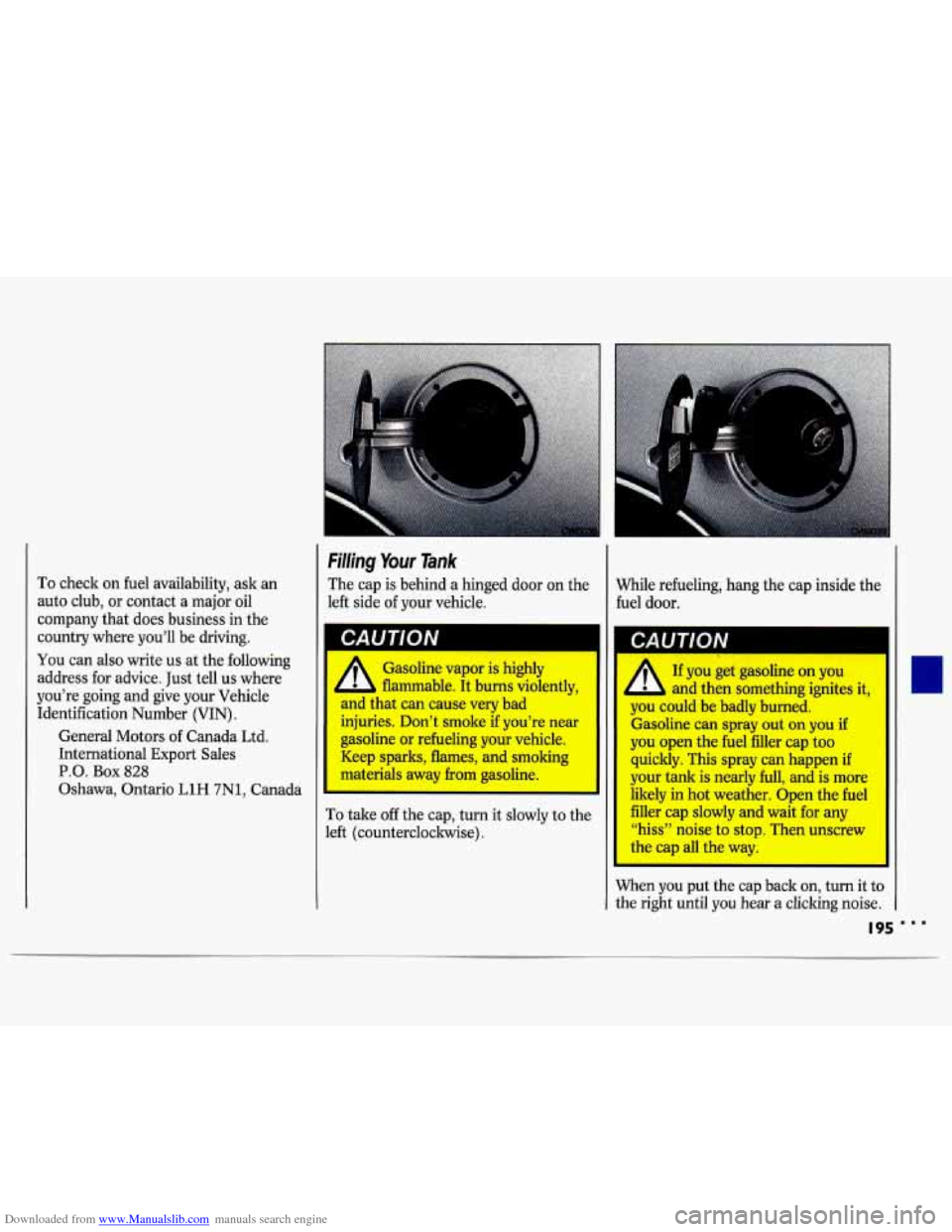
The cap is behind a hinged door on the
fuel
door. left side of your vehicle. While refueling, hang
the cap inside the
CAUTION I CAUTlON I
A Gasoline vapor is highly
- flammable. It burns violently,
and that can cause very bad
injuries. Don’t smoke if you’re near
gasoline or refueling your vehicle. Keep sparks, flames, and smoking
materials away from gasoline.
To take off the cap, turn it slowly to the
left (counterclockwise). I I
h If you get gasoline on you
A and then something ignites it,
,JU could be badly burned.
Gasoline can spray out on you
if
you open the fuel filler cap too
quickly. This spray can happen if
your tank is nearly full, and is more
likely in hot weather. Open the fuel
filler cap slowly and wait for any
“hiss” noise to stop. Then unscrew
I
When you put the cap back on, turn it to
the right until you hear a clicking noise.
195 ‘Im
Page 198 of 324
Downloaded from www.Manualslib.com manuals search engine Service & Appearance Care
-
Filling Your Tank (CONT.)
If you need a new cap, be sure to
get the right type.
Your dealer can
get one for you. If you get the
wrong type, it may not fit
or
proper venting, and your fue
and emissions system might be
damaged.
Checking ntings Under th
Hood
The following secuons tell you how to
check fluids, lubricants and important
parts underhood.
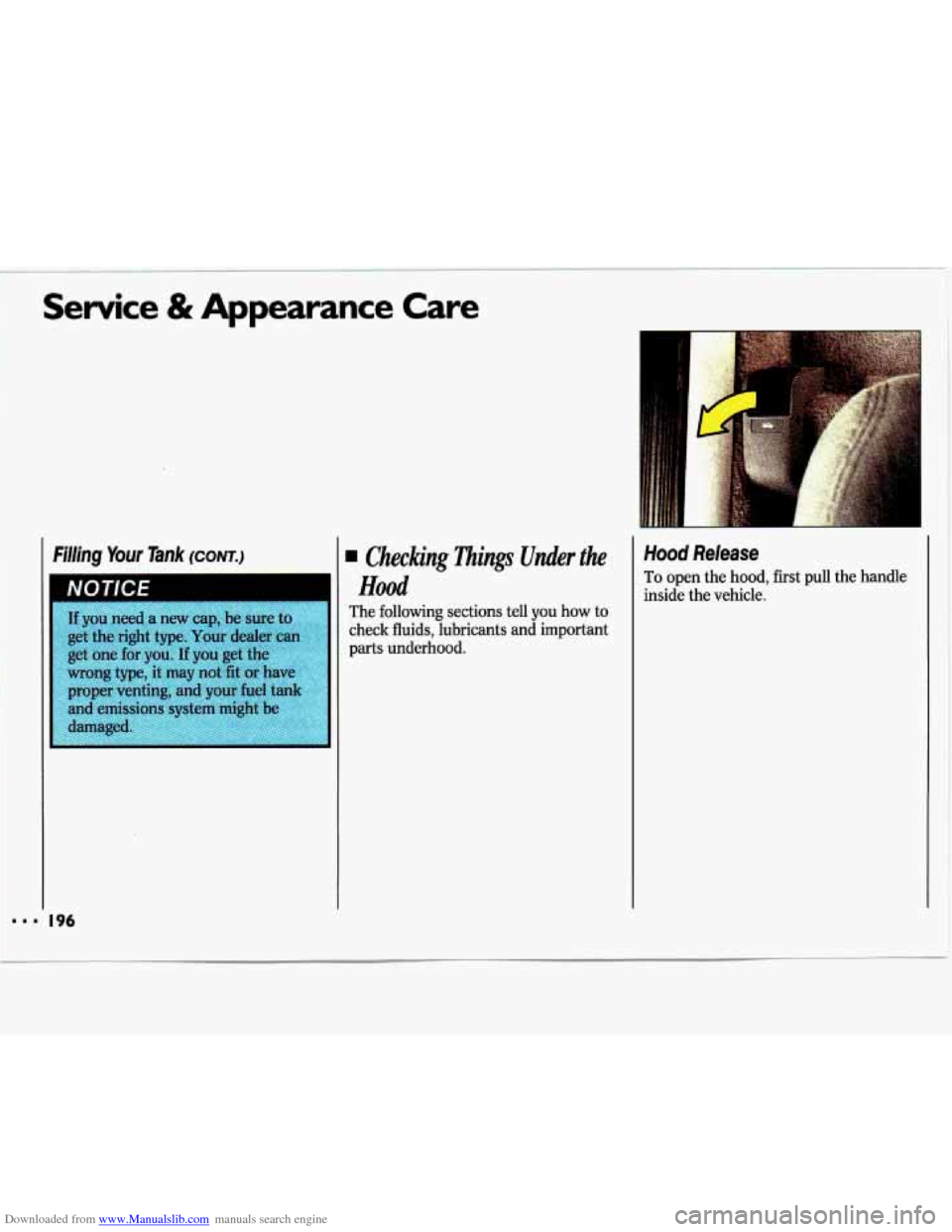
Hood Release
To open the hood, first pull the handle
inside the vehicle.