1993 CHEVROLET DYNASTY light
[x] Cancel search: lightPage 68 of 2438
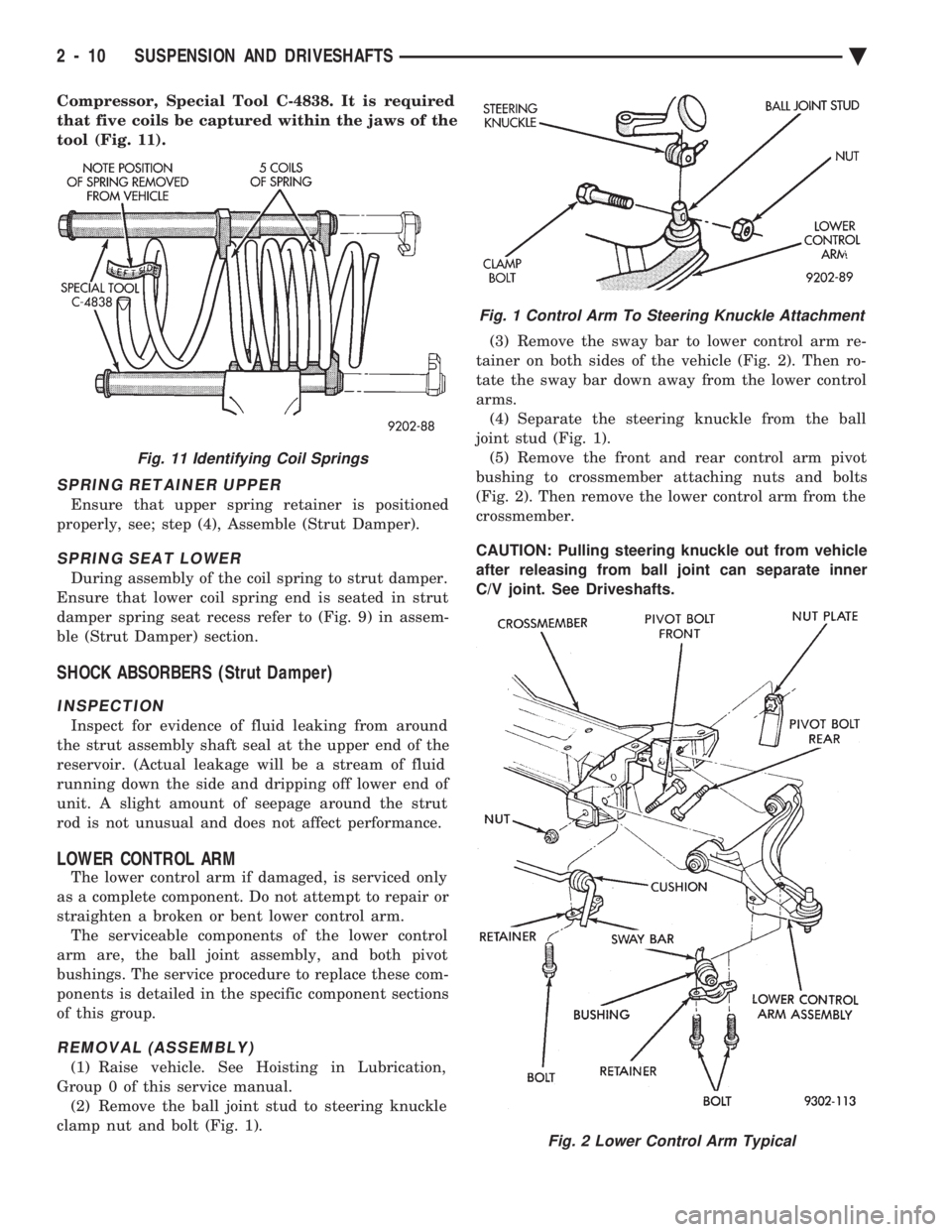
Compressor, Special Tool C-4838. It is required
that five coils be captured within the jaws of the
tool (Fig. 11).
SPRING RETAINER UPPER
Ensure that upper spring retainer is positioned
properly, see; step (4), Assemble (Strut Damper).
SPRING SEAT LOWER
During assembly of the coil spring to strut damper.
Ensure that lower coil spring end is seated in strut
damper spring seat recess refer to (Fig. 9) in assem-
ble (Strut Damper) section.
SHOCK ABSORBERS (Strut Damper)
INSPECTION
Inspect for evidence of fluid leaking from around
the strut assembly shaft seal at the upper end of the
reservoir. (Actual leakage will be a stream of fluid
running down the side and dripping off lower end of
unit. A slight amount of seepage around the strut
rod is not unusual and does not affect performance.
LOWER CONTROL ARM
The lower control arm if damaged, is serviced only
as a complete component. Do not attempt to repair or
straighten a broken or bent lower control arm. The serviceable components of the lower control
arm are, the ball joint assembly, and both pivot
bushings. The service procedure to replace these com-
ponents is detailed in the specific component sections
of this group.
REMOVAL (ASSEMBLY)
(1) Raise vehicle. See Hoisting in Lubrication,
Group 0 of this service manual. (2) Remove the ball joint stud to steering knuckle
clamp nut and bolt (Fig. 1). (3) Remove the sway bar to lower control arm re-
tainer on both sides of the vehicle (Fig. 2). Then ro-
tate the sway bar down away from the lower control
arms. (4) Separate the steering knuckle from the ball
joint stud (Fig. 1). (5) Remove the front and rear control arm pivot
bushing to crossmember attaching nuts and bolts
(Fig. 2). Then remove the lower control arm from the
crossmember.
CAUTION: Pulling steering knuckle out from vehicle
after releasing from ball joint can separate inner
C/V joint. See Driveshafts.
Fig. 11 Identifying Coil Springs
Fig. 1 Control Arm To Steering Knuckle Attachment
Fig. 2 Lower Control Arm Typical
2 - 10 SUSPENSION AND DRIVESHAFTS Ä
Page 73 of 2438
made by using a (M10 x 1.5 - 6H) thread chasing tap
on the holes to restore the threads to a usable condi-
tion. If threads can be restored to a usable condition,
install sway bar retainer attaching bolts and torque
to 68 N Im (50 ft. lbs.).
CAUTION: When performing repair procedure listed
below. Be sure replacement bolts and nuts meet the
same requirements as the original equipment man-
ufactures specifications.
If damage to threaded holes in lower control arm,
can not be restored to a usable condition using the
above procedure. Drill out holes in lower control arm
using an 11 mm drill bit. Then use a bolt and nut for
attachment of sway bar retainer to lower control
arm. Torque the nut and bolt to 68 N Im (50 ft. lbs.).
REMOVAL
(1) Raise and support the vehicle. See Hoisting in
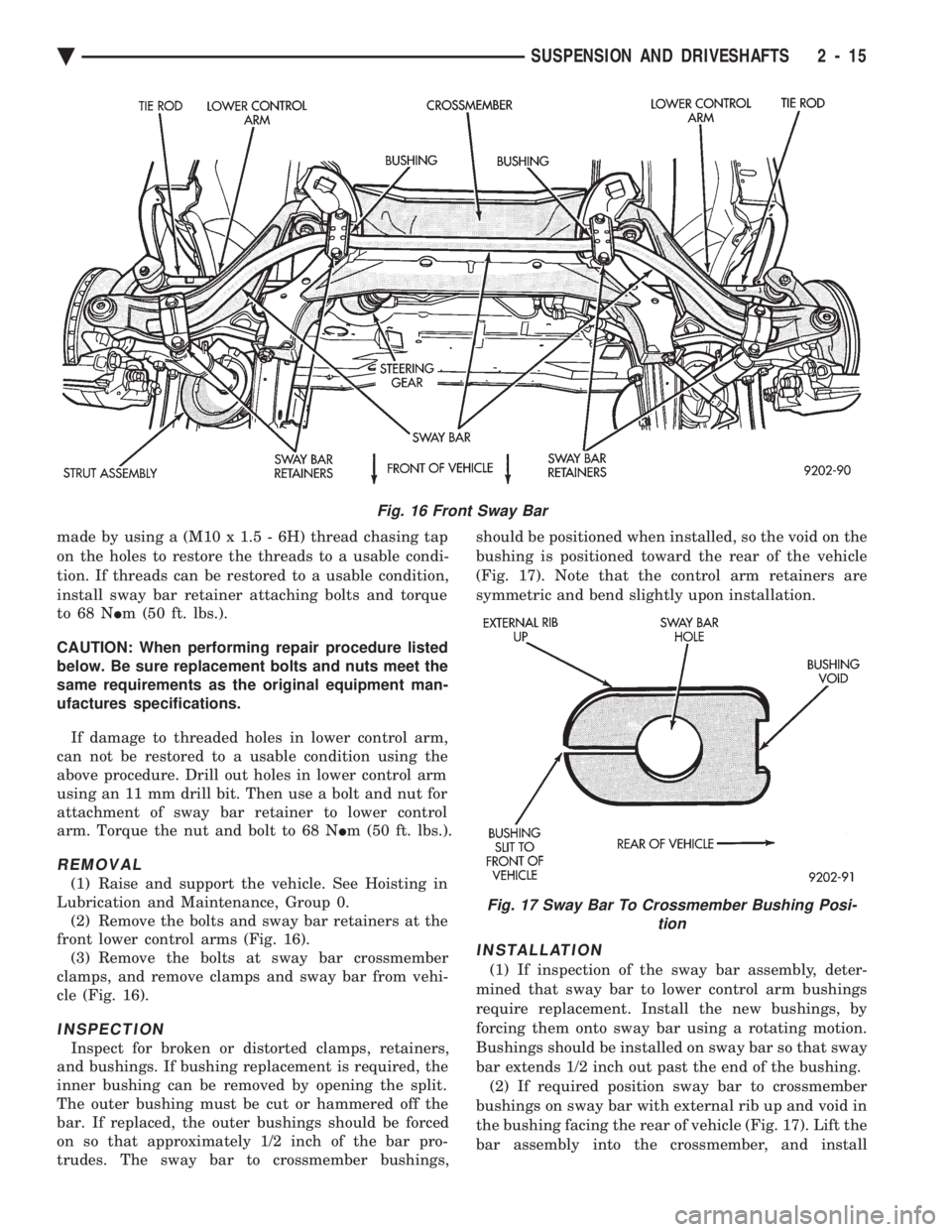
Lubrication and Maintenance, Group 0. (2) Remove the bolts and sway bar retainers at the
front lower control arms (Fig. 16). (3) Remove the bolts at sway bar crossmember
clamps, and remove clamps and sway bar from vehi-
cle (Fig. 16).
INSPECTION
Inspect for broken or distorted clamps, retainers,
and bushings. If bushing replacement is required, the
inner bushing can be removed by opening the split.
The outer bushing must be cut or hammered off the
bar. If replaced, the outer bushings should be forced
on so that approximately 1/2 inch of the bar pro-
trudes. The sway bar to crossmember bushings, should be positioned when installed, so the void on the
bushing is positioned toward the rear of the vehicle
(Fig. 17). Note that the control arm retainers are
symmetric and bend slightly upon installation.
INSTALLATION
(1) If inspection of the sway bar assembly, deter-
mined that sway bar to lower control arm bushings
require replacement. Install the new bushings, by
forcing them onto sway bar using a rotating motion.
Bushings should be installed on sway bar so that sway
bar extends 1/2 inch out past the end of the bushing. (2) If required position sway bar to crossmember
bushings on sway bar with external rib up and void in
the bushing facing the rear of vehicle (Fig. 17). Lift the
bar assembly into the crossmember, and install
Fig. 16 Front Sway Bar
Fig. 17 Sway Bar To Crossmember Bushing Posi- tion
Ä SUSPENSION AND DRIVESHAFTS 2 - 15
Page 97 of 2438
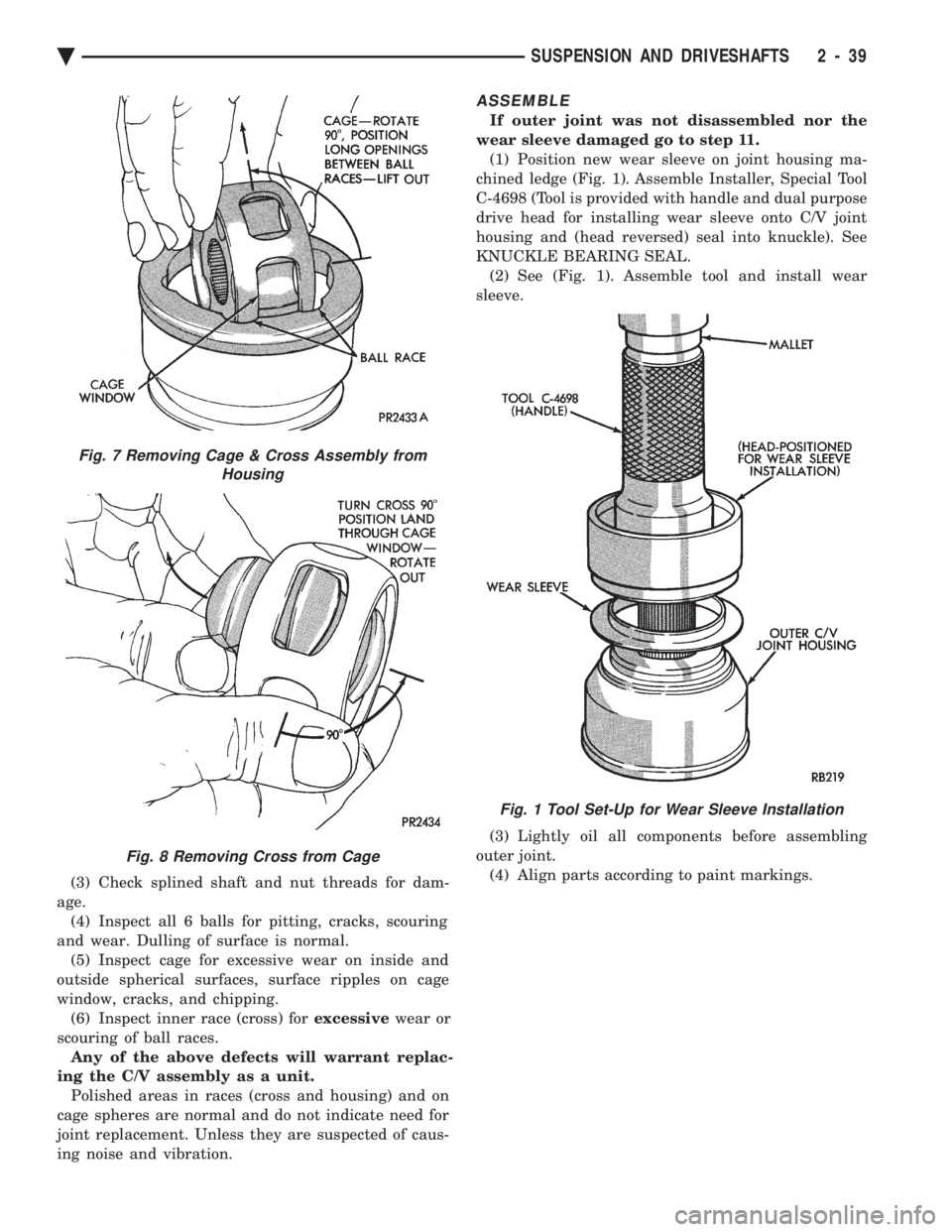
(3) Check splined shaft and nut threads for dam-
age. (4) Inspect all 6 balls for pitting, cracks, scouring
and wear. Dulling of surface is normal. (5) Inspect cage for excessive wear on inside and
outside spherical surfaces, surface ripples on cage
window, cracks, and chipping. (6) Inspect inner race (cross) for excessivewear or
scouring of ball races. Any of the above defects will warrant replac-
ing the C/V assembly as a unit. Polished areas in races (cross and housing) and on
cage spheres are normal and do not indicate need for
joint replacement. Unless they are suspected of caus-
ing noise and vibration.
ASSEMBLE
If outer joint was not disassembled nor the
wear sleeve damaged go to step 11. (1) Position new wear sleeve on joint housing ma-
chined ledge (Fig. 1). Assemble Installer, Special Tool
C-4698 (Tool is provided with handle and dual purpose
drive head for installing wear sleeve onto C/V joint
housing and (head reversed) seal into knuckle). See
KNUCKLE BEARING SEAL. (2) See (Fig. 1). Assemble tool and install wear
sleeve.
(3) Lightly oil all components before assembling
outer joint. (4) Align parts according to paint markings.
Fig. 7 Removing Cage & Cross Assembly from Housing
Fig. 8 Removing Cross from Cage
Fig. 1 Tool Set-Up for Wear Sleeve Installation
Ä SUSPENSION AND DRIVESHAFTS 2 - 39
Page 103 of 2438
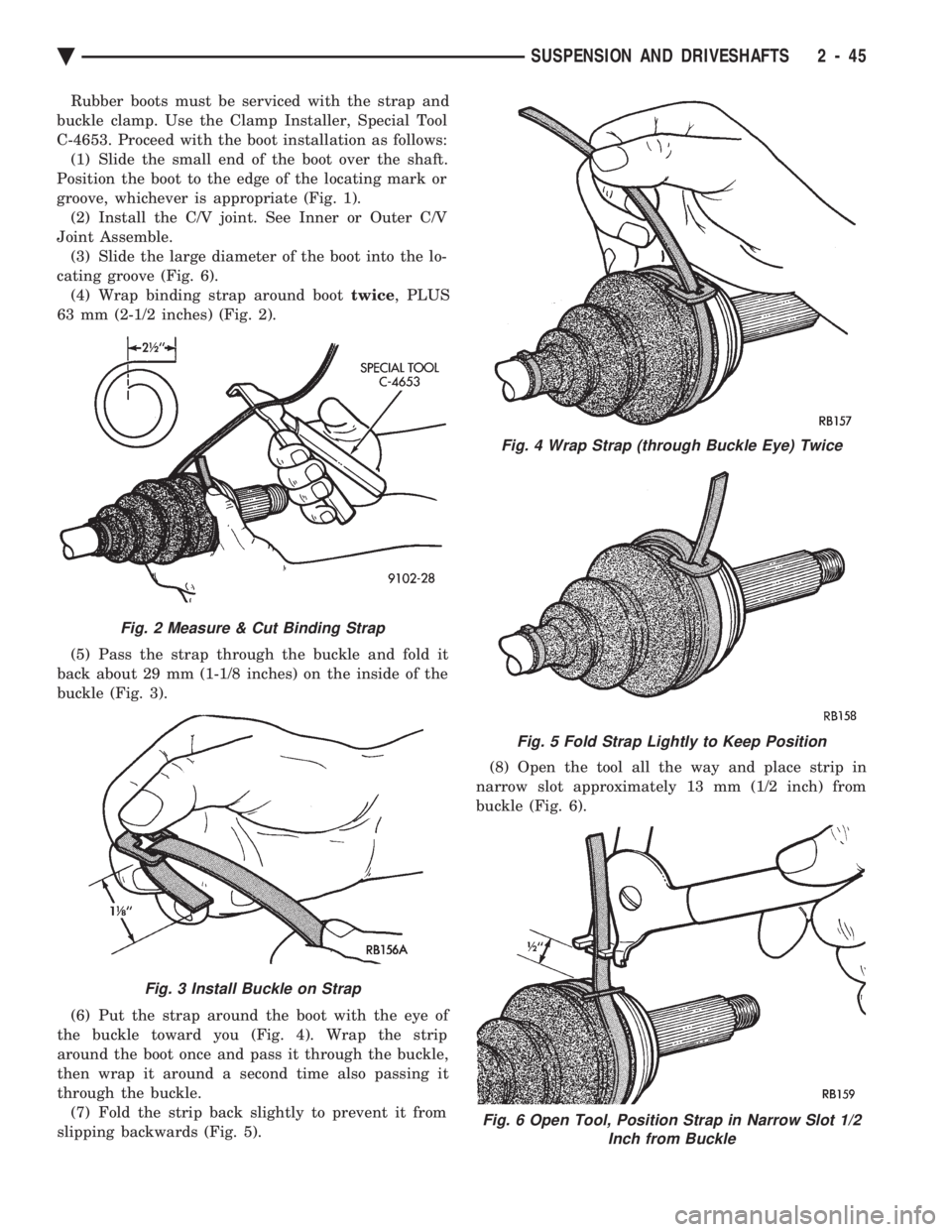
Rubber boots must be serviced with the strap and
buckle clamp. Use the Clamp Installer, Special Tool
C-4653. Proceed with the boot installation as follows: (1) Slide the small end of the boot over the shaft.
Position the boot to the edge of the locating mark or
groove, whichever is appropriate (Fig. 1). (2) Install the C/V joint. See Inner or Outer C/V
Joint Assemble. (3) Slide the large diameter of the boot into the lo-
cating groove (Fig. 6). (4) Wrap binding strap around boot twice, PLUS
63 mm (2-1/2 inches) (Fig. 2).
(5) Pass the strap through the buckle and fold it
back about 29 mm (1-1/8 inches) on the inside of the
buckle (Fig. 3).
(6) Put the strap around the boot with the eye of
the buckle toward you (Fig. 4). Wrap the strip
around the boot once and pass it through the buckle,
then wrap it around a second time also passing it
through the buckle. (7) Fold the strip back slightly to prevent it from
slipping backwards (Fig. 5). (8) Open the tool all the way and place strip in
narrow slot approximately 13 mm (1/2 inch) from
buckle (Fig. 6).
Fig. 2 Measure & Cut Binding Strap
Fig. 3 Install Buckle on Strap
Fig. 4 Wrap Strap (through Buckle Eye) Twice
Fig. 5 Fold Strap Lightly to Keep Position
Fig. 6 Open Tool, Position Strap in Narrow Slot 1/2 Inch from Buckle
Ä SUSPENSION AND DRIVESHAFTS 2 - 45
Page 104 of 2438
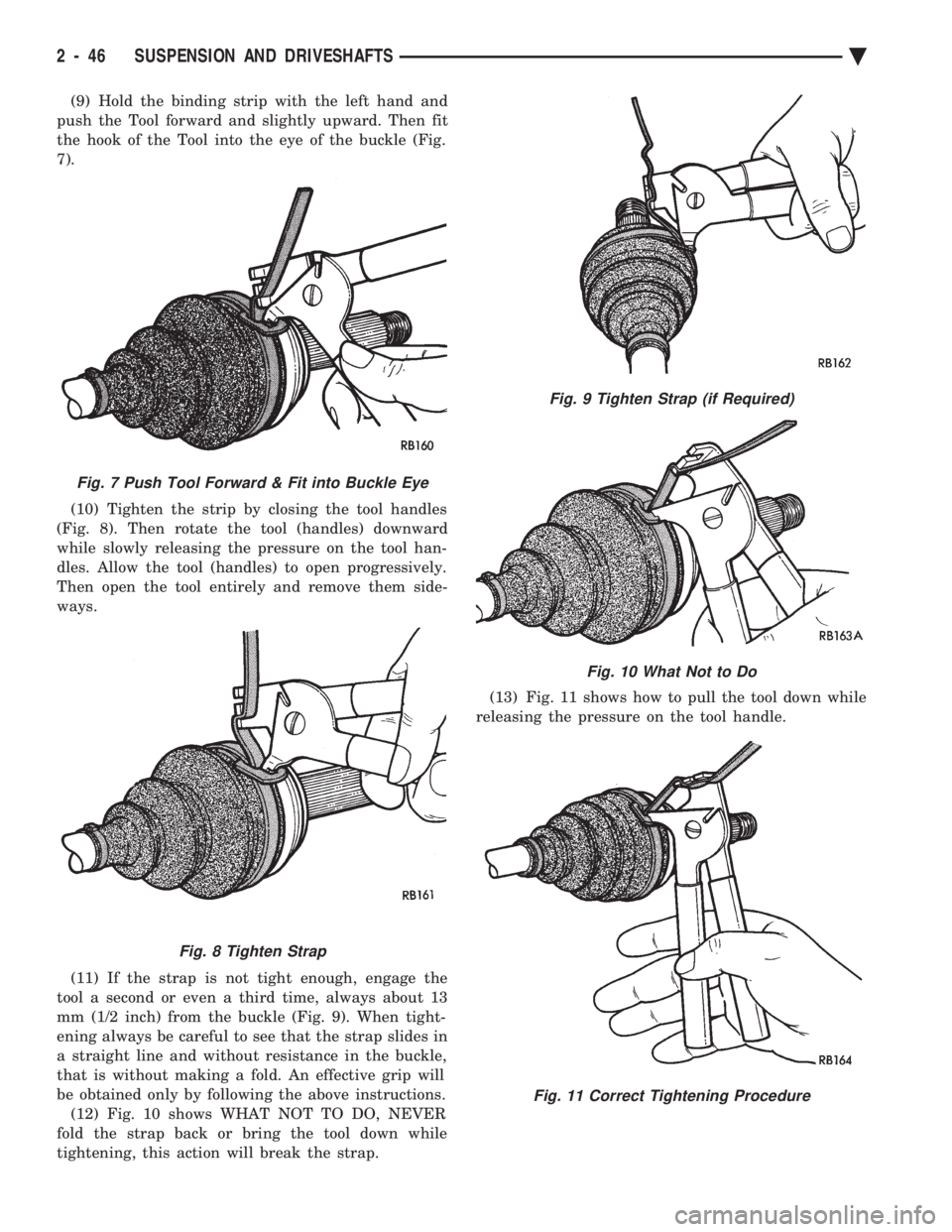
(9) Hold the binding strip with the left hand and
push the Tool forward and slightly upward. Then fit
the hook of the Tool into the eye of the buckle (Fig.
7).
(10) Tighten the strip by closing the tool handles
(Fig. 8). Then rotate the tool (handles) downward
while slowly releasing the pressure on the tool han-
dles. Allow the tool (handles) to open progressively.
Then open the tool entirely and remove them side-
ways.
(11) If the strap is not tight enough, engage the
tool a second or even a third time, always about 13
mm (1/2 inch) from the buckle (Fig. 9). When tight-
ening always be careful to see that the strap slides in
a straight line and without resistance in the buckle,
that is without making a fold. An effective grip will
be obtained only by following the above instructions. (12) Fig. 10 shows WHAT NOT TO DO, NEVER
fold the strap back or bring the tool down while
tightening, this action will break the strap. (13) Fig. 11 shows how to pull the tool down while
releasing the pressure on the tool handle.
Fig. 7 Push Tool Forward & Fit into Buckle Eye
Fig. 8 Tighten Strap
Fig. 9 Tighten Strap (if Required)
Fig. 10 What Not to Do
Fig. 11 Correct Tightening Procedure
2 - 46 SUSPENSION AND DRIVESHAFTS Ä
Page 109 of 2438
to the road surface. While being able to twist as one
wheel moves vertically with respect to the other.Roll resistance is provided partly by the axle's re-
sistance to twist. But primarily by a torque tube or
rod (depending on the suspension option called for)
running through the channel and attached rigidly to
its end plates by welding. Because the torque tube/
rod is an integral part of the axle assembly, it cannot
be individually replaced. The spindles are bolted to the axle end (spindle
mounting) plates and can be individually replaced if
required. Rear wheel alignment changes require the
use of shims between the spindle and axle end plates.
SHOCK ABSORBERS
REMOVAL
(1) Raise vehicle, see Hoisting, Group 0.
(2) Support axle and remove wheel and tire assem-
bly. (3) If equipped with air shocks, disconnect air
lines. (4) Remove upper and lower shock absorber fasten-
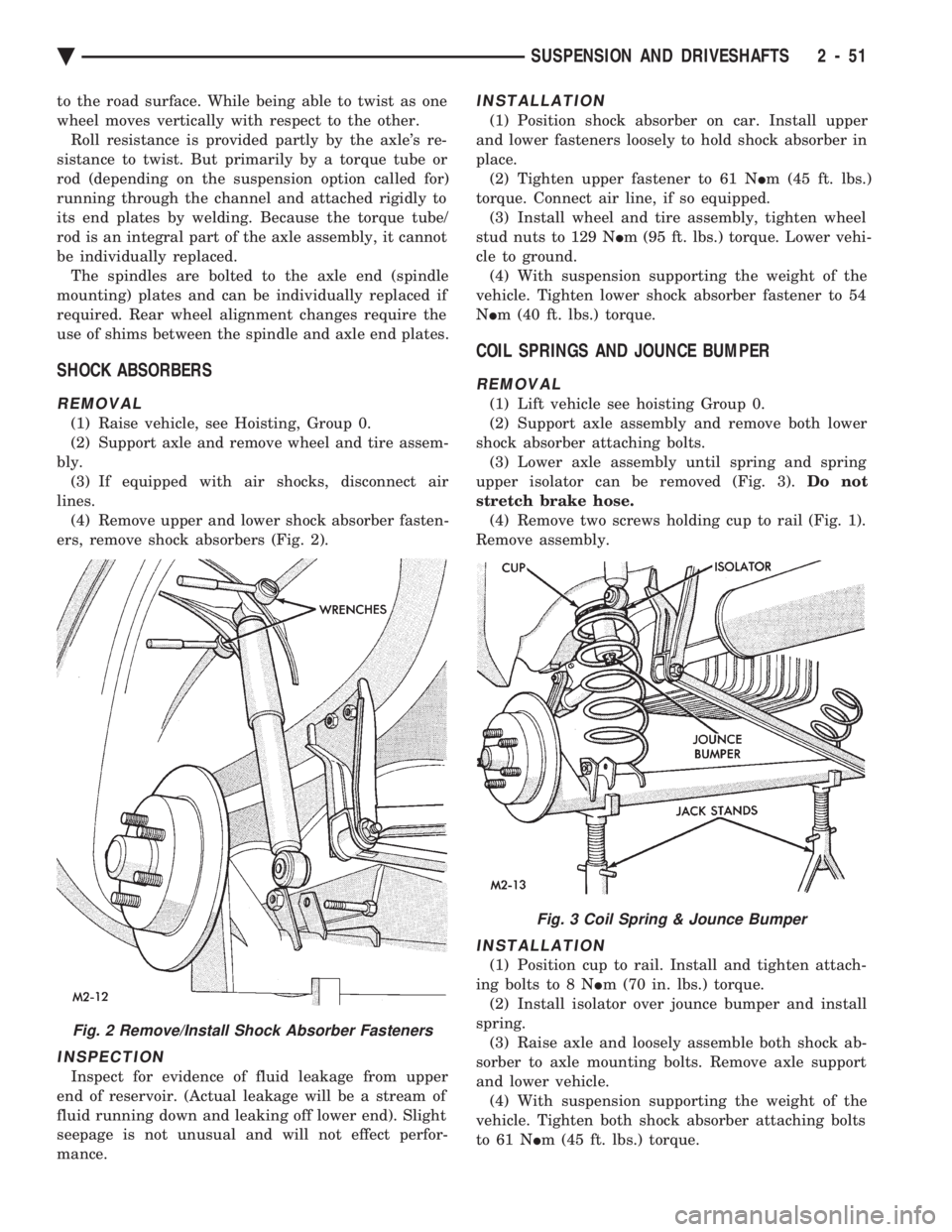
ers, remove shock absorbers (Fig. 2).
INSPECTION
Inspect for evidence of fluid leakage from upper
end of reservoir. (Actual leakage will be a stream of
fluid running down and leaking off lower end). Slight
seepage is not unusual and will not effect perfor-
mance.
INSTALLATION
(1) Position shock absorber on car. Install upper
and lower fasteners loosely to hold shock absorber in
place. (2) Tighten upper fastener to 61 N Im (45 ft. lbs.)
torque. Connect air line, if so equipped. (3) Install wheel and tire assembly, tighten wheel
stud nuts to 129 N Im (95 ft. lbs.) torque. Lower vehi-
cle to ground. (4) With suspension supporting the weight of the
vehicle. Tighten lower shock absorber fastener to 54
N Im (40 ft. lbs.) torque.
COIL SPRINGS AND JOUNCE BUMPER
REMOVAL
(1) Lift vehicle see hoisting Group 0.
(2) Support axle assembly and remove both lower
shock absorber attaching bolts. (3) Lower axle assembly until spring and spring
upper isolator can be removed (Fig. 3). Do not
stretch brake hose. (4) Remove two screws holding cup to rail (Fig. 1).
Remove assembly.
INSTALLATION
(1) Position cup to rail. Install and tighten attach-
ing bolts to 8 N Im (70 in. lbs.) torque.
(2) Install isolator over jounce bumper and install
spring. (3) Raise axle and loosely assemble both shock ab-
sorber to axle mounting bolts. Remove axle support
and lower vehicle. (4) With suspension supporting the weight of the
vehicle. Tighten both shock absorber attaching bolts
to 61 N Im (45 ft. lbs.) torque.
Fig. 2 Remove/Install Shock Absorber Fasteners
Fig. 3 Coil Spring & Jounce Bumper
Ä SUSPENSION AND DRIVESHAFTS 2 - 51
Page 111 of 2438
WARNING: WHEN REMOVING THE REAR AXLE
PIVOT BUSHING ON VEHICLES EQUIPPED WITH EI-
THER REAR COIL SPRINGS OR AIR SUSPENSION.
THE REAR AXLE MUST BE SUPPORTED BY THE
AXLE AND TRAILING ARM TO ENSURE ADEQUATE
SUPPORT OF REAR AXLE.
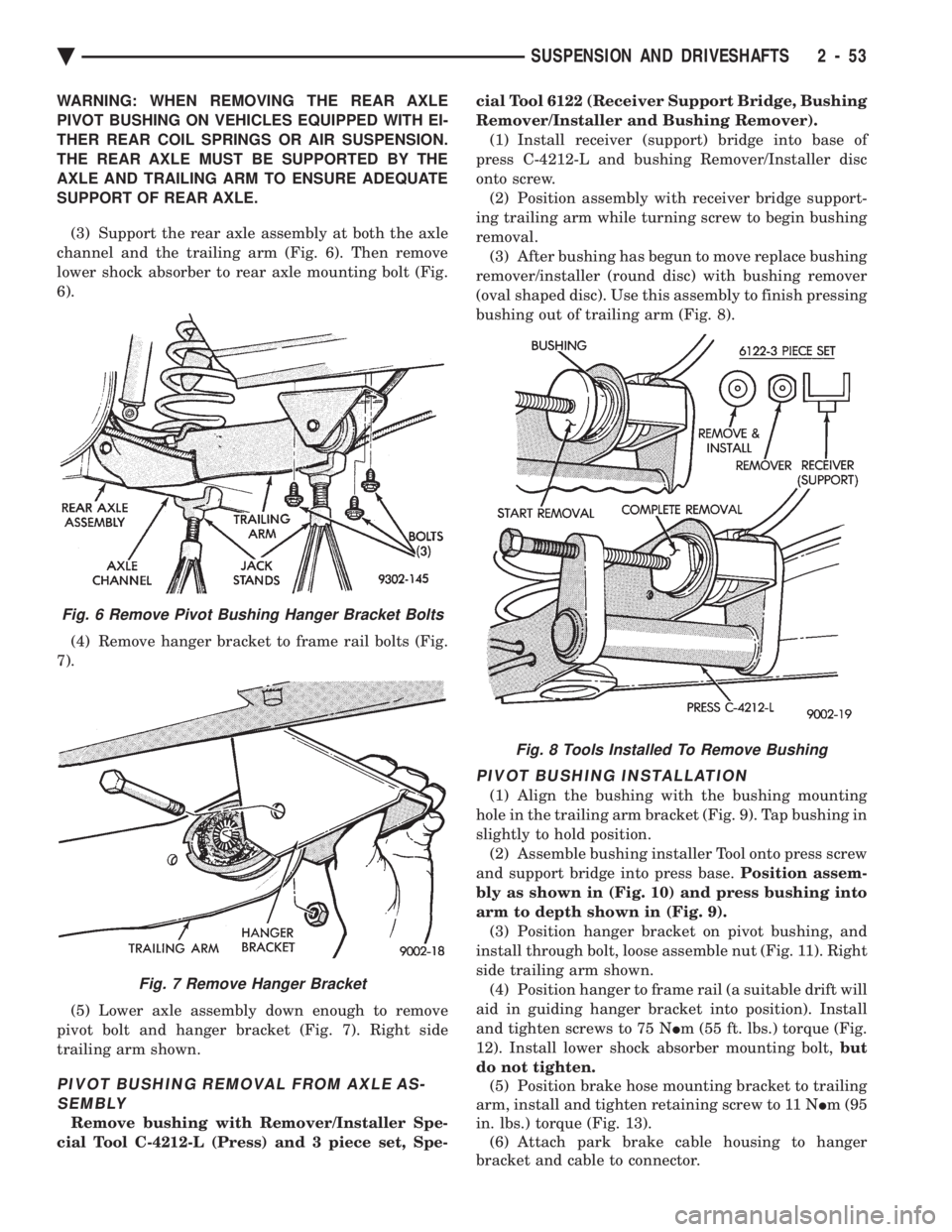
(3) Support the rear axle assembly at both the axle
channel and the trailing arm (Fig. 6). Then remove
lower shock absorber to rear axle mounting bolt (Fig.
6).
(4) Remove hanger bracket to frame rail bolts (Fig.
7).
(5) Lower axle assembly down enough to remove
pivot bolt and hanger bracket (Fig. 7). Right side
trailing arm shown.
PIVOT BUSHING REMOVAL FROM AXLE AS- SEMBLY
Remove bushing with Remover/Installer Spe-
cial Tool C-4212-L (Press) and 3 piece set, Spe- cial Tool 6122 (Receiver Support Bridge, Bushing
Remover/Installer and Bushing Remover). (1) Install receiver (support) bridge into base of
press C-4212-L and bushing Remover/Installer disc
onto screw. (2) Position assembly with receiver bridge support-
ing trailing arm while turning screw to begin bushing
removal. (3) After bushing has begun to move replace bushing
remover/installer (round disc) with bushing remover
(oval shaped disc). Use this assembly to finish pressing
bushing out of trailing arm (Fig. 8).
PIVOT BUSHING INSTALLATION
(1) Align the bushing with the bushing mounting
hole in the trailing arm bracket (Fig. 9). Tap bushing in
slightly to hold position. (2) Assemble bushing installer Tool onto press screw
and support bridge into press base. Position assem-
bly as shown in (Fig. 10) and press bushing into
arm to depth shown in (Fig. 9). (3) Position hanger bracket on pivot bushing, and
install through bolt, loose assemble nut (Fig. 11). Right
side trailing arm shown. (4) Position hanger to frame rail (a suitable drift will
aid in guiding hanger bracket into position). Install
and tighten screws to 75 N Im (55 ft. lbs.) torque (Fig.
12). Install lower shock absorber mounting bolt, but
do not tighten. (5) Position brake hose mounting bracket to trailing
arm, install and tighten retaining screw to 11 N Im (95
in. lbs.) torque (Fig. 13). (6) Attach park brake cable housing to hanger
bracket and cable to connector.
Fig. 8 Tools Installed To Remove Bushing
Fig. 6 Remove Pivot Bushing Hanger Bracket Bolts
Fig. 7 Remove Hanger Bracket
Ä SUSPENSION AND DRIVESHAFTS 2 - 53
Page 113 of 2438
PIVOT BUSHING AC AG AJ AP BODY
REMOVE FROM VEHICLE
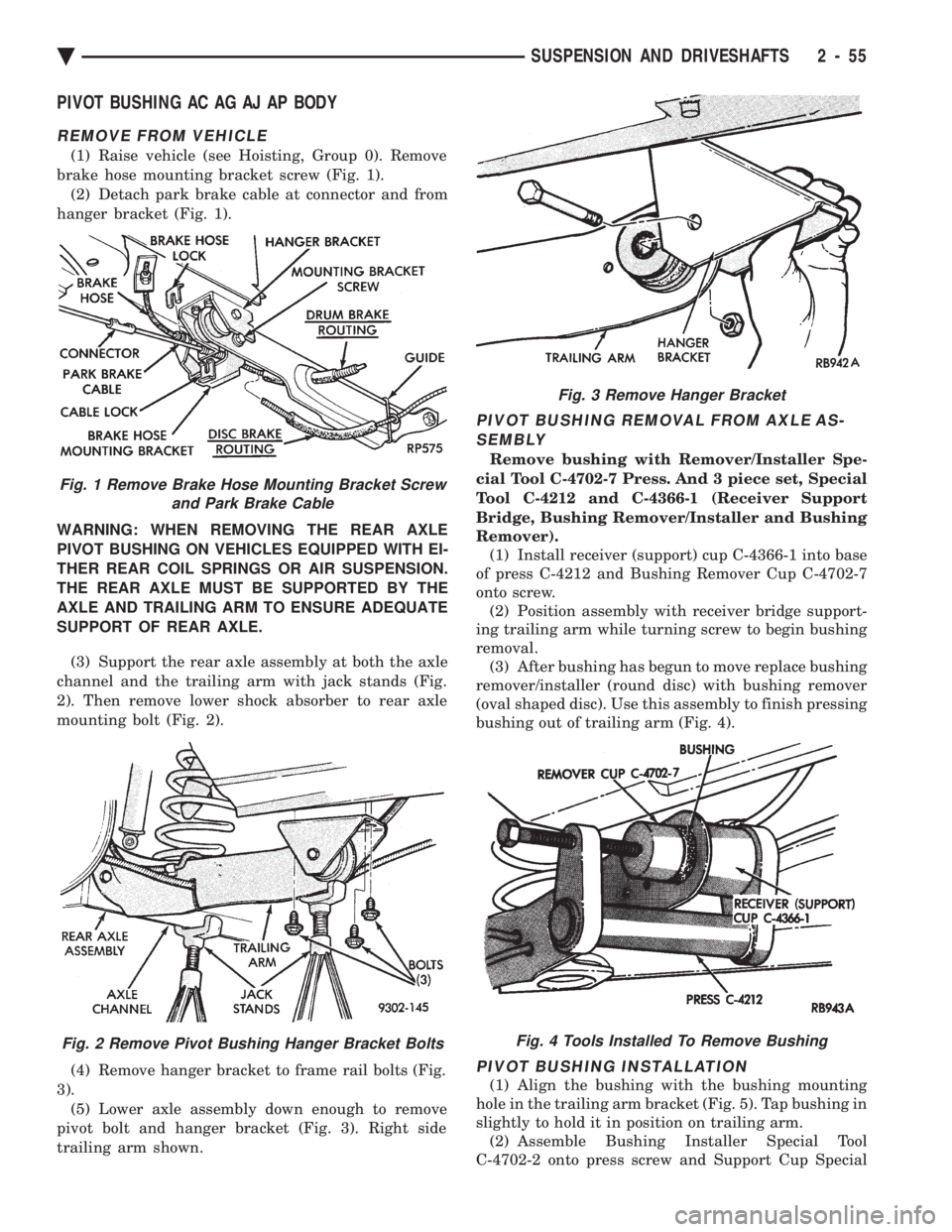
(1) Raise vehicle (see Hoisting, Group 0). Remove
brake hose mounting bracket screw (Fig. 1). (2) Detach park brake cable at connector and from
hanger bracket (Fig. 1).
WARNING: WHEN REMOVING THE REAR AXLE
PIVOT BUSHING ON VEHICLES EQUIPPED WITH EI-
THER REAR COIL SPRINGS OR AIR SUSPENSION.
THE REAR AXLE MUST BE SUPPORTED BY THE
AXLE AND TRAILING ARM TO ENSURE ADEQUATE
SUPPORT OF REAR AXLE. (3) Support the rear axle assembly at both the axle
channel and the trailing arm with jack stands (Fig.
2). Then remove lower shock absorber to rear axle
mounting bolt (Fig. 2).
(4) Remove hanger bracket to frame rail bolts (Fig.
3). (5) Lower axle assembly down enough to remove
pivot bolt and hanger bracket (Fig. 3). Right side
trailing arm shown.
PIVOT BUSHING REMOVAL FROM AXLE AS- SEMBLY
Remove bushing with Remover/Installer Spe-
cial Tool C-4702-7 Press. And 3 piece set, Special
Tool C-4212 and C-4366-1 (Receiver Support
Bridge, Bushing Remover/Installer and Bushing
Remover). (1) Install receiver (support) cup C-4366-1 into base
of press C-4212 and Bushing Remover Cup C-4702-7
onto screw. (2) Position assembly with receiver bridge support-
ing trailing arm while turning screw to begin bushing
removal. (3) After bushing has begun to move replace bushing
remover/installer (round disc) with bushing remover
(oval shaped disc). Use this assembly to finish pressing
bushing out of trailing arm (Fig. 4).
PIVOT BUSHING INSTALLATION
(1) Align the bushing with the bushing mounting
hole in the trailing arm bracket (Fig. 5). Tap bushing in
slightly to hold it in position on trailing arm. (2) Assemble Bushing Installer Special Tool
C-4702-2 onto press screw and Support Cup Special
Fig. 1 Remove Brake Hose Mounting Bracket Screw and Park Brake Cable
Fig. 2 Remove Pivot Bushing Hanger Bracket Bolts
Fig. 3 Remove Hanger Bracket
Fig. 4 Tools Installed To Remove Bushing
Ä SUSPENSION AND DRIVESHAFTS 2 - 55