Page 1605 of 2438
REFACING VALVES AND VALVE SEATS
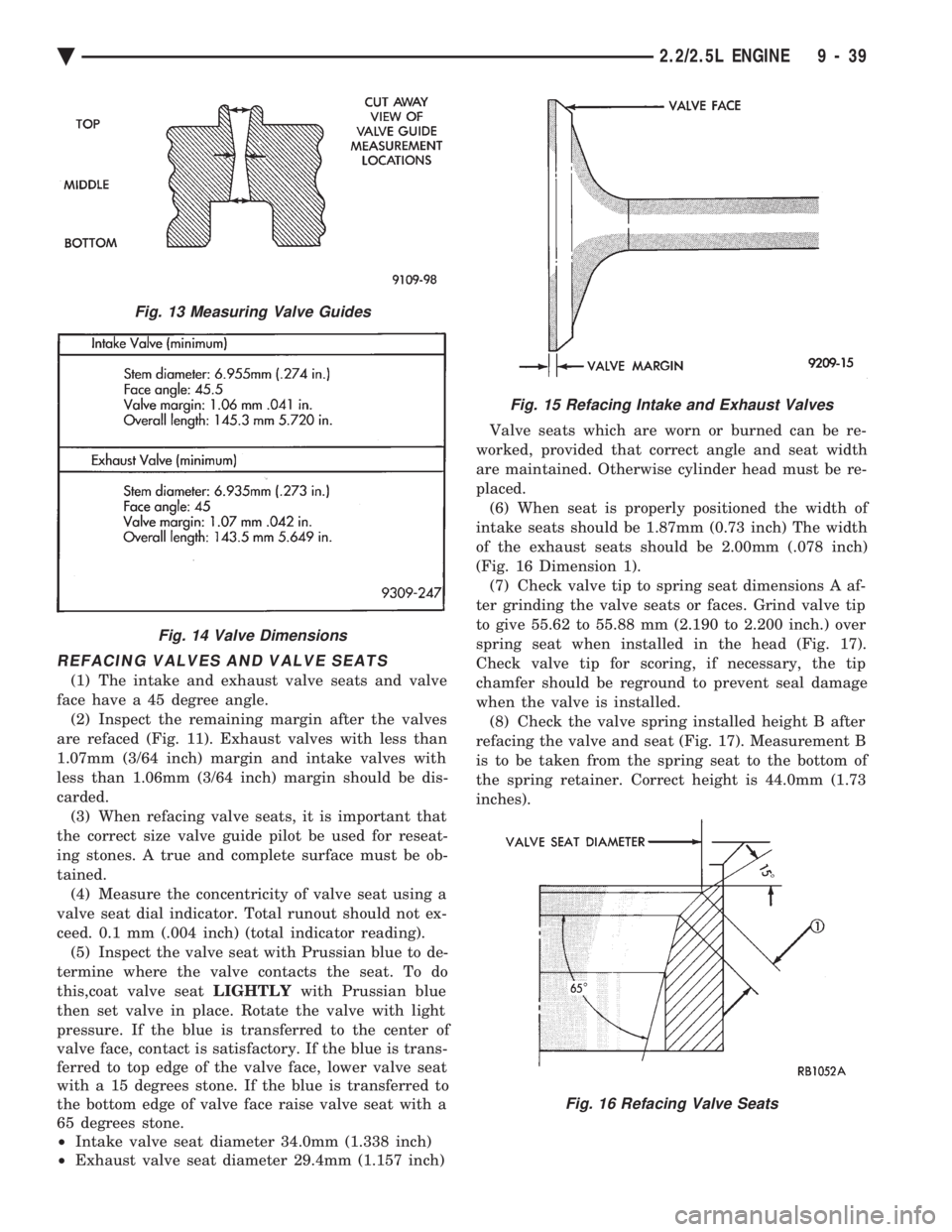
(1) The intake and exhaust valve seats and valve
face have a 45 degree angle. (2) Inspect the remaining margin after the valves
are refaced (Fig. 11). Exhaust valves with less than
1.07mm (3/64 inch) margin and intake valves with
less than 1.06mm (3/64 inch) margin should be dis-
carded. (3) When refacing valve seats, it is important that
the correct size valve guide pilot be used for reseat-
ing stones. A true and complete surface must be ob-
tained. (4) Measure the concentricity of valve seat using a
valve seat dial indicator. Total runout should not ex-
ceed. 0.1 mm (.004 inch) (total indicator reading). (5) Inspect the valve seat with Prussian blue to de-
termine where the valve contacts the seat. To do
this,coat valve seat LIGHTLYwith Prussian blue
then set valve in place. Rotate the valve with light
pressure. If the blue is transferred to the center of
valve face, contact is satisfactory. If the blue is trans-
ferred to top edge of the valve face, lower valve seat
with a 15 degrees stone. If the blue is transferred to
the bottom edge of valve face raise valve seat with a
65 degrees stone.
² Intake valve seat diameter 34.0mm (1.338 inch)
² Exhaust valve seat diameter 29.4mm (1.157 inch) Valve seats which are worn or burned can be re-
worked, provided that correct angle and seat width
are maintained. Otherwise cylinder head must be re-
placed. (6) When seat is properly positioned the width of
intake seats should be 1.87mm (0.73 inch) The width
of the exhaust seats should be 2.00mm (.078 inch)
(Fig. 16 Dimension 1). (7) Check valve tip to spring seat dimensions A af-
ter grinding the valve seats or faces. Grind valve tip
to give 55.62 to 55.88 mm (2.190 to 2.200 inch.) over
spring seat when installed in the head (Fig. 17).
Check valve tip for scoring, if necessary, the tip
chamfer should be reground to prevent seal damage
when the valve is installed. (8) Check the valve spring installed height B after
refacing the valve and seat (Fig. 17). Measurement B
is to be taken from the spring seat to the bottom of
the spring retainer. Correct height is 44.0mm (1.73
inches).
Fig. 13 Measuring Valve Guides
Fig. 14 Valve Dimensions
Fig. 15 Refacing Intake and Exhaust Valves
Fig. 16 Refacing Valve Seats
Ä 2.2/2.5L ENGINE 9 - 39
Page 1672 of 2438
REFACING VALVES AND VALVE SEATS
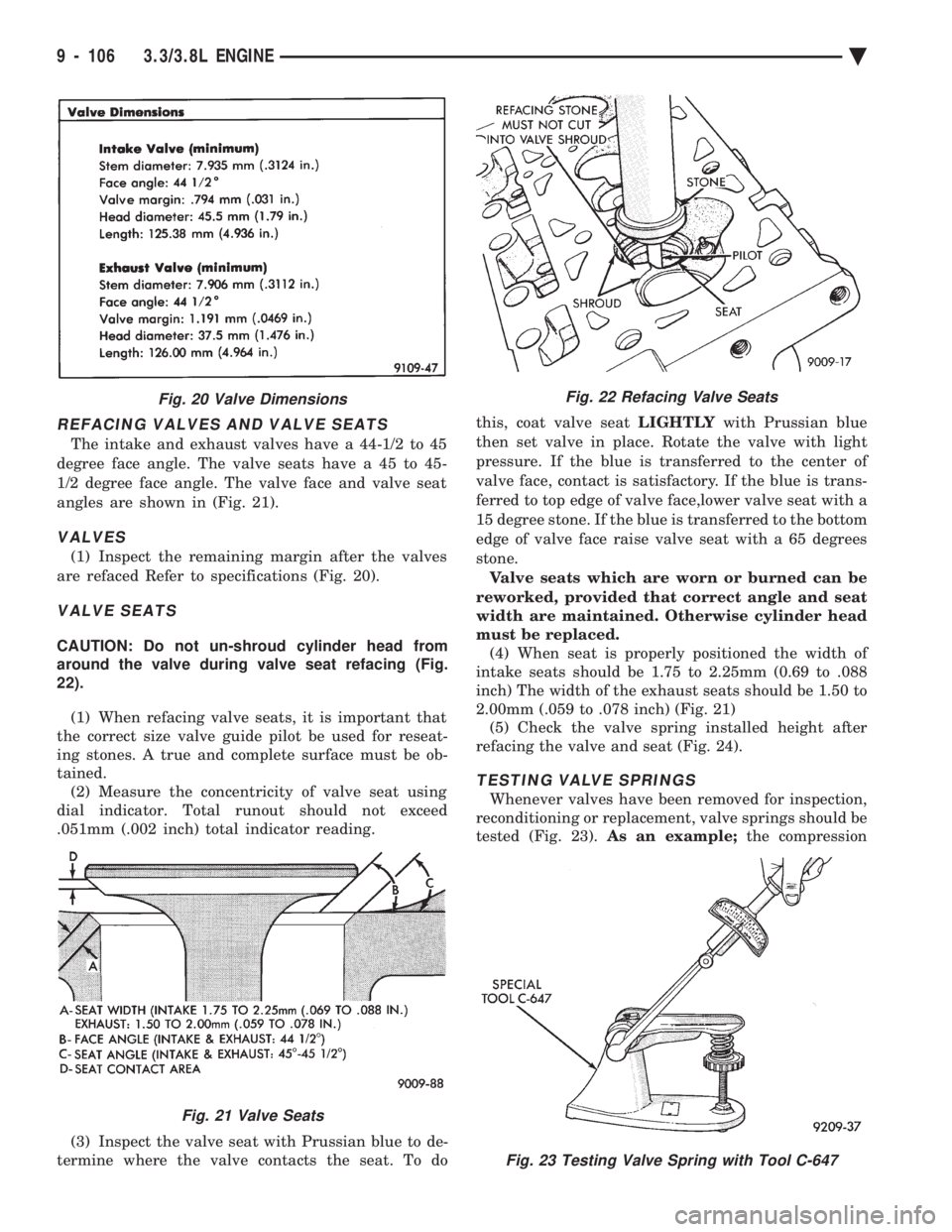
The intake and exhaust valves have a 44-1/2 to 45
degree face angle. The valve seats have a 45 to 45-
1/2 degree face angle. The valve face and valve seat
angles are shown in (Fig. 21).
VALVES
(1) Inspect the remaining margin after the valves
are refaced Refer to specifications (Fig. 20).
VALVE SEATS
CAUTION: Do not un-shroud cylinder head from
around the valve during valve seat refacing (Fig.
22).
(1) When refacing valve seats, it is important that
the correct size valve guide pilot be used for reseat-
ing stones. A true and complete surface must be ob-
tained. (2) Measure the concentricity of valve seat using
dial indicator. Total runout should not exceed
.051mm (.002 inch) total indicator reading.
(3) Inspect the valve seat with Prussian blue to de-
termine where the valve contacts the seat. To do this, coat valve seat
LIGHTLYwith Prussian blue
then set valve in place. Rotate the valve with light
pressure. If the blue is transferred to the center of
valve face, contact is satisfactory. If the blue is trans-
ferred to top edge of valve face,lower valve seat with a
15 degree stone. If the blue is transferred to the bottom
edge of valve face raise valve seat with a 65 degrees
stone. Valve seats which are worn or burned can be
reworked, provided that correct angle and seat
width are maintained. Otherwise cylinder head
must be replaced. (4) When seat is properly positioned the width of
intake seats should be 1.75 to 2.25mm (0.69 to .088
inch) The width of the exhaust seats should be 1.50 to
2.00mm (.059 to .078 inch) (Fig. 21) (5) Check the valve spring installed height after
refacing the valve and seat (Fig. 24).
TESTING VALVE SPRINGS
Whenever valves have been removed for inspection,
reconditioning or replacement, valve springs should be
tested (Fig. 23). As an example; the compression
Fig. 23 Testing Valve Spring with Tool C-647
Fig. 20 Valve Dimensions
Fig. 21 Valve Seats
Fig. 22 Refacing Valve Seats
9 - 106 3.3/3.8L ENGINE Ä
Page 1731 of 2438
FRAME INDEX
page page
Crossmember ........................... 17
Frame Dimensions ........................ 9 General Information
........................ 9
GENERAL INFORMATION
In this section, references are made to Vehicle
Family (Body) codes. To determine the vehicle family
identification code, refer to the Introduction Group at
the front of this manual.
FRAME DIMENSIONS
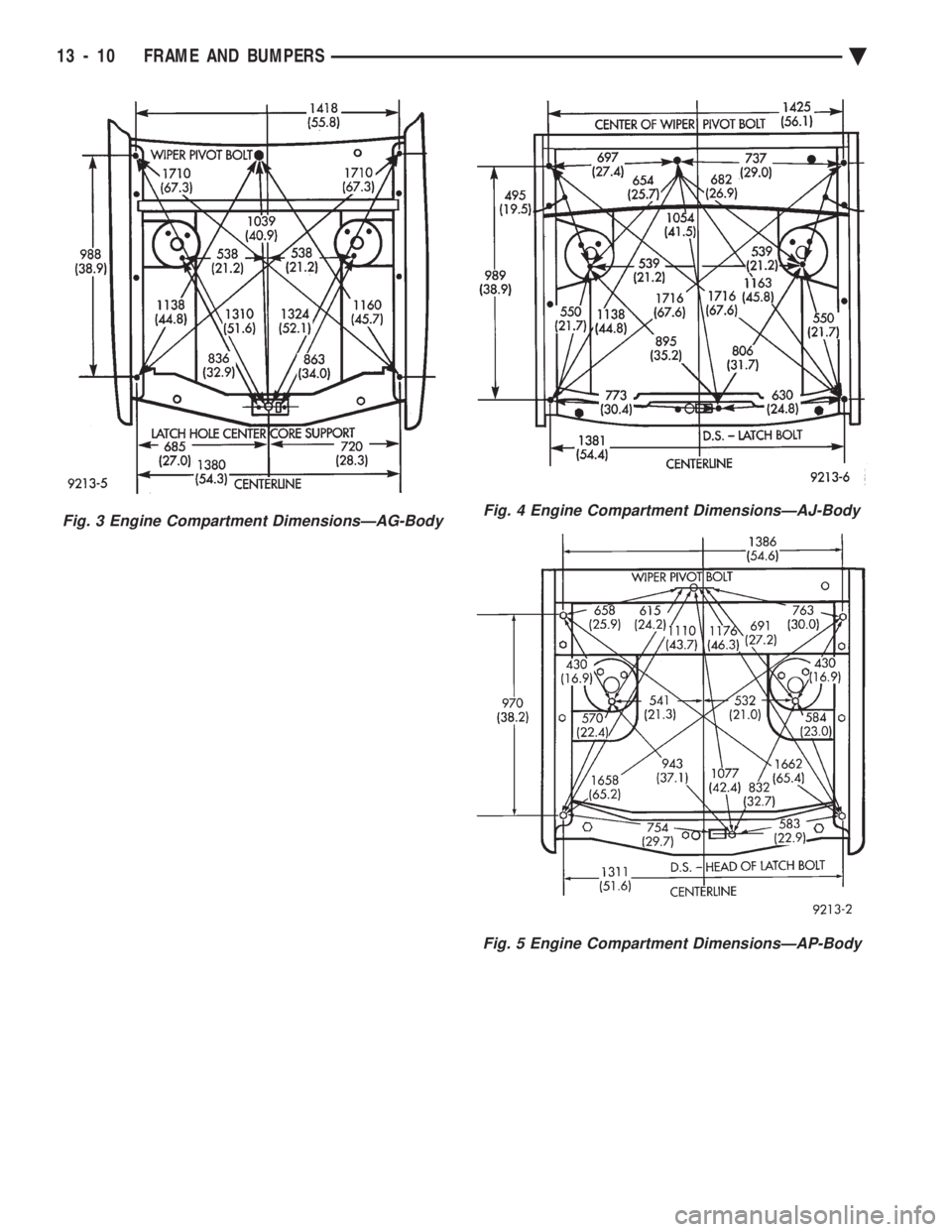
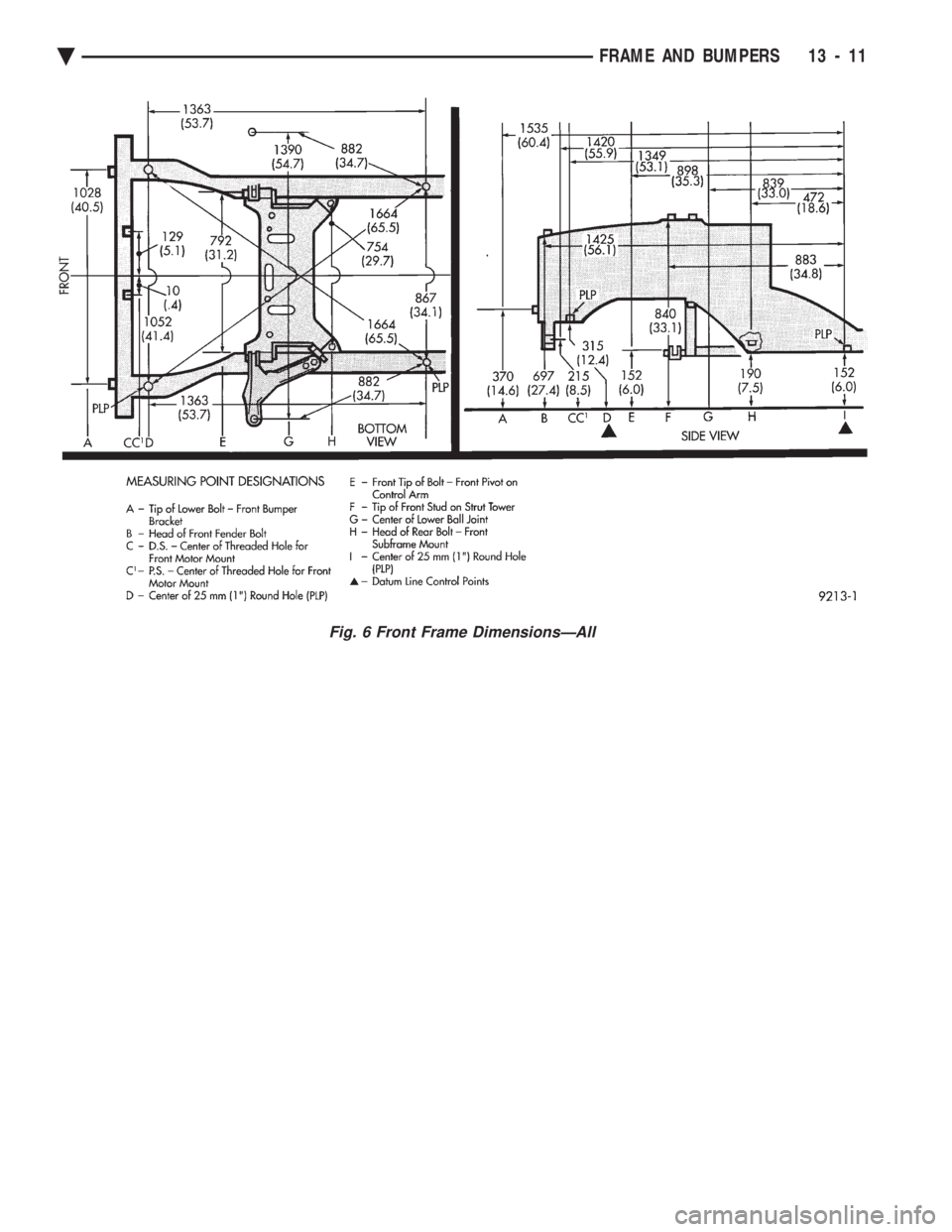
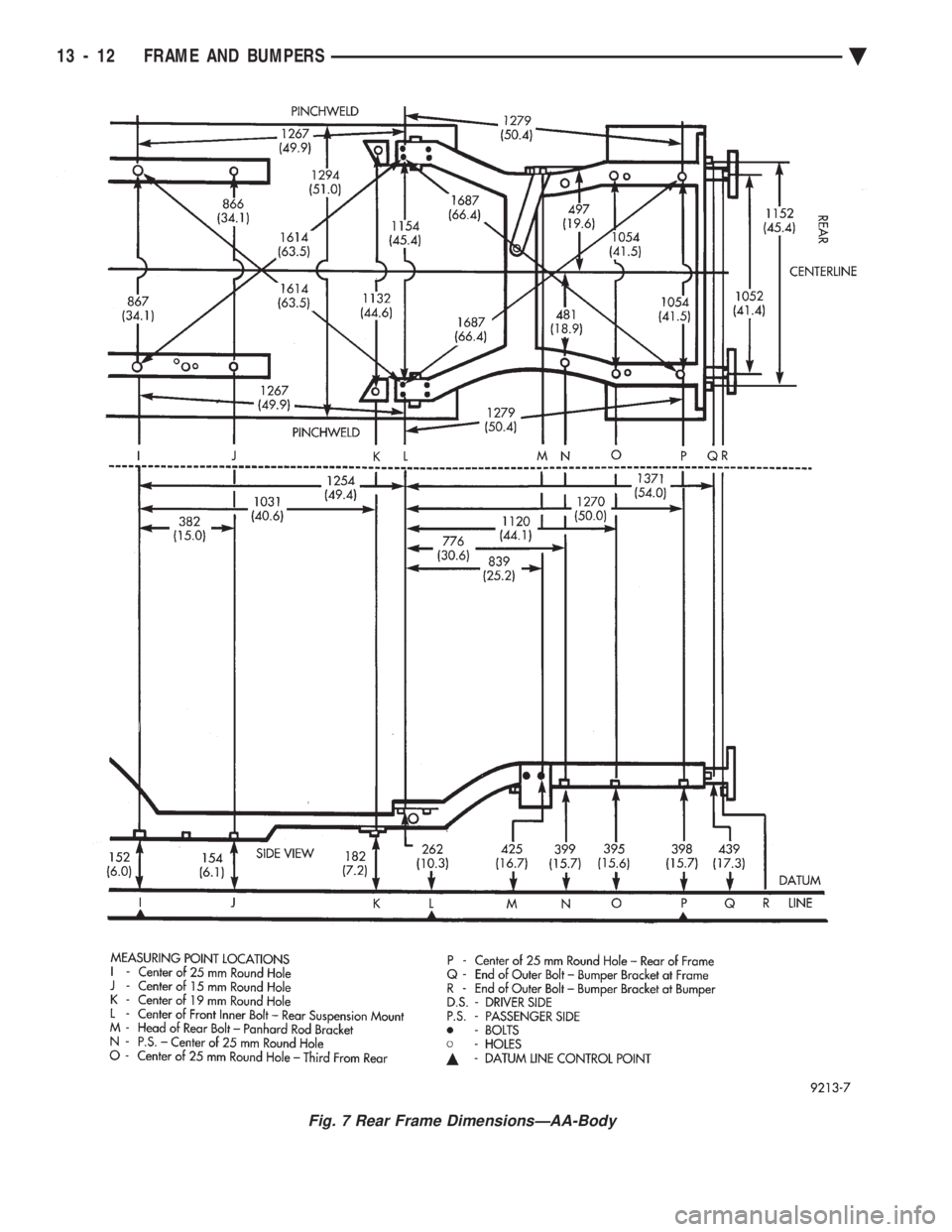
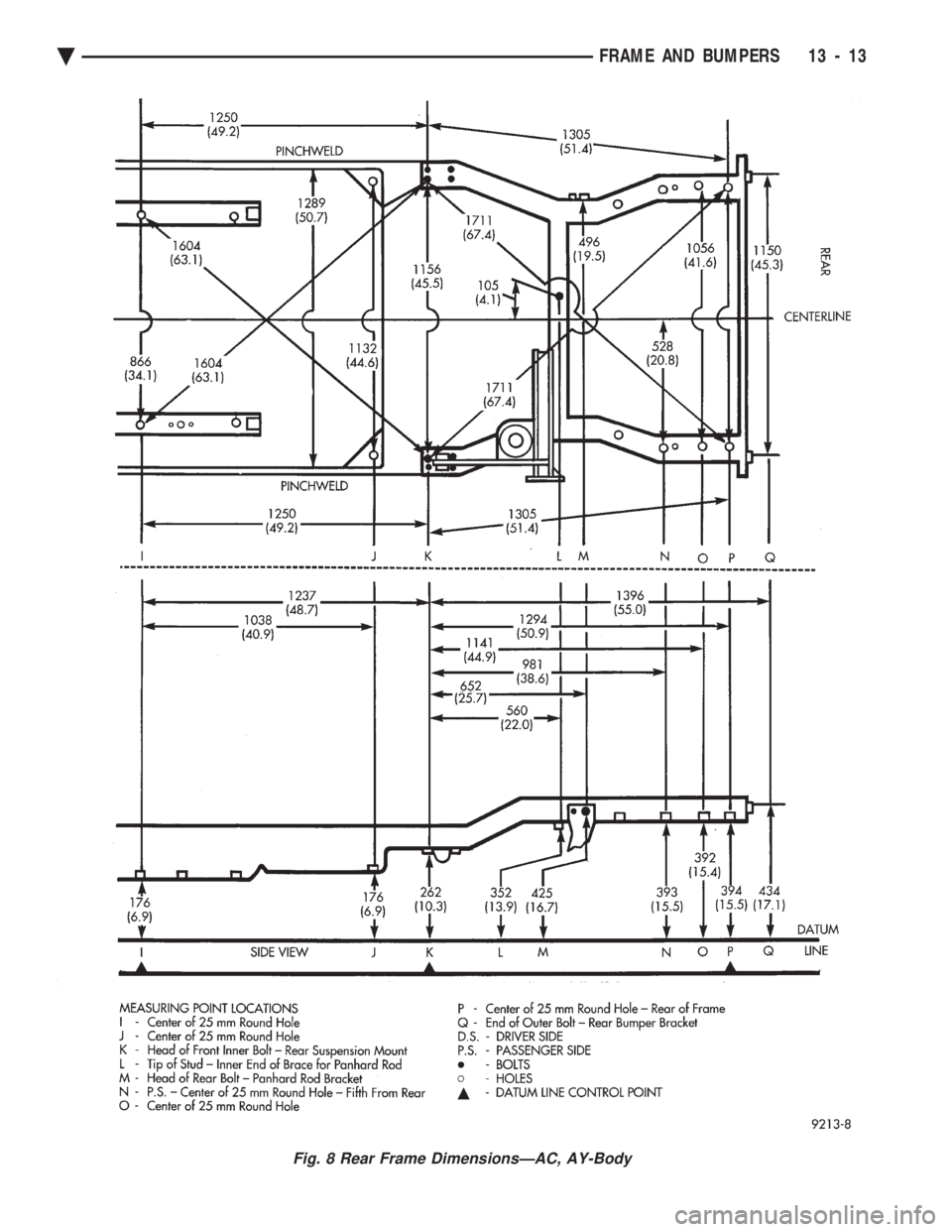
Frame dimensions are listed in metric scale then
converted to inch scale listed in parenthesis. Engine
compartment charts include front suspension upper
strut damper mounting tower location. All dimen-
sions are from center to center of Principal Locating
Point (PLP), or from center to center of PLP and fas-
tener location.
VEHICLE PREPARATION
Position the vehicle on a level work surface. Using
screw or bottle jacks, adjust the vehicle height to the
specified PLP dimension above the Datum Line
(work surface). Vertical dimensions can be taken
from the datum line to the PLP.
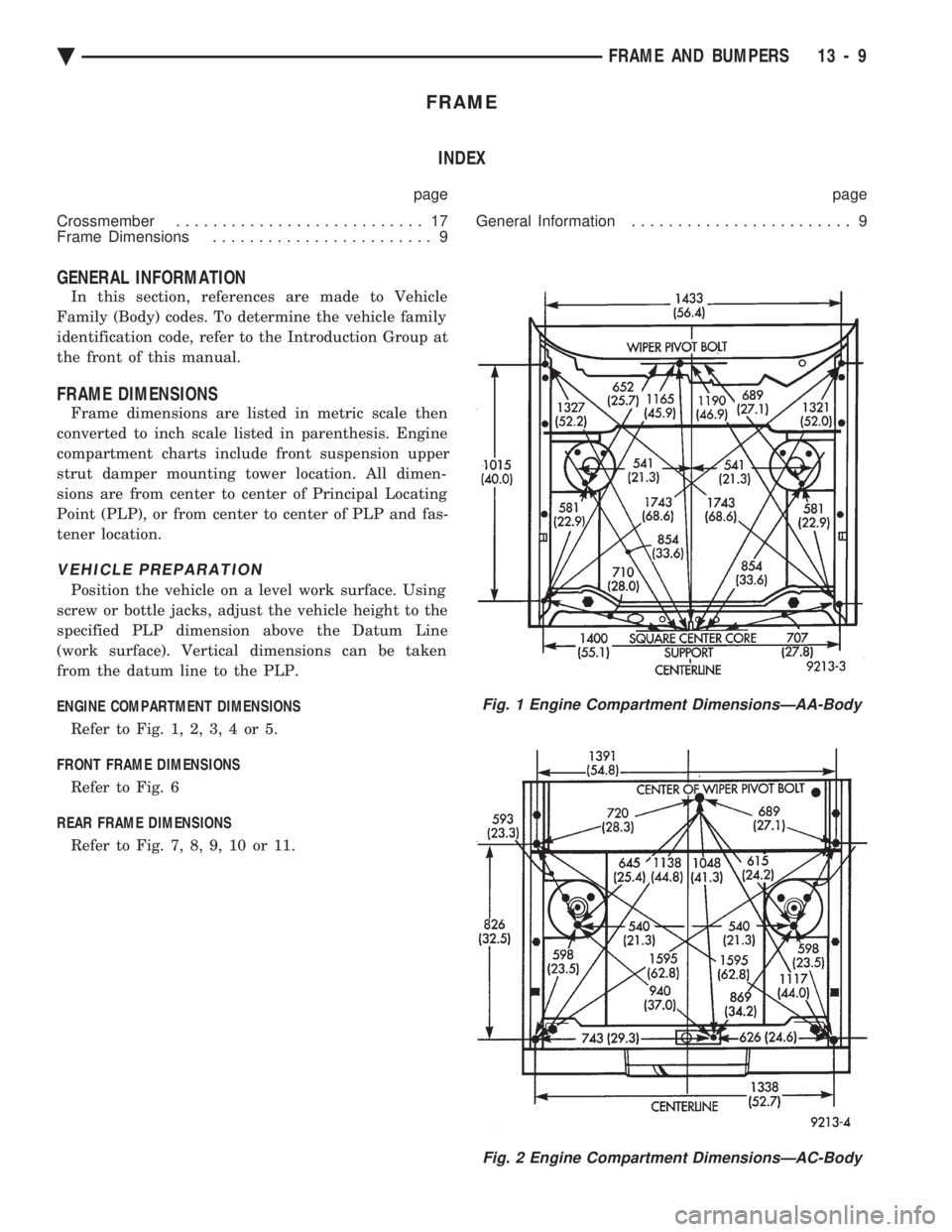
ENGINE COMPARTMENT DIMENSIONS Refer to Fig. 1, 2, 3, 4 or 5.
FRONT FRAME DIMENSIONS Refer to Fig. 6
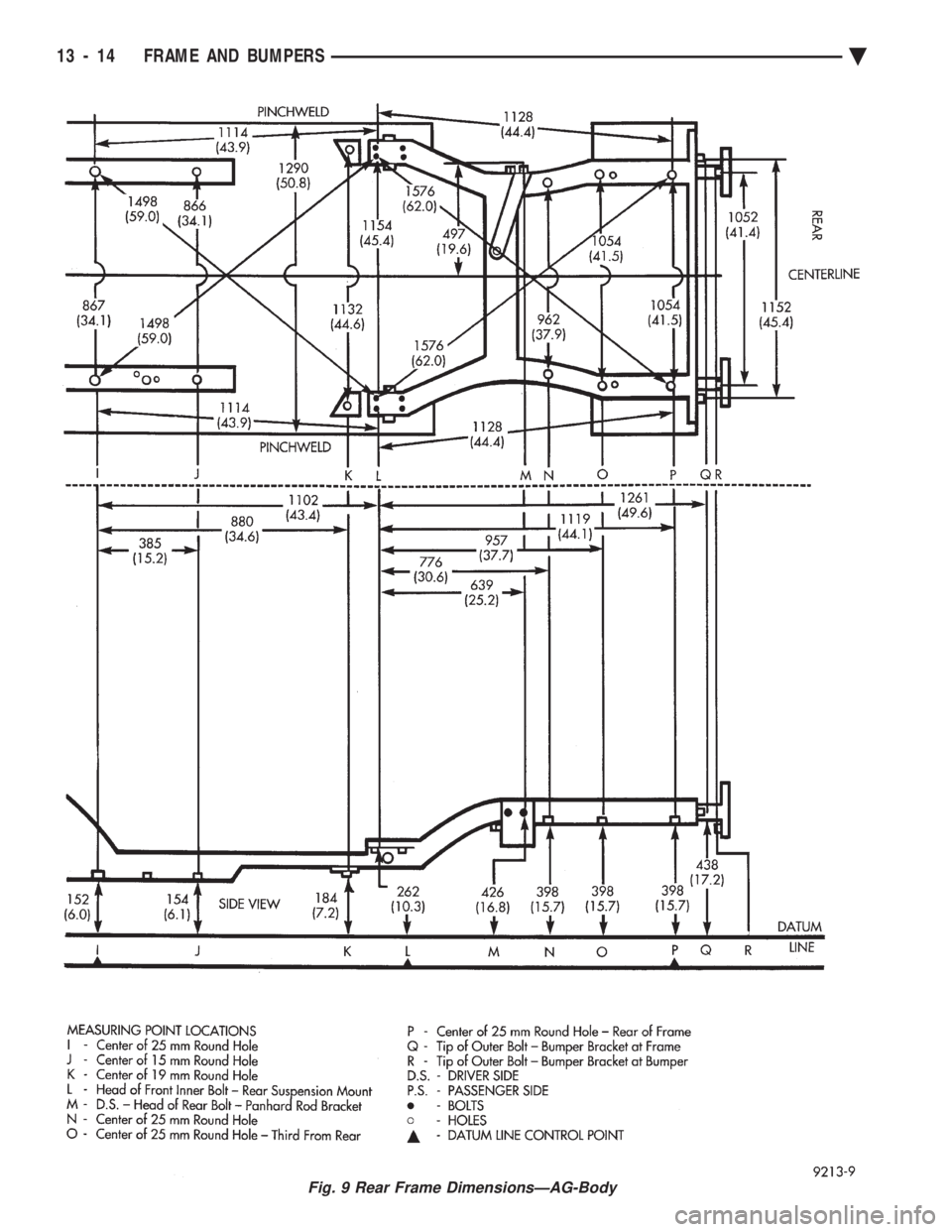
REAR FRAME DIMENSIONS Refer to Fig. 7, 8, 9, 10 or 11.
Fig. 1 Engine Compartment DimensionsÐAA-Body
Fig. 2 Engine Compartment DimensionsÐAC-Body
Ä FRAME AND BUMPERS 13 - 9
Page 1732 of 2438
Fig. 5 Engine Compartment DimensionsÐAP-Body
Fig. 3 Engine Compartment DimensionsÐAG-BodyFig. 4 Engine Compartment DimensionsÐAJ-Body
13 - 10 FRAME AND BUMPERS Ä
Page 1733 of 2438
Fig. 6 Front Frame DimensionsÐAll
Ä FRAME AND BUMPERS 13 - 11
Page 1734 of 2438
Fig. 7 Rear Frame DimensionsÐAA-Body
13 - 12 FRAME AND BUMPERS Ä
Page 1735 of 2438
Fig. 8 Rear Frame DimensionsÐAC, AY-Body
Ä FRAME AND BUMPERS 13 - 13
Page 1736 of 2438
Fig. 9 Rear Frame DimensionsÐAG-Body
13 - 14 FRAME AND BUMPERS Ä