Page 276 of 370
Downloaded from www.Manualslib.com manuals search engine Headlight Aiming
Improperly aimed headlights can be
dangerous. Periodic headlight. checks
for proper aiming and adjustment are
strongly recommended. Your Chevroket
dealer is well. equip,ped to
provide such
service.
Fog Ught Bulb Replacement
The fog lights can be reached from
under the- front bumper.
1 Remove the hex-head screw using a
7 m hex-head socket.
2. Open the door. Then reach up into
the fog light assembly €or the bulb.
3. Rotate the bulb base eounter-
doclm&e l/s turn. Then pull the bulb
bise out.
from the wiring harness.
reconnect the
wiring h-mess. Cluse
and secure the door.
4. &refully disconnect the bulb base
5. Insert the neq7 bulb -and then
If your fog 'lights become improperly
aimed,
have your Chwrokt dealer aim
tka QQr YOU.
Page 277 of 370
Downloaded from www.Manualslib.com manuals search engine ..I
Service & Appearance Care
Front Turn Signal Light
Replacement
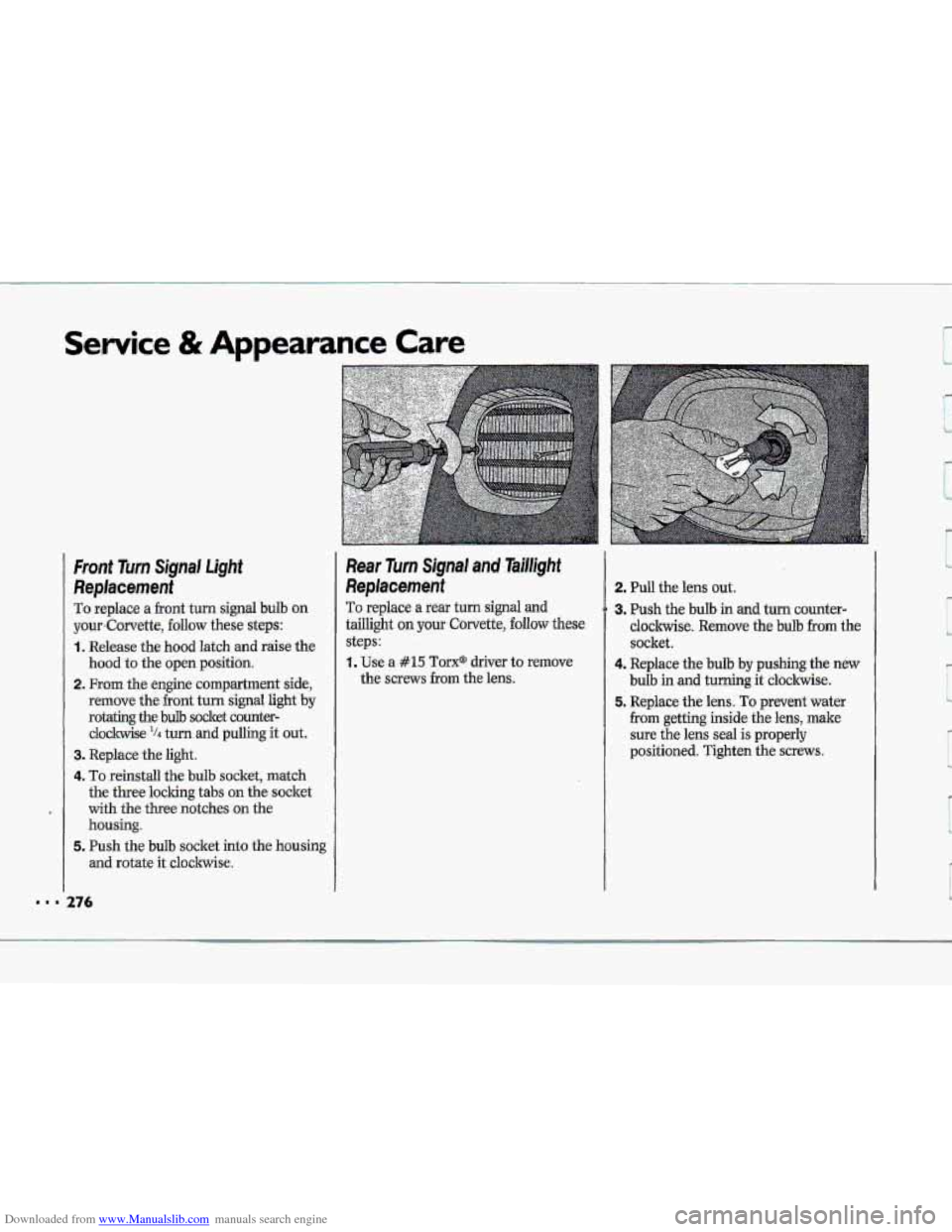
To replace a front turn signal bulb on
your,Corvette, follow these steps:
1, Release the hood latch and raise the
hood
to the open position.
2. From the engine compartment side,
remove the front turn signal light by
rotating the bdb socket counter-
cloclwise
'14 turn and pulling it out.
3. Replace the light.
4. To reinstall the bulb socket, match
the three
loclcing tabs on the socket
with the three notches
on the
housing.
and rotate it cloclmise.
5. Push the bulb socket into the housing
276
.................
....................................................
Rear Turn Slgnal and Taillight
Replacement
To replace a rear turn signal and
taillight on your Corvette, €0110~ these
steps:
1. Use a #15 Tom* driver to remove
the
screws from the lens.
2. Pull the lens out.
3. Push the bulb in and turn counter-
clockwise. Remove the bulb from the
socket.
4. Replace the bulb by pushing the new
bulb in and turning it clockwise.
5. Replace the lens. To prevent water
from getting inside the lens, make
sure the lens seal is properly
positioned. Tighten the
screws.
Page 278 of 370
Downloaded from www.Manualslib.com manuals search engine Back-up Light Replacement-
You can service the back-up lights by
removing the license plate and reaching
through the
opening. Tu replace a back-
up light
on YOUV Corvette, follow these
steps:
1, Push the tab on the bulb socket in
and turn it counterclockwise.
.Remove
the bulb from the socket.
2. Push the new bulb in and turn it
clockwise.
3:Reinstall the
bulb socket. J3t Ire the'
tab on the socket latches.
4. Reinstall thelicense plate.
Side Marker Light Replacement
'You can service the front side marker
Jights from inside the engine
compartment. Service' the rear
side
marker lights from underneath the
vehicle, To replace a side marker-light
on your Corvette., foIlow these steps:
1 To remow the; bulb socket, rotate 'the
bulb -socket counterclo.c,kwise turn
and
pull it out..
2. Repiac,e the bulb.
,3. To reinstdl the bulb socket, pu! it.
into the h.ousing and- turn'it
clockwise.
Page 279 of 370

Downloaded from www.Manualslib.com manuals search engine Service & Appearance Care
Rear Cargo Compartment Light
Replacement (couw
To replace axear cargo compartment
light
in your Corvette coupe, .follow
these
steps:
1. Remove the targo light cover by
carehlly prying it off with a
screwdriver.
2. Replace the bulb.
3. Position the cover over the operiing
.and. press into place.
Rear Cargo Compartment Light
Repkement (CONVERTIBLE)
To replace a rear cargo compartment
light in
your Corvette convertible,
folluw these steps:
1, Remove the cargo light assembly by
carefully prying it out with a
screwdriver.
2. Replace the bulb.
3. Position the light assembly over the
opening
and press it into place,
Canter High-Mounted Stop Light
Replacement (~GEPTZR-I)
You can service this 'light by removing
the license plate and reaching through
the
opening. To replace the center high-
mounted stop light on your Corvette,
follow these steps:
1. Rotate the bulb socket counter-
clockwise
'/4 turn and pull. out.
2. Replace the bulb.
3. To reinstall the bulb socket, push it
into
the housing and turn it
cloclnvise.
4. Reinstall the license plate.
Page 281 of 370
Downloaded from www.Manualslib.com manuals search engine Service & Appearance Care
I
= * 280
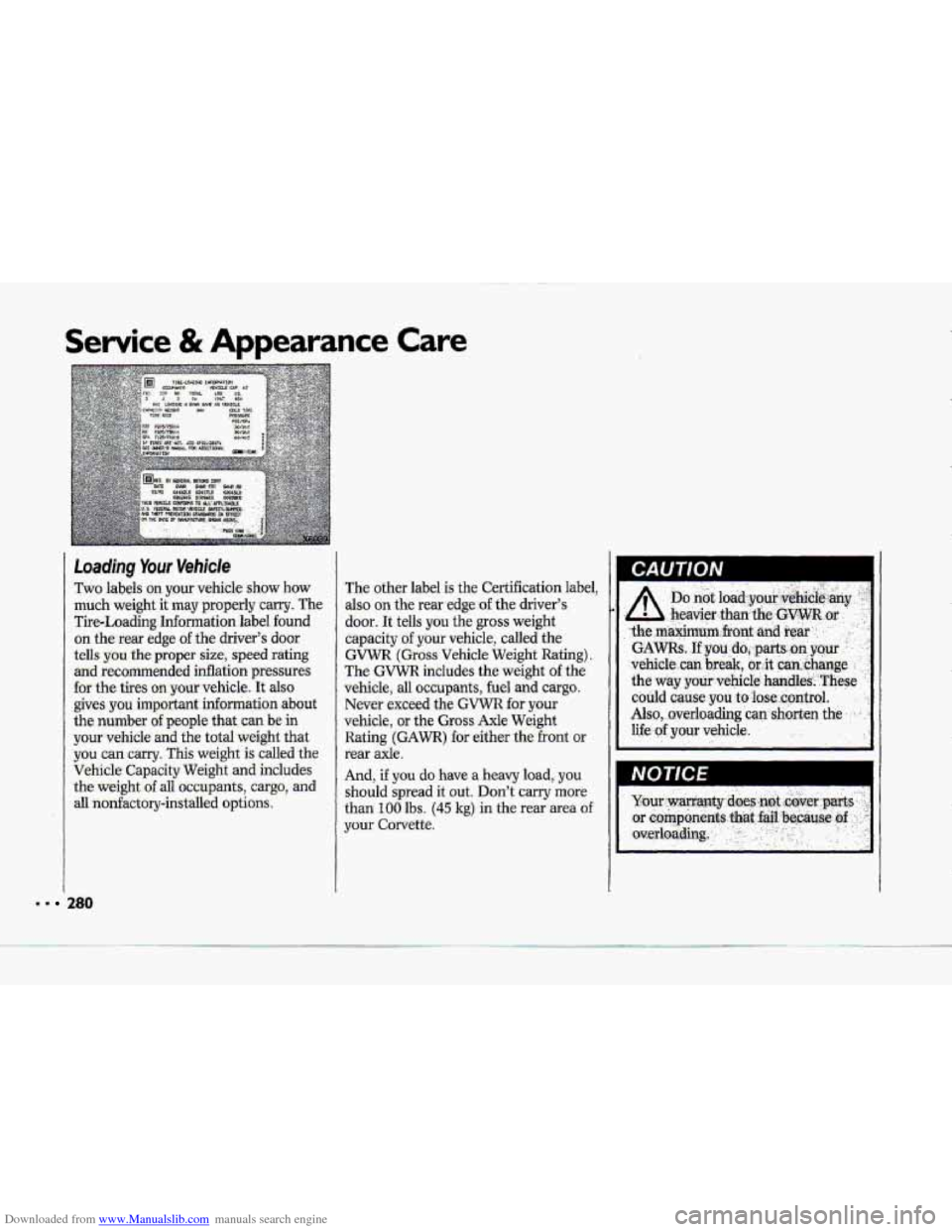
Two labels on your vehicle show how
much weight
it may properly carry. The
Tire-Loading Information label found
on
the rear edge of the driver's door
tells
you the proper size, speed rating
and recommended inflation pressures
€or the tires
on your vehicle. It also
gives you impartant information about
the number
of people that can be in
your vehicle and the total weight that
you can carry. This weight is called the
Vehicle Capacity Weight and includes
the weight of all occupants, cargo, and
all nonfactory-installed options. The other
label is the Certification label,
also on the rear
edge of the driver's
door. It
tells you the gross weight
capacity of
your vehicle, called the
GVWR (Gross Vehicle Weight Rating).
The
GVWR includes the weight of the
vehicle, all occupants, fuel and cargo.
Never exceed the GVWR
for your
vehicle, or the Gross Axle Weight
Rating
(GAWR) for either the front or
rear axle.
And, if you do have a heavy load, you
should spread it out. Don't carry more
than
100 lbs. (45 kg) in the rear area of
your Corvette.
I I
U
i
Page 285 of 370
Downloaded from www.Manualslib.com manuals search engine Sewice & Appearance Care
When It’s Time.for New Tires
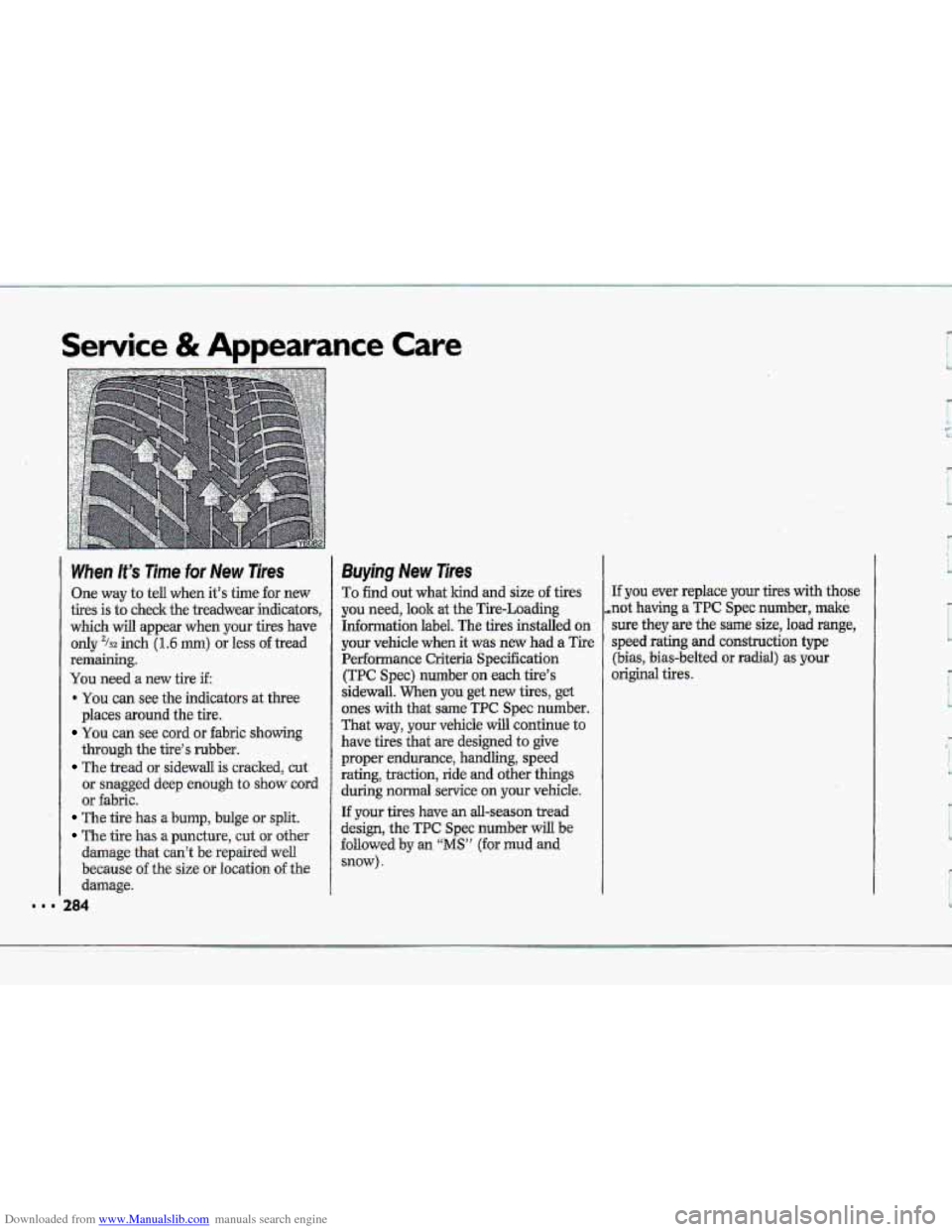
One way to tell when it’s time for new
tires is to check the treadwear indicators,
which will appear when your tires have
only%2 inch (1.6 mm) or less of tread
remaining.
You need a new tire if:
* You can see the indicators at three
You can see cord or fabric showing
The tread or sidewall is cracked, cut
places around the tire.
through the
tire’s rubber.
or snagggd deep enough to show cord
or fabric.
The tire has a bump, bulge or split.
The tire has a puncture, cut or other
damage that can’t he repaired well
because
of the size or location of the
damage.
Buying New Tires
To find out what kind and size of tires
you need, look at the Tire-Loading
Information label. The
tires installed on
your vehicle when it was new had a Tire
Per€omance
Criteria Specification
(TPC Spec) number on each tire’s
sidewall. When
you get new tires, get
ones with that sme TPC Spec number.
That way, your vehicle will continue to
have
tires that are designed to give
proper endurance, handling, speed
rating, traction, ride and other things
during normal service on your vehicle.
If your tires have an all-season tread
design, the TPC Spec number will be
followed by an “MS” (for mud and
snow).
. ... r .: ;.- - .
If yuu ever replace your tires with those
,not having a TPC Spec number, make
SLUT they are the same size, load range,
speed rating and construction
type
(bias, bias-belted or radial) as your
original tires.
G
Page 286 of 370
Downloaded from www.Manualslib.com manuals search engine i
r- 1
F L
Unijiim Tire Quality
Grading
The following information relates to the
system developed by the United States
National
Highway Tr&c Safety
Administration which grades tires by
treadwear, traction and temperature
performance. (This applies only
to
vehicles sold in the United States.)
Treadwear
The treadwear grade is a comparative
rating based on the wear rate of the tire
wh
on
a specified government test course.
For example, a tire graded 150 would
wear one
and a half (1%) times as well
on the govement course as a tire
graded
100. Therelative performance of
tires depends upon the actual
conditions
of their use, however, and
may depart significantly from the norm
due to variations in driving habits,
service practices and differences in road
characteristics and climate.
Page 287 of 370
Downloaded from www.Manualslib.com manuals search engine ...
Service & Appearance Care
Tra~ti~n-A, 6, C
33% traction grades, from highest to
.lowest are:
A, B, and C. They represent
the tire's ability to stop
on wet pavement
as measured under controlled conditions
on specified ,government test surfaces
of
asphalt and concrete. A tire marked C
may have podr.traction p-erformance.
Warning: The traction grade assigned
to.
this tire is based on braking (straight-
ahead) traction
tests and does not
include cornering (turning) traction.
186.
Temperature-A, B, C
The temperature grades are A (the
highest),
B, and'C, representing the
tire's-resistance to the generation of
heat and its ability to dissipate heat
when tested under controlled conditions
on a specified indoor laboratory test
wheel: Sustained high temperature can
cause the inaterid af the tire to
degenwate.-and
reduce tire @e, and
excessive temperature can
lead to.
sudden tire failure. The-grade
C
corresponds to. a level of performance
which
dl passenger car tires must meet
under:the Federal
Motor Vehicle Sa€ety
Standard
NO.. 109. Grades B.and A
represent higher levels of perfomnance on
the laboratory test wheel than the
minimum
required by law.
Warning: The temperatute grade for
this tire 'is established for a tire that is
properly inftated and not overloaded.
Excessive
speed, underinflation, or
excessive loading, iither separately or in
combination, cah cause heat buildup
and possible
tire failure.
Those grades are
molded on the
sidewalls of passenger car tires.
While the tires available
as standard or
optional equipment on General
Motors
vehicles may vary with. respect to these
grades, all such
tires meet Gene$d.
Motors performance
standards and
have
been appToved for use QII General
Motors vehicles. All passenger type
(P
Metric) tifes .must conform to federal
safety requirements in addition to these.
grades.