Page 201 of 370
Downloaded from www.Manualslib.com manuals search engine ..I
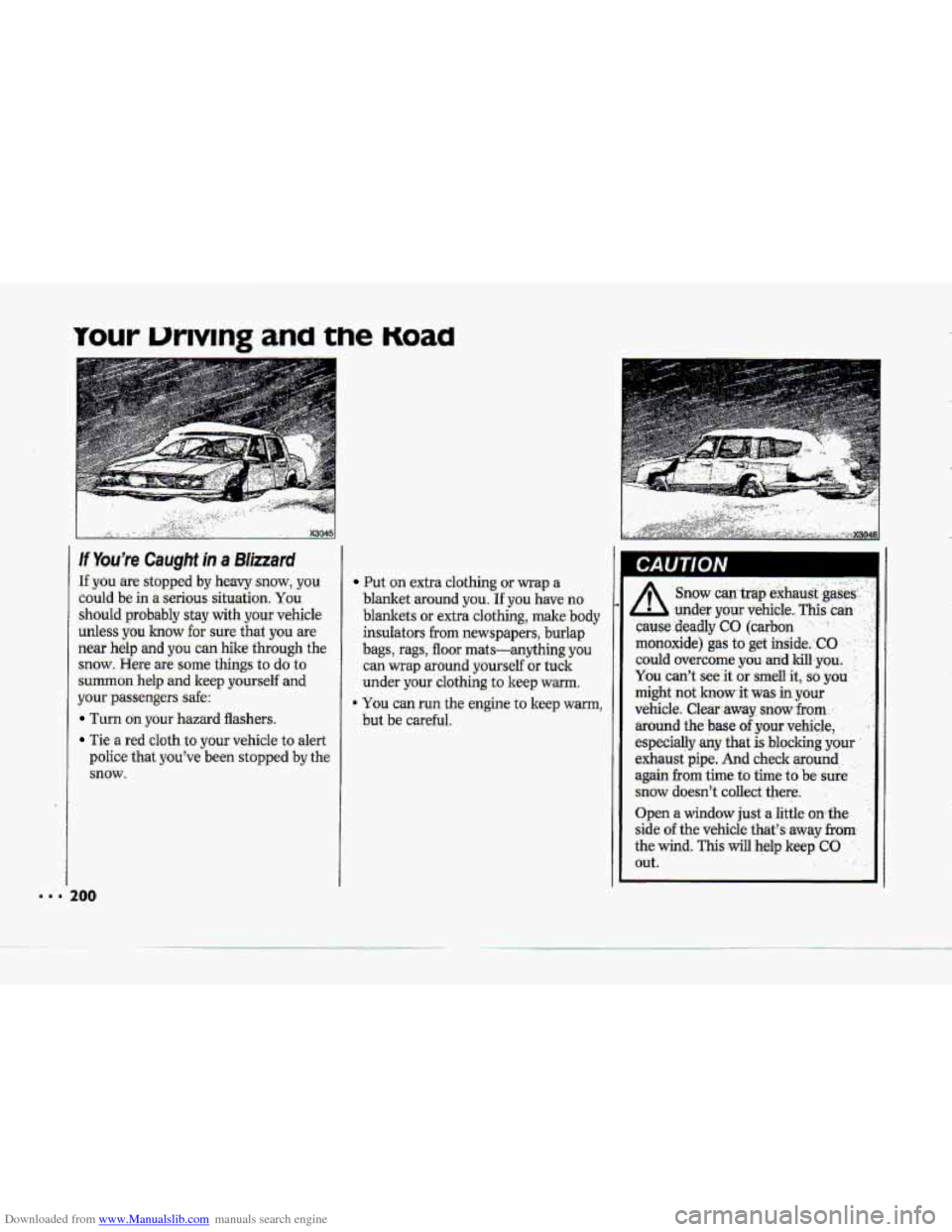
If You're Caught in a Blizzard
If you are stopped by heavy snow, you
could be in
a serious situation. You
should probably stay with your vehicle
unless you
know for sure that you are
near help and you can hike through the
snow. Here are some things
to do to
summon help and keep yourself and
your passengers
safe:
Turn on your hazard flashers.
Tie a red cloth to your vehicle to alert
police that you've been stopped
by the
snow.
!OO
Put on extra clothing or wrap a
blanket around you. If you have no
blankets or extra clothing, make body
insulators
from newspapers, burlap
bags, rags, floor mats-anything you
can wrap around yourself or tuck
under
your clothing tu keep warm.
but be careful.
4 You can run the engine to keep warm,
CAUTION ~
~~
A
Snow can trap exhaust gases:
under your vehicle..
This can.
cause :deadly CO (carbon '
monoxide) gas to get inside. ..CO . '
could overcome you and kill .you;
You can't see
it or smell it, so you
might not know it was in your
vehicle. Clear away. snow.from
around the'.base
of your vehicle,
especially any that
is blocking your
exhaust pipe.
And check around.
again
from time to time to be sure
snow doesn't collect there.
Open
a window just a little on-the
side
of the vehicle that's. away from
the wind. This will help keep CO
out.
..
Page 225 of 370
Downloaded from www.Manualslib.com manuals search engine Problems on the Road
lJu Tire Goes Flat
It’s unusual for a tire to “blow out”
while you’re driving, especially if-you
maintain
your tires properly. If air goes
out of a tire, it’s much more likely to
leak out
slowly. But if you should ever
have a “blowout,” here are a few tips-
about what to expect
and what to do:
If a front tire fails, the flat tire will
create a drag that pulls the vehicle
toward that side. Take yuur foot 08 the
accelerator pedal
and grip the steering
wheel firmly. Steer to maintain lane
p-osition, then gently brake to -a stop
well out of the. traffic lam.
A rear blowout, particularly on a curve,
acts much like a skid and may require
the
same corre&ion you’d use in a skid.
h any rear bhwout, remove yop foot
from the accelerator pedal. Get the
vehicle under control by steering the
way you want the vehicbto go. It may
be very bumpy and noisy, hut you can
still steer. Gently brake to B stop, well
off’ the road if posiible.
If your tire go& flat, the next section
shows how to use your jacking
equipment to change a flat tire sdely.
e
Page 243 of 370
Downloaded from www.Manualslib.com manuals search engine Service & Appearance Care
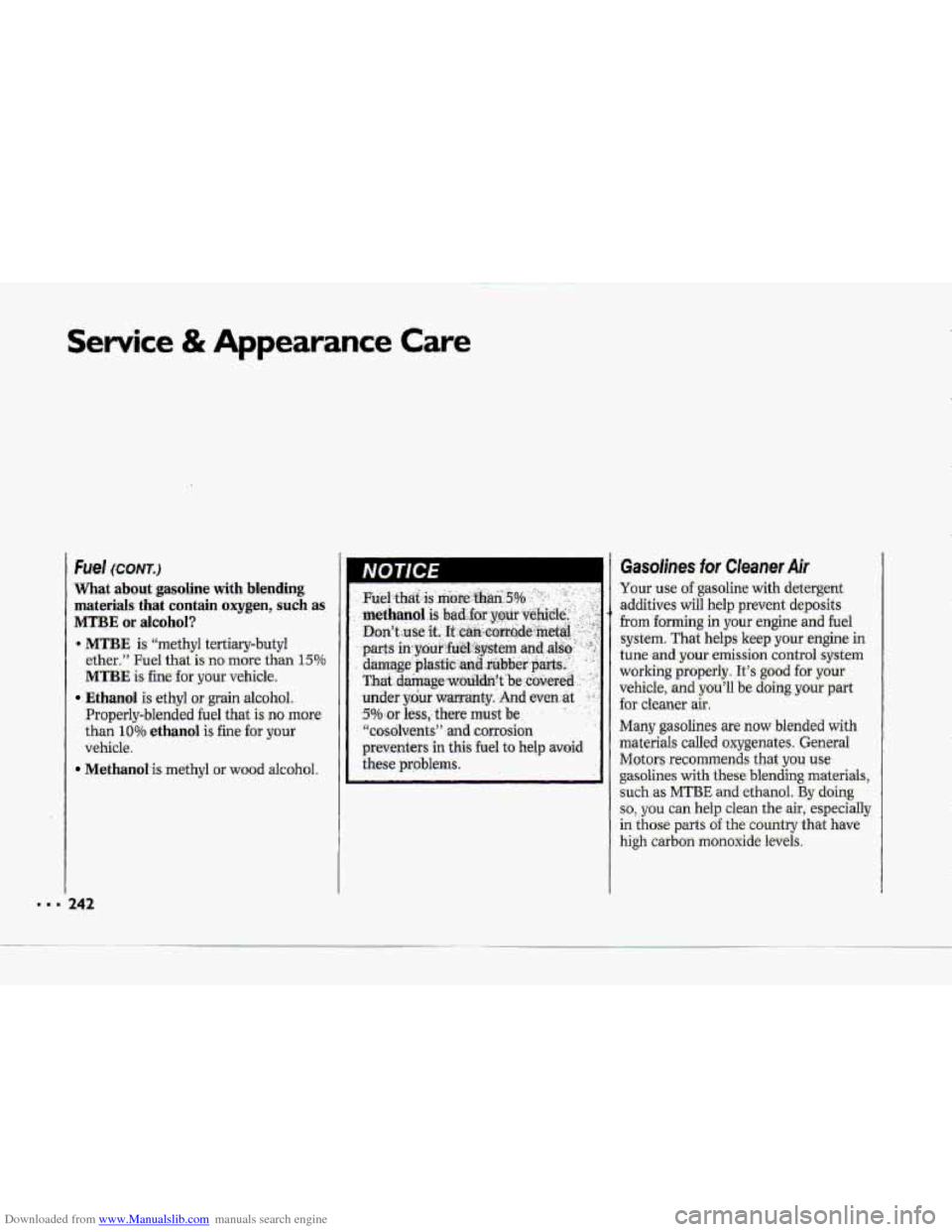
Fuel (CONT.)
What about gasoline with .blending
materialsthat contain oxygen, such as
MTBE or alcohol?
4 MTBE is ‘‘m&hYl tefiiary-butyl
ether,” Fuel that -is. no more than 15%
MTBE is fine %or your vehicle..
Ethanol is .ethyl or -grain alcohol.
.Prop,erly-bknded he1 that is no more
than 10% ethanol is fine €or your
vehicle.
Methanol is methyl or wcrod alcohoI. I
I
Gasdines for Cleaner Air
Your use of gasoline with detergent
additives will help pr-event deposits
from foxrning in your engine and fuel
system. That helps keep your engine in
tune and your emission control system
workijng properly. 1t”s good for.your
vehicle,
md.,yoU’ll be doing-your part
for cleaner- air.
Many gasolines are now blended with
materials called oxygenates, General
Motors ree.omrnends’that-.you use
ga.s.olines with these blending materials,
suchas MTBEa~~.~~~af?crX.By.doing
so, y.0~ can help clean the air, especially
in those parts. of thecountry that have
high carbon monoxide levels.
.C
Page 244 of 370
Downloaded from www.Manualslib.com manuals search engine i
i.R", I
F". i !
P !
In addition, some gasoline suppliers are
now producing reformulated gasolines.
These gasolinesare specially designed
to reduce vehicle emissions. General
Motors recommends that
you use
reformulated gasoline. By doing so, you
can help clean the air, especially in
those parts of the country that have
high ozone levels.
You should.aslc your service station
operators
if their gasolines contain
detergents and oxygenates, and
if they
have been reformulated to reduce
vehicle
emissions.
Fuels in Foreign Countries
If you plan on drivingh another
country outside the
U.S. or Canada,
unleaded
fuel may be hard to find.
Do not use leaded gasoline. If you use
even
one tankful, your emission
controls won't
work well or at all. With
continuous use,
spa& plugs can get
fouled,
the exhaust system can corrode,
and
your engine oil can deteriorate
quickly. Your vehicle's oxygen sensor
will be damaged.
All ofthat means
costly repairs that wouldn't be covered
by
your warranty.
To check on fuel availability, ask an
auto club,
or contact a major oil
cuspany that does business in the
countqrwhere you'll
be driving.
You can also write us at ,the following
address
for advice. Just tell us where
you're
going and give your Vehicle
Identification Number
(VIN) .
General Motors of Canada Ltd.
International Export Sales
P.O. Box 828
Oshawa, Ontario LlH 7N1, Canada
Page 258 of 370
Downloaded from www.Manualslib.com manuals search engine NOTICE
Wait at least 38 minutes .before
checking the transmission fluid level if
you have
been driving:.
When outside temperatures ae above
At high speed for qui-tte a while.
In heavy traffic-especially in hot
To get -the right reading, the fluid
should be at normal op-erating
temperature, which
is 180°F to 200°F
(82OC to 93'C).
90°F (32OC).
we-ather.
To Check T-ransmission Fluid Hot:
Get4he vehicle warmed.:up by driving
abaut 15 miles. (24 h) when outside
temperatures are ab.ove 50°F ( 10OC). If
it's colder than 5OoF (lOC), drive the
vehicle in D (third-gear) until the
engine temperature gage.moves and.
then-remains steady for ten minutes.
Thenfollow the procedures under To
Check the Eluid Hot or Cold.
Page 260 of 370
Downloaded from www.Manualslib.com manuals search engine c
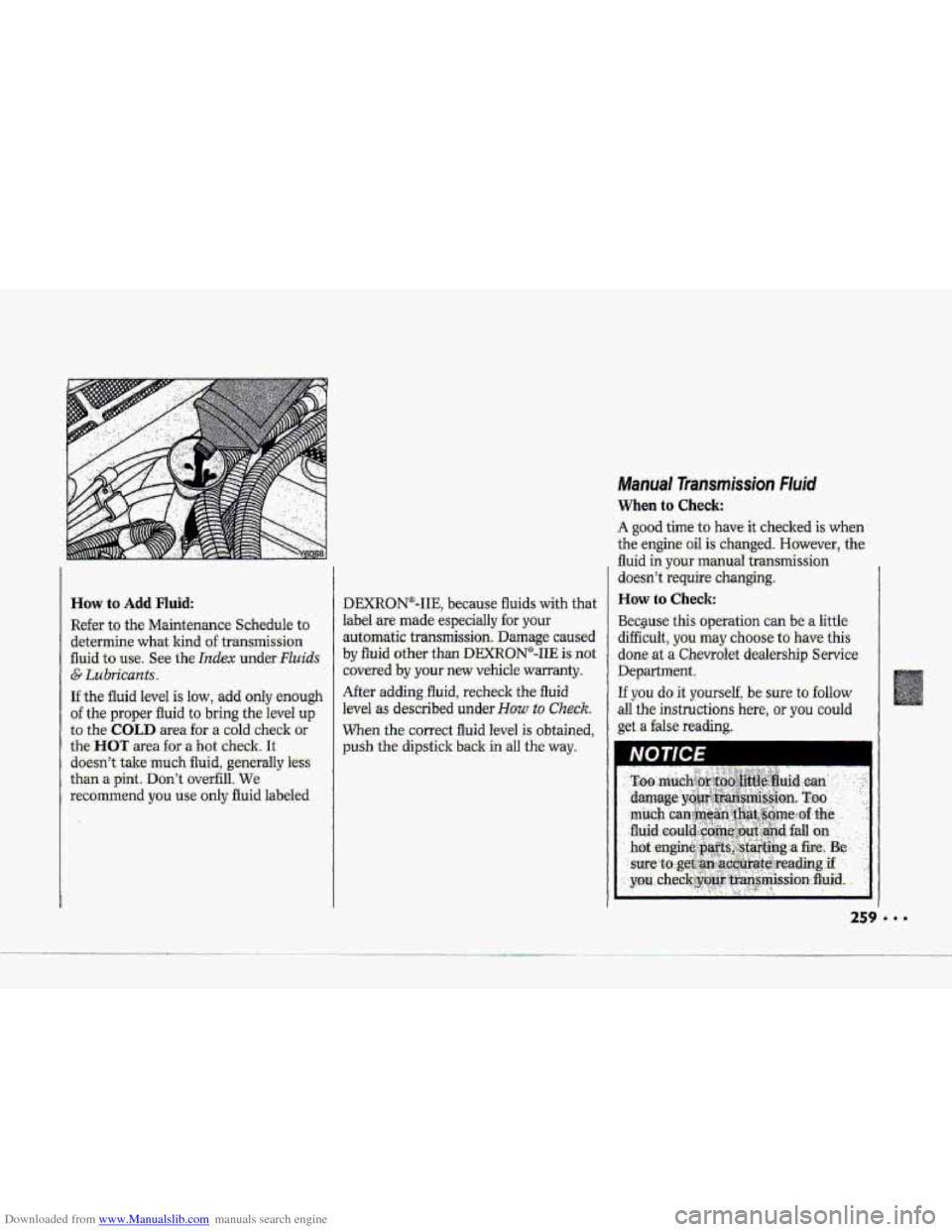
c How to Add Fluid:
Refer to the Maintenance Schedule to
determine
what kind oftransmission
fluiil to use. See the Index under Fluids.
G Lubricants.
If the fluid level is low, add only enough
of the proper fluid to bring. the level up
to the COLD area.for a cold-check or
the-HQT
area for a-.hot ‘check. It
doesn’t take much fluid, generally legs
than a pint. Don’t overfill. We
recommend
you use only fluid IabeIed
DEXRON@-JIE, because fluids with that
label are made especially
for your
automatic transmission.. Damage caused
by fluid other than DEXXO-Nq-IIE is not
covtir,ed by your-new vehicle warranty.
After adding fluid, recheck the fluid
level as described under How to Check.
When the correct fluid level is obtained,
push
the dipstick back in all the way.
Manual Transmission Fluid
When to Check
A good time to have it checked is when
the
engine oil is changed. Howevw, tbe
fluid in your-manual transmission
doesn’t require-changing.
How to Check:
Becguse this operation can be a iittie
difficult,
you may choose to-have this
done at a Chevrolet dealership Service
Department.
If you do it y.Ourself, be sure to follow
all the instrvctiuns here, or you could
get a false reading.
Page 284 of 370
Downloaded from www.Manualslib.com manuals search engine When to Check:
Check your tires once a month or more.
Don’t forget your compact spare tire. It
should be at 60 psi (420 1tPa).
How to Check:
Use the tire pressure gage provided in
your center storage console to check
tire pressure. Simply looking
at the tires
will not tell you the pressure, especially
if you have radial tires-which may look
properly inflated even if they’re
underinflated.
If your tires have valve caps, be sure to
put them back
on. They help prevent
leaks
by keeping out dirt and moisture.
Tire Rotation
The tires on your Corvette are
directional, asymmetrical, and are
different sizes
front tu rear. Due to this,
your tires should not be rotated. Each
tire
and wheel should be used only in
theqosition it
is in.
Page 287 of 370
Downloaded from www.Manualslib.com manuals search engine ...
Service & Appearance Care
Tra~ti~n-A, 6, C
33% traction grades, from highest to
.lowest are:
A, B, and C. They represent
the tire's ability to stop
on wet pavement
as measured under controlled conditions
on specified ,government test surfaces
of
asphalt and concrete. A tire marked C
may have podr.traction p-erformance.
Warning: The traction grade assigned
to.
this tire is based on braking (straight-
ahead) traction
tests and does not
include cornering (turning) traction.
186.
Temperature-A, B, C
The temperature grades are A (the
highest),
B, and'C, representing the
tire's-resistance to the generation of
heat and its ability to dissipate heat
when tested under controlled conditions
on a specified indoor laboratory test
wheel: Sustained high temperature can
cause the inaterid af the tire to
degenwate.-and
reduce tire @e, and
excessive temperature can
lead to.
sudden tire failure. The-grade
C
corresponds to. a level of performance
which
dl passenger car tires must meet
under:the Federal
Motor Vehicle Sa€ety
Standard
NO.. 109. Grades B.and A
represent higher levels of perfomnance on
the laboratory test wheel than the
minimum
required by law.
Warning: The temperatute grade for
this tire 'is established for a tire that is
properly inftated and not overloaded.
Excessive
speed, underinflation, or
excessive loading, iither separately or in
combination, cah cause heat buildup
and possible
tire failure.
Those grades are
molded on the
sidewalls of passenger car tires.
While the tires available
as standard or
optional equipment on General
Motors
vehicles may vary with. respect to these
grades, all such
tires meet Gene$d.
Motors performance
standards and
have
been appToved for use QII General
Motors vehicles. All passenger type
(P
Metric) tifes .must conform to federal
safety requirements in addition to these.
grades.