1993 CHEVROLET CAVALIER check engine light
[x] Cancel search: check engine lightPage 169 of 308
Downloaded from www.Manualslib.com manuals search engine Using a match near a battery
can cause battery gas to
explode. People have been hurt
doing
this, and some have been
blinded. Use a flashlight if you
need
more light.
Be
sure the batteries have enough
water. You
don’t need to add water
to the Delco Freedom@ battery
installed in every new GM vehicle.
But if a battery has filler caps, be
sure the right amount
of fluid is
there. If it is low, add water to take
care of that first. If you don’t,
explosive gas could be present.
Battery fluid contains acid that can
burn you. Don’t get it on you.
If
you accidentally get it in your eyes
or on your skin, flush the place
with water and get medical help
immediately.
5. Check that the jumper cables don’t
have
loose or missing insulation. If
they do, you could get a shock. The
vehicles could be damaged, too.
Before you connect the cables, here are
some things you should know. Positive
(+) will go to positive (+) and negative
(-) will go to negative (-) or a metal
engine part.
Don’t connect
(+) to (-) or you’ll get a
short that would damage the battery and
maybe other parts, too.
4
Fans or other moving engine
parts can injure you badly.
Keep your hands away
from
moving parts once the engines are
running.
167
Page 193 of 308
Downloaded from www.Manualslib.com manuals search engine Don’t try to put a wheel cover on your
compact spare tire.
It won’t fit. Store the
wheel cover and plastic cap nuts in the
trunk or rear area until you have the flat
tire repaired or replaced.
16. Store the flat tire in the compact
spare tire compartment, and secure
with the wing bolt and extension.
Store the jack and wheel wrench in
their compartment, also.
MU I IVN 1
Storing a jack, a tire, or other
:quipment in the passenger
compartment
of the vehicle could
cause injury. In a sudden stop
or
collision, loose equipment could
strike someone. Store all these in
the proper place.
The compact spare is for temporary use
only. Replace the compact spare tire
with a full-size tire as soon as you can.
See
Compact Spare Tire next in this
section.
Compact Spare Tire
Although the compact spare was fully
inflated when your vehicle was new, it
can lose air after a time. Check the
inflation pressure regularly.
It should be
60 psi (420 Wa). The compact spare is
made to go up to
3,000 miles (5 000 km),
so you can finish your trip and have
your full-size tire repaired or replaced
where you want.
Of course, it’s best to
replace
your spare with a full-size tire as
soon as you can. Your spare will last
longer and be in good shape in case you
need it again.
Your anti-lock brake system warning
light may come on when you are driving
with a compact spare. See the
Index
under Anti-Lock Brake System Warning
Light.
191
Page 218 of 308
Downloaded from www.Manualslib.com manuals search engine 888
Service rance Care
Hydraulic Clutch (CONTJ
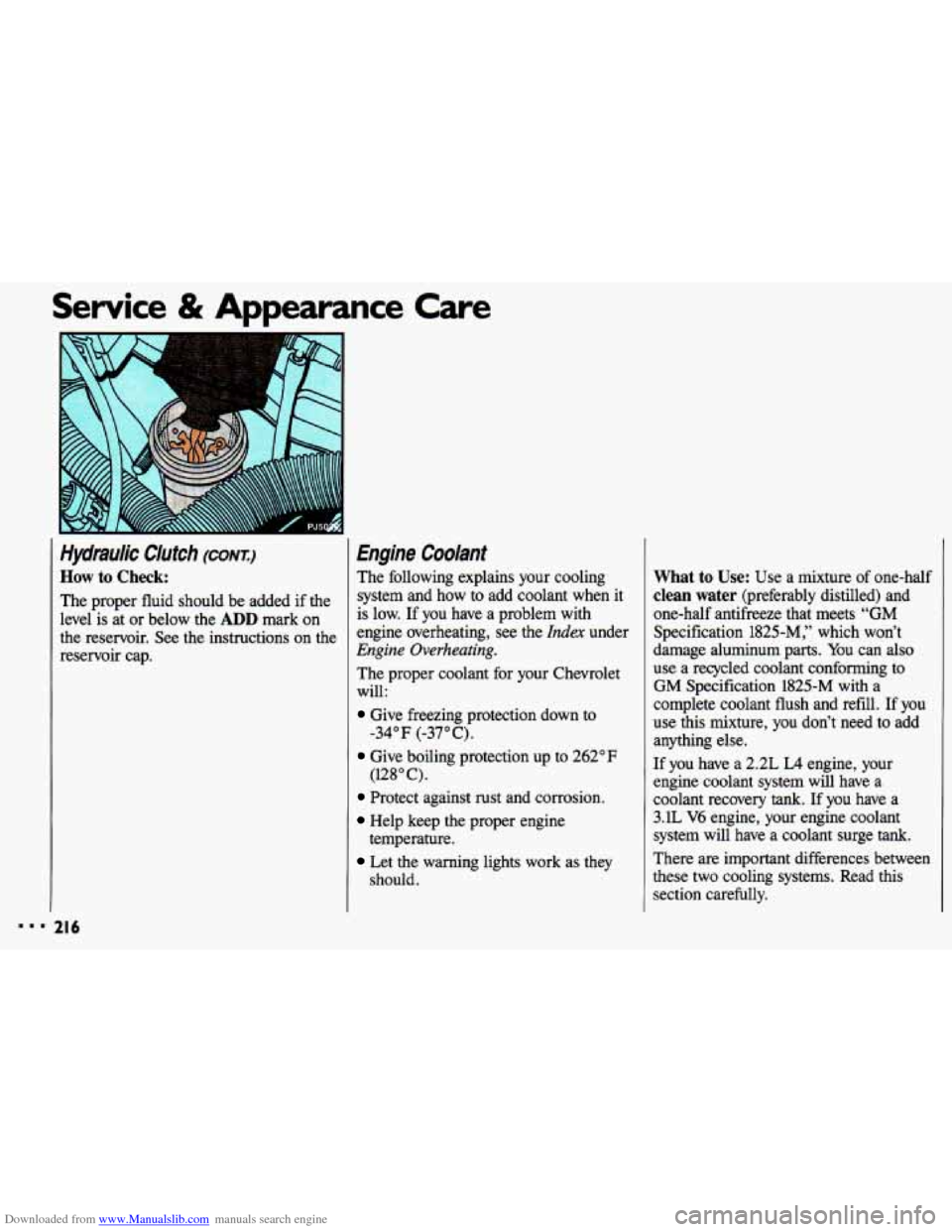
How to Check:
The proper fluid should be added if the
level is at or below the
ADD mark on
the reservoir.
See the instructions on the
reservoir cap.
216
Engine Coolant
The following explains your cooling
system and how to add coolant when it
is low. If you have a problem with
engine overheating,
see the Index under
Engine Overheating.
The proper coolant for your Chevrolet
will:
Give freezing protection down to
Give boiling protection up to 262°F
Protect against rust and corrosion.
Help keep the proper engine
Let the warning lights work as they
-34" F (-37" C).
(128" C).
temperature.
should.
What to Use: Use a mixture of one-half
clean water (preferably distilled) and
one-half antifreeze that meets "GM
Specification 1825-M," which won't
damage aluminum parts.
You can also
use a recycled coolant conforming to
GM Specification 1825-M with a
complete coolant flush and refill.
If you
use this mixture, you don't need to add
anything else.
If you have a 2.2L LA engine, your
engine coolant system will have a
coolant recovery
tank. If you have a
3.1L V6 engine, your engine coolant
system will have a coolant surge
tank.
There are important differences between
these two cooling systems. Read this section carefully.
Page 231 of 308
Downloaded from www.Manualslib.com manuals search engine 1--
-
Things you=
strike and injure
people in
a sudden stop or turn, or
in
a crash.
Put things in the trunk or rear
area
of your vehicle. In a trunk,
put them as hr forward as you
can.
Try to spread the weight
evenly.
If you have fold-down
rear seats, you’ll find four
anchors on the back wall
of your
trunk.
You can use these anchors
to tie down lighter loads. They’re
not strong enough for
heavy
things, however, so put them as
fbr forward
as you can in the
trunk or rear area.
Never stack heavier things, like
suitcases, inside the vehicle
so
that some of them are above the
tops
of the seats.
e When you carry something
inside the vehicle, secure it
whenever you can.
unless you need to.
0 Don’t leave a seat folded down
I
Tires
We don’t make tires. Your new vehicle comes with high quality tires made by a
leading tire manufacturer. These tires are warranted by the tire manufacturers and
their warranties are delivered with every
new Chevrolet. If your spare tire is a
different brand than your road tires,
you will have a tire warranty folder from each
of these manufacturers.
I I
CAUTION
Poorly maintained and improperly used tires are dangerous. 1
’ - Overloading your tires can cause overheating as a result of too much
friction. You could have
an air-out and a serious accident. See the Index
under hading Your Vehicle.
Underinflated tires pose the same danger as overloaded tires. The resulting
accident could cause serious injury. Check all tires frequently to maintain
the recommended pressure. Tire pressure should be checked
when your
tires
are cold.
sudden impact:
such as when you hit a pothole. Keep tires at the
recommended pressure.
I Overinflated tires are more likely to be cut, punctured, or broken by a
Worn, old tires can cause accidents. If your tread is badly worn, or if your
I tires have been damaged, replace them. I
229
I
I..
Page 250 of 308
Downloaded from www.Manualslib.com manuals search engine Service & Appearance Care
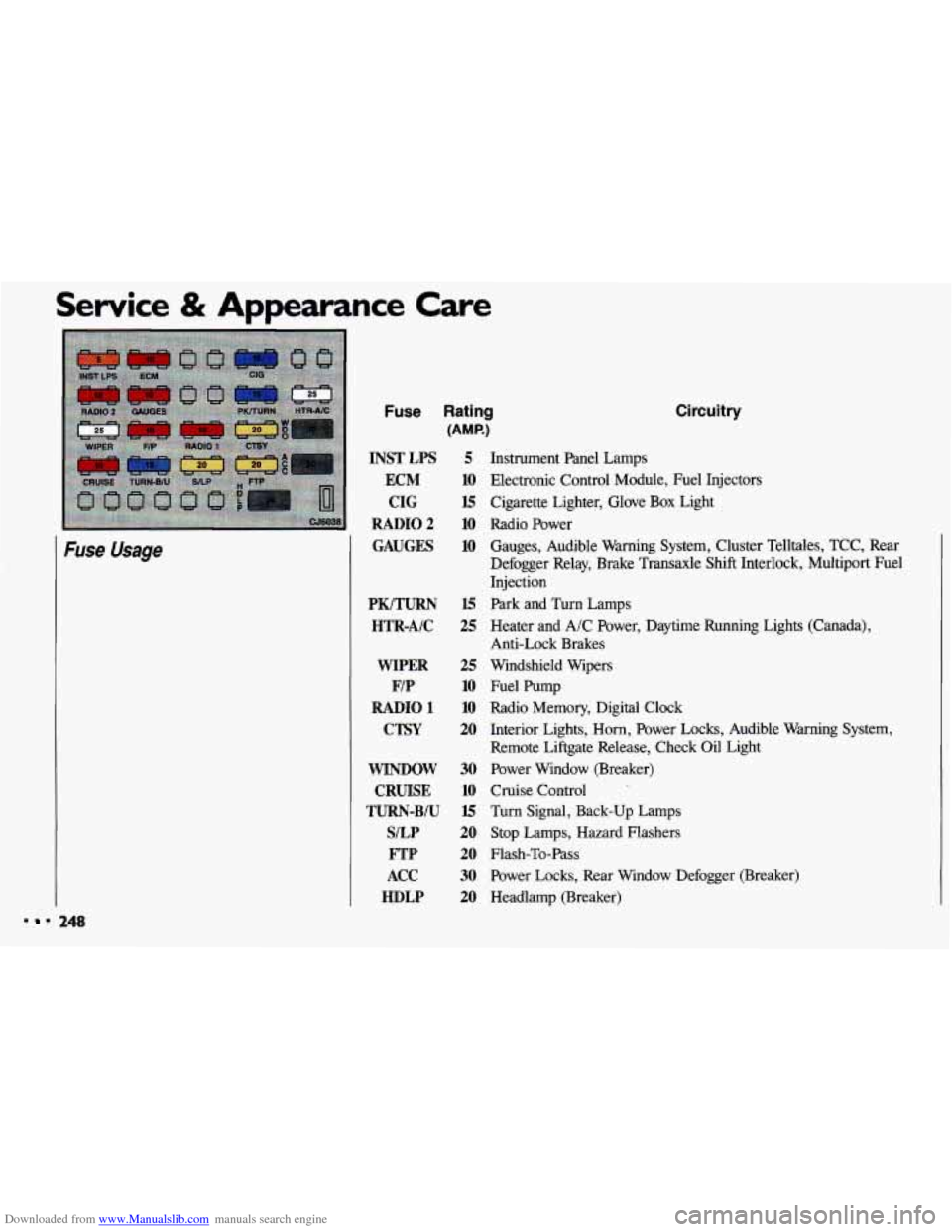
Fuse Usage
Fuse Rating
(AMP.)
INSTLPS 5
ECM 10
CIG 15
RADIO2 10
GAUGES 10
PK/TURN HTR-AIC
WIPER
F/P
RADIO 1
CTSY
WINDOW CRUISE
TURN-BIU
S/LP FTP
ACC
HDLP
15
25
25
10
10
20
30
10
15
20
20
30
20
Circuitry
Instrument Panel Lamps
Electronic Control Module, Fuel Injectors Cigarette Lighter, Glove
Box Light
Radio Power Gauges, Audible Warning System, Cluster Telltales, TCC, Rear
Defogger Relay, Brake Transaxle Shift Interlock, Multiport Fuel
Injection
Park and Turn Lamps
Heater and A/C Power, Daytime Running Lights (Canada),
Anti-Lock Brakes
Windshield Wipers
Fuel Pump
Radio Memory, Digital Clock
Interior Lights, Horn, Power Locks, Audible Warning System,
Remote Liftgate Release, Check Oil Light
Power Window (Breaker)
Cruise Control
Turn Signal, Back-up Lamps Stop Lamps, Hazard Flashers
Flash-To-Pass
Power Locks, Rear Window Defogger (Breaker)
Headlamp (Breaker)
248
Page 251 of 308
Downloaded from www.Manualslib.com manuals search engine Headlight Wiring
The headlight wiring is protected by a
circuit breaker in the fuseblock. An
electrical overload will cause the lights
to go on and
off, or in some cases to
remain
off. If this happens, have your
headlight system checked right away.
To access the headlight circuit breaker,
squeeze the plastic clip together and
remove.
Windsheld Wipers
The windshield wiper motor is protected
by a circuit breaker and a fuse.
If the
motor overheats due to heavy snow, etc.,
the wiper will stop until the motor
cools.
If the overload is caused by some
electrical problem, have it fixed.
Power Windows and Other
Power Options
Circuit breakers in the fuse panel protect
the power windows and other power
accessories. When the current load is
too heavy, the circuit breaker opens and
closes, protecting the circuit until the
problem is fixed.
249
Page 274 of 308
Downloaded from www.Manualslib.com manuals search engine Maintenance Schedule
Section B: Owner Checks & Services (Cont.)
At Least Twice a Year
... L
CHECK
I OR SERVICE I WHAT TO DO
Hydraulic Clutch
in this system could indicate a problem. Have the system inspected and repaired at once. System Inspection
Check
the fluid level in the clutch reservoir. See the Index under Hydraulic Clutch. A fluid loss
At Least Once a Year
CHECK
I OR SERVICE I WHAT TO DO
I
Key Lock Cylinders I Lubricate the key lock cylinders with the lubricant specified in Section D.
Body Lubrication Lubricate all body
door hinges. Also lubricate all hinges and latches, including those \
for the
hood, headlight door assemblies (if equipped), fuel door, trunk, glove box door, console door
and any folding seat hardware. Section
D tells you what to use.
L
272
I CAUTION
1. Before you start, be sure you have enough room around the vehicle.
2. Firmly apply both the parking brake (see the Index under Parking Brake if necessary) and the
NOTE:
Do not use the accelerator pedal, and be ready to turn off the engine immediately if it starts.
3. On automatic transaxle vehicles, try to start the engine in each gear. The starter should work
only in P (Park) or N (Neutral). If the starter works in any other position, your vehicle needs
service. On manual transaxle vehicles, put the shift lever in
N (Neutral), push the clutch down
halfway and
try to start the engine. The starter should work only when the clutch is pushed
down all the way to the floor. If the starter works when the clutch isn’t pushed all the way
down, your vehicle needs service.
regular brake.
I
Page 277 of 308
Downloaded from www.Manualslib.com manuals search engine Section C: Periodic Maintenance Inspections
Listed below are inspections and services which should be performed at least twice a year (for instance, each spring and fall).
You should let your GM dealer’s service department or other qualified service center do these jobs. Make sure any necessary
repairs are completed at once.
INSPECTION
I OR SERVICE
Steering, Suspension
and Front-Wheel-Drive
Axle Boot and Seal
1 Inspection
Exhaust System
Inspection
Throttle Linkage
Inspection
WHAT SHOULD BE DONE
Inspect the front and rear suspension and steering system for \
damaged, loose or missing parts,
signs of wear, or lack of lubrication. Inspect the power steering lines and hoses for proper
hookup, binding, leaks, cracks, chafing, etc. Clean and then in\
spect the drive axle boot seals for
damage, tears or leakage. Replace seals
if necessary.
Inspect the complete exhaust system. Inspect the body near
the exhaust system. Look for broken,
damaged, missing or out-of-position parts as well as open seams, holes, loose connections, or
other conditions which could cause a heat build-up in the floor pan or could let exhaust fumes
into the vehicle. See the
Index under Engine Exhaust.
Inspect the throttle linkage for interference or binding, and for damaged or missing parts.
Replace parts
as needed.
Inspect the complete system. Inspect brake lines and hoses for \
proper hookup, binding, leaks,
cracks, chafing, etc. Inspect disc brake pads for wear and rotors for \
surface condition. Also
inspect drum brake linings for wear and cracks. Inspect other brake parts, including drums,
wheel cylinders, calipers, parking brake, etc. Check parking brake adjustment. You may need to
have your brakes inspected more often
if your driving habits or conditions result in frequent
braking.
NOTE: A low brake fluid level can indicate worn disc brake pads which \
may need to be
serviced. Also,
if the brake system warning light stays on or comes on, something may be wrong
with the brake system. See the
Index under Brake System Warning Light. If your anti-lock brake
system warning light stays on, comes on or flashes, something may be wrong with the anti-lock
brake system. See the
Index under Anti-Lock Brake System Warning Light.
275 . .