1993 CHEVROLET CAVALIER ECU
[x] Cancel search: ECUPage 159 of 308

Downloaded from www.Manualslib.com manuals search engine Torque Lock
(AUTOMATIC TRANSAXLE)
If you are parking on a hill and you
don’t shift
your transaxle into P (Park)
properly, the weight of the vehicle may
put too much force on the parking pawl
in the transaxle. You may find it difficult
to pull the
shift lever out of P (Park).
This
is called “torque lock.” To prevent
torque lock, always be sure to shift into
P (Park) properly before you leave the
driver’s seat.
To find out how, see the
Index under Shiftirtg Into P (Park),
When you are ready to drive, move the
shift lever out
of P (Park) before you
release the parking brake.
If torque lock does occur, you may need
to have another vehicle push yours a
little uphill to take some
of the pressure
from the transaxle,
so you can pull the
shift lever out
of P (Park).
Winter Driving
Here are some tips for winter driving:
Have your Chevrolet in good shape for
winter. Be sure your engine coolant
mix is correct.
Snow tires can help in loose snow, but
they may give you less traction on ice
than regular tires.
If you do not expect
to be driving in deep snow, but may
have to travel over ice,
you may not
want to switch to snow tires at all.
You may want to put winter
emergency supplies in your trunk or
rear area.
Include an ice scraper, a small brush
or broom, a supply of windshield
washer fluid, a rag, some winter outer
clothing, a small shovel, a flashlight,
a
red cloth, and a couple of reflective
warning triangles. And, if you will be
driving under severe conditions,
include a small bag
of sand, a piece of
old carpet or a couple
of burlap bags
to help provide traction. Be sure you
properly secure these items
in your
vehicle.
I57
Page 172 of 308
Downloaded from www.Manualslib.com manuals search engine Problems on the Road
bwing Your Chevrolet (CONI)
To help avoid injury to you or
lers:
a Never let passengers ride in a
vehicle that is being towed.
a Never tow faster than safe or
posted speeds.
* Never tow with damaged parts
not fully secured.
* Never get under your vehicle after
it
has been lifted by the tow truck.
* Always use separate safety
chains on each side when towing
a vehicle.
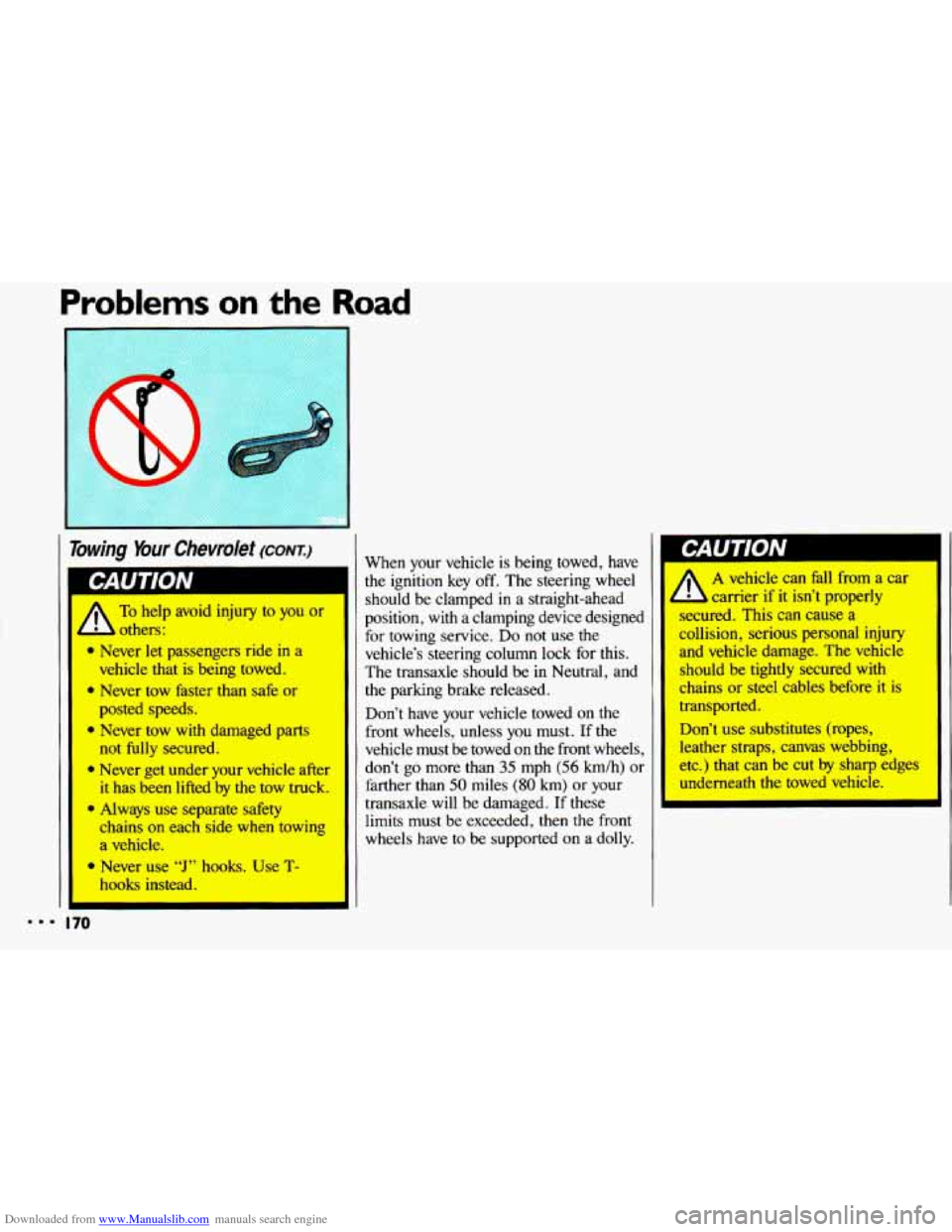
Never use
“J” hooks. Use T-
hooks instead.
the ignition key off. The steering wheel
should be clamped
in a straight-ahead
position,
with a clamping device designed
for towing service. Do not use the
vehicle’s steering column lock for this.
The transaxle should be
in Neutral, and
the parking brake released.
Don’t have your vehicle towed on the
front wheels, unless
you must. If the
vehicle must be towed on the front wheels,
don’t go more than
35 mph (56 km/h) or
farther than
50 miles (80 km) or your
transaxle will be damaged. If these
limits must be exceeded, then
the front
wheels have to be supported on a dolly.
p-AU I IUN I
A vehicle can fall from a car
carrier if it isn’t properly
secured. This can cause a
collision, serious personal injury
and vehicle damage. The vehicle
should be tightly secured with
chains or steel cables before it is
transported.
Don’t use substitutes (ropes,
leather straps, canvas webbing,
etc.) that can be cut
by sharp edges
underneath
the towed vehicle.
A
mmm 170
Page 188 of 308
Downloaded from www.Manualslib.com manuals search engine Problems on the R
Changing a Flat Tire (CONT:)
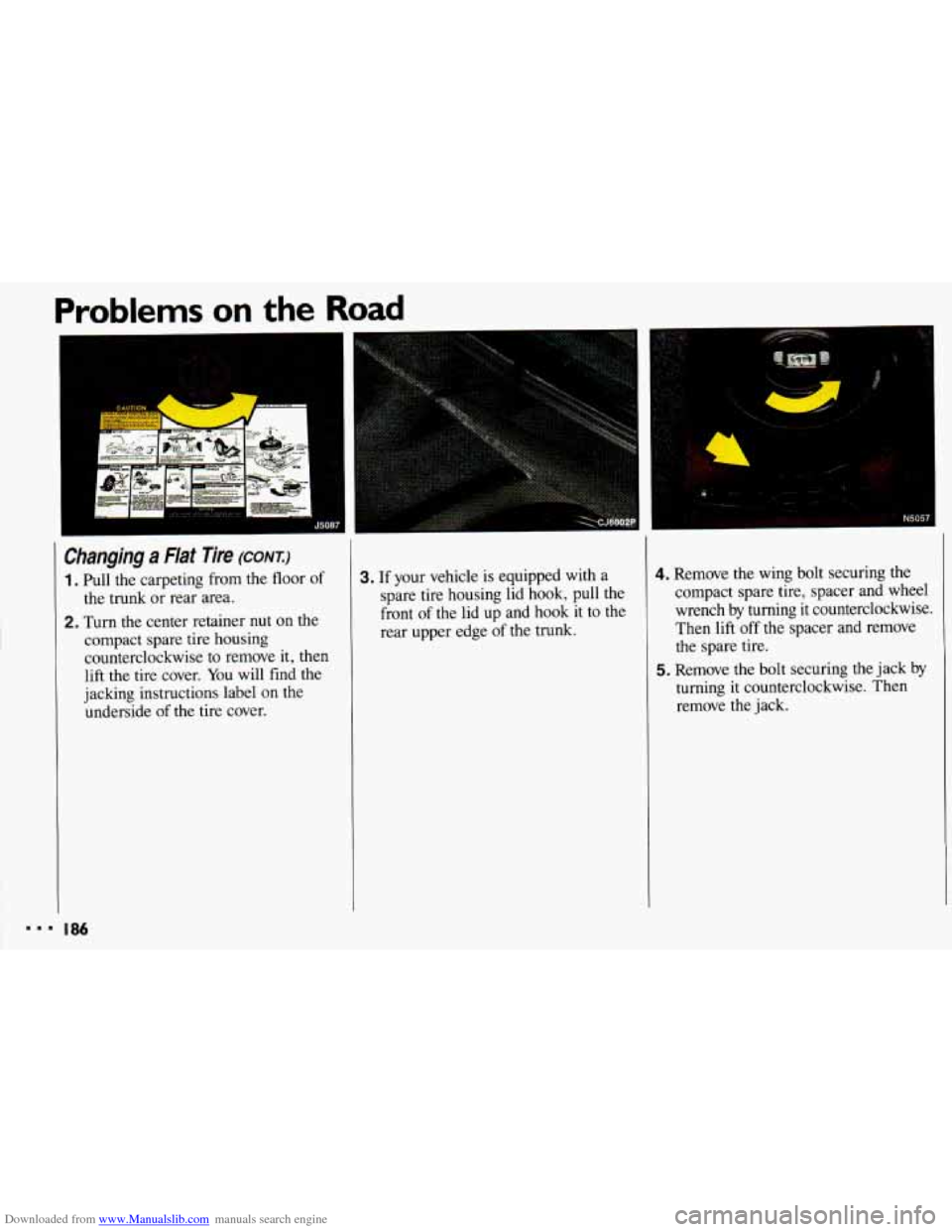
1 . Pull the carpeting from the floor of
2. Turn the center retainer nut on the
the trunk
or rear area.
compact spare tire housing
counterclockwise to remove it, then
lift the tire cover. You will find the
jacking instructions label on the underside
of the tire cover.
3. If your vehicle is equipped with a spare tire housing lid hook, pull the
front
of the lid up and hook it to the
rear upper edge of the trunk.
4. Remove the wing bolt securing the
compact spare tire, spacer and wheel
wrench
by turning it counterclockwise.
Then lift
off the spacer and remove
the spare tire.
5. Remove the bolt securing the jack by
turning it counterclockwise. Then
remove the jack.
... I a6
Page 193 of 308
Downloaded from www.Manualslib.com manuals search engine Don’t try to put a wheel cover on your
compact spare tire.
It won’t fit. Store the
wheel cover and plastic cap nuts in the
trunk or rear area until you have the flat
tire repaired or replaced.
16. Store the flat tire in the compact
spare tire compartment, and secure
with the wing bolt and extension.
Store the jack and wheel wrench in
their compartment, also.
MU I IVN 1
Storing a jack, a tire, or other
:quipment in the passenger
compartment
of the vehicle could
cause injury. In a sudden stop
or
collision, loose equipment could
strike someone. Store all these in
the proper place.
The compact spare is for temporary use
only. Replace the compact spare tire
with a full-size tire as soon as you can.
See
Compact Spare Tire next in this
section.
Compact Spare Tire
Although the compact spare was fully
inflated when your vehicle was new, it
can lose air after a time. Check the
inflation pressure regularly.
It should be
60 psi (420 Wa). The compact spare is
made to go up to
3,000 miles (5 000 km),
so you can finish your trip and have
your full-size tire repaired or replaced
where you want.
Of course, it’s best to
replace
your spare with a full-size tire as
soon as you can. Your spare will last
longer and be in good shape in case you
need it again.
Your anti-lock brake system warning
light may come on when you are driving
with a compact spare. See the
Index
under Anti-Lock Brake System Warning
Light.
191
Page 229 of 308
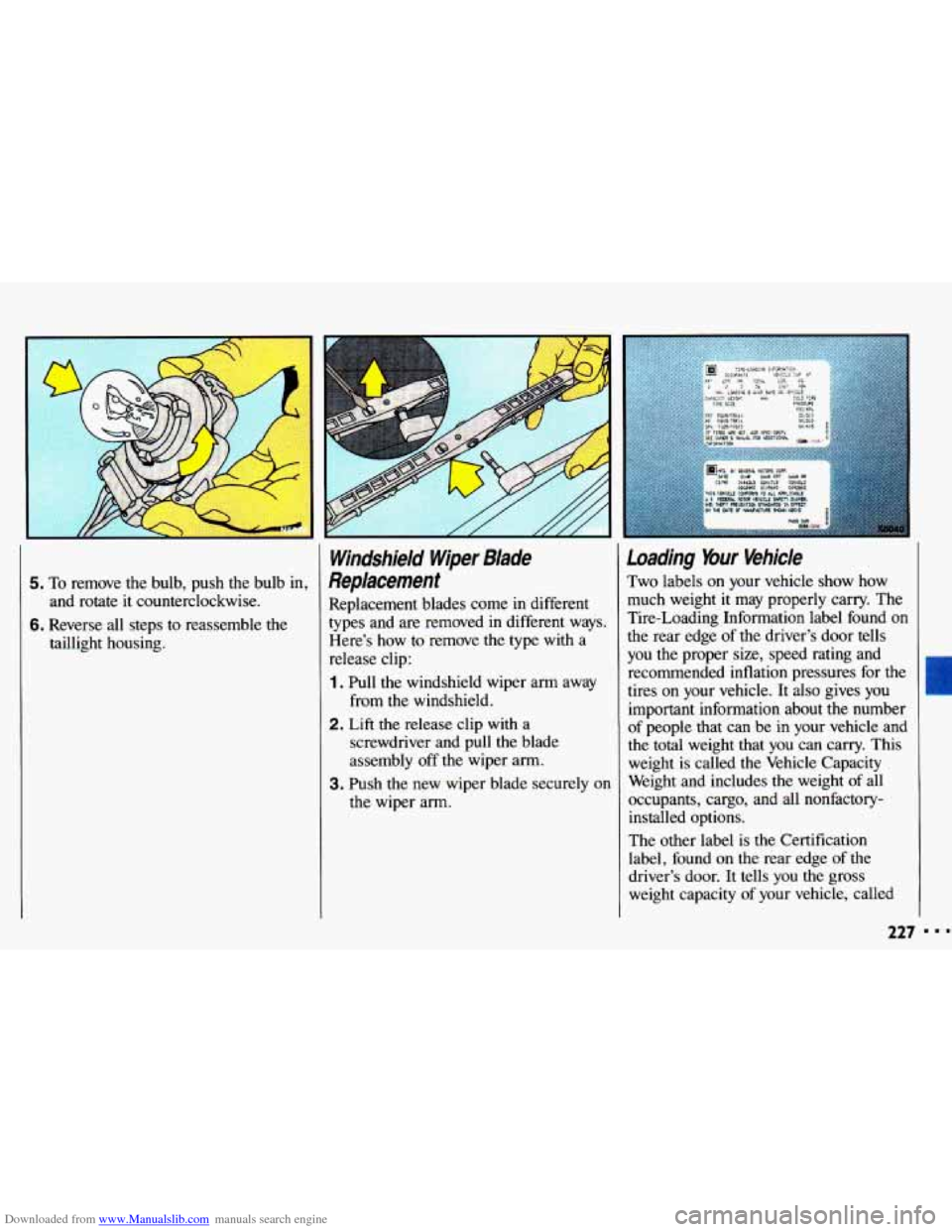
Downloaded from www.Manualslib.com manuals search engine 5. To remove the bulb, push the bulb in,
and rotate it counterclockwise.
6. Reverse all steps to reassemble the
taillight housing.
Windshield Wiper Blade
Replacement
Replacement blades come in different
types and are removed in different ways.
Here’s how
to remove the type with a
release clip:
1. Pull the windshield wiper arm away
2. Lift the release clip with a
from the windshield.
screwdriver and pull the blade
assembly
off the wiper arm.
the wiper arm.
3. Push the new wiper blade securely on
Loading %ur Vehicle
Two labels on your vehicle show how
much weight it may properly carry. The
Tire-Loading Information label found
on
the rear edge of the driver’s door tells
you the proper size, speed rating and
recommended inflation pressures for the
tires on your vehicle. It also gives
you
important information about the number
of people
that can be in your vehicle and
the total weight that you can carry. This
weight
is called the Vehicle Capacity
Weight and includes the weight
of all
occupants, cargo, and all nonfactory- installed options.
The other label
is the Certification
label, found on the rear edge of the
driver’s door. It tells you the gross
weight capacity
of your vehicle, called
I
227
Page 231 of 308
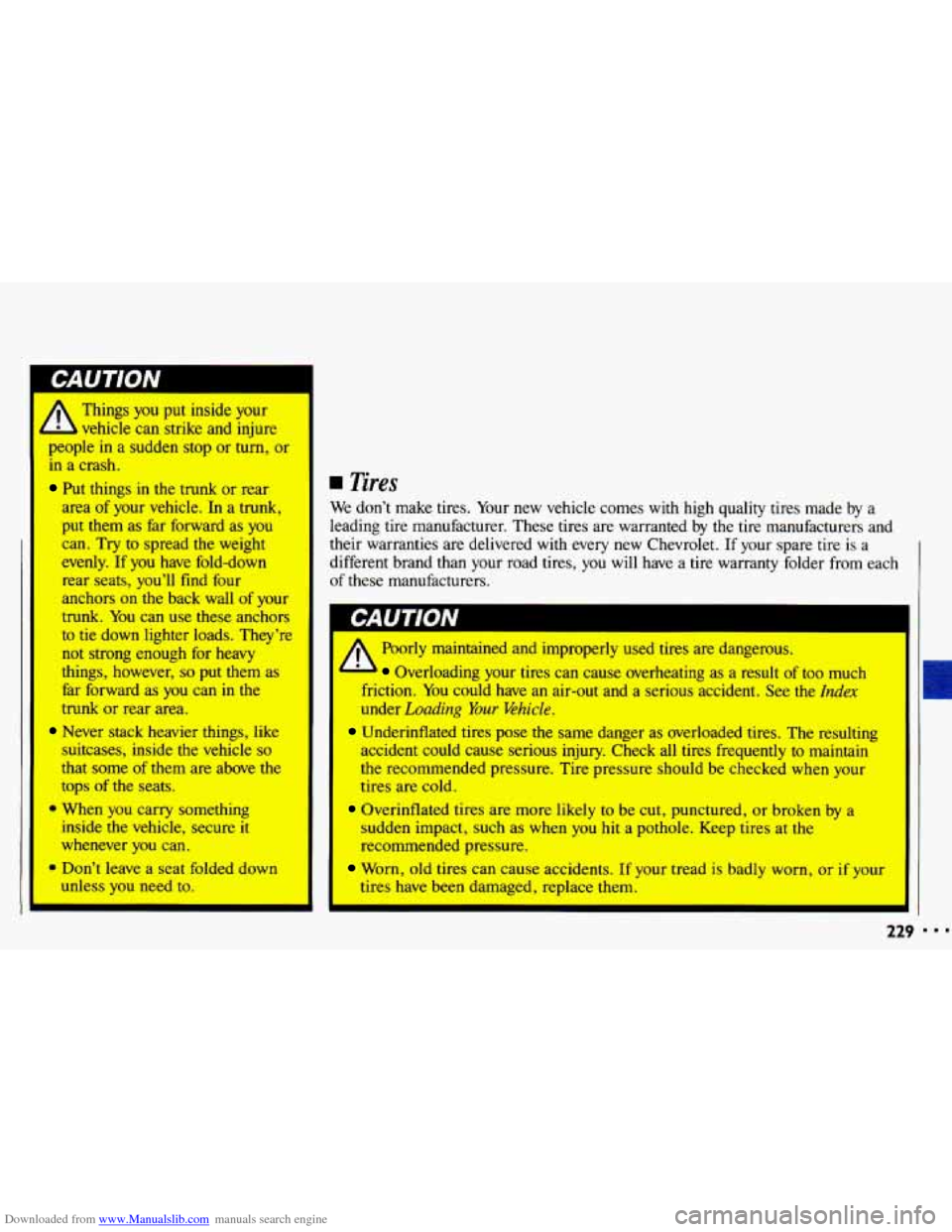
Downloaded from www.Manualslib.com manuals search engine 1--
-
Things you=
strike and injure
people in
a sudden stop or turn, or
in
a crash.
Put things in the trunk or rear
area
of your vehicle. In a trunk,
put them as hr forward as you
can.
Try to spread the weight
evenly.
If you have fold-down
rear seats, you’ll find four
anchors on the back wall
of your
trunk.
You can use these anchors
to tie down lighter loads. They’re
not strong enough for
heavy
things, however, so put them as
fbr forward
as you can in the
trunk or rear area.
Never stack heavier things, like
suitcases, inside the vehicle
so
that some of them are above the
tops
of the seats.
e When you carry something
inside the vehicle, secure it
whenever you can.
unless you need to.
0 Don’t leave a seat folded down
I
Tires
We don’t make tires. Your new vehicle comes with high quality tires made by a
leading tire manufacturer. These tires are warranted by the tire manufacturers and
their warranties are delivered with every
new Chevrolet. If your spare tire is a
different brand than your road tires,
you will have a tire warranty folder from each
of these manufacturers.
I I
CAUTION
Poorly maintained and improperly used tires are dangerous. 1
’ - Overloading your tires can cause overheating as a result of too much
friction. You could have
an air-out and a serious accident. See the Index
under hading Your Vehicle.
Underinflated tires pose the same danger as overloaded tires. The resulting
accident could cause serious injury. Check all tires frequently to maintain
the recommended pressure. Tire pressure should be checked
when your
tires
are cold.
sudden impact:
such as when you hit a pothole. Keep tires at the
recommended pressure.
I Overinflated tires are more likely to be cut, punctured, or broken by a
Worn, old tires can cause accidents. If your tread is badly worn, or if your
I tires have been damaged, replace them. I
229
I
I..