1993 CHEVROLET CAVALIER parking brake
[x] Cancel search: parking brakePage 72 of 308
Downloaded from www.Manualslib.com manuals search engine Features & Controls
Parking Your Vehicle
(MANUAL TRANSAXLE)
Before you get out of your vehicle, put
your manual transaxle in
R (Reverse)
and firmly apply the parking brake.
If you are parking on a hill, see the
Index under Parking on Hills.
10
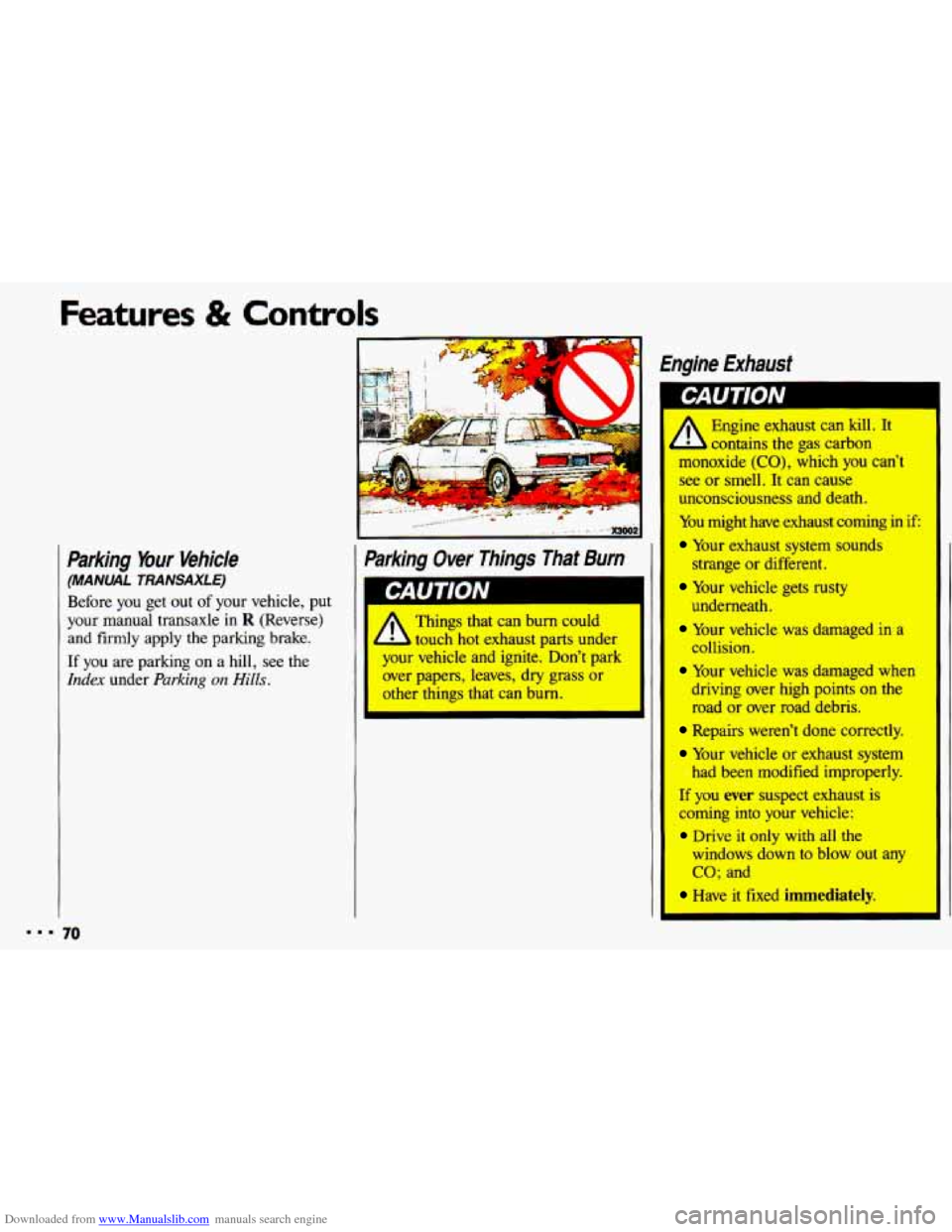
brking Over Things That Burn
I CAUTION
A
I
Things that can bum could
touch hot exhaust parts under‘
your vehicle and ignite. Don’t park
over papers, leaves, dry grass or
other things that can burn.
Engine Exhausf
I * - B contains the gas carbon
monoxide (CO), which you can’t
see or smell. It can cause
unconsciousness and death.
You might have exhaust coming in if
Your exhaust system sounds
strange or different.
Your vehicle gets rusty
underneath.
Your vehicle was damaged in a
collision.
Your vehicle was damaged when
driving over high points on the
road or over road debris.
Repairs weren’t done correctly.
Your vehicle or exhaust system
had been modified improperly.
If you ever suspect exhaust is
coming into your vehicle:
Drive it only with all the
Engine exhaust can
kill. It
windows down
to blow out any
CO; and
Have it fixed immediately.
=
Page 73 of 308
Downloaded from www.Manualslib.com manuals search engine Running Your Engine While You’re Parked (AuToMATIc TRANSAXLE)
It’s better not to park with the engine running. But if you ever have to, here are
some things to know.
I
Idling the engine with the air system control OFF could allow dangerous
1 exhaust into your vehicle (see the earlier CAUTION under Engine
Exhaust).
I
Also, idling in a closed-in place can let deadly carbon monoxide (CO) into
your vehicle even
if the fan switch is at the highest setting. One place this can
happen is a garage. Exhaust-with CO-can come
in easily. NEVER park in
a garage with the engine running.
Another closed-in place can be a blizzard. (See
the Index under Blizzard.)
It can be dangerous to get out of your vehicle if the shift lever is not fully in
P (Park) with the parking brake firmly set. Your vehicle can roll. Don’t leave
your vehicle when the engine is running unless you have
to. If you’ve left the
engine running, the vehicle can move suddenly. You or others could be
injured.
To be sure your vehicle won’t move, even when you’re on fairly level
ground, always set your parking brake and move the shift lever
to P (Park).
If
you are parking on a hill, also see the Index under Parking on Hills.
Windows
3n a vehicle with manual windows, use
:he window crank to open and close
:ach window.
71 ...
Page 80 of 308
Downloaded from www.Manualslib.com manuals search engine Features & Controls
To Get Out of Cruise Control
There are several ways to turn off the
cruise control:
Step lightly on the brake pedal, or
push the clutch pedal,
if you have a
manual transaxle; OR
Move the cruise switch to OFF.
To Erase Cruise Speed Memory
When you turn off the cruise control or
the ignition, your cruise control set
speed memory
is erased.
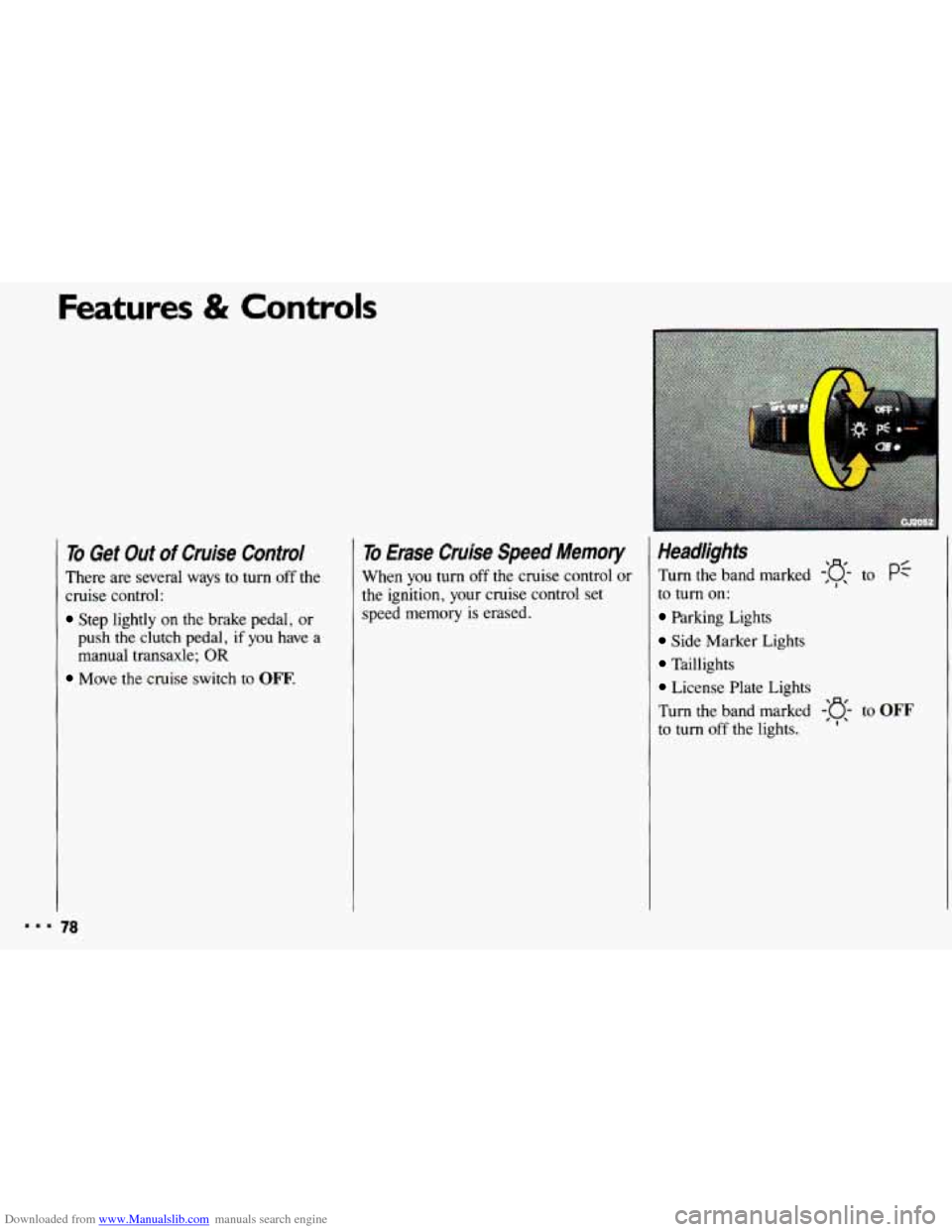
Headlights
Turn the band marked -:g- to pf
to turn on:
Parking Lights
Side Marker Lights
Taillights
License Plate Lights
Turn the band marked
-'o- to OFF
to turn off the lights. 'I'
Page 82 of 308
Downloaded from www.Manualslib.com manuals search engine Features & Controls
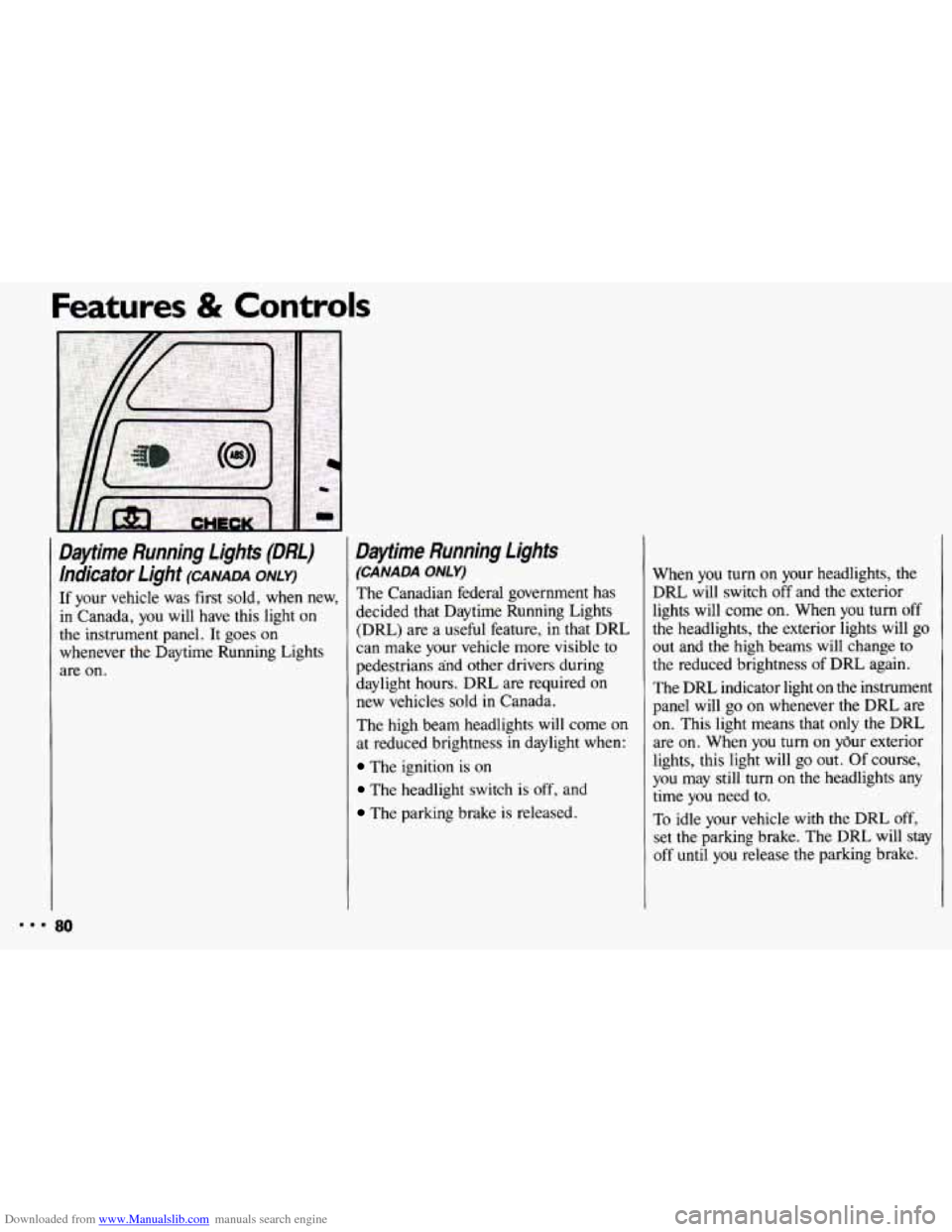
Daytime Running Lights (DRL) hdicator Light
(CANADA ONLY)
If your vehicle was first sold, when new,
in Canada, you will have this light on
the instrument panel. It goes on
whenever the Daytime Running Lights
are on.
Daflime Running Lights
(CANADA ONLY)
The Canadian federal government has
decided that Daytime Running Lights (DRL) are a useful feature,
in that DRL
can make your vehicle more visible to
pedestrians and other drivers during
daylight hours. DRL are required on
new vehicles sold
in Canada.
The high beam headlights
will come on
at reduced brightness
in daylight when:
The ignition is on
The headlight switch is off, and
The parking brake is released. When you
turn on your headlights,
the
DRL will switch off and the exterior
lights will come on. When you turn off
the headlights, the exterior lights will go out and the high beams will change to
the reduced brightness of DRL again.
The DRL indicator light on the instrument
panel will go
on whenever the DRL are
on. This light means that only the DRL
are on. When you turn
on your exterior
lights, this light will
go out. Of course,
you may still
turn on the headlights any
time
you need to.
To idle your vehicle with the DRL
off,
set the parking brake. The DRL will stay
off
until you release the parking brake.
80
Page 95 of 308
Downloaded from www.Manualslib.com manuals search engine The lnstrument Panel-
Your information System
Your instrument panel is designed to let
you know at a glance how your vehicle
is running. You’ll know how fast you’re
going, how much fuel you’re using, and
many other things you’ll need to drive
safely and economically.
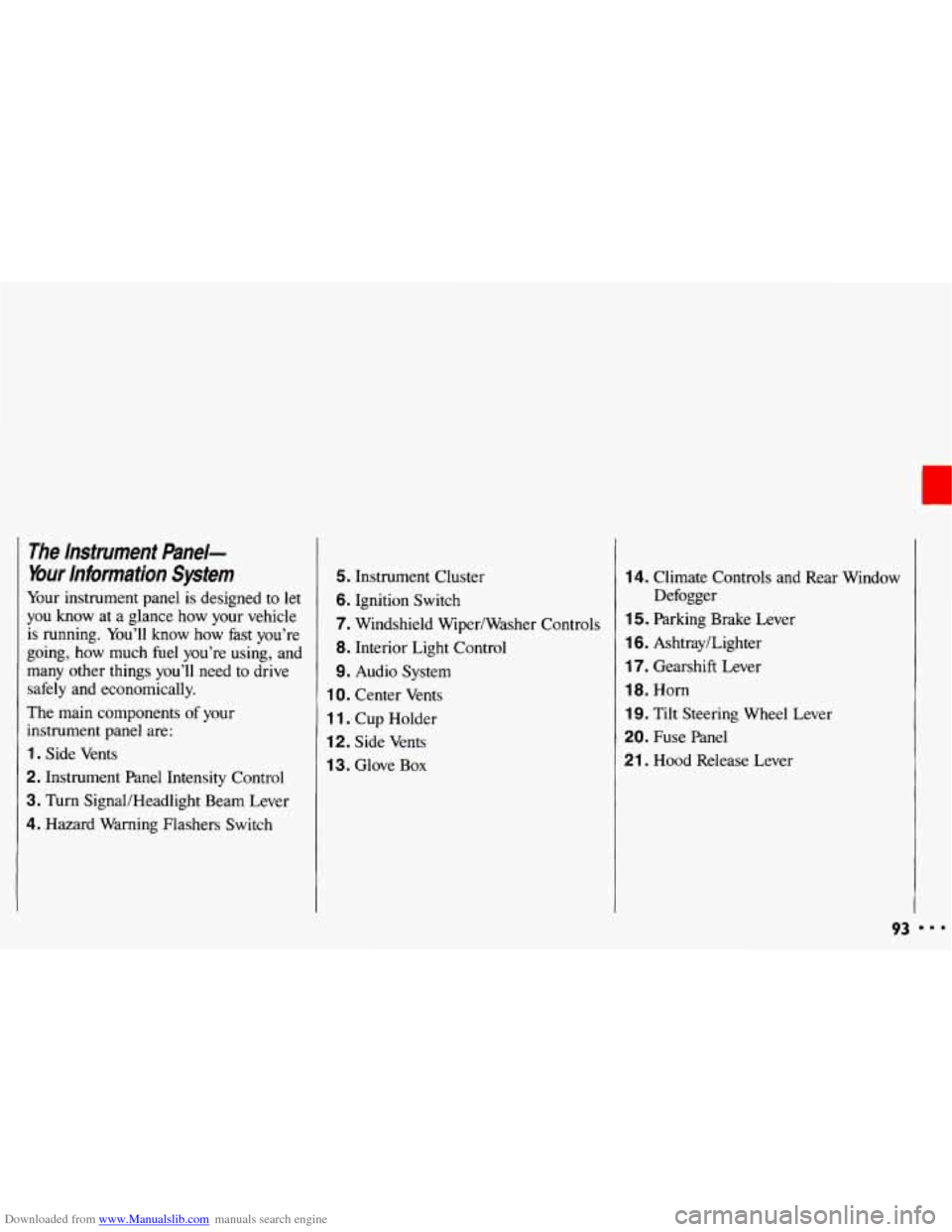
The main components
of your
instrument panel are:
1. Side Vents
2. Instrument Panel Intensity Control
3. Turn SignaVHeadlight Beam Lever
4. Hazard Warning Flashers Switch
5. Instrument Cluster
6. Ignition Switch
7. Windshield Wiper/Washer Controls
8. Interior Light Control
9. Audio System
1 0. Center Vents
1 1. Cup Holder
12. Side Vents
1 3. Glove Box
14. Climate Controls and Rear Window
1 5. Parking Brake Lever
16. Ashtray/Lighter
17. Gearshift Lever
18. Horn
19. Tilt Steering Wheel Lever
20. Fuse Panel
21 . Hood Release Lever Defogger
93 I..
Page 102 of 308
Downloaded from www.Manualslib.com manuals search engine Features & Controls
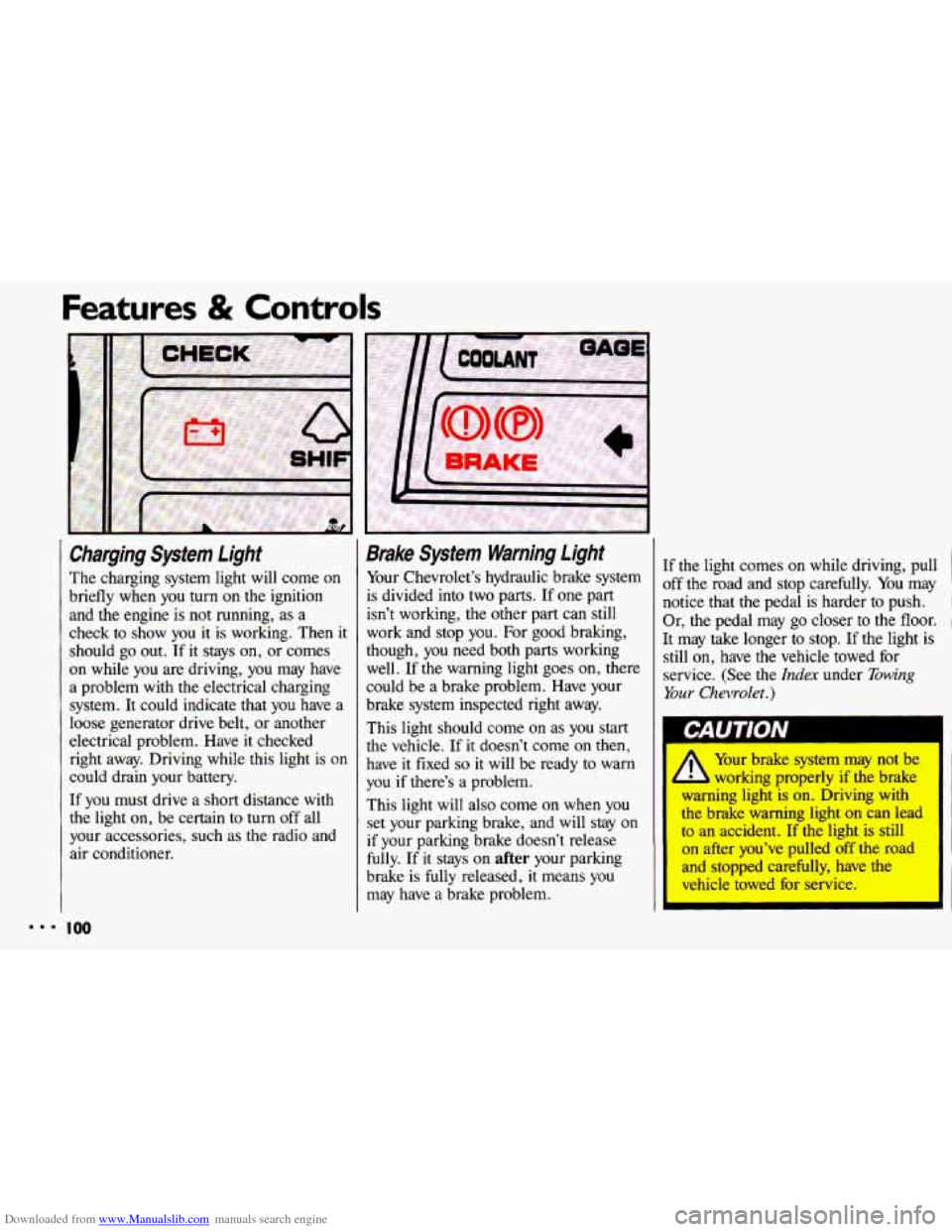
Charging System Light
The charging system light will come on
briefly when
you turn on the ignition
and the engine is not running, as a
check to show you it is working. Then it
should go out. If it stays on, or comes
on while you are driving, you may have
a problem with the electrical charging
system.
It could indicate that you have a
loose generator drive belt, or another
electrical problem. Have
it checked
right away. Driving while this light is on
could drain your battery.
If you must drive a short distance with
the light on, be certain to turn off all
your accessories, such as the radio and
air conditioner.
Brake Sysfem Warning Light
Your Chevrolet’s hydraulic brake system
is divided into two parts. If one part
isn’t working, the other part can still
work and stop you. For good braking,
though, you need both parts working
well. If the warning light goes on, there
could be a brake problem. Have your
brake system inspected right away.
This light should come on as you start
the vehicle. If it doesn’t come on then,
have
it fixed so it will be ready to warn
you if there’s
a problem.
This light will also come on when you
set your parking brake, and will stay
on
if your parking brake doesn’t release
fully. If it stays
on after your parking
brake is fully released,
it means you
may have
a brake problem. If
the light comes
on while driving, pull
off the road and stop carefully. You may
notice that the pedal is harder to push.
I
Or, the pedal may go closer to the floor. 1
It may take longer to stop. If the light is
still on, have the vehicle towed for
service. (See the
Index under Towing
Your Chevrolet.)
L-AU I IVN
I
/1 Your brake system may not be
L working properly if the brake
warning light is on. Driving with
the brake warning light
on can lead
to an accident. If the light is still
on after you’ve pulled off the road
and stopped carefully, have the
vehicle towed for service.
I
Page 125 of 308
Downloaded from www.Manualslib.com manuals search engine Part 4
Here you’ll find information about
driving on different kinds of roads
and in varying weather conditions
.
We’ve also included many other
useful tips on driving
.
Your Driving and the Road
Roadsigns ...................................................... 124
Defensive Driving ................................................ 128
Drunken Driving ................................................. 129
Control of a Vehicle ............................................... 131
Braking ....................................................... 132
Anti-Lock Brakes ............................................... 134
Steering Tips ................................................... 138
Steering in Emergencies .......................................... 139
Passing ....................................................... 140
DrivingatNight
.................................................. 143
Driving in the Rain ............................................... 145
Driving in Fog, Mist and Haze ...................................... 148
CityDriving ...................................................... 149
Freeway Driving ................................................. 150
Driving a Long Distance ........................................... 152
HillandMountainRoads ........................................... 154
ParkingonHills .................................................. 155
Winter Driving ................................................... 157
TowingaTrailer .................................................. 161
I23
Page 130 of 308
Downloaded from www.Manualslib.com manuals search engine Your Driving and the Road
Defensive Driving
The best advice anyone can give about
driving is: Drive defensively.
Please
start with a very important safety
device in your Chevrolet: Buckle up. (See the
Index under Safety Belts.)
Defensive driving really means “be
ready for anything.” On city streets, rural roads, or freeways, it means
“always expect the unexpected.”
Assume that pedestrians or other drivers
are going to be careless and make
mistakes. Anticipate what they might do. Be ready for their mistakes.
Expect children to dash out from behind
parked cars, often followed by other
children. Expect occupants in parked
cars to open doors into traffic. Watch for movement in parked cars-someone
may be about to open a door.
213
Expect other drivers to run stop signs
when you are on a through street. Be
ready to brake if necessary as you go
through intersections. You may not have
to use the brake, but if you do, you will
be ready.
If you’re driving through a shopping
center parking lot where there are well-
marked lanes, directional arrows, and
designated parking areas, expect some
drivers to ignore
all these markings and
dash straight toward one part of the lot.
Pedestrians can be careless. Watch for
them.
In general, you must give way to
pedestrians even if you know you have
the right of way.
Rear-end collisions are about the most
preventable of accidents. Yet they are
common. Allow enough following distance. It’s the best defensive driving
maneuver, in both city and
rural
driving.
You never know when the
vehicle in front of you is going
to brake
or turn suddenly.
Here’s a final bit
of information about
defensive driving. The most dangerous
time for driving in the
U.S. is very early
on Sunday morning.
In fact, GM
Research studies show that the most and
the least dangerous times for driving,
every week, fall on the same day. That
day is Sunday. The most dangerous time
is Sunday from
3 a.m. to 4 a.m. The
safest time is Sunday from
10 a.m. to
11 a.m. Driving the same distance on a
Sunday at
3 a.m. isn’t just a little more
dangerous than it is at
10 a.m. It’s about
134 times more dangerous!
That leads to the next section.