1993 CHEVROLET CAVALIER overheating
[x] Cancel search: overheatingPage 184 of 308
Downloaded from www.Manualslib.com manuals search engine Problems on the Road
Engine Overheating (CONT)
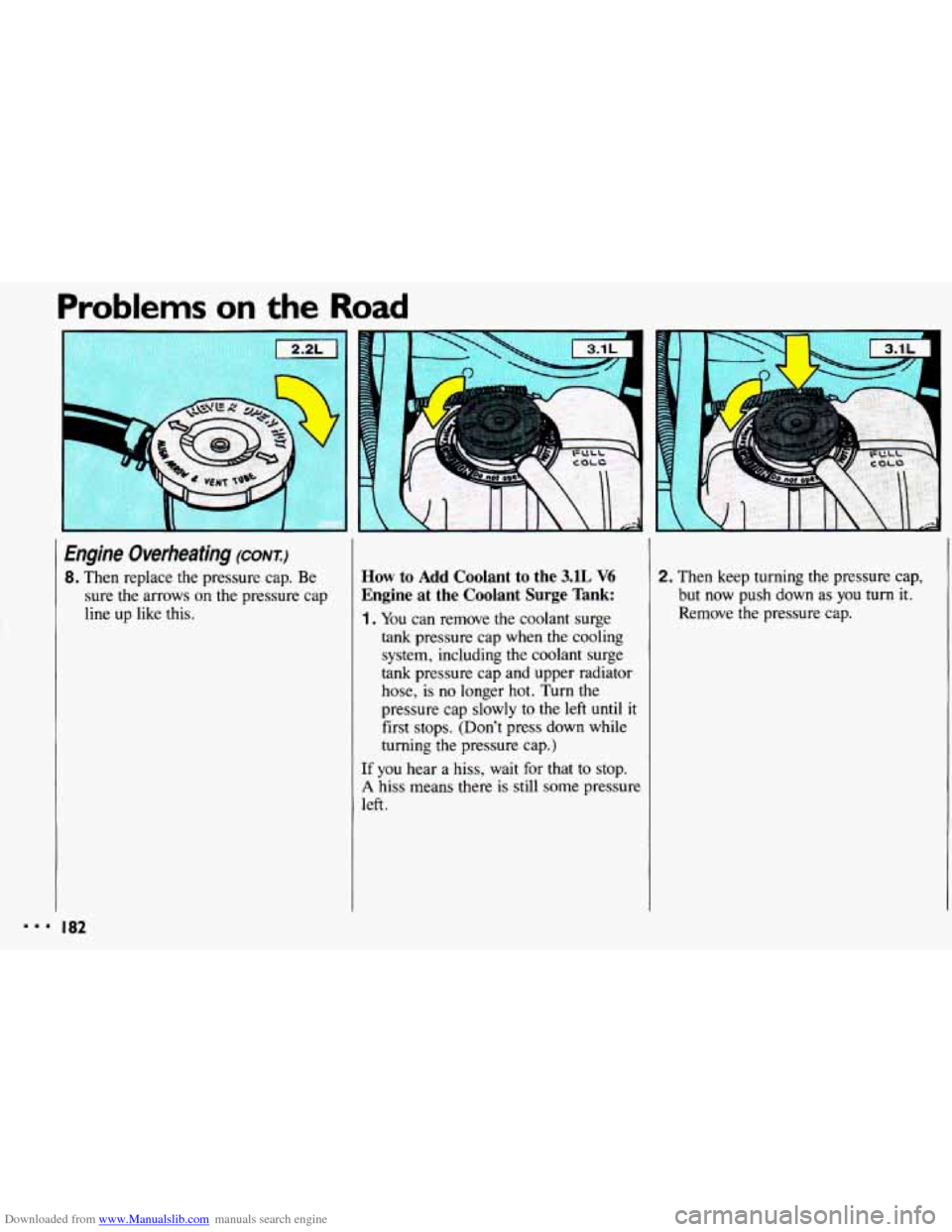
8. Then replace the pressure cap. Be
sure the arrows
on the pressure cap
line up like this.
How to Add Coolant to the 3.lL V6
Engine at the Coolant Surge Tank:
1. You can remove the coolant surge
tank pressure cap when the cooling
system, including the coolant surge
tank pressure cap and upper radiator
hose, is
no longer hot. Turn the
pressure cap slowly
to the left until it
first stops. (Don’t press down while
turning the pressure cap.)
If you hear a hiss, wait for that to stop.
A hiss means there is still some pressure
left.
2. Then keep turning the pressure cap,
but now push down
as you turn it.
Remove the pressure cap.
Page 218 of 308
Downloaded from www.Manualslib.com manuals search engine 888
Service rance Care
Hydraulic Clutch (CONTJ
How to Check:
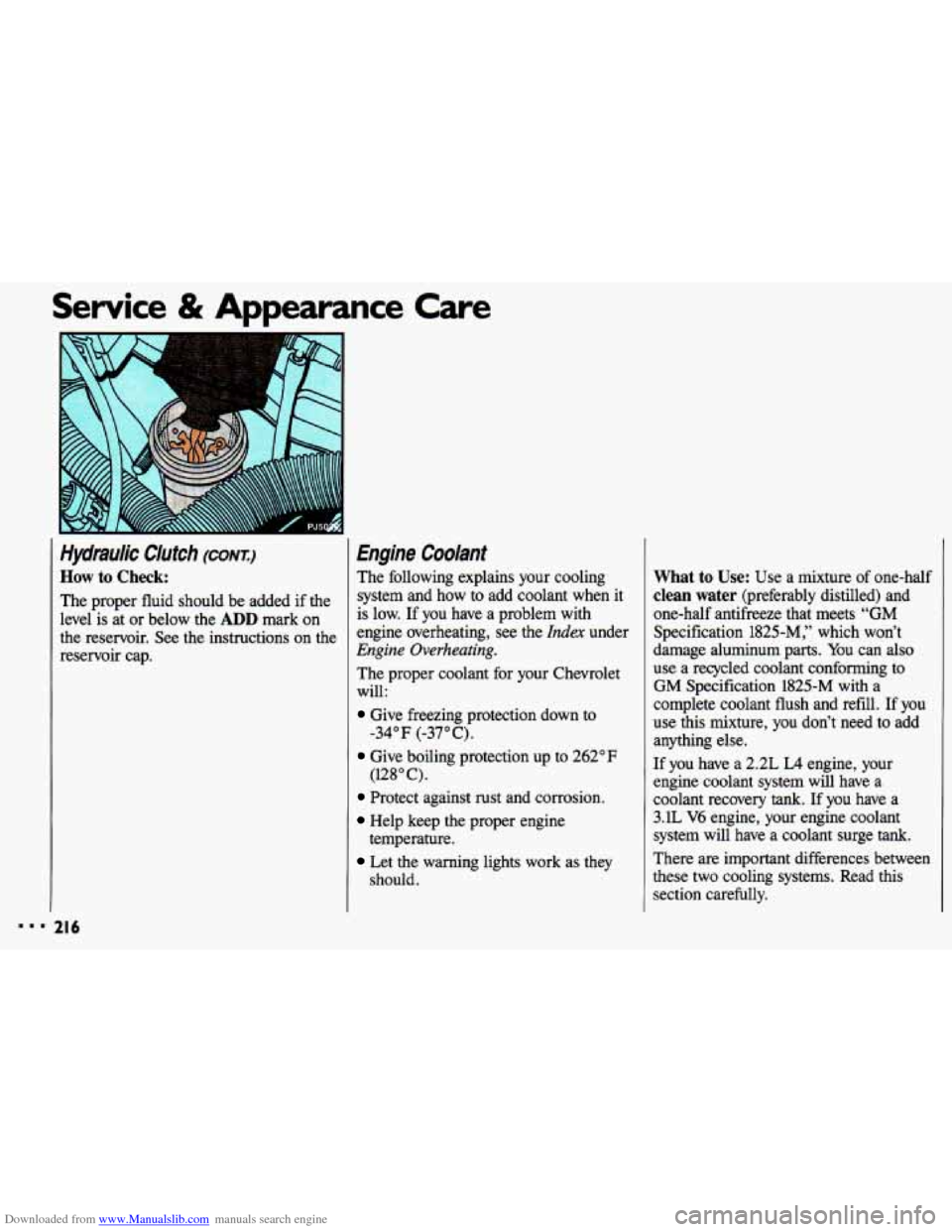
The proper fluid should be added if the
level is at or below the
ADD mark on
the reservoir.
See the instructions on the
reservoir cap.
216
Engine Coolant
The following explains your cooling
system and how to add coolant when it
is low. If you have a problem with
engine overheating,
see the Index under
Engine Overheating.
The proper coolant for your Chevrolet
will:
Give freezing protection down to
Give boiling protection up to 262°F
Protect against rust and corrosion.
Help keep the proper engine
Let the warning lights work as they
-34" F (-37" C).
(128" C).
temperature.
should.
What to Use: Use a mixture of one-half
clean water (preferably distilled) and
one-half antifreeze that meets "GM
Specification 1825-M," which won't
damage aluminum parts.
You can also
use a recycled coolant conforming to
GM Specification 1825-M with a
complete coolant flush and refill.
If you
use this mixture, you don't need to add
anything else.
If you have a 2.2L LA engine, your
engine coolant system will have a
coolant recovery
tank. If you have a
3.1L V6 engine, your engine coolant
system will have a coolant surge
tank.
There are important differences between
these two cooling systems. Read this section carefully.
Page 221 of 308
Downloaded from www.Manualslib.com manuals search engine Radiator Pressure Cap
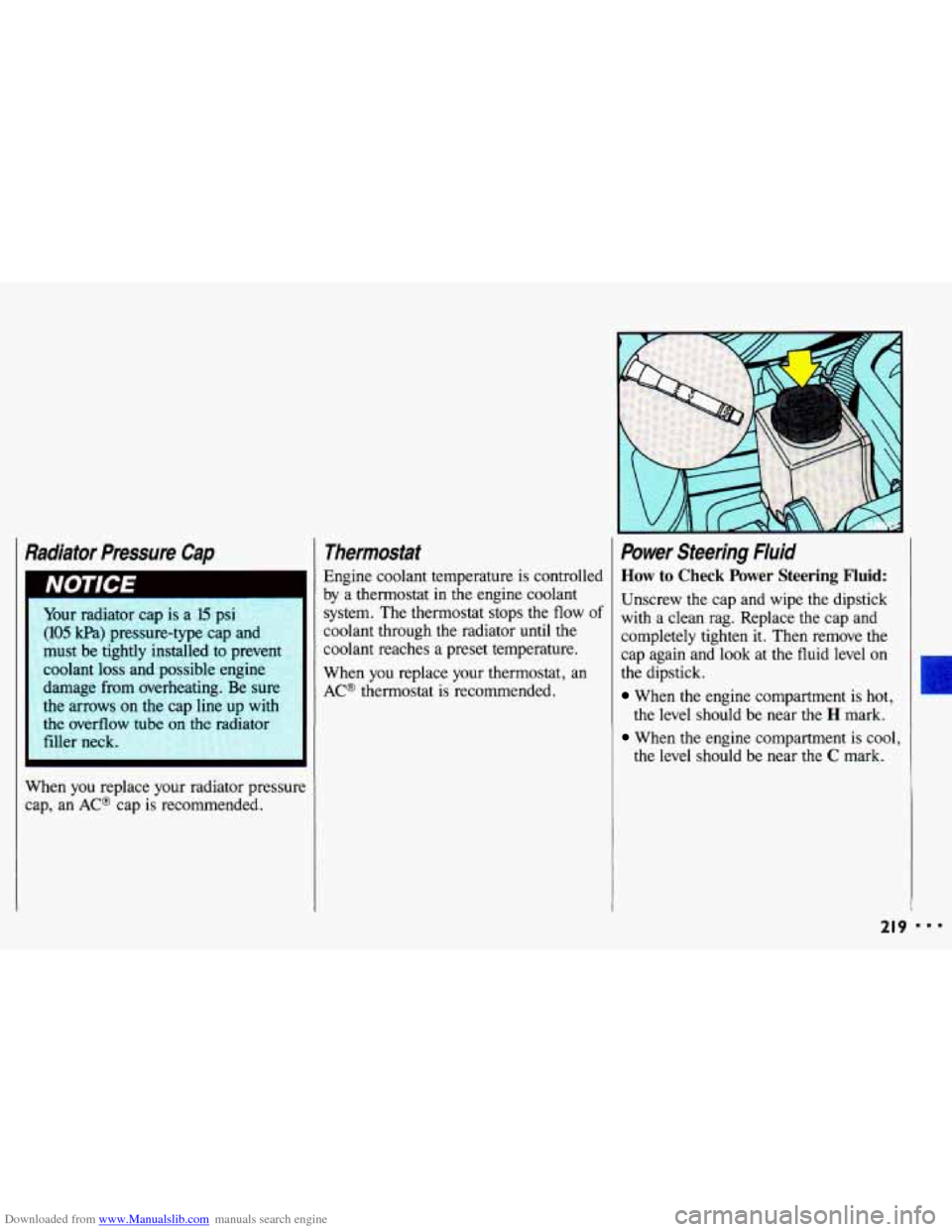
, .. g.., ',!: Your radiator cap is a 15 psi
I.,, ''.' (105 kPa) pressure-type cap and
,;:, must be tightly installed to prevent
'.. coolant loss and possible engine
.':: damage from overheating. Be sure
.; the arrows on the cap line up with
the overflow
tube on the radiator
Y; _/,.__ filler neck.
When you replace your radiator pressurl
cap, an
AC@ cap is recommended.
.. . ..
~. .
..
F+
Thermostat
Engine coolant temperature is controlled
by a thermostat in the engine coolant
system. The thermostat stops the
flow of
coolant through the radiator until the
coolant reaches a preset temperature.
When you replace your thermostat, an
AC@ thermostat is recommended.
Power Steering Fluid
How to Check Power Steering Fluid:
Unscrew the cap and wipe the dipstick
with a clean rag. Replace the cap and
completely tighten it. Then remove the
cap again and
look at the fluid level on
the dipstick.
When the engine compartment is hot,
the level should be near the H mark.
When the engine compartment is cool,
the level should be near the
C mark.
21 9 I..
Page 231 of 308
Downloaded from www.Manualslib.com manuals search engine 1--
-
Things you=
strike and injure
people in
a sudden stop or turn, or
in
a crash.
Put things in the trunk or rear
area
of your vehicle. In a trunk,
put them as hr forward as you
can.
Try to spread the weight
evenly.
If you have fold-down
rear seats, you’ll find four
anchors on the back wall
of your
trunk.
You can use these anchors
to tie down lighter loads. They’re
not strong enough for
heavy
things, however, so put them as
fbr forward
as you can in the
trunk or rear area.
Never stack heavier things, like
suitcases, inside the vehicle
so
that some of them are above the
tops
of the seats.
e When you carry something
inside the vehicle, secure it
whenever you can.
unless you need to.
0 Don’t leave a seat folded down
I
Tires
We don’t make tires. Your new vehicle comes with high quality tires made by a
leading tire manufacturer. These tires are warranted by the tire manufacturers and
their warranties are delivered with every
new Chevrolet. If your spare tire is a
different brand than your road tires,
you will have a tire warranty folder from each
of these manufacturers.
I I
CAUTION
Poorly maintained and improperly used tires are dangerous. 1
’ - Overloading your tires can cause overheating as a result of too much
friction. You could have
an air-out and a serious accident. See the Index
under hading Your Vehicle.
Underinflated tires pose the same danger as overloaded tires. The resulting
accident could cause serious injury. Check all tires frequently to maintain
the recommended pressure. Tire pressure should be checked
when your
tires
are cold.
sudden impact:
such as when you hit a pothole. Keep tires at the
recommended pressure.
I Overinflated tires are more likely to be cut, punctured, or broken by a
Worn, old tires can cause accidents. If your tread is badly worn, or if your
I tires have been damaged, replace them. I
229
I
I..
Page 299 of 308
Downloaded from www.Manualslib.com manuals search engine Daytime Running Lights ........ -80
Dead Battery: What to Do ........ 164
Defects. Safety (see
Safety Defects)
Defensive Driving .............. 128
Defogger. Rear Window .......... 109
Defrosting
.................... 108
Dome Light
.................... 82
Door Locks
.................... 49
Downshifting
.............. .65. W4
Driver Position
.................. 23
Driving
....................... 123
At Night
.................... 143
City
........................ 149
Controlling a Skid
............. 142
Defensively
................. -128
Drunken .................... 129
Freeway
.................... 150
Hill and Mountain ............ 154
In a Foreign Country
.......... 199
In Fog, Mist and Haze ......... 148
In the Rain .................. 145
Long Distance
................ 152
Loss
of Control ............... 142
On Curves
................... 138
Passing
..................... 140
Defogging
Your Windows
.... .106. 109 Through
Deep Standing Water
.... 58
Winter Driving ............... 157
Drunken Driving
............... 129
n
Easy-Entry Seat ................ 15
Electrical Equipment. Adding ..... 247
Emergencies. Braking
........... 137
Emergencies on the Road
......... 164
Emergencies. Steering in
......... 139
Emergency
Starting ............. 164
Emergency Towing
.............. 169
Engine Block Heater
........ .59, 208
Engine Coolant (see
Coolant)
Engine Coolant Temperature Warning
Engine Identification
........ .56. 246
Engine Oil
.................... 205
Additives
................... 207
Checking
&
Adding .......... .205. 250. 252
Crankcase Capacity
........... 250
Disposing of Used Oil ......... 209
Energy Conserving
............ 207
Filter
.................. .208. 256
Gage
(see Coolant)
Pressure Gage ................. 99
Warning Light ................ 98
When to
Change .............. 208
Engine Overheating
............. 174
Engine Specifications
............ 255
Engine, Starting
................. 56
Automatic Transaxle ........... 57
Manual Transaxle
.............. 57
Ethanol in Gasoline ............. 198
Exhaust Dangerous
Gas in ......... .70, 159
Parking with the Engine Running
................ .68, 71
Expectant Mothers, Use of
Safety Belts
................... 27
Expressway Driving
............. 150
Extender. Safety Belt ............ -44
Exterior Appearance
(see
Appearance Care)
Fabric Cleaning (see Appearance Care)
Fan Warnings .......... .166. 167. 175
Filling
the Fuel Tank ....... .200. 251
Filter. Oil
............ .208, 250. 256
Flashers, Hazard Warning
........ 164
297 r
Page 302 of 308
Downloaded from www.Manualslib.com manuals search engine Index
Manual Adjust ................ 85
Manual Remote Control ......... 86
Mountain Driving ............... 154
New Vehicle Break-In
Requirements
................. 54
Night Driving .................. 143
Octane Requirements
Odometer
& Speedometer ......... 94
Oil. Engine ................... 205
Pressure Gage ................. 99
Thickness ................... 207
Used Oil ................... -209
When to Add ................ 206
When to Change .............. 208
Oil Warning Light ............... 98
Outside Rearview Mirrors ......... 85
Overheated Engine .............. 174
Overheated Engine Coolant
Warning Gage
............... 97
(see Fuel Requirements)
Quality ..................... 206
Operation of Lights .............. 79
Owner Checks & Services ........ 271
Owner’s Manual. How to Use ....... 6
Eint Spotting. Chemical ......... 245
Park. Shifting Into ........... .60. 67
Parking
On Hills
................ .60. 155
Over Things That Burn ......... 70
Torque Lock ............ .157. 251
With the Engine
Running
............. .60. 68. 71
Parking Brake .................. 66
Passenger Belts (see Safety Belts)
Passing ................... .77. 140
Polishing and Waxing
Power Door Locks
............... 50
Power Windows ................. 72
Power Window Lock-out
Switch
..................... 72
Pregnancy. Use of Safety Belts
During
...................... 27
Problems on the Road ........... 163
Publications (see Service Publications)
(see Appearance Care)
Power Steering Fluid .... .219. 251. 252
Radiator Overheating
(see
Overheated Engine)
Radiator Pressure Cap ........... 219
Radio (see Audio Systems)
Reading Light .................. 82
Rear Safety Belt Comfort Guides .... 30
Rear Seat. Split Fold-Down ........ 15
Rearview Mirrors ............... 85
Rear Window Defogger .......... 109
Reclining Seatbacks .............. 12
Replacement Bulbs ............. 253
Replacement Fuses ............ -248
Replacement Parts .............. 256
Replacing Safety Belts ............ 45
Replacing Tires ................ 232
Replacing Wheels .............. 234
Reporting Safety Defects ......... 286
Restraints. Child ............... -35
Road Signs .................... 124
Color ...................... 124
Shape ...................... 125
Symbols .................... 126
Traffic Lights ................ 126
Your Own Signals ............. 127
Roads. Hill and Mountain ........ 154
Replacement. Windshield Wiper ... 227