1993 CHEVROLET CAMARO oil dipstick
[x] Cancel search: oil dipstickPage 200 of 358
Problems on the Road
I. -
.. .
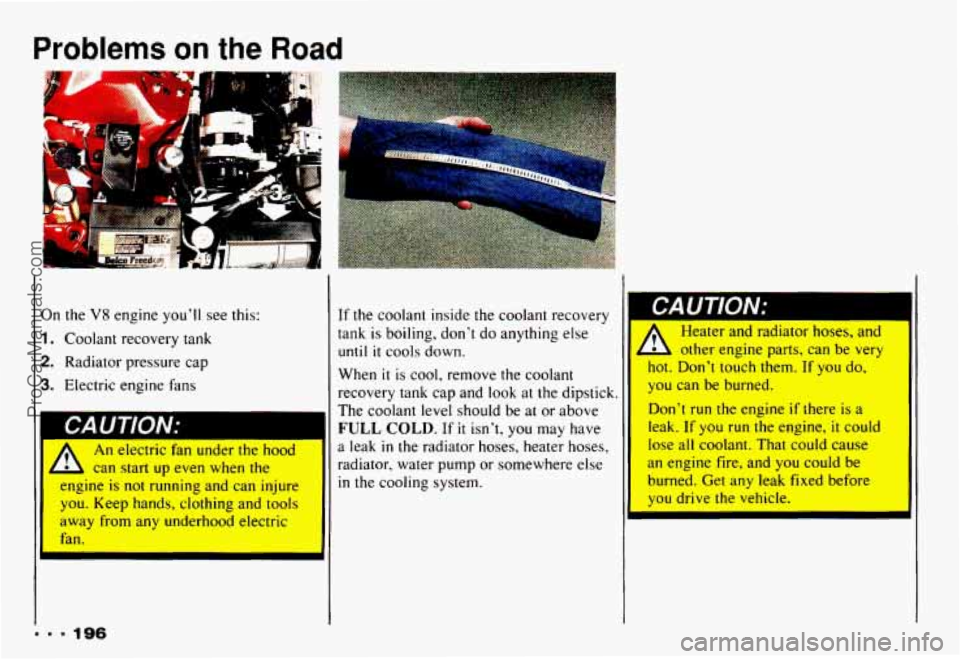
On the V8 engine you’ll see this:
1. Coolant recovery tank
2. Radiator pressure cap
3. Electric engine fans
An electric fan under the hood
L can start up even when the
engine
is not running and can injure
you. Keep hands, clbthing and tools
away from any underhood electric
fan.
... 196
I I
If the coolant inside the coolant recovery
tank
is boiling, don’t do anything else
until it cools down.
When
it is cool, remove the coolant
recovery tank cap and
look at the dipstick. I I
The coolant level should be at or above
FULL COLD. If it isn’t, you may have
a leak
in the radiator hoses, heater hoses,
radiator, water pump or somewhere else
in the cooling system. II
A Heater and radiator hoses, and
L other engine parts, can be very
hot. Don’t touch them.
If you do,
you can be burned. ~
Don’t run the engine if there is a
leak. If
you run the engine, it could
lose
all coolant. That could cause
an engine fire, and you could be
burned. Get any leak fixed before
you drive the vehicle.
ProCarManuals.com
Page 228 of 358
Service 8t Appearance Care
c
Then go to the front of the vehicle and
pull up on the hood release.
Lift
the hood.
I
I CAUTION:
An electric fan under the hood
can start up and injure you
even when
the engine is not
running. Keep hands, clothing and
tools away from any underhood
* xtric fan.
I
Y
3.4L L32 (Code S)
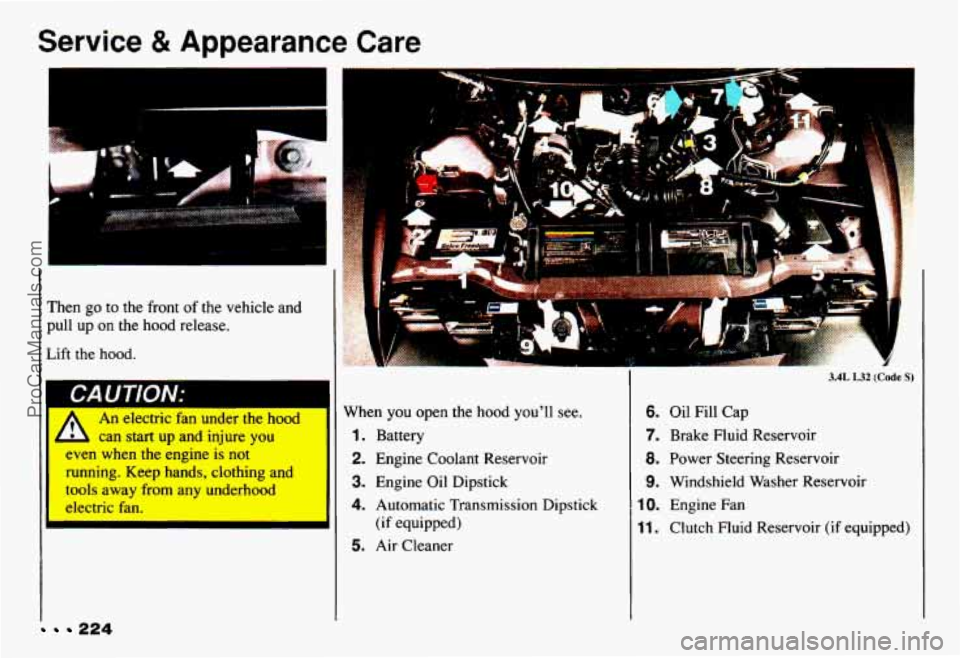
When you open the hood you'll see.
1. Battery
2. Engine Coolant Reservoir
3. Engine Oil Dipstick
4. Automatic Transmission Dipstick
5. Air Cleaner
(if equipped)
6. Oil Fill Cap
7. Brake Fluid Reservoir
8. Power Steering Reservoir
9. Windshield Washer Reservoir
10. Engine Fan
11. Clutch Fluid Reservoir (if equipped)
224
ProCarManuals.com
Page 229 of 358
\I I
-:E= 1
f
I
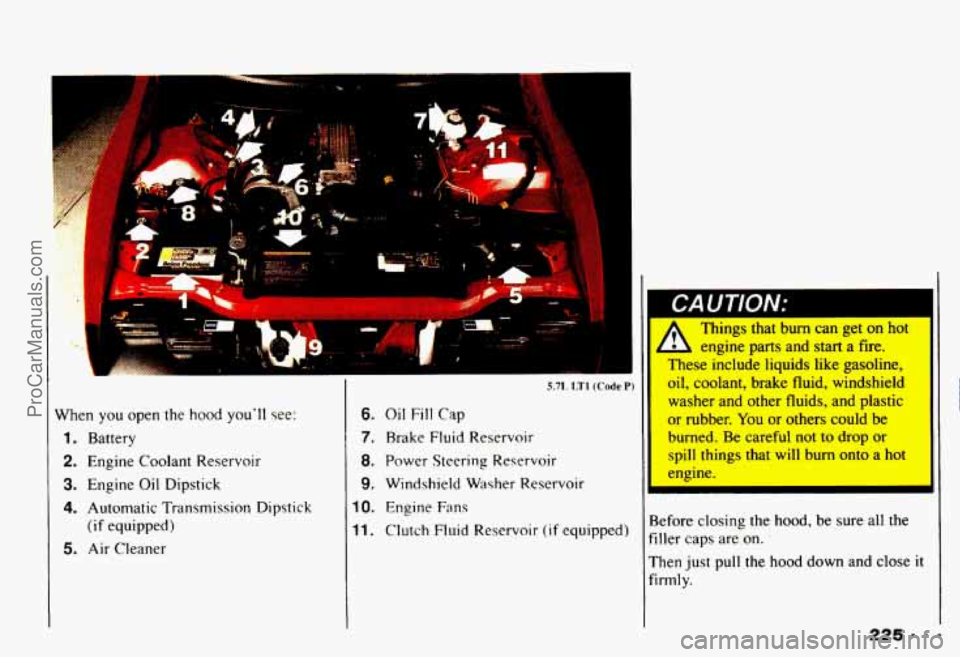
When you open the hood you'll see:
1. Battery
2. Engine Coolant Reservoir
3. Engine Oil Dipstick
4. Automatic Transmission Dipstick
5. Air Cleaner
(if equipped)
II
6. Oil Fill Cap
7. .Brake Fluid
Reservoir
8, Power Steering Reservoir
9. Windshield Washer Reservoir
10. Engine Fans
11. Clutch Fluid Reservoir (if equipped) Things that
burn
can get on hot
b engine parts and start a fire.
mese include liquids like gasoline,
oil, coolant, brake fluid, windshield
washer and other fluids, and plastic
or rubber. You or others could be
burned. Be careful not to drop or
spill things that will burn onto a hot
ennine. 1
Before closing the hood, be sure all the
filler caps are on.
Then just pull the hood down and
close it
firmly.
ProCarManuals.com
Page 230 of 358
Service & Appearance Care
. = 226
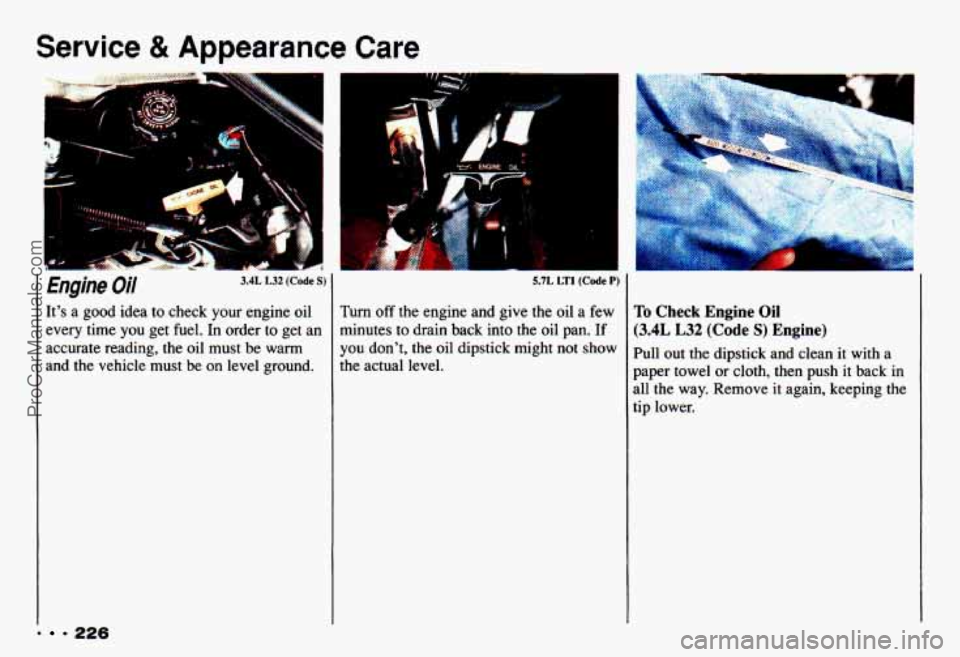
Engine Oil 3.4L L32 (Code S)
It's a good idea to check your engine oil
every time
you get fuel. In order to get an
accurate reading, the oil must be warm
and the vehicle must be on level ground,
5.7L LTl (Code P)
Turn off the engine and give the oil a few
minutes to drain back into the oil
pan. If
you don't, the oil dipstick might not show
the actual level.
To Check Engine Oil
(3.4L L32 (Code S) Engine)
Pull out the dipstick and clean it with a
paper towel or cloth, then push it back in
all the way. Remove it again, keeping the
tip lower.
ProCarManuals.com
Page 231 of 358
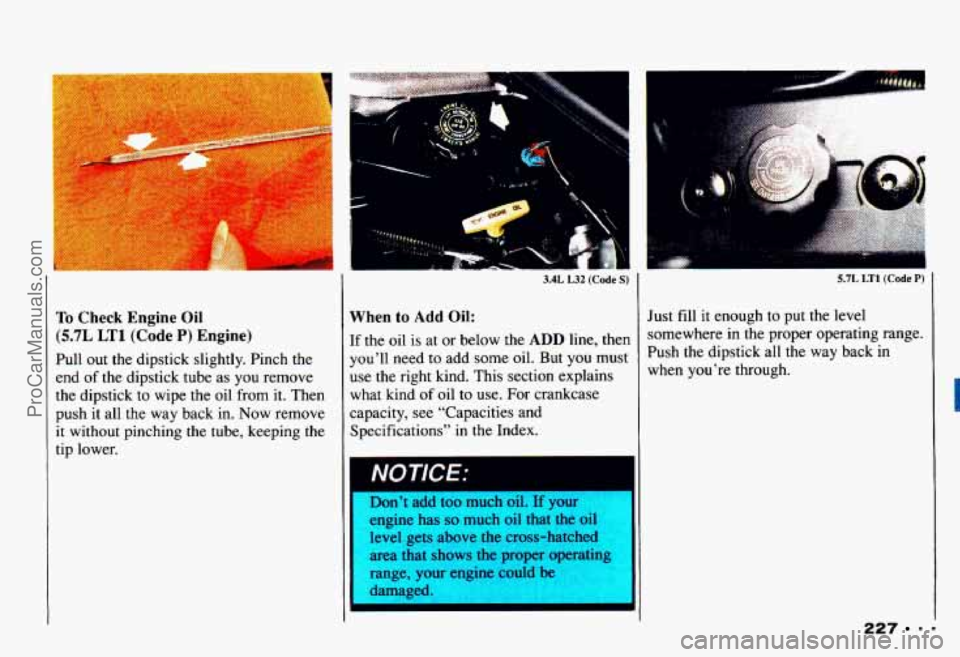
To Check Engine Oil
(5.7L LT1 (Code P) Engine)
Pull out the dipstick slightly. Pinch the
end of the dipstick tube as you remove
the dipstick to wipe the oil from it.
Then
push it all the way back in. Now remove
it without pinching the tube, keeping the
tip lower.
3.4L L32 (Code S:
When to Add Oil:
If the oil is at or below the ADD line, then
you’ll need
to add some oil. But you must
use the right kind. This section explains
what kind
of oil to use. For crankcase
capacity, see “Capacities and
Specifications” in the Index.
11 NOTICE:
UUll 1 auu LUU IIIULII u11. 11 ywul
engine has so much oil that the oil
I level gets above the cross-hatched
area that shows the proper operating
I
range, you
damaged.
I I
5.7L LT1 (Code P)
Just fill it enough to put the level
somewhere in the proper operating range.
Push the dipstick all
the way back in
when you’re through.
227 9
ProCarManuals.com
Page 237 of 358

Automatic Transmission Fluid
When to Check and Change:
A good time to check your automatic
transmission fluid level is when the
engine oil is changed. Refer
to the
Maintenance Schedule
to determine when
to change your fluid. See “Scheduled
Maintenance Services” in the Index.
How to Check:
Because this operation can be a little
difficult, you may choose to have this
done at a Chevrolet dealership Service
Department.
If you do it yourself, be sure to follow all
the instructions here,
or you could get a
false reading
on the dipstick. damage
your transmission.
Too
much can mean that some of thr
fluid could come
out and fall on hc
~.: engine parts, starting a fire. Be sure
to get an accurate reading if you ~“* check your transmission fluid. ~, \- ~
%it at least 30 minutes before checking
he transmission fluid level
if you have
>een driving:
D When outside temperatures are above
At high speed for quite a while.
0 In heavy traffic - especially in hot
While pulling a trailer.
90°F (32°C).
weather. To
get the right reading, the fluid should
be at normal operating temperature,
which is 180°F to 200°F
(82°C to 93°C).
To check transmission fluid hot: Get
the vehicle warmed up by driving
about
15 miles (24 km) when outside
temperatures are above
50°F (10OC). If
it’s colder than
50°F (lO”C), drive the
vehicle in
D (Third Gear) until the engine
temperature gage moves and then remains
steady for ten minutes. Then follow the
hot check procedures.
To check transmission fluid cold: A cold
check is made after the vehicle has been
sitting for eight hours
or more with the
engine off and
is used only as a reference.
Let the engine run at idle for five minutes
233 = =
ProCarManuals.com
Page 239 of 358

3. Check both sides of the dipstick, and
read the lower level. The fluid level
must be
in the COLD area for a cold
check or in the
HOT area or
cross-hatched area for a
hot check.
4. If the fluid level is where it should be,
push the dipstick back
in all the way.
How to Add Fluid:
Refer to the Maintenance Schedule to
determine what kind of transmission fluid
to use. See “Recommended Fluids and
Lubricants” in the Index. If the fluid level is low, add only enough
of the proper fluid to bring the level up to
the COLD area for
a cold check or the
HOT area for a hot check. It doesn’t take
much fluid, generally less than a pint.
Don’t overfill. We recommend you use
only fluid labeled
DEXRON@-IIE,
because fluids with that label are made
especially for your automatic
transmission. Damage caused by
fluid
other than DEXRON@-IIE is not covered
by your new vehicle warranty.
After adding fluid, recheck the fluid
level as described under “How to
Check.”
obtained, push the dipstick back
in all
the way.
When the correct fluid level is
Manual Transmission Fluid
When to Check:
A good time to have it checked is when
the engine oil is changed. However, the
fluid in your manual transmission doesn’t
require changing.
How to Check:
Because this operation can be a little
difficult, you may choose to have this
done at a Chevrolet dealership Service
Department.
If
you do it yourself, be sure to follow all
the instructions here, or you could get a
false reading.
235 9
ProCarManuals.com
Page 356 of 358
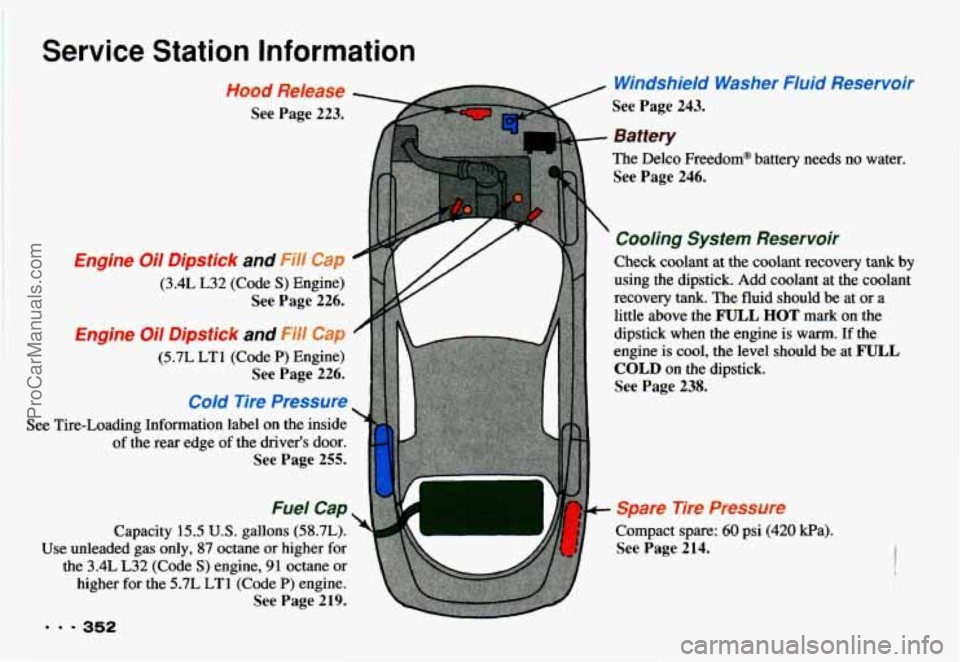
Service Station Information
Hood Release
See Page 223.
Engine Oil Dipstick and Fill Cap
(3.4L L32 (Code S) Engine)
See Page 226.
Engine Oil Dipstick and Fill Cap
(5.7L LT1 (Code P) Engine)
See Page 226.
Cold Tire Pressure
See Tire-Loading Information label on the inside
of the
rear edge of the driver's door.
See Page 255.
Fuel Cap
Capacity 15.5.U.S. gallons (58.7L).
Use unleaded gas only, 87 octane
or higher for
the 3.4L
L32 (Code S) engine, 91 octane or
higher
for the 5.7L LT1 (Code P) engine.
See Page 219.
Windshield Washer Fluid Reservorr
See Page 243.
Battery
The Delco Freedom@ battery needs no water.
See Page 246.
Cooling System Reservoir
Check coolant at the coolant recovery tank by
using the dipstick. Add coolant at the coolant
recovery tank. The fluid should be at
or a
little above
the FULL HOT mark on the
dipstick when
the engine is warm. If the
engine is cool, the level should be at
FULL
COLD on the dipstick.
See Page 238.
_?are Tire Pressure
Compact spare: 60 psi (420 kPa).
See Page 214.
ProCarManuals.com