1993 CHEVROLET CAMARO wheel
[x] Cancel search: wheelPage 84 of 358
Features & Controls
II
washer fluid, follow the
manufacturer’? instructiopc
fnr
adding water.
Don’t mix warGI with
ready-to-use washer
fluic..
Water can cause the solutinn tn
freeze and damage your
washer
fluid tank and other
parts of the washer systen
Also, water doesn’t clean as
well as washer fluid.
Fill your washer fluid tank
only
3/4 full when it’s ver
cold. This allows
fo
expansion, which COUI(
damage the tank if it is
completely full.
Don’t use radiator anurreeze In
your windshield washer. It can
and paint. damage yolw
wacher cvctpm
-=-8O I
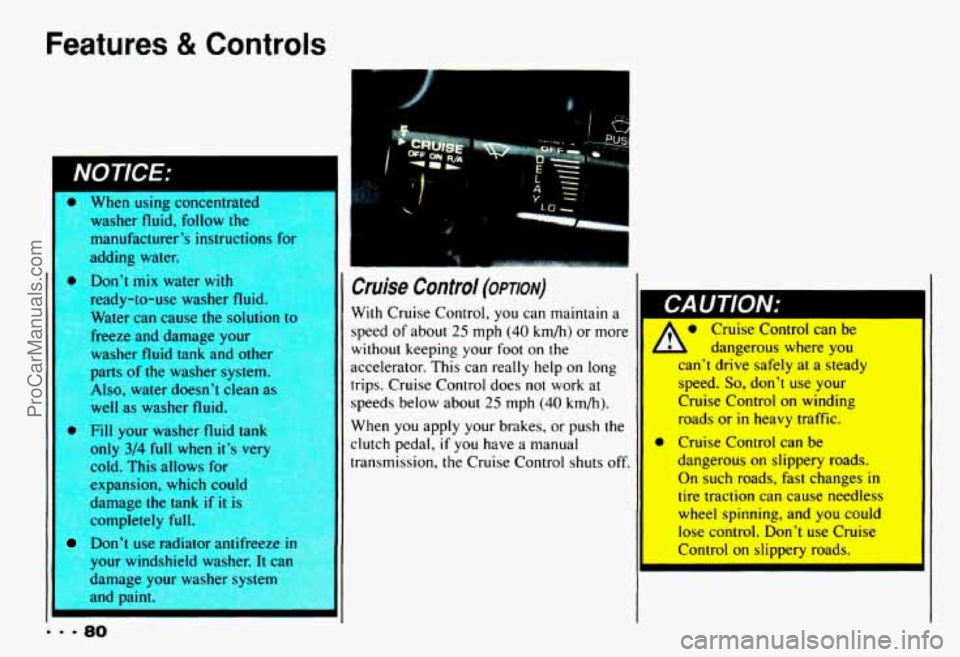
Cruise Control (opmv)
With Cruise Control, you can maintain a
speed of about
25 mph (40 km/h) or more
without keeping your foot on the
accelerator. This can really help on long
trips. Cruise Control does not work
at
speeds below about 25 mph (40 km/h).
When
you apply your brakes, or push the
clutch pedal,
if you have a manual
transmission, the Cruise Control shuts off.
Cruise Control can be
1 L dangerous where you
can’t drive safely at a steady
speed.
So, don’t use your
Cruise Control
on winding
roads or
in heavy traffic.
dangerous
on slippery roads.
On such roads, fast changes in
tire traction can cause needless
wheel spinning, and you
could
lese control. hn’t use Cruise
* Cruise Control can be
ProCarManuals.com
Page 148 of 358
Your Driving and the Road
I
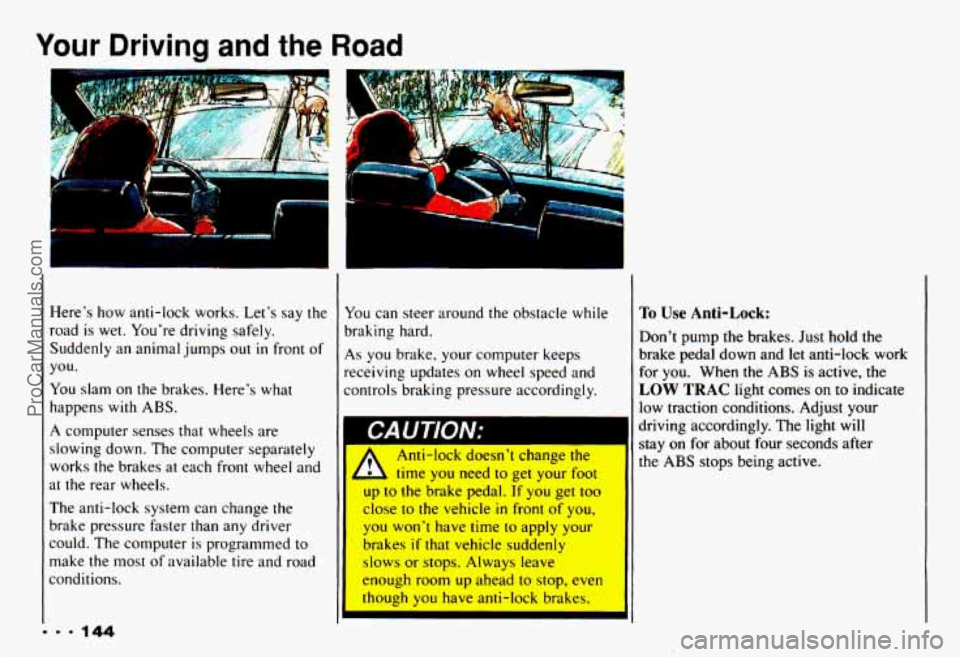
Here's how anti-lock works. Let's say the
road is wet. You're driving safely.
Suddenly an animal jumps out
in front of
you.
You slam on
the brakes. Here's what
happens with ABS.
A computer senses that wheels are
slowing down. The computer separately
works the brakes at each front wheel and
at the rear wheels.
The anti-lock system can change
the
brake pressure faster than any driver
could. The computer is programmed
to
make the most of available tire and road
conditions.
1
You can steer around the obstacle while
braking hard.
As you brake, your conlputer keeps
receiving updates
on wheel speed and
controls braking pressure accordingly.
I CAUTION;
A
Anti-lock doesn't change the
time
you need to get your foot
up
to the brake pedal. If you get too
close
to the vehicle in front of you,
1 you won't have time to apply your
brakes
if that vehicle suddenly
slows or stops. Always leave
enough room up ahead
to stop, even
though
you have anti-lock brakes.
I'o Use Anti-Lock:
Don't pump the brakes. Just hold the
brake pedal down and
let anti-lock work
for you. When the
ABS is active, the
LOW TRAC light comes on to indicate
low traction conditions. Adjust your
driving accordingly. The light will
stay on for about four seconds after
the
ABS stops being active.
ProCarManuals.com
Page 149 of 358

Disc Brake Wear Indicators
Unless you have the four-wheel disc
brake option, your Chevrolet has front
disc brakes and rear drum brakes.
Disc brake pads have built-in wear
indicators that make a high-pitched
warning sound when the brake pads are
worn and new pads are needed. The
sound may come and go or be heard all
the time your vehicle is moving (except
when you are pushing on the brake peda
firmly). 1 The brake wear warning sound
- means that sooner or later your
brakes won’t work well. That could
lead to an accident. When you hear
the brake wear warning sound, have
your vehicle serviced.
I
I
.1 LullllllullIg 1u UIIVt: Wllll WUIII-UU
brake pads could result in rnctl\~
brake repair. Some driving conditions
or climates may
cause a brake squeal when the brakes are
first applied or lightly applied. This does
not mean something
is wrong with your
brakes.
Rear Drum Brakes
If you have rear drum brakes, they don’t
have wear indicators,
but if you ever hear
a rear brake rubbing noise, have the rear
brake linings inspected.
Also, the rear
brake drums should be removed and
inspected each time the tires are removed
for rotation or changing. When you have
the front brakes replaced, have the rear
brakes inspected, too.
Brake linings should always be replaced
as complete axle sets.
ProCarManuals.com
Page 151 of 358
the tires against the road surface makes it
possible for the vehicle to change its path
when
you turn the front wheels. If there’s
no traction, inertia will keep the vehicle
going
in the same direction. If you’ve
ever tried to steer a vehicle on wet ice,
~ you’ll understand this.
The traction you can get
in a curve
depends on the condition of your tires and
the road surface, the angle at which the
curve is banked, and your speed. While
you’re
in a curve, speed is the one factor
you can control. Suppose you’re
steering through a sharp
curve. Then you suddenly accelerate.
Those two control systems
- steering
and acceleration
- can overwhelm those
places where the tires meet the road and
make you lose control.
What should you do
if this ever happens?
Let up on the accelerator pedal, steer the
vehicle the way you want
it to go, and
slow down.
Speed limit signs near curves warn
that
you should adjust your speed. Of course,
the posted speeds are based on good
weather and road conditions. Under less
favorable conditions you’ll want to
go
slower.
If you need to reduce your speed as you
approach
a curve, do it before you enter
the curve, while your front wheels are
straight ahead.
Try to adjust your speed so you can
“drive” through the curve. Maintain a
reasonable, steady speed. Wait to
accelerate
until you are out of the curve,
and then accelerate gently into the
straightaway.
When you drive into a curve at night, it’s
harder
to see the road ahead of you
because
it bends away from the straight
beams
of your lights. This is one good
reason to drive slower.
ProCarManuals.com
Page 152 of 358
Your Driving and the Road
Steering in Emergencies
There are times when steering can be
more effective than braking. For example,
you come over a
hill and find a truck
stopped
in your lane, or a car suddenly
pulls out from nowhere, or a child darts
out from between parked cars and stops
right
in front of you. You can avoid these
problems by braking
- if you can stop in
time. But sometimes you can’t; there isn’t
room. That’s the time for evasive action
- steering around the problem. Your
Chevrolet can perform very well
in
emergencies like these. First apply your
brakes. It is better
to remove as much
speed as you can from a possible
collision. Then steer around the problem,
to the left or right depending on the space
available.
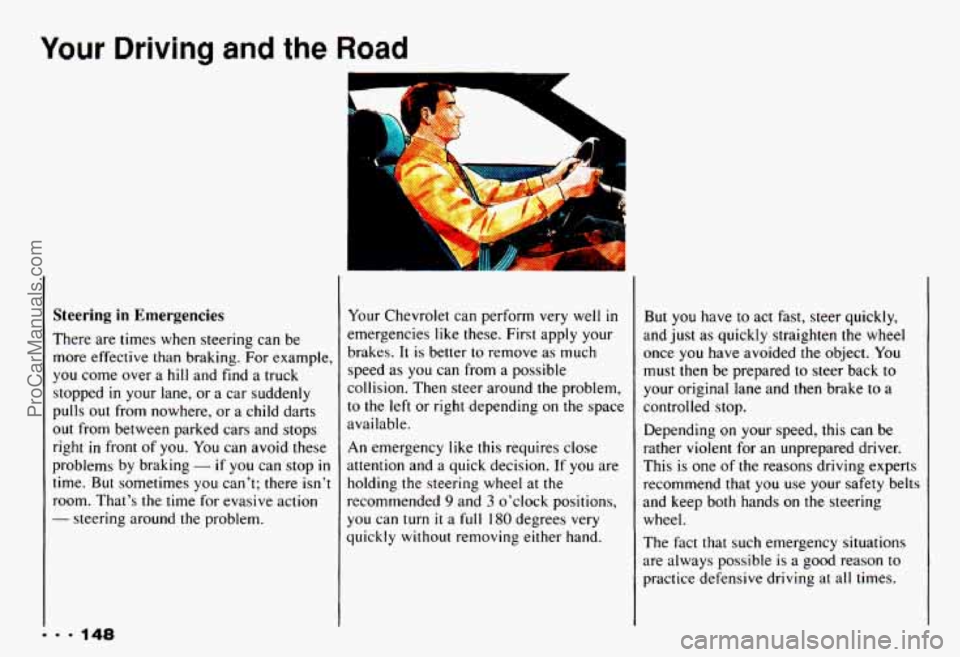
An emergency like this requires close
attention and a quick decision. If you are
holding the steering wheel at the
recommended
9 and 3 o’clock positions,
you can
turn it a full 180 degrees very
quickly without removing either hand.
But you have to act fast, steer quickly,
and just as quickly straighten the wheel
once you have avoided the object.
You
must then be prepared to steer back to
your original lane and then brake to a
controlled stop.
Depending on your speed, this can be
rather violent for an unprepared driver.
This is one of the reasons driving experts
recommend that you use your safety belts
and keep both hands on the steering
wheel.
The fact that such emergency situations
are always possible is a good reason
to
practice defensive driving at all times.
ProCarManuals.com
Page 153 of 358
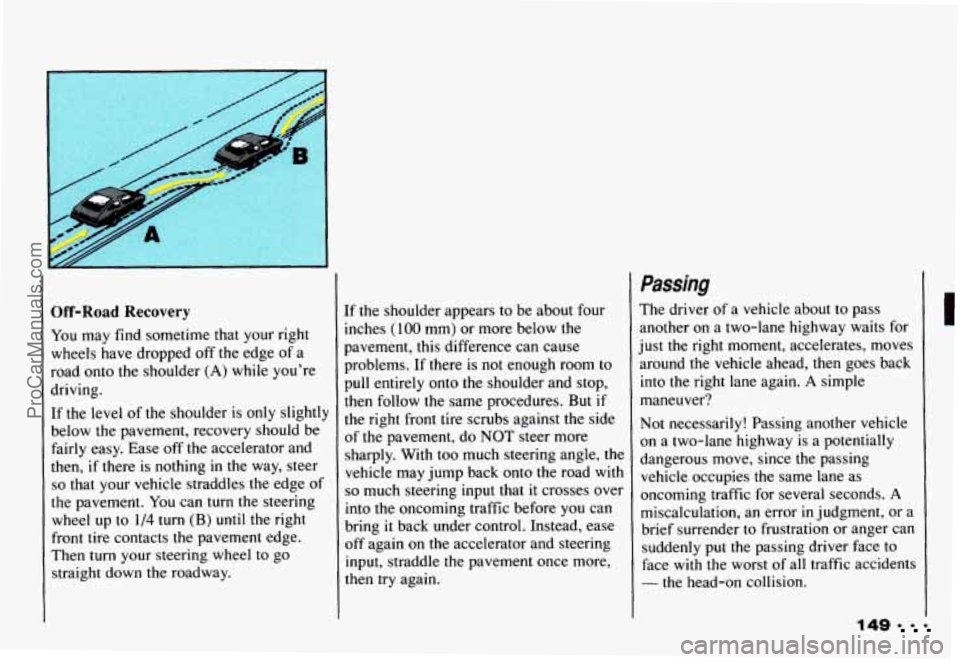
I Off-Road Recovery
You may find sometime that your right
wheels have dropped off the edge of a
road onto the shoulder
(A) while you’re
driving.
If the level of
the shoulder is only slightly
below the pavement, recovery should be
fairly easy. Ease off the accelerator and
then,
if there is nothing in the way, steer
so that your vehicle straddles the edge of
the pavement. You can turn
the steering
wheel up to 1/4 turn (B) until the right
front tire contacts the pavement edge.
Then turn your steering wheel to go
straight down the roadway. If
the shoulder appears to be about four
inches
(100 mm) or more below the
pavement, this difference can cause
problems. If there is not enough room to
pull entirely onto the shoulder and stop,
then follow the same procedures. But
if
the right front tire scrubs against the side
of the pavement, do NOT steer more
sharply. With too much steering angle, the
vehicle may jump back onto the road with
so much steering input that it crosses over
into the oncoming traffic before you can
bring
it back under control. Instead, ease
off again on the accelerator and steering
input, straddle the pavement once more,
then try again.
Passing
The driver of a vehicle about to pass
another on a two-lane highway waits for
just the right moment, accelerates, moves
around the vehicle ahead,
then goes back
into the right lane again.
A simple
maneuver?
Not necessarily! Passing another vehicle
on a two-lane highway is a potentially
dangerous move, since
the passing
vehicle occupies the same lane as
oncoming traffic for several seconds.
A
miscalculation, an error in judgment, or a
brief surrender to frustration or anger can
suddenly put the passing driver face to
face
with the worst of all traffic accidents
- the head-on collision.
149
ProCarManuals.com
Page 156 of 358

Your Driving and the Road
The three types of skids correspond to
your Chevrolet’s three control systems. In
the braking skid your wheels aren’t
rolling. In the steering or cornering skid,
too much speed or steering in a curve
causes tires to slip and lose cornering
force. And
in the acceleration skid too
much throttle causes the driving wheels to
spin.
A cornering skid and an acceleration skid
are best handled by easing your foot off
the accelerator pedal. If your vehicle
starts to slide (as when you turn a corner
on a wet, snow- or ice-covered road),
ease your
foot off the accelerator pedal as
soon as you feel the vehicle start to slide.
Quickly steer the way
you want the vehicle to
go. If you
start steering quickly
enough, your vehicle will straighten out.
As it does, straighten the front wheels.
Of course, traction
is reduced when water,
snow, ice, gravel, or other material is on
the road. For safety, you’ll want to
slow
down and adjust your driving to these
conditions. It is important to slow down
on slippery surfaces because stopping
distance will be longer and vehicle control more limited. While
driving on a surface
with reduced
traction,
try your best to avoid sudden
steering, acceleration, or braking
(including engine braking by shifting to a
lower gear). Any sudden changes could
cause the tires to slide.
You may not
realize the surface is slippery until your
vehicle is skidding. Learn to recognize
warning clues
- such as enough
water, ice or packed snow on the road to
make
a “mirrored surface” - and slow
down when you have any doubt.
Remember:
Any anti-lock braking system
(ABS) helps avoid only the braking skid.
Steer the way you want to go.
ProCarManuals.com
Page 167 of 358

Driving a Long
Distance
Although most long trips today are made
on freeways, there are
still many made on
regular highways.
Long-distance driving on freeways and
regular highways
is the same in some
ways. The
trip has to be planned and the
vehicle prepared, you drive at
higher-than-city speeds, and there are
longer turns behind the wheel. You’ll
enjoy your trip more
if you and your
vehicle are
in good shape. Here are some
:ips for a successful long trip.
Before Leaving on a Long Trip
Make sure you’re ready. Try to be well
rested. If you must start when you’re not
fresh
- such as after a day’s work -
don’t plan to make too many miles that
first part of the journey. Wear comfortable
clothing and shoes you can easily drive
in.
Is your vehicle ready for a long trip? If
you keep
it serviced and maintained, it’s
ready to go. If
it needs service, have it
done before starting out. Of course, you’ll
find experienced and able service experts
in Chevrolet dealerships all across North
America. They’ll be ready and willing to
help
if you need it. Here
are some things you can check
before a trip:
0
0
0
0
0
Windshield Washer Fluid: Is the
reservoir
full? Are all windows clean
inside and outside?
Wiper Blades: Are they in good
shape?
Fuel, Engine Oil, Other Fluids:
Have you checked all levels?
Lights: Are they all working? Are the
lenses clean?
Tires: They are vitally important to a
safe, trouble-free trip.
Is the tread
good enough for long-distance
driving? Are the tires all inflated to
the recommended pressure?
163 -
ProCarManuals.com