1993 CHEVROLET CAMARO brake light
[x] Cancel search: brake lightPage 149 of 358

Disc Brake Wear Indicators
Unless you have the four-wheel disc
brake option, your Chevrolet has front
disc brakes and rear drum brakes.
Disc brake pads have built-in wear
indicators that make a high-pitched
warning sound when the brake pads are
worn and new pads are needed. The
sound may come and go or be heard all
the time your vehicle is moving (except
when you are pushing on the brake peda
firmly). 1 The brake wear warning sound
- means that sooner or later your
brakes won’t work well. That could
lead to an accident. When you hear
the brake wear warning sound, have
your vehicle serviced.
I
I
.1 LullllllullIg 1u UIIVt: Wllll WUIII-UU
brake pads could result in rnctl\~
brake repair. Some driving conditions
or climates may
cause a brake squeal when the brakes are
first applied or lightly applied. This does
not mean something
is wrong with your
brakes.
Rear Drum Brakes
If you have rear drum brakes, they don’t
have wear indicators,
but if you ever hear
a rear brake rubbing noise, have the rear
brake linings inspected.
Also, the rear
brake drums should be removed and
inspected each time the tires are removed
for rotation or changing. When you have
the front brakes replaced, have the rear
brakes inspected, too.
Brake linings should always be replaced
as complete axle sets.
ProCarManuals.com
Page 155 of 358
If other cars are lined up to pass a
slow vehicle, wait your turn.
But take
care that someone isn’t
trying to pass
you as you pull out
to pass the slow
vehicle. Remember to glance over
your shoulder and check the blind
spot.
Check your mirrors, glance over your
shoulder, and start your left lane
change signal before moving out of
the right lane to pass. When you are
far enough ahead of the passed vehicle
to see its front in your inside mirror,
activate your right lane change signal
and move back into the right lane. (Remember
that your right outside
mirror is convex. The vehicle you
just
passed may seem to be farther away
from you than
it really is.)
Try not to pass more than one vehicle
at a time on two-lane roads.
Reconsider before passing the next
vehicle.
Don’t overtake a slowly moving
vehicle too rapidly. Even though the
brake lights are not flashing,
it may be
slowing down or starting to turn.
If you’re being passed, make
it easy
for the following driver
to get ahead
of you. Perhaps you can ease a little
to
the right.
Loss of Control
Let’s review what driving experts say
about what happens when the three
control systems (brakes, steering and
acceleration) don’t have enough friction
where the tires meet the road
to do what
the driver has asked.
In any emergency, don’t give up. Keep
trying to steer and constantly seek an
escape route or area of less danger.
Skidding
In a skid, a driver can lose control of the
vehicle. Defensive drivers avoid most
skids by taking reasonable care suited
to
existing conditions, and by not
“overdriving” those conditions.
But skids
are always possible.
ProCarManuals.com
Page 160 of 358
Your Driving and the Road
.I. 156
The heavier the rain, the harder it is to
see. Even if your windshield wiper blades
are
in good shape, a heavy rain can make
it harder to see road signs and traffic
signals, pavement markings, the edge of
the road, and even people walking. Road
spray can often be worse for vision than
rain, especially
if it comes from a dirty
road.
So it is wise to keep your wiping
equipment
in good shape and keep your
windshield washer tank filled. Replace
your windshield wiper inserts when they
show signs of streaking
or missing areas
on the windshield, or when strips of
rubber start to separate from the inserts. Driving too fast through large water
puddles or even going through some car
I I
washes can cause problems, too. The
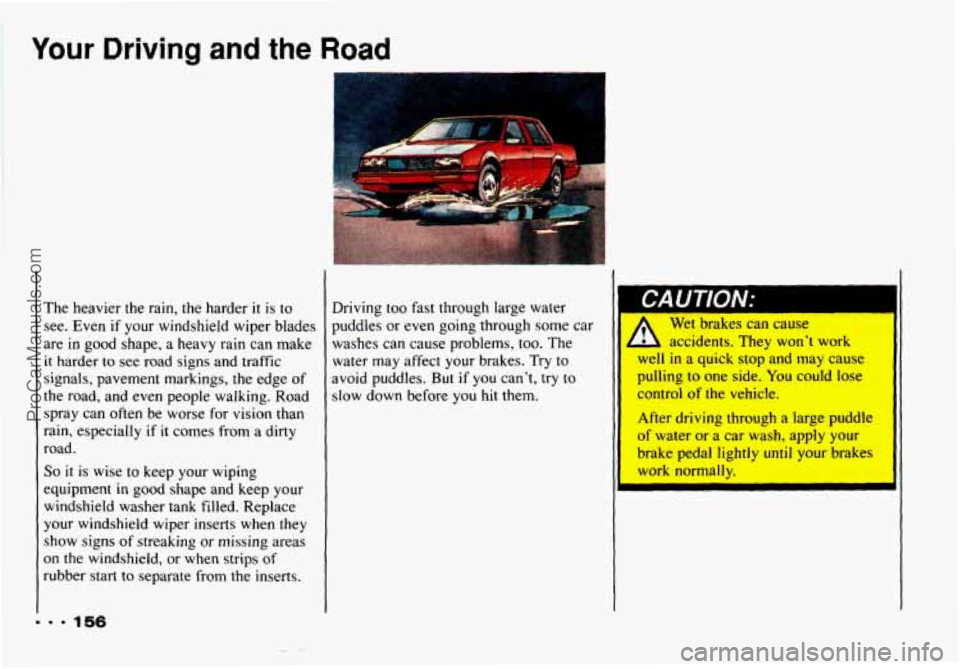
water may affect your brakes. Try to
avoid puddles. But
if you can’t, try to
slow down before
you hit them. Wet
brakes can cause
- L accidents. They won’t work
I
well in a quick stop and may cause
pulling to one side.
You could lose
control of the vehicle.
After driving through a large puddle
of water or a car wash, apply your
brake pedal lightly
until your brakes
work normally.
ProCarManuals.com
Page 166 of 358
Your Driving and the Road
Just before you leave the lane,’ glance
quickly over your shoulder to make sure
there isn’t another vehicle
in your “blind”
spot.
If you are moving from an outside to a
center lane on a freeway having more
than two lanes, make sure another vehicle
isn’t about
to move into the same spot.
Look
at the vehicles two lanes over and
watch for telltale signs:
turn signals
flashing, an increase
in speed, or moving
toward the edge of the lane. Be prepared
to delay your move.
Once
you are moving on the freeway,
make certain you allow
a reasonable
following distance. Expect
to move
slightly slower at night.
162
Leaving the Freeway
When you want to leave the freeway,
move to
the proper lane well in advance.
Dashing across lanes at the last minute is
dangerous. If you miss your exit do not,
under any circumstances, stop and back
up. Drive on
to the next exit.
At each exit point is a deceleration lane.
Ideally
it should be long enough for you
to enter it at freeway speed (after
signaling,
of course) and then do your
braking before moving onto the exit
ramp. Unfortunately, not all deceleration
lanes are long enough
- some are too
short for
all the braking. Decide when to
start braking. If you must brake on the
through lane, and
if there is traffic close behind you, you can allow
a little extra
time and flash your brake lights
(in
addition to your turn signal) as extra
warning that you are about to slow down
and exit.
The exit ramp can be curved, sometimes
quite sharply.
The exit speed
is usually posted. Reduce
your speed according to your
speedometer, not
to your sense of motion.
After driving for any distance at higher
speeds, you
may tend to think you are
going slower than you actually are. For
example,
40 mph (65 km/h) might seem
like only
20 mph (30 km/h). Obviously,
this could lead
to serious trouble on a
ramp designed for
20 mph (30 km/h)!
ProCarManuals.com
Page 169 of 358
What can you do about highway
hypnosis'? First, be aware that
it can
happen.
Then here are some tips:
Make sure your vehicle is well
ventilated,
with a comfortably cool
interior.
Keep your eyes moving. Scan the road
ahead and
to the sides. Check your
rearview mirrors frequently and your
instruments from time
to time. This
can help you avoid a fixed stare. Wear
good sunglasses
in bright light.
Glare can cause drowsiness.
But don't
wear sunglasses
at night. They will
drastically reduce your overall vision
at
the very time you need all the
seeing power you have.
If you get sleepy,
pull off the road into
a rest, service, or parking area and
take a nap, get some exercise, or both.
For safety, treat drowsiness on the
highway as an emergency.
As in any driving situation. keep pace
with traffic and allow adequate following
distances.
Hill and Mountain
Roads
Driving on steep hills or mountains is
different from driving
in flat or rolling
terrain. If you drive regularly
in steep
country. or
if you're planning to visit
there, here are some tips that can make
your trips safer and more enjoyable.
0 Keep your vehicle in good shape.
Check all fluid levels and also the
brakes, tires, cooling system and
transmission. These parts can work
hard on mountain roads.
1659 *
ProCarManuals.com
Page 177 of 358
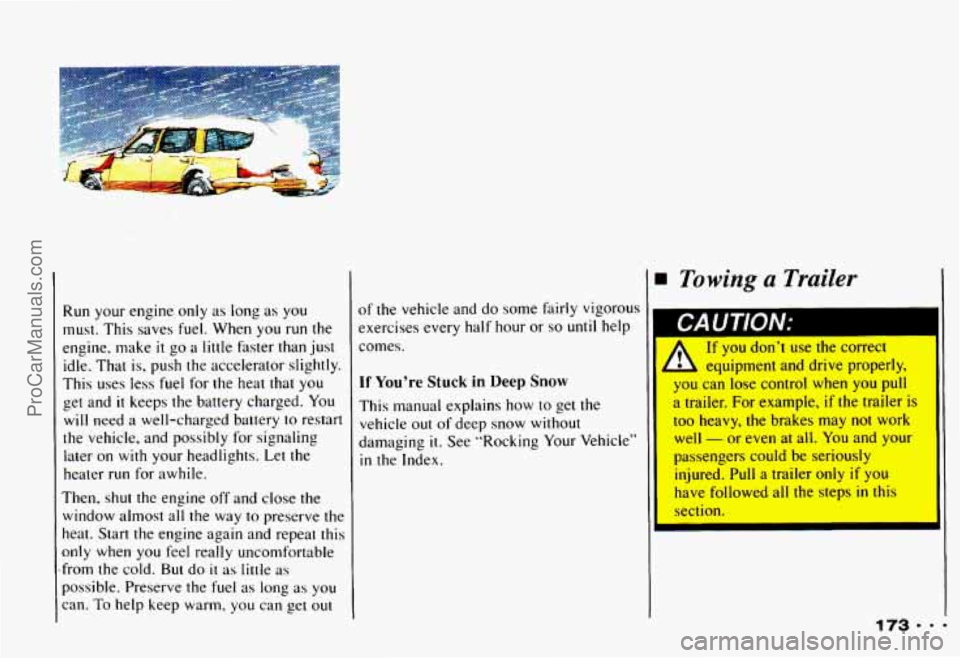
Run your engine only as long as you
must. This saves fuel. When you
run the
engine, make
it go a little faster than just
idle. That is, push the accelerator slightly.
This uses less fuel for the heat that you
get and
it keeps the battery charged. You
will need a well-charged battery to restart
the vehicle, and possibly for signaling
later on
with your headlights. Let the
heater
run for awhile.
Then. shut the engine off and close the
window almost all the way to preserve the
heat. Start the engine again and repeat this
only when you feel really uncomfortable
from the cold.
But do it as little as
possible. Preserve the fuel as long as you
can.
To help keep warm. you can get out
3f the vehicle and do some fairly vigorous
zxercises every half hour or
so until help
Zomes.
If You're Stuck in Deep Snow
This manual explains how to get the
vehicle
out of deep snow without
damaging it. See "Rocking Your Vehicle"
in the Index.
Towing a Trailer
you can lose control when you pull
a trailer. For example, if the trailer is
too heavy, the brakes may not work
well - or even at all. You and your
passengers could be seriously
injured. Pull a trailer only if you
have followed all the steps in this
section.
ProCarManuals.com
Page 182 of 358
Your Driving and the Road
178
weight of the trailer. And always keep in
mind that the vehicle you are driving is
now a good deal longer and not nearly so
responsive as your vehicle is by itself,
Before you start, check the trailer hitch
and platform, safety chains, electrical
connector, lights, tires and mirror
adjustment. If the trailer has electric
brakes, start your vehicle and trailer
moving and then apply the trailer brake
controller by hand
to be sure the brakes
are working. This lets you check your
electrical connection
at the same time.
During your trip, check occasionally to be
sure that the load is secure, and that the
lights and any trailer brakes are still
working.
Following Distance
Stay at least twice as far behind the
vehicle ahead as you would when driving
your vehicle without a trailer. This can
help you avoid situations that require
heavy braking and sudden turns.
Passing
You’ll need more passing distance up
ahead when you’re towing a trailer. And,
because you’re a good deal longer, you’ll
need to go much farther beyond the
passed vehicle before you can return
to
your lane.
Backing Up
Hold the bottom of the steering wheel
with one hand. Then, to move the trailer
to the left, just move that hand
to the left.
To move the trailer to the right, move
your hand
to the right. Always back up
slowly and,
if possible, have someone
guide you.
Making Turns
When you’re turning with a trailer, make
wider turns than normal.
Do this so your
trailer won’t strike
soft shoulders, curbs,
road signs, trees, or other objects. Avoid
jerky or sudden maneuvers. Signal well
in
advance.
ProCarManuals.com
Page 183 of 358

Turn Signals When Towing a Trailer
When you tow a trailer, your vehicle has to
have a different turn signal flasher and
extra wiring. The green arrows on your
instrument panel will flash whenever you
signal a turn or lane change. Properly
hooked up, the trailer lights will also flash,
telling other drivers you’re about to
turn,
change lanes or stop.
When towing a trailer, the green arrows on
your instrument panel will flash for turns
even if the bulbs on the trailer are burned
out. Thus,
you may think drivers behind
you are seeing your signal when they are
not. It’s important to check occasionally to
be sure the trailer bulbs are still working.
Driving on Grades
Reduce speed and shift to a lower gear
before you start down a long or steep
downgrade. If
you don’t shift down, you
might have to use your brakes
so much
that they would get hot and no longer work well.
On a long uphill grade, shift down and
reduce your speed to around
45 mph
(70 km/h) to reduce the possibility of
engine and transmission overheating. If you
are towing a trailer and you
have an automatic transmission with
Overdrive, you may prefer to drive
in D
instead of Overdrive (or, as you need to,
a lower gear). Or, if you have a manual
transmission
with fifth (or sixth) gear
and you are towing a trailer, it’s better
not to use
fifth (or sixth) gear. Just drive
in fourth gear (fifth gear
if you have
a six-speed manual transmission)
(or, as you need to, a lower gear.
ProCarManuals.com