Page 27 of 386
Seats & Safety Belts
1
I I
1
AM110001
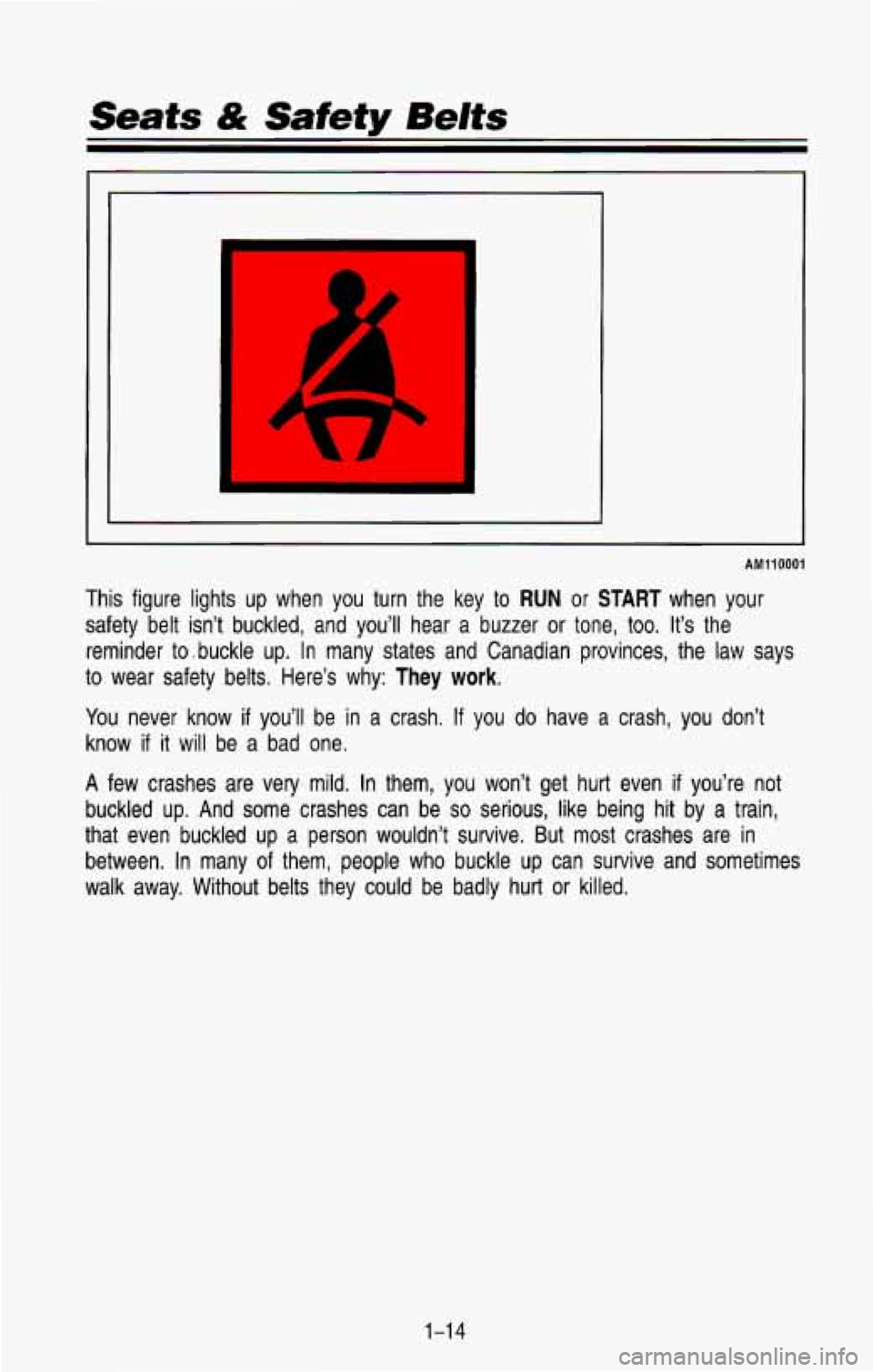
This figure lights up when you turn the key to RUN or START when your
safety belt isn’t buckled, and you’ll hear a buzzer or tone,
too. It’s the
reminder to .buckle
up. In many states and Canadian provinces, the law says
to wear safety belts. Here’s why: They work.
You never know if you’ll be in a crash. If you do have a crash, you don’t
know
if it will be a bad one.
A few crashes are very mild. In them, you won’t get hurt even if you’re not
buckled up. And
some crashes can be so serious, like being hit by a train,
that even buckled up a person wouldn’t survive.
But most crashes are in
between. In many of them, people who buckle up can survive an\
d sometimes
walk away. Without belts they could be badly hurt
or killed.
1-1 4
Page 29 of 386
Seats & Safety Belts
b
AM1 15003 AM115004
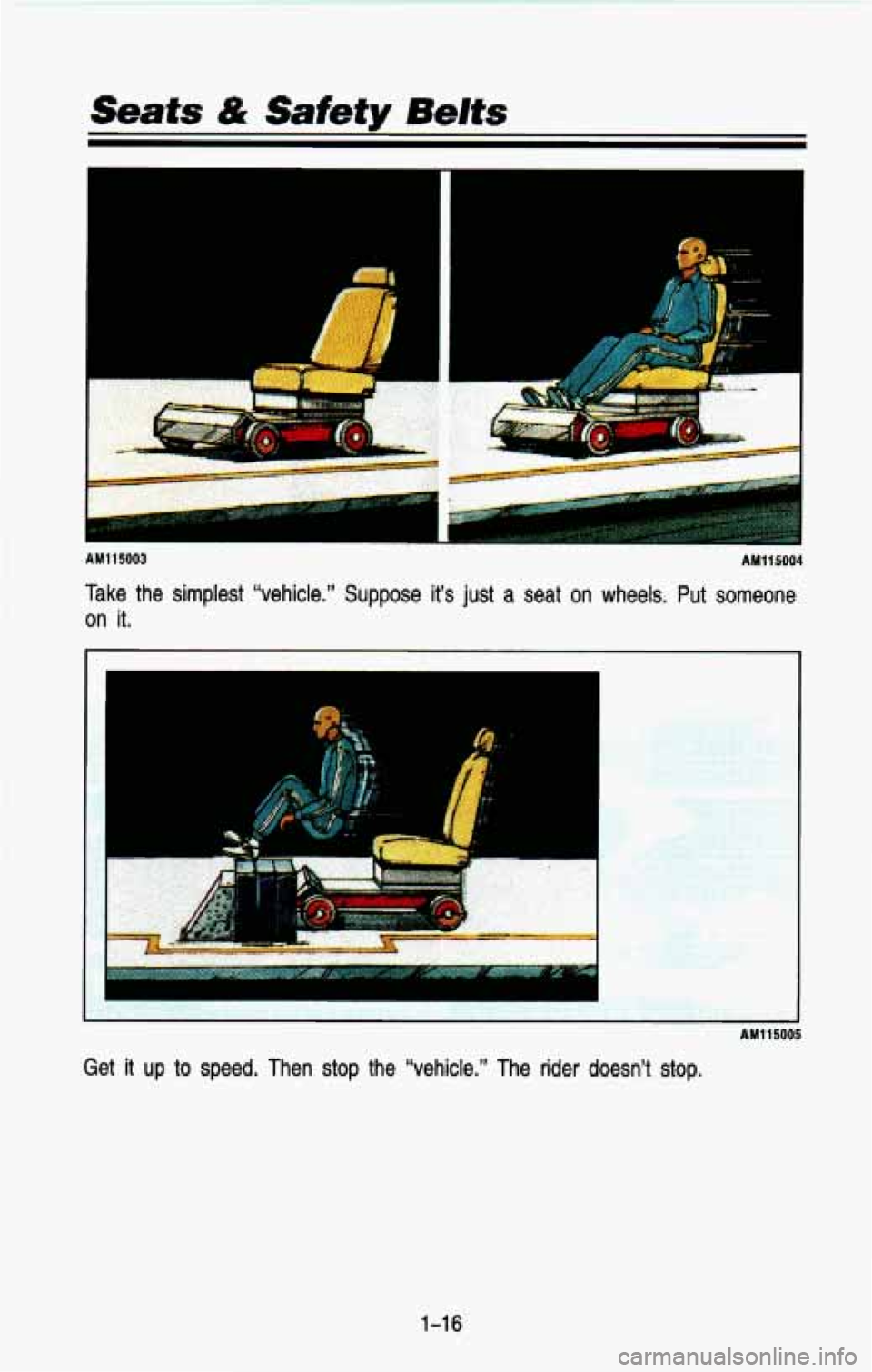
Take the simplest “vehicle.” Suppose it’s just a seat on wheels. Put someone
on it.
I
AM115005
Get it up to speed. Then stop the “vehicle.” The rider doesn’t stop.\
1-1 6
Page 31 of 386
Seats & Safety Belts
1
AM115008
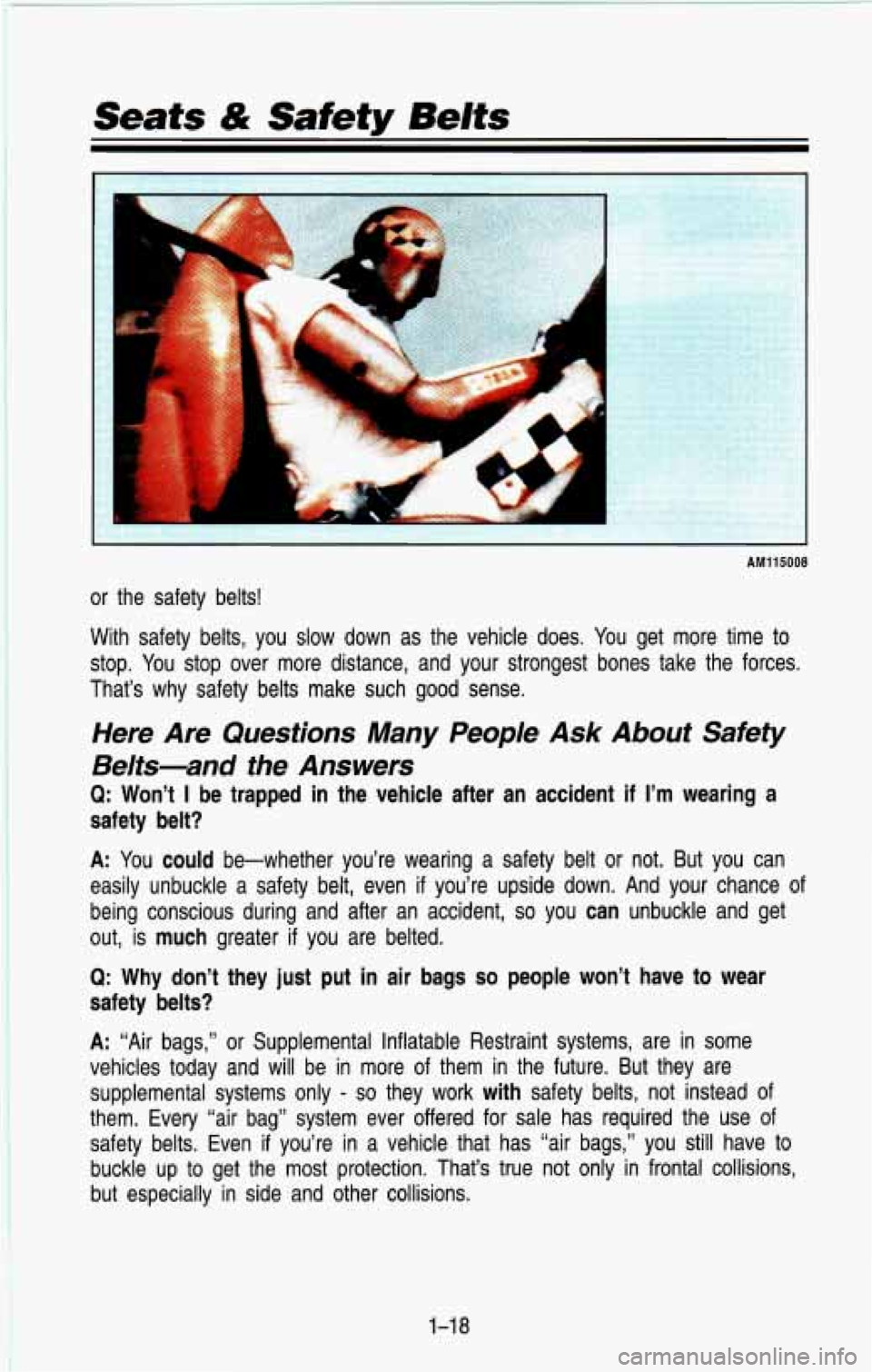
or the safety belts!
With safety belts, you slow down as the vehicle does. You get more time to
stop. You stop over more distance, and your strongest bones take the forces.
That’s why safety belts make such good sense.
Here Are Questions Many People Ask About Safety
Belts-and the Answers
Q: Won’t I be trapped in the vehicle after an accident if I’m wearing a
safety belt?
A: You could be-whether you’re wearing a safety belt or not. But you can
easily unbuckle a safety belt, even
if you’re upside down. And your chance of
being conscious during and after an accident,
so you can unbuckle and get
out, is
much greater if you are belted.
Q: Why don’t they just put in air bags so people won’t have to wear
safety belts?
A: “Air bags,” or Supplemental Inflatable Restraint systems, a\
re in some
vehicles today and
will be in more of them in the future. But they are
supplemental systems only
- so they work with safety belts, not instead of
them. Every “air bag” system ever offered for sale has r\
equired the use of
safety belts. Even if you’re in a vehicle that has “air bags,” you still have to
buckle up to get the most protection. That’s true not only in frontal collisions,
but especially in side and other collisions.
1-1 8
Page 34 of 386
Lap-Shoulder Belt
T
I 1 I I I
AM1 20007
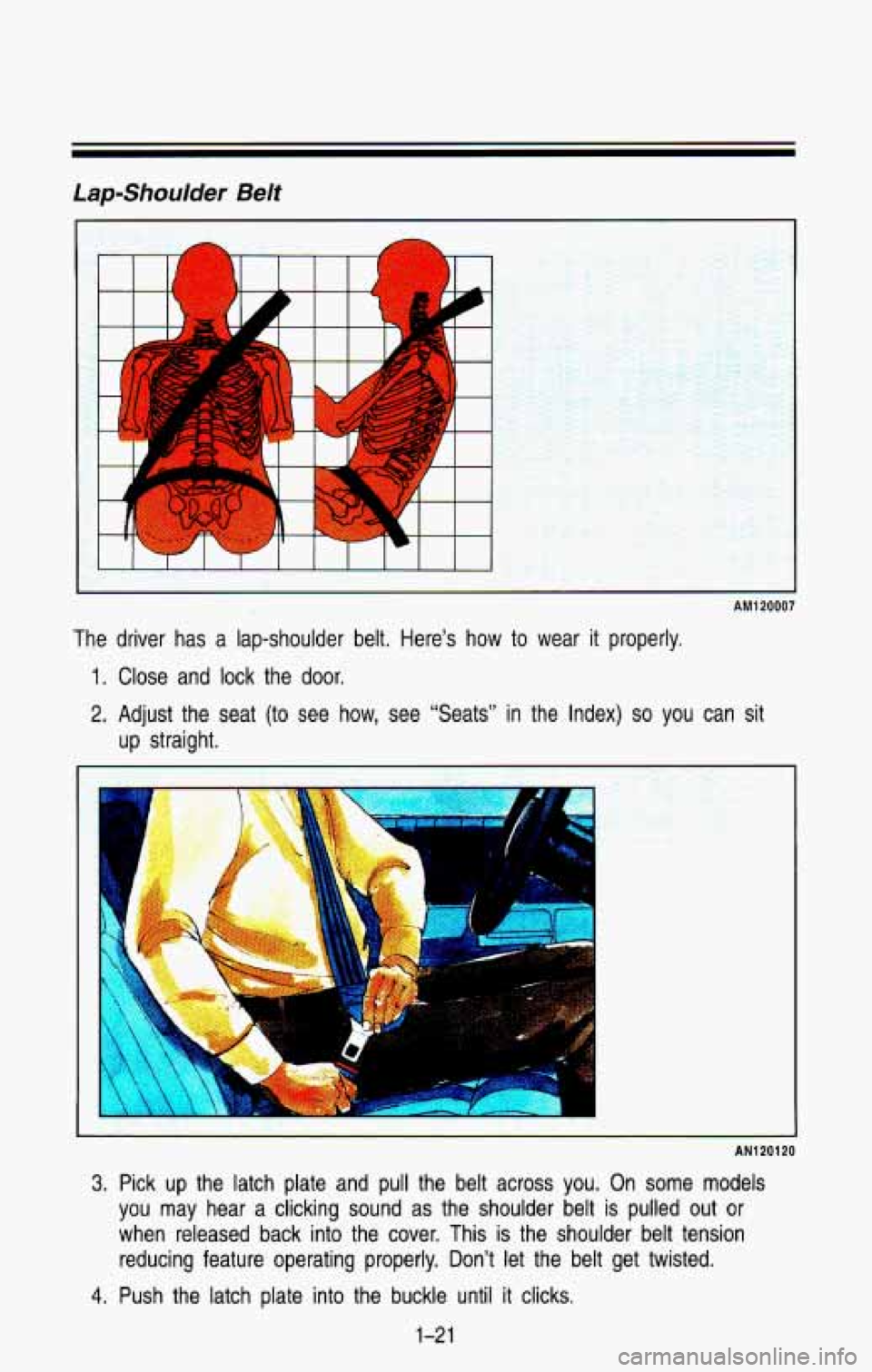
The driver has a lap-shoulder belt. Here’s how to wear it properly.
1. Close and lock the door.
2. Adjust the seat (to see how, see “Seats” in the Index)\
so you can sit
up straight.
1
AN120120
3. Pick up the latch plate and pull the belt across you. On some models
you may hear a clicking sound
as the shoulder belt is pulled out or
when released back into the cover. This is the shoulder belt tension
reducing feature operating properly. Don’t let the belt get \
twisted.
4. Push the latch plate into the buckle until it clicks.
1-21
Page 35 of 386

Seats & Safety Belts
If the belt isn’t long enough, see “Safety Belt Extender”\
at the end of this
section.
Make sure the release button on the buckle faces upward or outward
so you
would be able to unbuckle it quickly if you ever had to.
The lap part of the belt should be low and snug on the hips, just touching
the thighs. In a crash, this applies force to the strong pelv\
ic bones. And
you’d be less likely to slide under the lap belt.
If you slid under it, the belt
would apply force at your abdomen. This could cause serious or even \
fatal
injuries. The shoulder belt should
go over the shoulder and across the chest.
These parts of the body are best able to take belt restraining forces.
The safety belt locks
if there’s a sudden stop or a crash.
Q: What’s wrong with this?
AM120015
A: The shoulder belt is too loose. It won’t give nearly as much protection this
way.
A You can be seriously hurt if your shoulder belt is too loose. In a
- crash you would move forward too much, which could increase in\
jury.
The shoulder belt should
fit against your body.
1-22
Page 39 of 386
Seats & Safety Belts
Before you close the door, be sure the belt is out of the way, If you slam
the door on it, you can damage both the belt and your vehicl\
e.
Safety Belt Use During Pregnancy
Safety belts work for everyone, including pregnant women. Like \
all occupants,
they are more likely to be seriously injured
if they don’t wear safety belts.
A pregnant woman should wear a lap-shoulder belt, and the lap po\
rtion
should be worn as
low as possible throughout the pregnancy.
The best way to protect the fetus
is to protect the mother. When a safety
belt is worn properly, it’s more likely that the fetus won’t be \
hurt in a crash.
For pregnant women, as for anyone, the key to making safety belts effective
is wearing them properly.
1-26
Page 40 of 386
Right Front Passenger Position
K2426
The right front passenger’s safety belt works the same way \
as the driver’s safety belt.
See “Driver Position,” earlier in this section.
When the lap portion
of the belt is pulled out all the way, it will lock. If it
does, let it go back all the way and start again.
Center Passenger Position
(Except Wagon Models Second Seat)
If your vehicle has front and rear bench seats, someone can sit in the center
positions.
1-27
Page 41 of 386
- Seats & Safety Belts
When you sit in the center seating position, (except in the second seat of the
Wagon Models) you have a lap safety belt, which has no retractor.
To make
the belt longer, tilt the latch plate and pull it along the \
belt.
I AN145041 AN145043
To make the belt shorter, pull its free end as shown until the belt is snug.
Buckle, position and release
it the same way as the lap part of a
lap-shoulder belt.
If the belt isn’t long enough, see “Safety Belt Extender’’\
at the end of this
section.
Make sure the release button on the buckle faces upward or ou\
tward
so you
would be able to unbuckle
it quickly if you ever had to.
1-28