1993 CHEVROLET BLAZER mirror
[x] Cancel search: mirrorPage 210 of 386
 are the safest of all roads. But \
they have their
own spe")
Freeway Driving
Mile for mile, freeways (also called thruways, parkways, expres\
sways,
turnpikes, or superhighways) are the safest of all roads. But \
they have their
own special rules.
The most important advice on freeway driving is: Keep up with \
traffic and keep to the right. Drive at the same speed most of the other drivers are
driving. Too-fast or too-slow driving breaks a smooth traffic f\
low. Treat the left
lane on a freeway as a passing lane.
Entering the Freeway
At the entrance there is usually a ramp that leads to the freeway. If you have
a clear view of the freeway as you drive along the entrance ramp, you
should begin to check traffic. Try to determine where you expect to blend
with the flow.
If traffic is light, you may have no problem. But if it is heavy,
find a gap as you move along the entering lane and time your approach. Try
to merge into the gap at close to the prevailing speed. Switch on your turn
signal, check your rearview mirrors as you move along, and gla\
nce over your
shoulder as often as necessary. Try to blend smoothly with the traffic flow.
Driving on the Freeway
Once you are on the freeway, adjust your speed to the posted limit or to the
prevailing rate
if it’s slower. Stay in the right lane unless you want to pass. If
you are on a two-lane freeway, treat the right lane as the slow lane and the
left lane as the passing lane.
If you are on a three-lane freeway, treat the
right lane as the slower-speed through lane, the middle lane as the
higher-speed through lane, and the left lane as the passing la\
ne.
4-43
Page 211 of 386

Your Driving and the Road
Before changing lanes, check your rearview mirrors. Then use yo\
ur turn
signal. Just before you leave the lane, glance quickly over yo\
ur shoulder to
make sure there isn’t another vehicle in your “blind” spot.
If you are moving from an outside to a center lane on a freeway\
having
more than two lanes, make sure another vehicle isn’t about to move into the
same spot. Look at the vehicles two lanes over and watch for \
telltale signs:
turn signals flashing, an increase in speed, or moving toward \
the edge of the
lane. Be prepared to delay your move.
Once you are moving on the freeway, make certain you allow a \
reasonable
following distance. Expect to move slightly slower at night.
Leaving the Freeway
When you want to leave the freeway, move to the proper lane \
well in
advance. Dashing across lanes at the last minute is dangerous. \
If you miss
your exit do not, under any circumstances, stop and back up. \
Drive
on to the
next exit.
At each exit point is a deceleration lane. Ideally it should be long enough for
you to enter it at freeway speed (after signaling, of course) and then do your
braking before moving onto the exit ramp. Unfortunately, not al\
l deceleration
lanes are long enough-some are too short for
all the braking. Decide when
to start braking.
If you must brake on the through lane, and if there is traffic
close behind you, you can allow a little extra time and flash\
your brake lights
(in addition to your turn signal) as extra warning that you are about to slow
down and exit.
The exit ramp can be curved, sometimes quite sharply. The exit\
speed
is
usually posted. Reduce your speed according to your speedometer, not to
your sense of motion. After driving for any distance at higher speeds, you
may tend to think you are going slower than you actually are. For example,
40 mph (65 km/h) might seem like only 20 mph (30 kmlh). Obviously, this
could lead to serious trouble on a ramp designed for
20 mph (30 km/h)!
Driving a Long Distance
Although most long trips today are made on freeways, there are\
still many
made on regular highways.
Long-distance driving on freeways and regular highways is the same in some
ways. The trip has to be planned and the vehicle prepared, yo\
u drive at higher-than-city speeds, and there are longer turns behind the wheel. You’ll
enjoy your trip more
if you and your vehicle are in good shape. Here are
some tips for
a successful long trip.
4-44
Page 213 of 386

Your Driving and the Road
Highway Hypnosis
Is there actually such a condition as “highway hypnosis?” Or \
is it just plain
falling asleep at the wheel? Call
it highway hypnosis, lack of awareness, or
whatever.
There is something about an easy stretch of road with the sam\
e scenery, along with the hum of the tires on the road, the drone of the engine, and the
rush
of the wind against the vehicle that can make you sleepy. Don’\
t let it
happen to you! If it does, your vehicle can leave the road in less than a
second,
and you could crash and be injured.
What can you do about highway hypnosis? First, be aware that
it can
happen.
Then here are some tips:
Make sure your vehicle is well ventilated, with a comfortably \
cool interior.
Keep your eyes moving. Scan the road ahead and to the sides. Check
your rearview mirrors frequently and your instruments from time \
to time.
This can help you avoid a fixed stare.
Wear good sunglasses in bright light. Glare can cause drowsiness. But
don’t wear sunglasses at night. They will drastically reduce your overall
vision at the very time you need all the seeing power you have.
If you get sleepy, pull off the road into a rest, service, or parking area
and take a nap, get some exercise, or both. For safety, treat\
drowsiness
on the highway as an emergency.
As in any driving situation, keep pace with traffic and allow ade\
quate
following distances.
4-46
Page 227 of 386

Your Driving and 0% Road
Will you have to make any holes in the body of your vehicle when you
install a trailer hitch?
If you do, then be sure to seal the holes later
when you remove the hitch.
If you don’t seal them, deadly carbon
monoxide
(CO) from your exhaust can get into your vehicle (see “Carbon
Monoxide” in the Index). Dirt and water can, too.
Safety Chains
You should always attach chains between your vehicle and your trail\
er. Cross
the safety chains under the tongue of the trailer
so that the tongue will not
drop to the road
if it becomes separated from the hitch. Instructions about
safety chains may be provided by the trailer manufacturer. Follow the
manufacturer’s recommendation
for attaching safety chains. Always leave just
enough slack
so you can turn with your rig. And, never allow safety chains to
drag on the ground.
Trailer Brakes
If your trailer weighs more than 1,000 pounds (450 kg) loaded, then it needs
its own brakes-and they must be adequate. Be sure
to read and follow the
instructions for the trailer brakes
so you’ll be able to install, adjust and
maintain them properly.
Don’t tap into your vehicle’s brake system if the trailer’s brake system will use
more than
0.02 cubic inch (0.3 cc) of fluid from your vehicles master cylinder.
If it does, both braking systems won’t work well. You could even lose your
brakes.
Will the trailer brake parts take 3,000 psi (20 650 kPa) of pressure? If
not, the trailer brake system must not be used with your vehi\
cle.
If everything checks out this far, then make the brake fluid tap at the
port on the master cylinder that sends fluid
to the rear brakes. But don’t
use copper tubing for this.
If you do, it will bend and finally break off.
Use steel brake tubing.
Driving with a Trailer
Towing a trailer requires a certain amount of experience. Before setting out
for the open road, you’ll want
to get to know your rig. Acquaint yourself with
the feel of handling and braking with the added weight of the trailer. And
always keep in mind that the vehicle you are driving is now a good deal
longer and not nearly
so responsive as your vehicle is by itself.
Before you start, check the trailer hitch and platform, safety \
chains, electrical
connector, lights, tires and mirror adjustment.
If the trailer has electric brakes,
start your vehicle and trailer moving and then apply the trail\
er brake controller
by hand to be sure the brakes are working. This lets vou check your
electrical connection at the same time.
4-60
Page 329 of 386
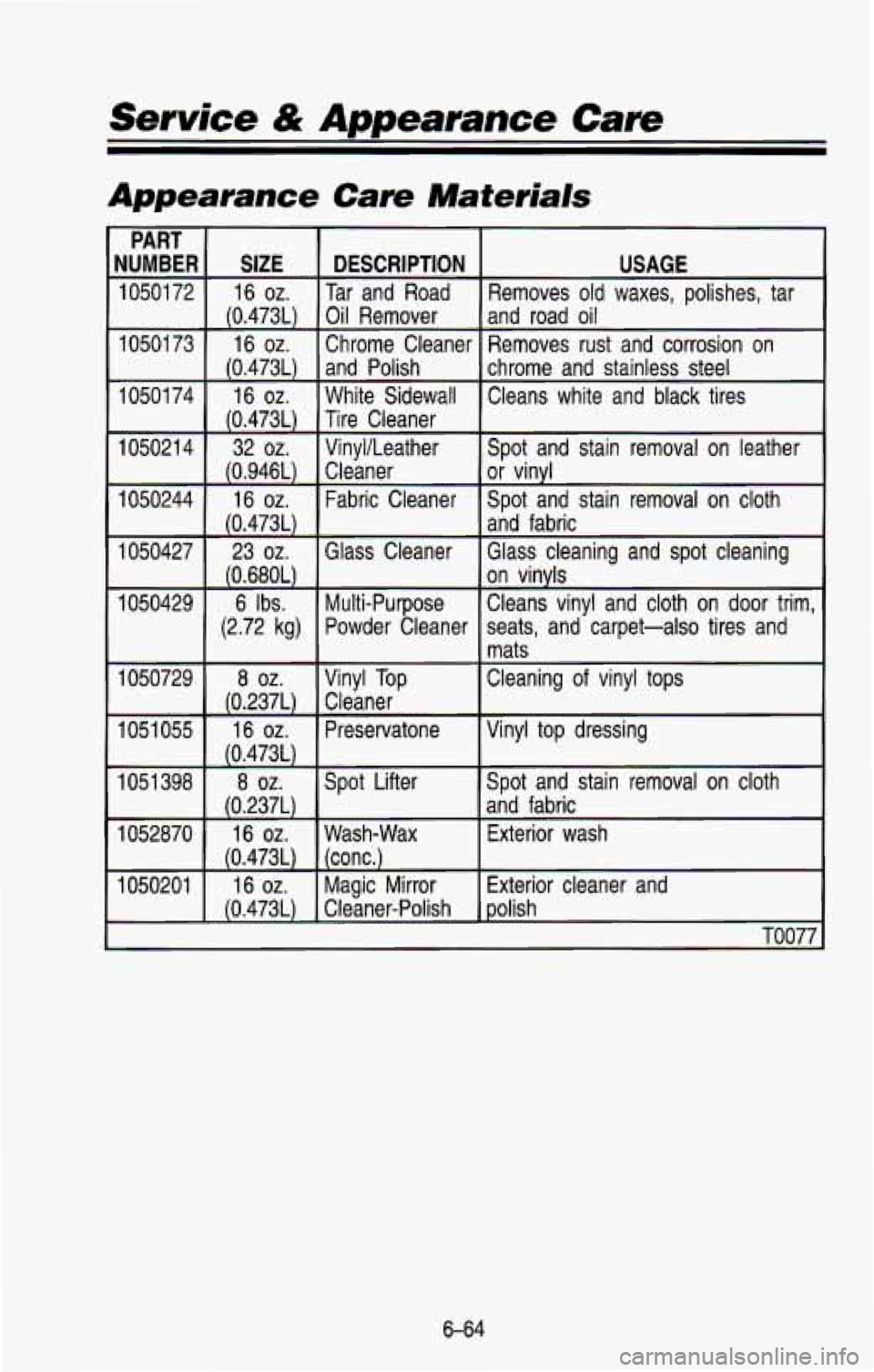
Service & Appearance Care
Appearance Care Materials
PART I I I
NUMBER SIZE DESCRIPTION USAGE
1050172 16 02. Tar and Road Removes old waxes, polishes, tar
1050173 16
oz. Chrome Cleaner Removes rust and corrosion on
I0501 74 16
02. White Sidewall Cleans white and black tires
(0.473L)
Oil Remover and road oil
(0.473L) and Polish chrome and stainless steel
(0.473L) Tire Cleaner
1050214 32
oz. VinvVLeather Spot and stain removal on leather
(0.946L) Cleaner or vinyl
(0.473L) and fabric
1050244 16 02. Fabric Cleaner Spot and stain removal on cloth
I050427 23
02. Glass Cleaner Glass cleanina and sDot cleaning I
(0.680L)
"
on vinyls
-
1050429 6 Ibs. Multi-PurDose Cleans vinvl and cloth on door tr\
im,
(2.72 kg) Powder cleaner seats, and'carpet-also tires and
mats
1050729 8
02. Vinyl Top
Cleaning of vinyl tops
1051
055 16 02. Preservatone Vinyl top dressing
IO51
398 8 02. Spot Lifter Spot and stain removal on cloth
1052870 16
02. Wash-Wax Exterior wash
(0.237L) Cleaner
(0.473L)
(0.237L)
and fabric
(0.473L) (conc.)
1050201 16
02. Magic Mirror Exterior cleaner and
I (0.473L) I Cleaner-Polish 1 polish
TO077
6-64
Page 380 of 386

M
Maintenance Other Items
............................... 6-34
Periodic Inspections
................. 7-24
Record
............................... 7.3. 7-27
Scheduled Maintenance
.. 7.4. 7-1 8
Underbody
................................ 6-62
When Towing a Trailer
............. 4-63
Master Cylinder (See “Brakes”)
Mirrors
........................................... 2-51
Convex Outside
........................ 2-52
Electric Outside
........................ 2-52
Inside
.......................................... 2-51
Model Reference
............................... III
Multifunction Lever ...................... 2-36
...
Turn SignalLane
Change Indicator
........... 2-37, 2-75
0
Odometer ....................................... 2-66
Off-Road Driving (See “Driving”)
Off-Road Recovery
..................... 4-20
Oil ..................................................... 6-9
Additives
................................... 6-1 5
Disposal of Used ...................... 6-1 6
Pressure Gage
.......................... 2-78
To Check
................................... 6-1 0
What Kind to Use .................... 6-12
When
to Add ............................ 6-10
When
to Change ...................... 6-1 5
Owner Checks and Services ...... 7-22
Parking On Hills
...................................... 4.49
Over Things That Burn
............ 2-27
Torque Lock (Automatic
Transmission)
............. 2.24. 4-52
Your Vehicle (Manual Transmission)
........................ 2-26
Parking Brake
............................... 2-23
Passing
Other Vehicles .... 4.21. 4-61
Pavement Markings
........................ 4-8
Periodic Maintenance
Power Inspections
................................ 7-24
Door Locks
.................................. 2-7
Steering
..................................... 4-18
Steering Fluid
........................... 6-29
Winches
..................................... 4-64
Product Service Publications
....... 8-6
R
Radiator Pressure Cap ................ 6-28
Radio (See “Audio Systems”)
Rear Window Defogger
.............. 3-11
Recommended Fluids And Lubricants
......................... 7-25
Recovery Hooks
........................... 5-32
Replacement Parts
...................... 6-68
Reporting Safety Defects
............. 8-4
Road Signs
..................................... 4-2
Roadside Assistance
..................... 8-5
Rocking Your Vehicle
.................. 5-32
S
Safety Belts .................................. 1-13
Center Passenger
........... 1-27, 1-29
Cleaning
..................................... 6-60
Checking Restraint System
.... 1-47
Child Restraints
........................ 1-36
Children
...................................... 1-34
Driver Position
.......................... 1-20
Extender
.................................... 1-46
Lap Shoulder
............................ 1-21
Larger Children
......................... 1-44
Proper Wear
............................. 1-20
Questions and Answers
.......... 1-18
Rear Seat
.................................. 1-30
Replacing After a Crash
......... 1-47
Right Front Passenger
............ 1-27
Small Children and Babies
..... 1-34
Use During Pregnancy
............ 1-26
Why They Work ....................... 1-15
Adults
......................................... 1-20
Reminder Light
......................... 1-19
9-5