1993 CHEVROLET BLAZER heating
[x] Cancel search: heatingPage 155 of 386
Comfort Controls & Audio Systems
Rear Air Conditioning and Rear Heater
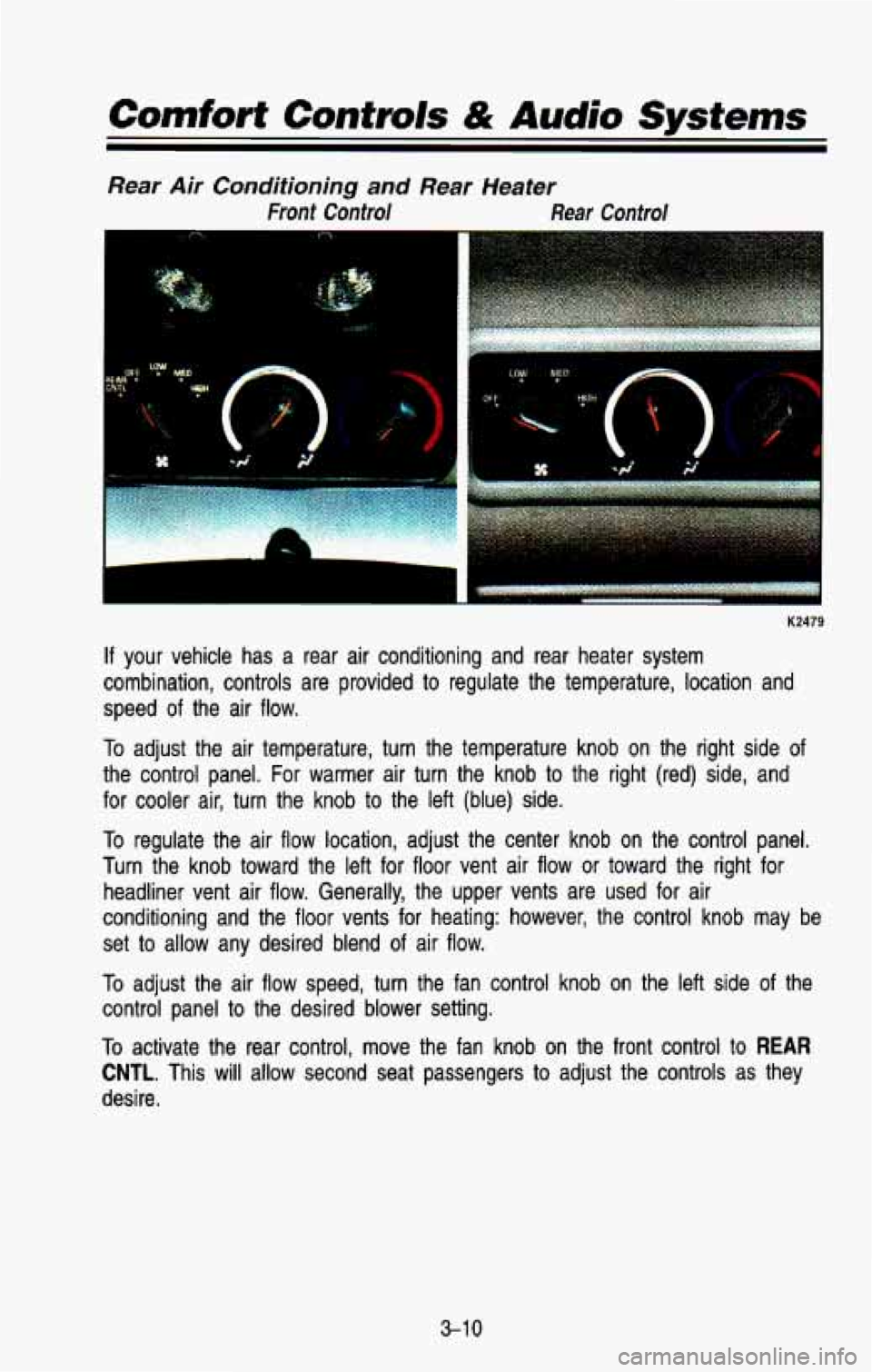
Front Control Rear Control
K2479
If your vehicle has a rear air conditioning and rear heater system
combination, controls are provided to regulate the temperature, \
location and
speed of the air flow.
To adjust the air temperature, turn the temperature knob on the r\
ight side of
the control panel. For warmer air turn the knob to the right (re\
d) side, and
for cooler air, turn the knob to the left (blue) side.
To regulate the air flow location, adjust the center knob on the \
control panel,
Turn the knob toward the left for floor vent air flow or tow\
ard the right for headliner vent air flow. Generally, the upper vents are used f\
or air
conditioning and the floor vents for heating: however, the cont\
rol knob may be
set to allow any desired blend
of air flow.
To adjust the air flow speed, turn the fan control knob on the \
left side of the
control panel to the desired blower setting.
To activate the rear control, move the fan knob on the front control to REAR
CNTL. This will allow second seat passengers to adjust the controls as they
desi re.
3-10
Page 228 of 386

I
If you have a rear-most window open and you pull a trailer with \
your
can’t see or smell
CO. It can cause unconsciousness or death (See
“Engine Exhaust” in the Index).
To maximize your safety when towing
a trailer:
- vehicle, carbon monoxide (CO) could come into your vehicle. You
Have the exhaust system inspected for leaks and make
Keep the rear-most windows closed.
If exhaust does come into your vehicle through a window in the
rear or another opening, drive with your front, main heating or
cooling system
on and with the fan on any speed. This will
bring fresh, outside air into your vehicle.
Do not use RECIR
because it only recirculates the air inside your vehicle. See
“Comfort Controls” in the Index.
necessary repairs before starting on your trip.
During your trip, check occasionally to be sure that the load is secure, and
that the lights and any trailer brakes are still working.
Following Distance
Stay at least twice as far behind the vehicle ahead as you would when
driving your vehicle without a trailer. This can help you avoid situations that
require heavy braking and sudden turns.
Passing
You’ll need more passing distance up ahead when you’re towing a tr\
ailer.
And, because you’re
a good deal longer, you’ll need to go much farther
beyond the passed vehicle before you can return to your lane.
Backing Up
Hold the bottom of the steering wheel with one hand. Then, to move the
trailer left, just move your hand to the left.
To move the trailer to the right,
move your hand to the right. Always back up slowly and,
if possible, have
someone guide you.
Making Turns
When you’re turning with a trailer, make wider turns than n\
ormal. Do this so
your trailer wheels won’t strike soft shoulders, curbs, road signs, trees, or
other objects. Avoid jerky or sudden maneuvers. Signal well in advance.
4-61
Page 229 of 386
Your Driving and the Road
Turn Signals When Towing a Trailer
When you tow a trailer, your vehicle has to have a different turn signal
flasher and extra wiring. The green arrows on your instrument \
panel will flash
whenever you signal a turn
or lane change. Properly hooked up, the trailer
lights will also flash, telling other drivers you’re about
to turn, change lanes,
or stop.
When towing a trailer, the green arrows on your instrument pan\
el will flash for
turns even
if the bulbs on the trailer are burned out. Thus, you may think \
drivers behind you are seeing your signal when they are not.
It’s important to
check occasionally to be sure the trailer bulbs are still working.
Driving on Grades
Reduce speed and shift to a lower gear before you start down a long or
steep downgrade. If you don’t shift down, you might have to use your brakes
so much that they would get hot and no longer work well.
On
a long uphill grade, shift down and reduce your speed to 45 mph (70
kmlh) or less to reduce the possibility of engine and transmission overheating.
If you have an automatic transmission, you should use D (or, as you need to,
a lower gear) when towing a trailer. Operating your vehicle in D when towing
a trailer will minimize heat buildup and extend the
life of your transmission.
Or,
if you have a manual transmission with fifth gear and you are to\
wing a
trailer, it’s better not
to use fifth gear, just drive in fourth gear (or, as you
need to, a lower gear).
Parking on Hilk
You really should not park your rig on a hill. If something goes wrong, your
rig could start
to move. People can be injured and both your vehicle and the
trailer can be damaged.
But
if you ever have to park your rig on a hill, here’s how to do it:
1. Apply your regular brakes, but don’t shift into P (Park) yet, or into gear
for a manual transmission.
2. Have someone place chocks under the trailer wheels.
3, When the wheel chocks are in place, release the regular brakes\
until the
4. Reapply the regular brakes. Then apply your parking brake, and \
then
chocks absorb the load.
shift
to P (Park), or R (Reverse) for a manual transmission.
5. If you have a four-wheel-drive vehicle, be sure the transfer case \
is in
a
drive gear-not in
N (Neutral).
4-62
Page 232 of 386

Here you’ll find what to do about some problems that can occur on the road.
Hazard Warning Flashers ........................................................................\
............. 5-2
Other Warning Devices ........................................................................\
................. 5-3
Jump Starting ........................................................................\
................................ 5-3
Towing Your Vehicle, ........................................................................\
..................... 5-7
Engine Overheating ........................................................................\
....................... 5-8
Engine Fan Noise ........................................................................\
....................... 5-1 6
If a Tire Goes Flat ........................................................................\
...................... 5-16
Changing a Flat
Storing the Jack
If You’re Stuck: In
Tire ........................................................................\
............... 5-16
and
Tire. ........................................................................\
...... 5-30
Sand, Mud, Ice or Snow ................................................... 5-31
5-1
Page 239 of 386

Pmbkms on the Road
If your vehicle has the four-wheel-drive option and the transfer case is
engaged,
a dolly must be used under the rear wheels when towing from the
front.
Engine Overheating
You will find a coolant temperature gage on your vehicle instrument panel,
If Steam Is Coming From Your Engine:
I
‘i Steam from an overheated engine can bum you badly, even if you
just open the hood. Stay away from the engine if you see or hear
steam coming from it. Just turn it off and get everyone away from
the vehide until it cools down. Wait until there is no sign of steam or
coalant before opening the hood.
If you keep driving when your engine is overheated, the liquids in it
can catch fire. You or others could be badly burned. Stop your
engine if it overheats, and get out of the vehicle until the engine is
Cool.
you keep driving with no coolant, your
costly repairs would not be covered
by
your warranty.
5-8
Page 242 of 386

The coolant level should be at or above COLD. If it isn’t, you may have a
leak in the radiator hoses, heater hoses, radiator, water pump or somewhere
else in the cooling system.
CAUTION
A
Heater and radiator hoses, and other engine parts, can be very\
hot.
Don’t touch them. If you
do, you can be burned.
Don’t run the engine
if there is a leak. If you run the engine, 1‘ it coulc
lose all coolant. That could cause an engine fire, and you could
be
I burned. Get any leak fixed before you drive the vehicle.
I
If there seems to be no leak, check to see if the electric engine fan (if you
have one) is running. If the engine is overheating, the fan \
should be running.
If
it isn’t, your vehicle needs service.
Start the engine again to see
if the regular fan runs when the engine does.
If
it doesn’t, your vehicle needs service. Turn off the engine.
How to Add Coolant to the Coolant Recovery Tank
If you haven’t found a problem yet, but the coolant level \
isn’t at or above
COLD, add a 50150 mixture of clean water (preferably distilled) and a proper
5-1 1
Page 291 of 386

Service & Appearance Care
The following explains your cooling system and how to add cool\
ant when it is
low.
If you have a problem with engine overheating, see “Engine
Overheating” in the Index.
The proper coolant for your vehicle
will:
Give freezing protection down to -34°F (-37°C).
Give boiling protection up to 258°F (125°C).
Protect against rust and corrosion.
Help keep the proper engine temperature.
Let the warning lights and gages work as they should.
What to Use:
Use a mixture of clean water (preferably distilled), and antifreeze that meets
“GM Specification
6038-M,” which won’t damage aluminum parts. Also use
GM Engine Coolant Supplement (sealer) with a complete coolant change.
If
you use these, you don’t need to add anything else.
Adding only plain water to your cooling system can be dangerous.
I
Plain water, or some other liquid like alcohol, can boil before the \
proper coolant mix will. Your vehicle’s coolant warning system is set
for the proper coolant mix. With plain water or the wrong mix, your
engine could get too hot but you wouldn’t get the overheat \
warning. Your engine could catch fire and you or others could be burned. Us\
e
a 50/50 mix of clean water and a proper antifreeze.
jIi ,yo.w use an improper coolant mix, your engine .coutd overheat andi
badly damaged. The repair cost wouldn’t be covered by your warranty.’ TP~
much water in ;the mix can freeze and crack the engine, radiator, .heater
wre-ad -.other parts.
Some conditions, such as air trapped in the cooling system, can affect the
coolant level in the radiator. Check the coolant level when th\
e engine is cold
and follow the steps under “Adding Coolant” for the prope\
r way to
add
coolant.
.. .. ..
If you have to add coolant mdre than four times a year, have your dealer
check
your cooling system.
6-26
Page 293 of 386
Service & Appearance Care
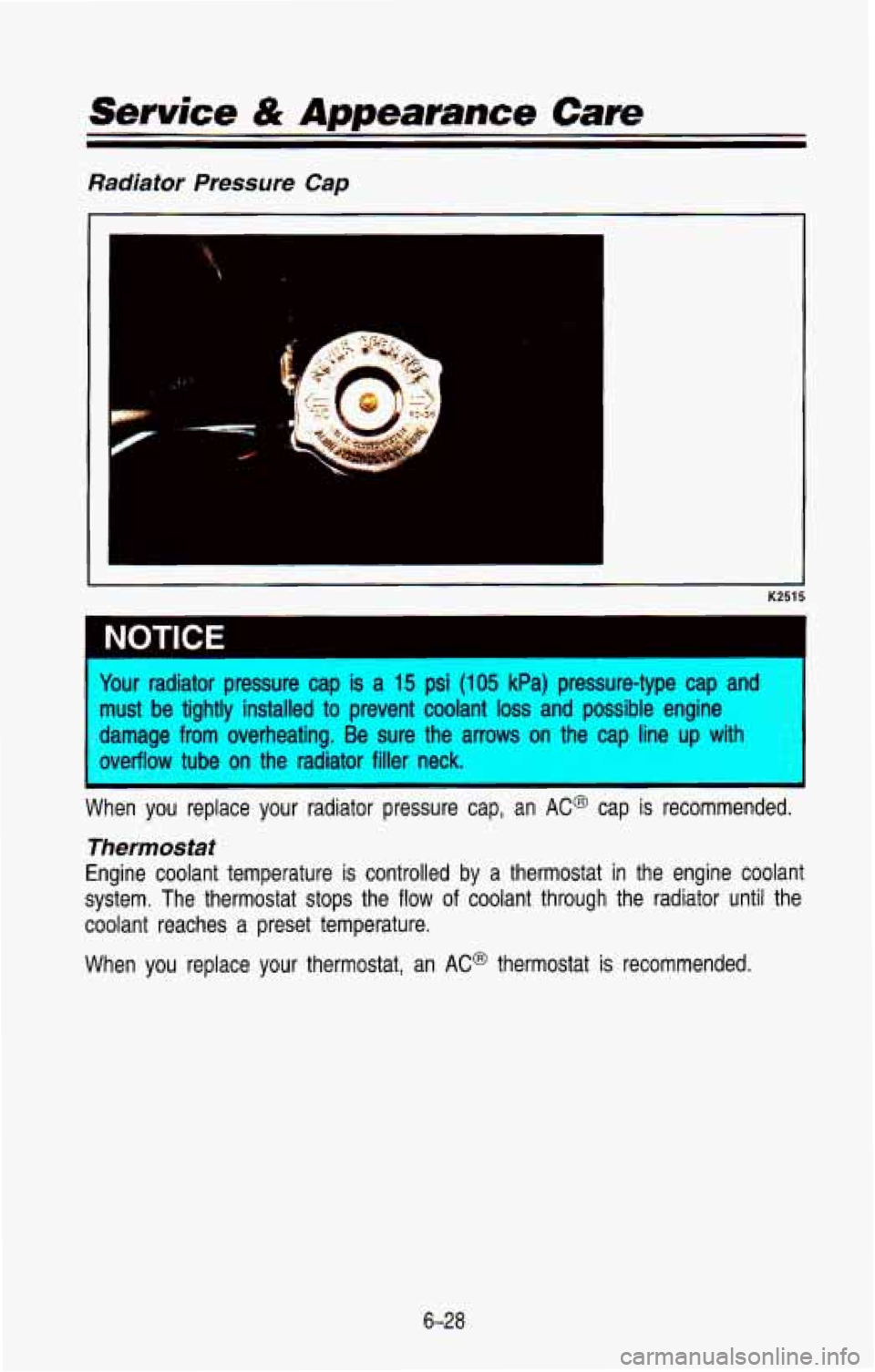
Radiator Pressure Cap
I
I
-
- K2515
1 NOTICE
four radiator pressure cap is a 15 psi (105 kPa) pressure-type cap and
nust be tightly installed to prevent coolant loss and possible engine
mage from overheating. Be sure the arrows on the cap line up \
with
werffow tube
on the radiator filler neck.
-m recommended.
I
Thermostat
Engine coolant temperature is controlled by a thermostat in the engine coolant
system. The thermostat stops the
flow of coolant through the radiator until the
coolant reaches a preset temperature.
When you replace
your thermostat, an AC@ thermostat is recommended.
6-28