1993 CHEVROLET BLAZER cooling
[x] Cancel search: coolingPage 243 of 386

Adding only plain water to your cooling system")
antifreeze at the coolant recovery tank. (See “Coolant” i\
n the Index for more information about the proper coolant mix.)
Adding only plain water to your cooling system can be dangerou\
s. Plain water,
or some other liquid like alcohol, can boil before the
proper coolant mix will. Your vehicle’s coolant warning system is set
for the proper coolant mix. With plain water
or the wrong mix, your
engine
could get too hot but you wouldn’t get the overheat warning.
Your engine could catch fire and you or others could be burned. Use
a 50150 mix of clean water and a proper antifreeze. I I
NOTICE I
In cold weather, water can freeze and crack the engine. radiator, heater
I core and other parts. Use the recommended coolant.
1
1 ::.
L.
k’
II
PO206
CAUTION
- = -
You can be burned if you spill coolant on hot engine parts. Coolant
contains ethylene glycol
and it will burn if the engine parts are hot
enough. Don’t spill coolant on
a hot engine.
When the coolant in the coolant recovery
is at or above COLD, start your
vehicle.
5-1 2
Page 244 of 386
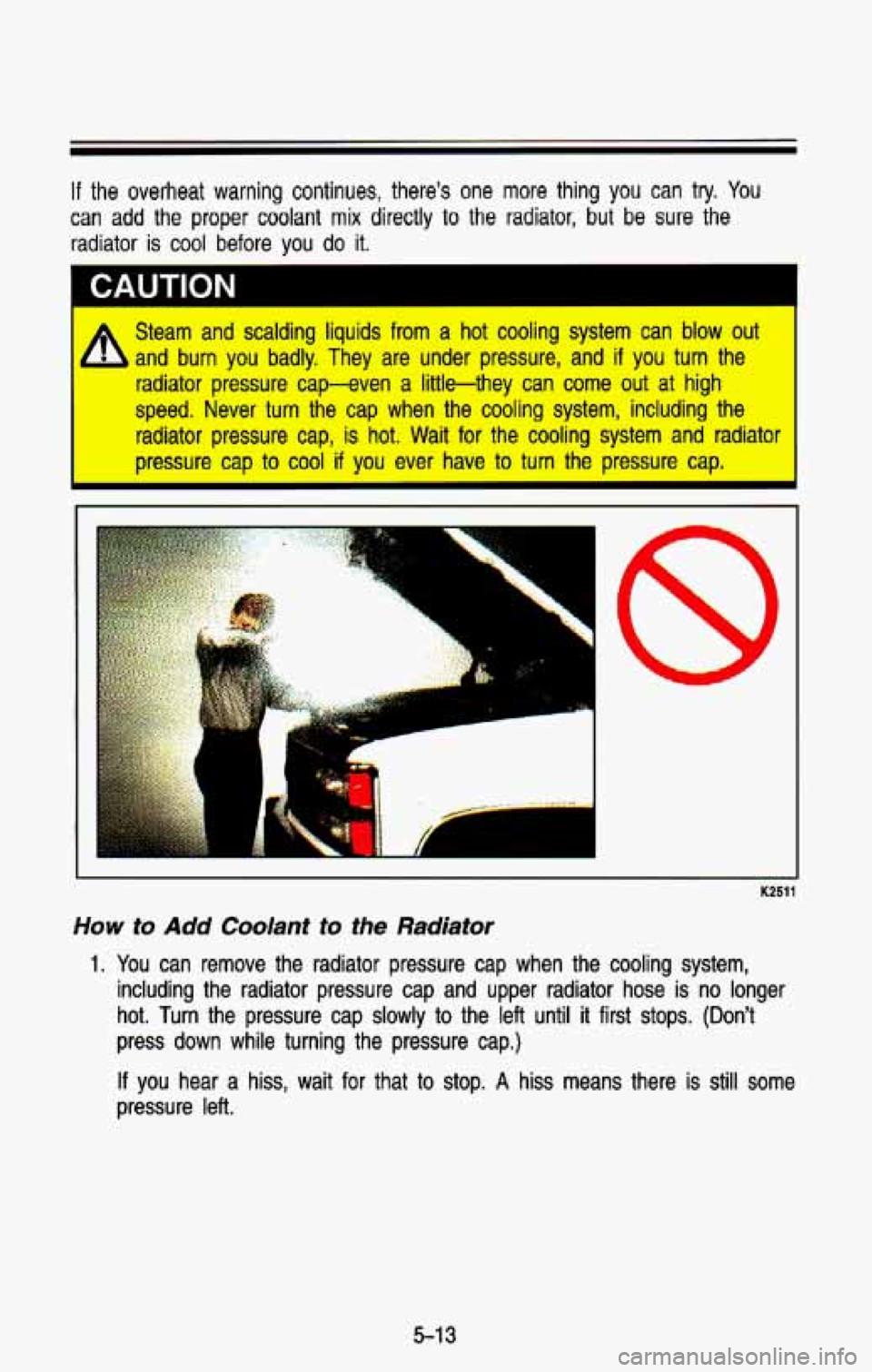
If the overheat warning continues, there's one more thing you can try. You
can add the proper coolant mix directly to the radiator, but be sure the
radiator is cool before you
do it.
I CAUTION
4 Steam and scalding liquids from a hot cooling system can blow out
- and burn you badly. They are under pressure, and if you turn the
radiator
pressure capeven a little-they can come out at high
speed. Never turn the cap when the cooling system, Including the
radiator pressure cap, is hat. Wait for the cooling system and radiato
pressure cap to cool if you ever have to turn the pressure cap.
I
8
K2511
How to Add Coolant to the Radiator
1. You can remove the radiator pressure cap when the cooling system,
including the radiator pressure cap and upper radiator hose is no longer
hot. Turn the pressure cap
slowly to the left until it first stops. (Don't
press down while turning the pressure cap.)
If you hear a hiss, wait for that to stop. A hiss means there is still some
pressure left.
5-1 3
Page 247 of 386

Engine Fan Noise
This vehicle has a clutched engine cooling fan. When the clutc\
h is engaged,
the fan spins faster
to provide more air to cool the engine. In most every day
driving conditions the clutch is not engaged. This improves fuel economy and
reduces fan noise. Under heavy vehicle loading, trailer towing \
and/or high
outside temperatures, the fan speed increases when the clutch e\
ngages.
So
you may hear an increase in fan noise. This is normal and sh\
ould not be
mistaken
as the transmission slipping or making extra shifts. It is merely the
cooling system functioning properly. The fan
will slow down when additional
cooling is not required and the clutch disengages.
You may also hear this fan noise when you start the engine. \
It will go away
as the fan clutch disengages.
If a Tire Goes Fiat
It’s unusual for a tire to “blow out” while you’re driving,\
especially if you
maintain your tires properly.
If air goes out of a tire, it’s much more likely to
leak out slowly. But if you should ever have a “blowout,” here are a few tips
about what
to expect and what to do:
If a front tire fails, the flat tire will create a drag that pulls the vehicle toward
that side. Take your foot
off the accelerator pedal and grip the steering wheel
firmly. Steer to maintain lane position, then gently brake
to a stop well out of
the traffic lane.
A rear blowout, particularly on a curve, acts much like a skid and may
require the same correction you’d use in a skid. In any rear blowout, remove
your foot from the accelerator pedal. Get the vehicle under co\
ntrol by steering
the way you want the vehicle
to go. It may be very bumpy and noisy, but
you can still steer. Gently brake to a stop, well off the road if possible.
If your tire goes flat, the next part shows how to use your jacking equipment
to change a flat tire safely.
Changing a Flat Tire
If a tire goes flat, avoid further tire and wheel damage by driving slowly to a
level place. Turn
on your hazard warning flashers.
5-1 6
Page 291 of 386

Service & Appearance Care
The following explains your cooling system and how to add cool\
ant when it is
low.
If you have a problem with engine overheating, see “Engine
Overheating” in the Index.
The proper coolant for your vehicle
will:
Give freezing protection down to -34°F (-37°C).
Give boiling protection up to 258°F (125°C).
Protect against rust and corrosion.
Help keep the proper engine temperature.
Let the warning lights and gages work as they should.
What to Use:
Use a mixture of clean water (preferably distilled), and antifreeze that meets
“GM Specification
6038-M,” which won’t damage aluminum parts. Also use
GM Engine Coolant Supplement (sealer) with a complete coolant change.
If
you use these, you don’t need to add anything else.
Adding only plain water to your cooling system can be dangerous.
I
Plain water, or some other liquid like alcohol, can boil before the \
proper coolant mix will. Your vehicle’s coolant warning system is set
for the proper coolant mix. With plain water or the wrong mix, your
engine could get too hot but you wouldn’t get the overheat \
warning. Your engine could catch fire and you or others could be burned. Us\
e
a 50/50 mix of clean water and a proper antifreeze.
jIi ,yo.w use an improper coolant mix, your engine .coutd overheat andi
badly damaged. The repair cost wouldn’t be covered by your warranty.’ TP~
much water in ;the mix can freeze and crack the engine, radiator, .heater
wre-ad -.other parts.
Some conditions, such as air trapped in the cooling system, can affect the
coolant level in the radiator. Check the coolant level when th\
e engine is cold
and follow the steps under “Adding Coolant” for the prope\
r way to
add
coolant.
.. .. ..
If you have to add coolant mdre than four times a year, have your dealer
check
your cooling system.
6-26
Page 300 of 386
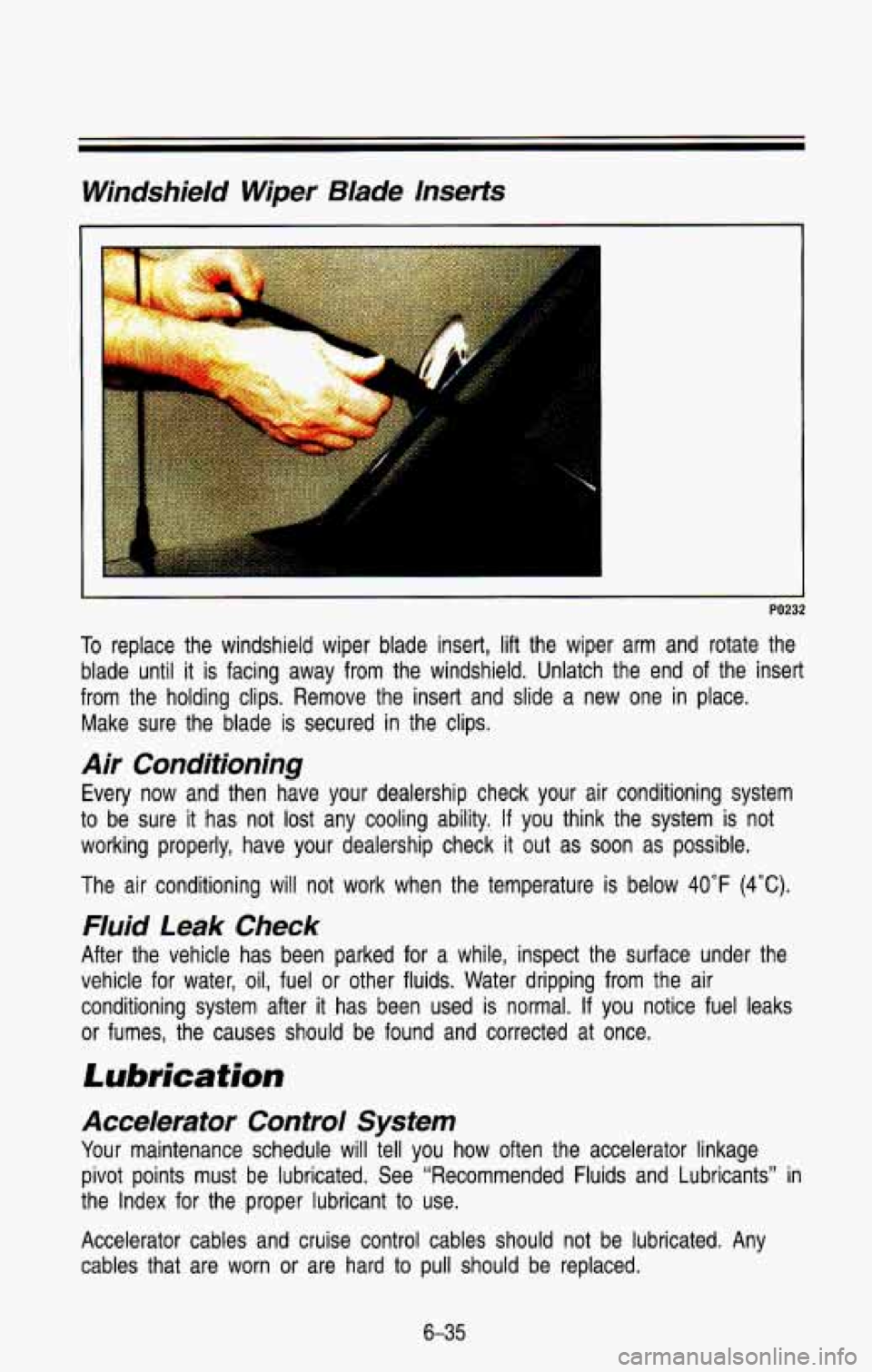
Windshield Wiper Blade lnserfs
J
PO232
To replace the windshield wiper blade insert, lift the wiper arm and rotate the
blade until
it is facing away from the windshield. Unlatch the end of the insert
from the holding clips. Remove the insert and slide a new one in place,
Make sure the blade
is secured in the clips.
Air Conditioning
Every now and then have your dealership check your air conditioning system
to be sure it has not lost any cooling ability,
If you think the system is not
working properly, have your dealership check
it out as soon as possible.
The air conditioning will not work when the temperature is below
40°F (4°C).
Fluid Leak Check
After the vehicle has been parked for a while, inspect the su\
rface under the
vehicle for water, oil, fuel or other fluids. Water dripping from the air
conditioning system after
it has been used is normal. If you notice fuel leaks
or fumes, the causes should be found and corrected at once.
Lubrication
Accelerator Control System
Your maintenance schedule will tell you how often the accelerator linkage
pivot points must be lubricated. See “Recommended Fluids and Lubric\
ants”
in
the Index for the proper lubricant to use.
Accelerator cables and cruise control cables should not be lubr\
icated. Any
cables that are worn or are hard to pull
should be replaced.
6-35
Page 321 of 386
I CAUTION I
A Using the wrong replacement wheels, wheel bolts or wheel nuts on
your vehicle can be dangerous.
It could affect the braking and
handling
of your vehicle, make your tires lose air and make you lose
control. You could have an collision in which you or others could be
injured. Always use the correct wheel, wheel
bolts, and wheel nuts
for replacement.
I
I
I The wrong wheel can also cause problems with bearing life, brake cooling,
speedometerlodometer calibration, headlight aim, bumper height, vehicle
ground clearance, and tire
or tire chain clearance to the body and chassis.
A Putting a used wheel on your vehicle is dangerous. You can't know
how it's been used or how many miles it's been driven. It could fail
suddenly and cause an accident. If you have to replace a wheel, use
a new GM original equipment wheel,
I
Tire Chains
rNOTICE 'If put vehicle has LT265/75R16 size tires, don't use tire chams; they i can!
damage your vehicle.
6-56
Page 333 of 386
Service & Appearance Care
Specification Charts
Replacement Parts
Replacement part numbers listed in this section are based on the latest
information available at the time
of printing, and are subject to change. If a
part listed in this manual is not the same as the part used in your vehicle
when
it was built, or if you have any questions, please contact your GM truck
dealer.
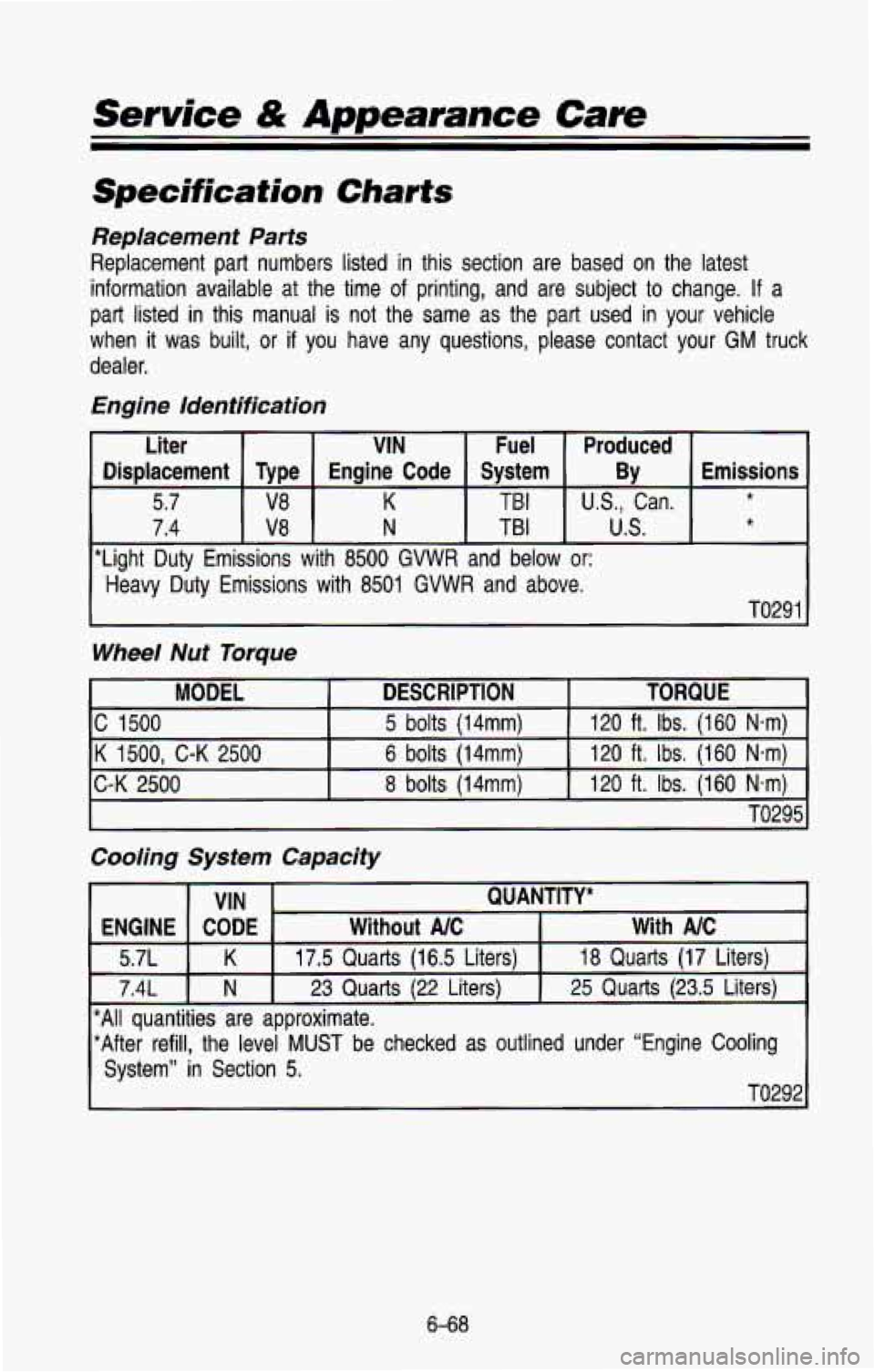
Engine identification
Liter VIN Fuel Produced
Displacement Type Engine Code System BY Emissions
5.7 V8 K TB I U.S., Can.
7.4 V8 N TB I us.
*
*
*Light Duty Emissions with 8500 GVWR and below or:
Heavy Duty Emissions with 8501 GVWR and
above.
TO291
Wheel Nut Torque
MODEL DESCRIPTION TORQUE
C 1500 5 bolts (14mm) 120 ft. Ibs. (1 60 Nmm)
K 1500, C-K 2500 6 bolts (1 4mm) 120 ft. Ibs. (160
N-m)
C-K 2500 8 bolts (14mm) 120 ft. Ibs. (160 Nem)
I TO2951
Cooling System Capacity
VIN QUANTITY*
ENGINE CODE Without NC With AIC
5.7L K 17.5 Quarts (16.5 Liters)
18 Quarts (1 7 Liters)
7.4- N 23 Quarts
(22 Liters) 25 Quarts (23.5 Liters)
*All quantities are approximate.
*After refill, the level
MUST be checked as outlined under “Engine Cooling
System” in Section
5.
TO292
6-68
Page 345 of 386

Scheduled Maintenance Services
GASOLINE ENGINES WITH LIGHT DUTY EMISSIONS-
If your driving conditions meet those specified in “Scheduled Ma\
intenancc
Services” in this section, use Maintenance Schedule
I (t).
Item Miles (000) 3 6 7.5 9 12 15 18
No. Service Kilometers (000) 5 10 12.5 15 20 25 30
1 Engine Oil Change*-Every 12 Months, or e
Oil Filter Change*-Every 12 Months, or e
2 Chassis Lubrication-Every 12 Months, or e
3 Clutch Fork Ball Stud Lubrication
5 Cooling System Service*-Every 24
6 Air Cleaner Filter Replacement* Months
or
7 Front Wheel Bearing Repack
8 Transmission Service**
25 Drive Axle Service**
26 Brake Systems Inspection**
FOOTNOTES:
**See “Explanation
of Scheduled Maintenance Services” in this section.
*An Emission Control Service
tTo determine the emissions classification of your engine refer to “Selecting
the
Proper Maintenance Chart”
in this section.
TO332