Page 153 of 386

If- your vehicle has either or both of these systems, you can inc\
rease and
decrease the air
flow at the rear vents.")
Rear Air Conditioning and Heating Systems (Wagon
Models)
If- your vehicle has either or both of these systems, you can inc\
rease and
decrease the air
flow at the rear vents. Depending on the system you have
and the setting selected,
you can send cooled or heated air to the rear of
the vehicle.
Rear Air Conditioning (Without Rear Heater)
Front Control Rear Control
K 2478
If your vehicle has rear air conditioning (without rear heater), \
the controls are
located above the front and second seats. The front and rear \
overhead
controls let you increase and decrease the air flow at the rear vents.
To operate the rear air conditioning system, the front air conditioning system \
must be on. With the front
air conditioning system off, the rear system
controls can be used
to circulate air in the rear of the vehicle.
To operate the rear system using the front control, just turn the knob to
blower position you want.
To use the rear control, first turn the front control knob
to REAR CNTL.
Then, the rear control can be used to increase and decrease the air flow.
3-8
Page 154 of 386
Rear Heater (Without Rear Air Conditioning)
K2172
If you have a rear heater (without rear air conditioning), the \
control switch is
located
on the instrument panel. To increase and decrease the flow of heated
air
to the rear floor vents, move the switch with the fan symbol on it to the
blower speed you want.
Move the switch all the way
to the left position to turn the rear blower off,
and each position to the right increases the flow of heated air.
Move the switch all the way
to the right position to turn the blower on high,
providing maximum flow of heated air.
3-9
Page 155 of 386
Comfort Controls & Audio Systems
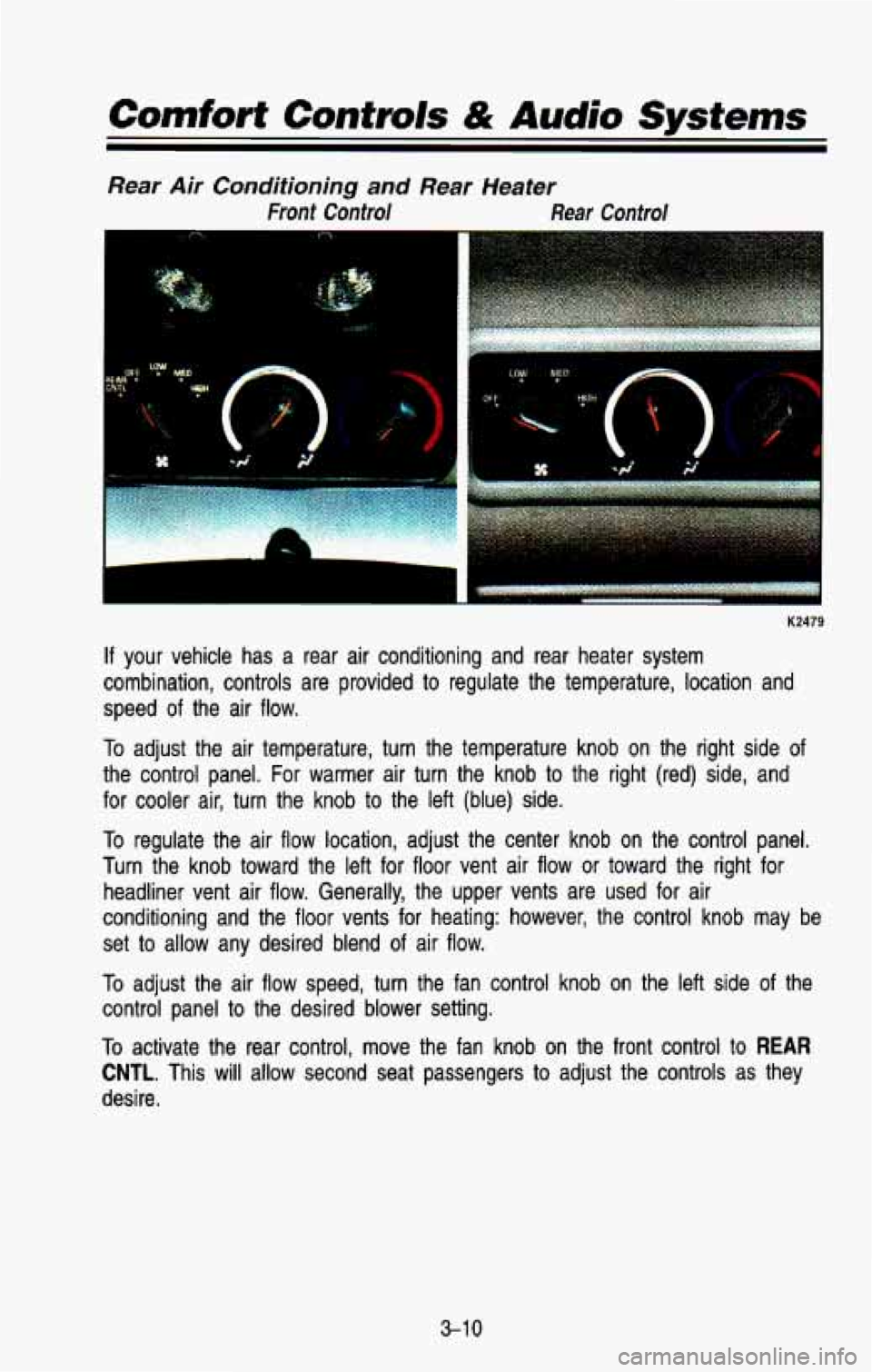
Rear Air Conditioning and Rear Heater
Front Control Rear Control
K2479
If your vehicle has a rear air conditioning and rear heater system
combination, controls are provided to regulate the temperature, \
location and
speed of the air flow.
To adjust the air temperature, turn the temperature knob on the r\
ight side of
the control panel. For warmer air turn the knob to the right (re\
d) side, and
for cooler air, turn the knob to the left (blue) side.
To regulate the air flow location, adjust the center knob on the \
control panel,
Turn the knob toward the left for floor vent air flow or tow\
ard the right for headliner vent air flow. Generally, the upper vents are used f\
or air
conditioning and the floor vents for heating: however, the cont\
rol knob may be
set to allow any desired blend
of air flow.
To adjust the air flow speed, turn the fan control knob on the \
left side of the
control panel to the desired blower setting.
To activate the rear control, move the fan knob on the front control to REAR
CNTL. This will allow second seat passengers to adjust the controls as they
desi re.
3-10
Page 184 of 386
Brake System Warning Light
K2325
This light appears on your instrument cluster to warn you if your regular
braking system needs service. See “Brake System Warning Light\
”
in the
Index.
Disc Brake Wear lndicators
Disc brake pads have built-in wear indicators that make a high\
-pitched
warning sound when the brake pads are worn and new pads are \
needed.
The sound may come and go or be heard all the time your veh\
icle is moving
(except when you are pushing on the brake pedal firmly).
I
CAUTION
The brake wear warning sound means that sooner or later your \
your
brakes won’t work well. That could lead to an accident. When you
hear the brake wear warning sound, have your vehicle serviced. \
I
NOTICE
Continuing to drive with worn-out brake pads could result in costly brakt
repair.
ome driving conditions
or climates may cause a brake squeal when the
brakes are first applied or lightly applied. This does
not mean something is
wrong with your brakes.
4-1 7
Page 240 of 386
If No Steam Is Coming From Your C gine:
If you get the overheat warning but see or hear no steam, the problem may
not be too serious. Sometimes the engine can get a little too hot when you:
Climb a long hill on a hot day.
Stop after high speed driving.
Idle for long periods in traffic.
Tow a trailer.
If you get the overheat warning with no sign of steam, try this for a minute
or so:
1. If you have an air conditioner, turn it off.
2. Turn on your heater to full hot at the highest fan speed and open the
3. If you’re in a traffic jam, shift to N (Neutral).
window
as necessary.
If you no longer have the overheat warning, you can drive. Just to be safe,
drive slower for about ten minutes.
If the warning doesn’t come back on, you
can drive normally.
If the warning continues, pull over, stop, and park your vehicle right away.
If there’s still no sign of steam, push the accelerator until the engine speed is
about twice as fast as normal idle speed. Bring the engine speed back to
normal idle speed after two or three minutes.
Now see if the warning stops.
But then,
if you still have the warning, TURN OFF THE ENGINE AND GET
EVERYONE
OUT OF THE VEHICLE until it cools down.
You may decide not
to lift the hood but to get service help right away.
5-9
Page 247 of 386

Engine Fan Noise
This vehicle has a clutched engine cooling fan. When the clutc\
h is engaged,
the fan spins faster
to provide more air to cool the engine. In most every day
driving conditions the clutch is not engaged. This improves fuel economy and
reduces fan noise. Under heavy vehicle loading, trailer towing \
and/or high
outside temperatures, the fan speed increases when the clutch e\
ngages.
So
you may hear an increase in fan noise. This is normal and sh\
ould not be
mistaken
as the transmission slipping or making extra shifts. It is merely the
cooling system functioning properly. The fan
will slow down when additional
cooling is not required and the clutch disengages.
You may also hear this fan noise when you start the engine. \
It will go away
as the fan clutch disengages.
If a Tire Goes Fiat
It’s unusual for a tire to “blow out” while you’re driving,\
especially if you
maintain your tires properly.
If air goes out of a tire, it’s much more likely to
leak out slowly. But if you should ever have a “blowout,” here are a few tips
about what
to expect and what to do:
If a front tire fails, the flat tire will create a drag that pulls the vehicle toward
that side. Take your foot
off the accelerator pedal and grip the steering wheel
firmly. Steer to maintain lane position, then gently brake
to a stop well out of
the traffic lane.
A rear blowout, particularly on a curve, acts much like a skid and may
require the same correction you’d use in a skid. In any rear blowout, remove
your foot from the accelerator pedal. Get the vehicle under co\
ntrol by steering
the way you want the vehicle
to go. It may be very bumpy and noisy, but
you can still steer. Gently brake to a stop, well off the road if possible.
If your tire goes flat, the next part shows how to use your jacking equipment
to change a flat tire safely.
Changing a Flat Tire
If a tire goes flat, avoid further tire and wheel damage by driving slowly to a
level place. Turn
on your hazard warning flashers.
5-1 6
Page 273 of 386
Service & Appearance Care
Checking Things Under the Hood
a&
.. .. .
~
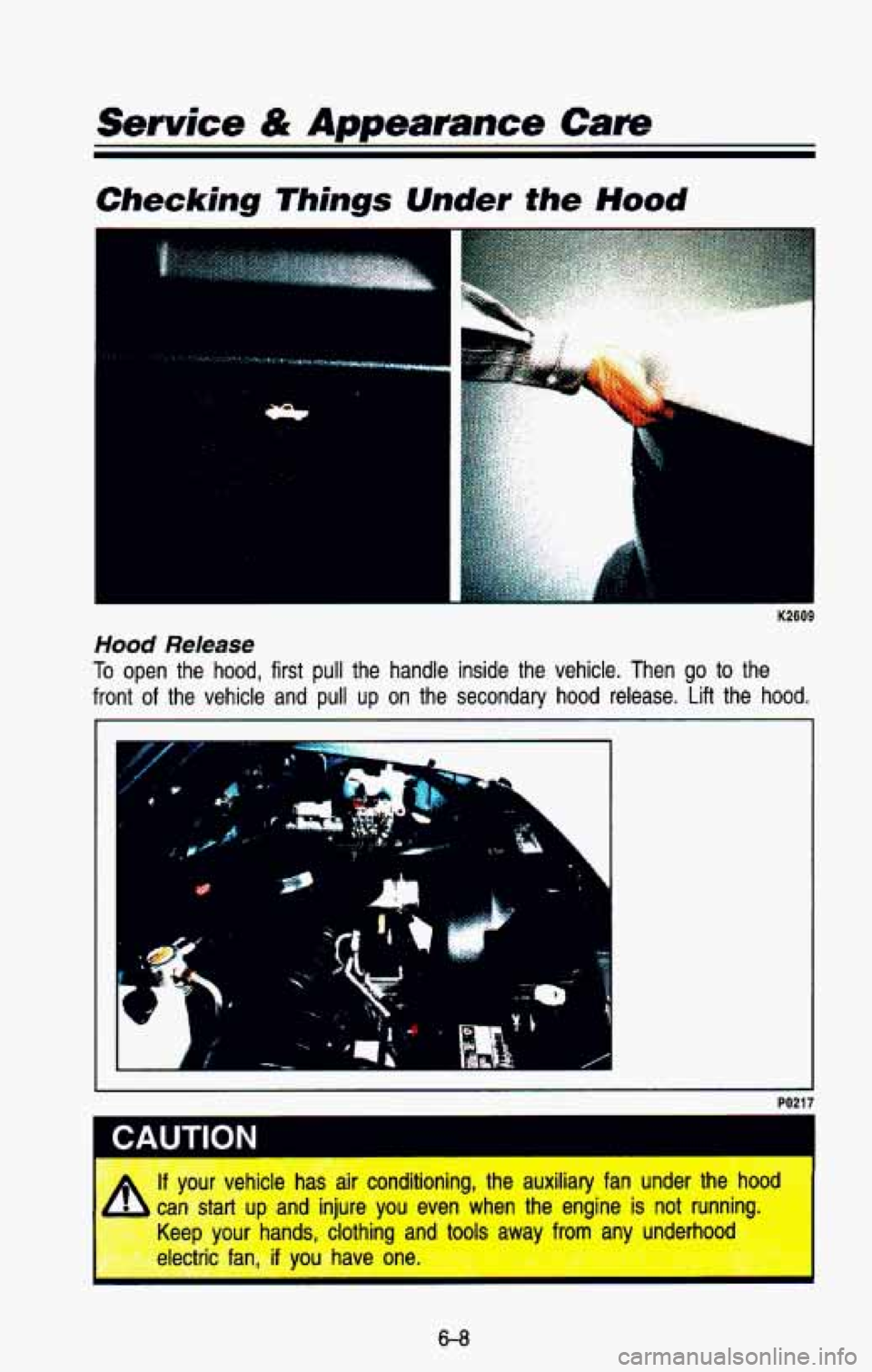
Hood Release
To open the hood, first pull the handle inside the vehicle. Then go to the
front of the vehicle and pull
up on the secondary hood release. Lift the hood.
PO21 7
.. .
CAUTION
A
If your vehicle h;- air conditioning, the auxiliary fan under the hood
,can
start up and injure you even when the engine is not runninc
*y,?*& 8gKeep your hands, clothing and tools awav from anv underhoo
Wk%selectric fan,
you have one
6-8
Page 291 of 386

Service & Appearance Care
The following explains your cooling system and how to add cool\
ant when it is
low.
If you have a problem with engine overheating, see “Engine
Overheating” in the Index.
The proper coolant for your vehicle
will:
Give freezing protection down to -34°F (-37°C).
Give boiling protection up to 258°F (125°C).
Protect against rust and corrosion.
Help keep the proper engine temperature.
Let the warning lights and gages work as they should.
What to Use:
Use a mixture of clean water (preferably distilled), and antifreeze that meets
“GM Specification
6038-M,” which won’t damage aluminum parts. Also use
GM Engine Coolant Supplement (sealer) with a complete coolant change.
If
you use these, you don’t need to add anything else.
Adding only plain water to your cooling system can be dangerous.
I
Plain water, or some other liquid like alcohol, can boil before the \
proper coolant mix will. Your vehicle’s coolant warning system is set
for the proper coolant mix. With plain water or the wrong mix, your
engine could get too hot but you wouldn’t get the overheat \
warning. Your engine could catch fire and you or others could be burned. Us\
e
a 50/50 mix of clean water and a proper antifreeze.
jIi ,yo.w use an improper coolant mix, your engine .coutd overheat andi
badly damaged. The repair cost wouldn’t be covered by your warranty.’ TP~
much water in ;the mix can freeze and crack the engine, radiator, .heater
wre-ad -.other parts.
Some conditions, such as air trapped in the cooling system, can affect the
coolant level in the radiator. Check the coolant level when th\
e engine is cold
and follow the steps under “Adding Coolant” for the prope\
r way to
add
coolant.
.. .. ..
If you have to add coolant mdre than four times a year, have your dealer
check
your cooling system.
6-26

K2172
If you have a rear heater (without rear air conditioning), the \
control switch is
located
on the instrument panel. To increase")