Page 19 of 345
Downloaded from www.Manualslib.com manuals search engine K3106
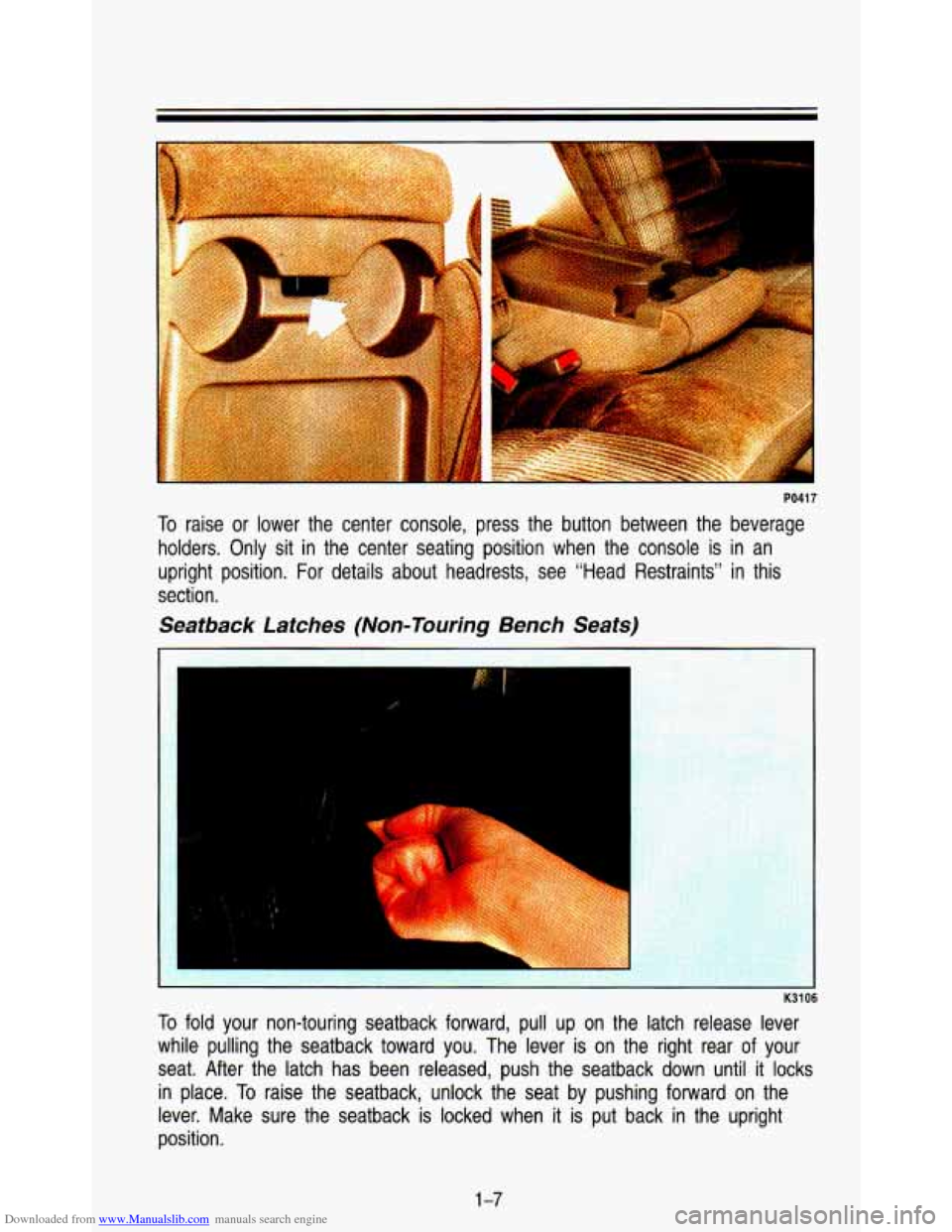
To fold your non-touring seatback forward, pull up on the latch release lever
while pulling the seatback toward you. The lever is
on the right rear of your
seat. After the latch has been released, push the seatback dow\
n until it locks
in place.
To raise the seatback, unlock the seat by pushing forward on the \
lever. Make sure the seatback is locked when it is put back in the upright
position.
1 -7
Page 22 of 345

Downloaded from www.Manualslib.com manuals search engine Seats and Safety Belts
To install the seat:
a
1.
2.
3.
Lower the seat into position. Make sure the front retainers ar\
e hooked
onto the anchor pins.
Do the same for the rear retainers. Make sure the
seat is locked in by pulling up and down on the seat.
Raise the seatback by pushing forward on the latch at the rig\
ht rear of
the seat. Pull up on the seatback until it is locked securely in the up
position.
Attach the quick release latch plate
to the buckles in the roof. If you are
installing the center seat, connect the right lap-shoulder belt \
to the
attachment on the seat cushion. If you have a safety belt gui\
de on your
seat, pull the belt through the guide before reattaching the l\
ap-shoulder
belt
to the side of the seat. The release hole should be facing outward.
If you installed the safety belt with the release hole facing inw\
ard
(toward the seat), slide the plastic cover
up so you can see the buckle.
Disconnect the seat belt. Slide the cover back down and reinst\
all the
belt correctly.
A
To avoid personal injury, do not ride in the right position of the
center seat unless the safety belt is securely anchored. Be sure the
buckle on the free end of the belt is fastened securely to the latch
plate mounted at the base of the seat.
1-1 0
Page 53 of 345
Downloaded from www.Manualslib.com manuals search engine AM1 70037
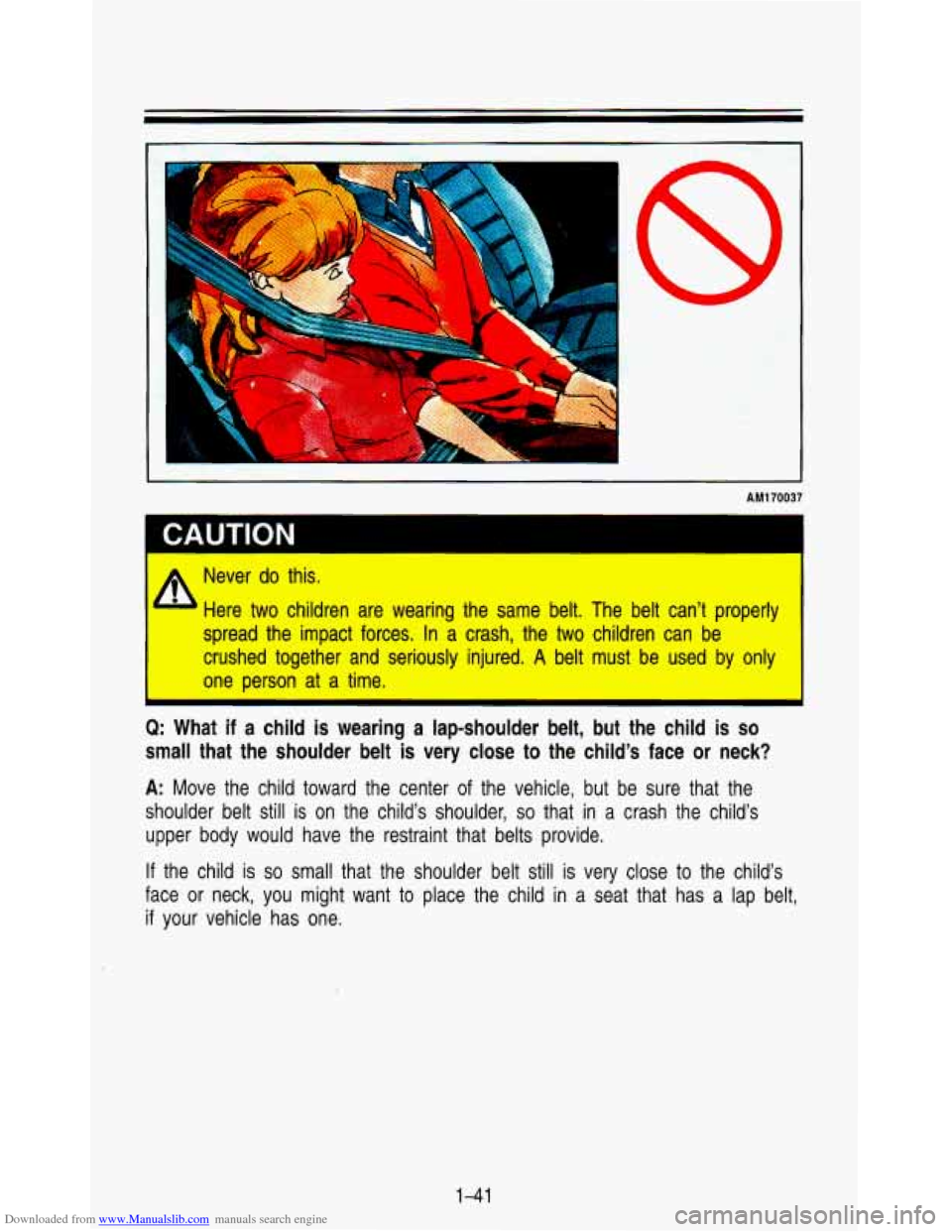
CAUTION
Never do this.
Here two children are wearing the same belt. The belt can’t properly
spread the impact forces. In a crash, the
two children can be
crushed together and seriously injured.
A belt must be used by only
one person at a time.
I
Q: What if a child is wearing a lap-shoulder belt, but the child is so
small that the shoulder belt is very close to the child’s face or neck?
A: Move the child toward the center of the vehicle, but be sure that the
shoulder belt still is on the child’s shoulder,
so that in a crash the child’s
upper body would have the restraint that belts provide.
If the child is so small that the shoulder belt still is very close to the child’s
face or neck, you might want to place the child in a seat that has a lap belt,
if your vehicle has one.
1-41
Page 61 of 345
Downloaded from www.Manualslib.com manuals search engine lour vehicle has a number of new features that can help prevent thefi.
3ut you can have a
lot of trouble getting into your vehicle if you ever lo(
four keys inside. You may even have to damage your vehicle to aet in.
50 be sure you have extra keys.
-
Your Doors and How They Work
Side Doors
-
PO41 3
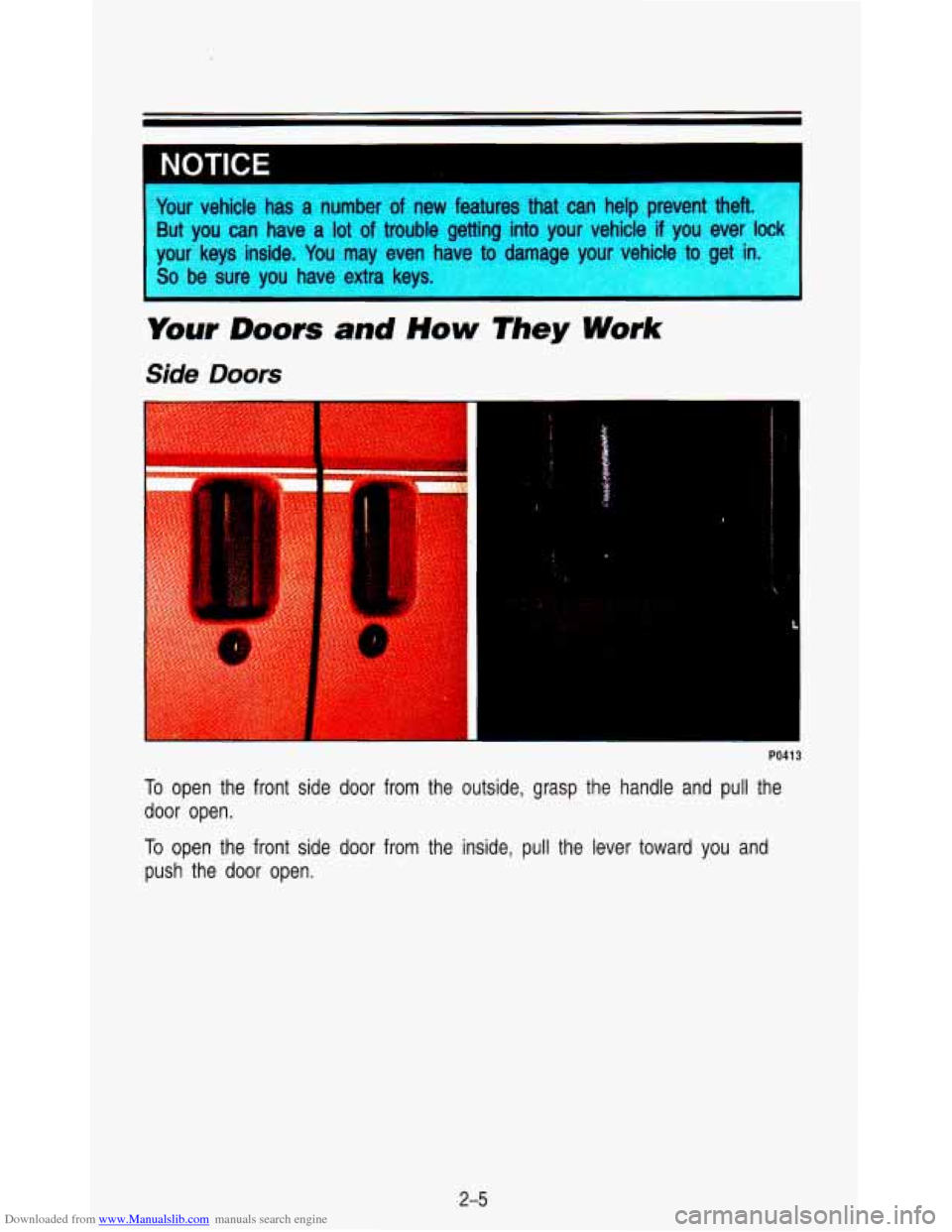
To open the front side door from the outside, grasp the handle a\
nd pull the
door open.
To open the front side door from the inside, pull the lever toward you and
push the door open.
2-5
Page 62 of 345
Downloaded from www.Manualslib.com manuals search engine Features & Controls
Sliding Side Door
PO411
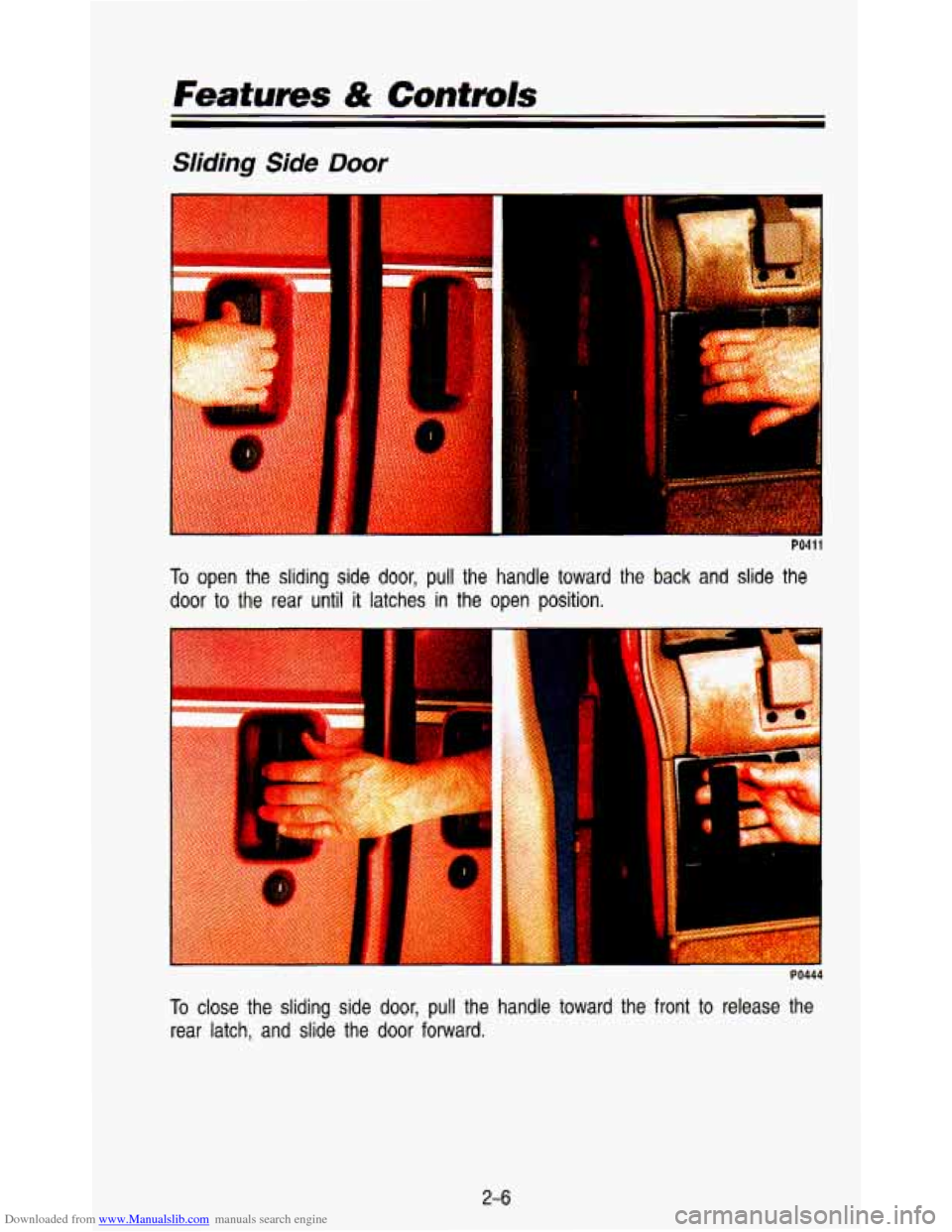
To open the sliding side door, pull the handle toward the back and slide the
door to the rear until it latches in the open position.
'0444
To close the sliding side door, pull the handle toward the front to release the
rear latch, and
slide the door forward.
2-6
Page 69 of 345
Downloaded from www.Manualslib.com manuals search engine I NOTICE
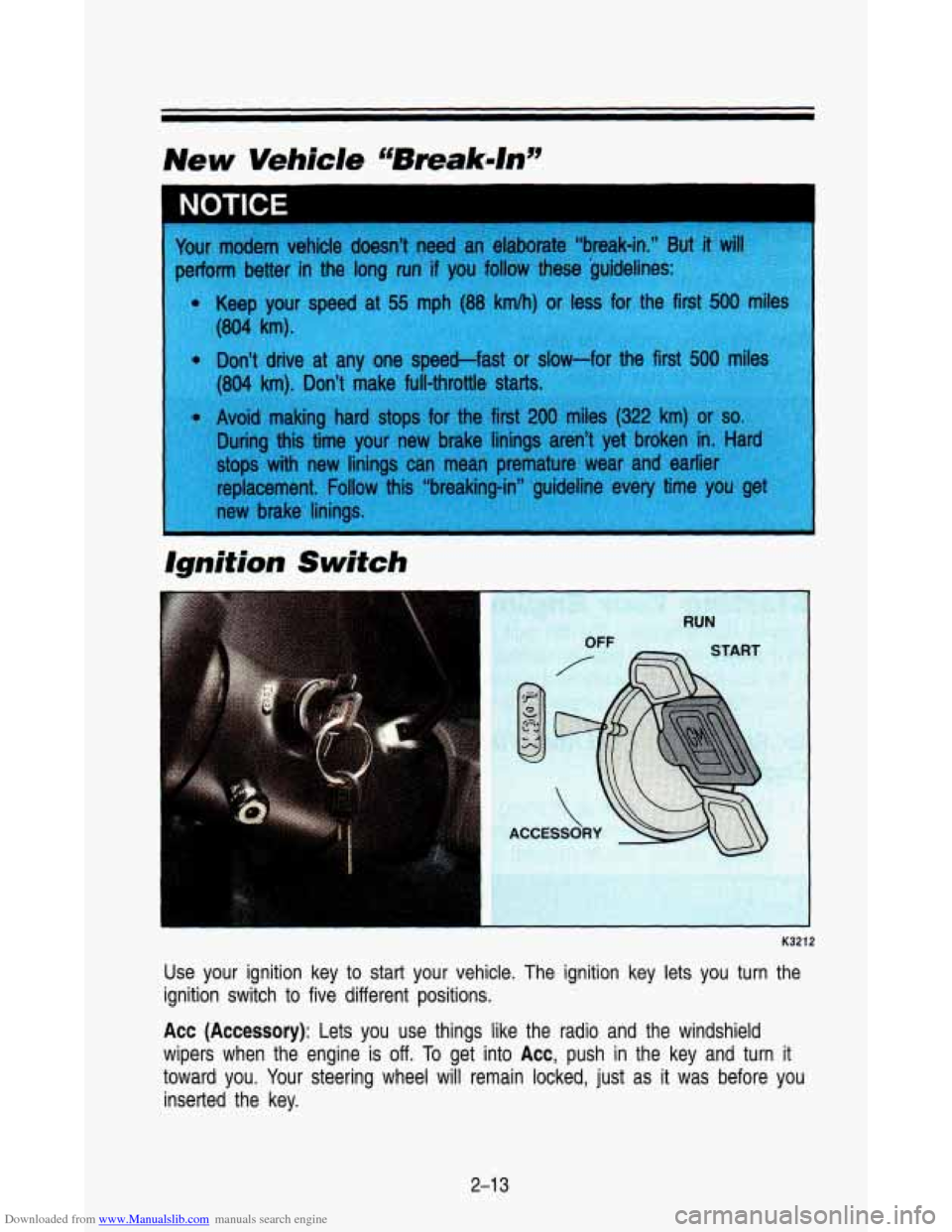
Ignition Switch
Use your ignition key to start your vehicle. The ignition key lets you turn the
ignition switch to five different positions.
Acc (Accessory): Lets you use things like the radio and the windshield
wipers when the engine is off. To get into
Acc, push in the key and turn it
toward you. Your steering wheel will remain locked, just as
it was before you
inserted the key.
2-1 3
Page 71 of 345
Downloaded from www.Manualslib.com manuals search engine 3. Turn your ignition key to Start. When the engine starts, let go of the
key. The idle speed will go down as your engine gets warm.
NOTICE
Holding your key in Start for longer than 15 seconds at a time will car-
your battery to be drained
---? s~-~~~ And the e:*-?ssive heat ---
damage your starter motor
I
4. If it doesn’t start right away, hold your key in atart. If it doesn’t start in
three seconds, push the accelerator pedal about one-quarter of the way
down for
12 more seconds, or until it starts.
flooded with too much gasoline. Try this:
Wait
15 seconds to let the starter motor cool down. Then push your
accelerator pedal all the way to the floor. Hold it there. Then, hold the
key in
Start for no more than ten seconds. This clears the extra
gasoline from the engine.
5. If your engine still won’t start (or starts but then stops), \
it could be
If the engine still doesn’t start, wait another
15 seconds and do it all
again.
When the engine starts, let go
of the key and the accelerator pedal.
~ NOTICE
Your engine is designed to work with the electronics in your vehicle. If yo
add electrical parts or accessories, you could change the way the fuel
injection svstem operates. Before adding electrical equipment, ch\
eck with
vour
dt If you -.m’t, you. -ngi might not 1 -.form I perlv.
IT you ever have to have your vehicle towe see tl pan of tnrs Man[
that tells how to do it without damaging your ‘We.
e “Towing You
Vehi
’ ” ‘7 the Inc’ .
Fuel Regulator
If you have the 4.3L engine (VIN Code W), you will have a fuel regulator
that shuts the fuel
off when the engine reaches 5600 rpm.
2-1 5
Page 74 of 345
Downloaded from www.Manualslib.com manuals search engine P (Park).
This locks your rear wheels.
It’s the best position to use when you start
your engine because your vehicle can’t move easily.
WTION
It is dangerous to get out of your vehicle if the shift lever is not -fully
in
P (Park) with the parking brake firmly set. Your vehicle can roll. .
Don’t leave your vehicle when the engine is running unless you have
to.
If you have left the engine running, the vehicle can move
suddenly. You
or others could be injured. to be sure your vehicle
won’t move, when you’re on fairly level ground, always set your
parking brake and move the shift lever
to P (Park).
See “Shifting Into
P (Park)” in the Index. If you are parking on a hill:
or pulling a trailer, also see “Parking on Hills” or “Towing a Trailer”
in the Index.
Ensure the shift lever is fully in
P (Park) range before starting the
engine. Your vehicle has a brake-transmission shift interlock. You have
to fully
apply your regular brakes before you can shift from P (Park)
when the ignition key is in the
Run position. If you cannot shift out of
P (Park), ease pressure on the shift lever-push the shift lever\
all the
way into
P (Park) as you maintain brake application. Then move the shift\
lever into the gear you wish. See “Shifting Out of
P (Park) in this part.
R (Reverse).
Use this gear to back up.
I
Shifting to R (Reverse) while your vehicle is moving forward could dama--
your transmission. Shift
to R (Reverse) only after your vehicle is stoppec
To rock your vehicle back and forth to get out of snow, ice or sand
without damaging your transmission, see
“If You’re Stuck in Sand, Mud,
Ice or Snow” in the Index.
N (Neutral).
In this position, your engine doesn’t connect with the wheels.
To restart
when you’re already moving, use
N (Neutral) only. Also, use N (Neutral)
when your vehicle
is being towed.
2-1 8