1993 CHEVROLET ASTRO PASSENGER warning
[x] Cancel search: warningPage 114 of 345
Downloaded from www.Manualslib.com manuals search engine Features & Contmls
Warning lights go on when there may be or is a problem with one of your
vehicle’s functions.
As you will see in the details on the next few pages,
some warning lights come on briefly when you turn the ignition\
key just to let
you know they’re working.
If you are familiar with this section, you should not
be alarmed when this happens.
Gages can indicate when there may be
or is a problem with one of your
vehicle’s functions. Often gages and warning lights work toge\
ther to let you
know when there’s
a problem with your vehicle.
When one
of the warning lights comes on and stays on when you are
driving, or when one
of the gages shows there may be a problem, check the
section that tells you what to
do about it. Please follow the manual’s advice.
Waiting to
do repairs can be costly-and even dangerous. So please get to
know your warning lights and gages. They’re
a big help.
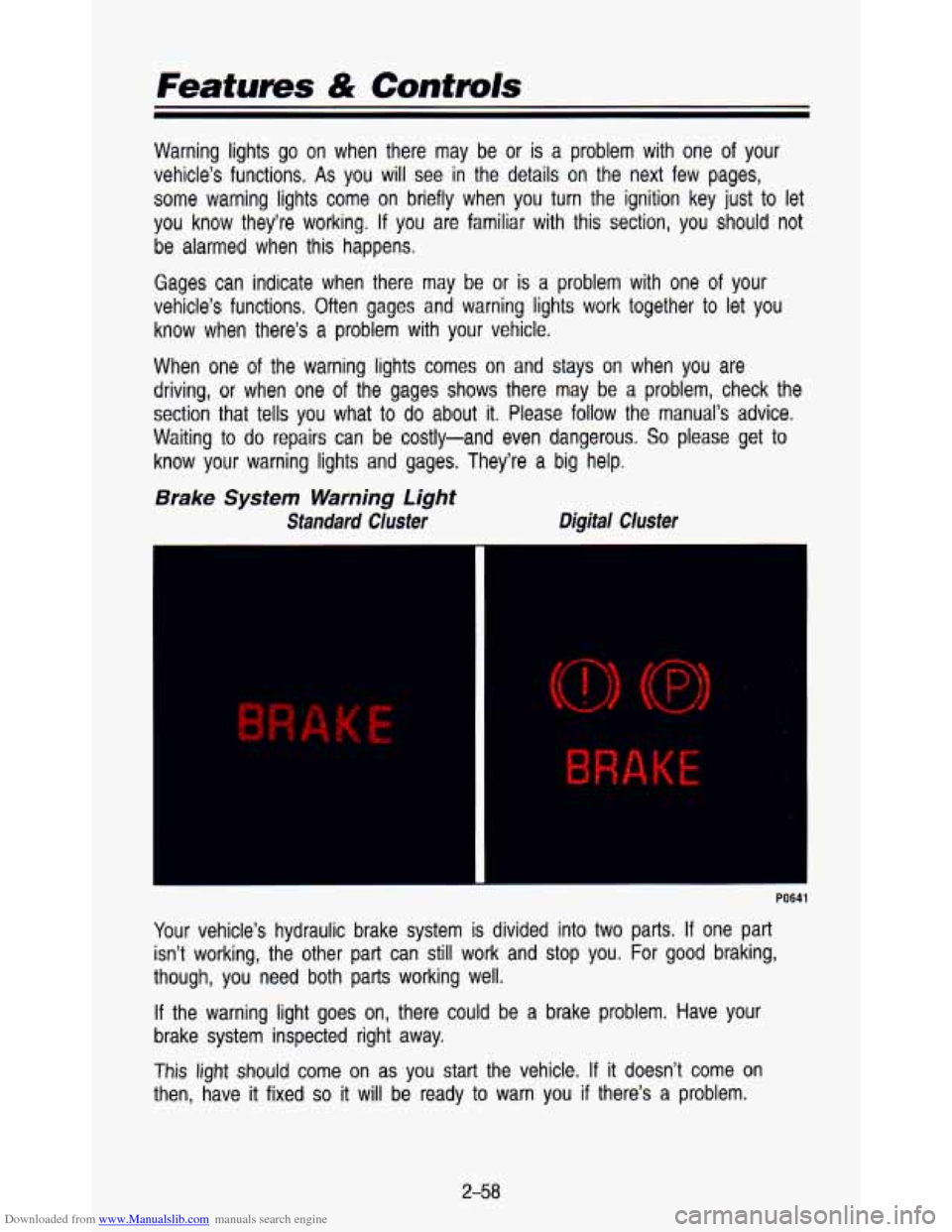
Brake System Warning Light
Standard Cluster Digital Cluster
K E
Your
vehicle’s hydraulic brake system is divided into two parts. If one part
isn’t working, the other part can still work and stop you. \
For
good braking,
though, you need both parts working well.
If the warning light goes on, there could be a brake problem. Have your
brake system inspected right away.
This
light should come on as you start the vehicle. If it doesn’t come on
then, have
it fixed so it will be ready to warn you if there’s a problem.
2-58
Page 115 of 345
Downloaded from www.Manualslib.com manuals search engine This light will also come on when you set your parking brake, and will stay
on if your parking brake doesn’t release fully. If it stays on after your parking
brake is fully released, it means you have a .brake problem.
If the light comes on while driving, pull
off the road and stop carefully. You
may notice that the pedal is harder
to push. Or the pedal may go closer to
the floor. It may take longer to stop. If the light is still on, have the vehicle
towed for service. (See “Towing your vehicle” in the Index).
I
Your brake system may not be working properly if the brake warning
light is on. Driving with the brake warning light on can lead
to an
accident.
If the light is still on after you’ve pulled off the road and
stopped carefully, have the vehicle towed for service.
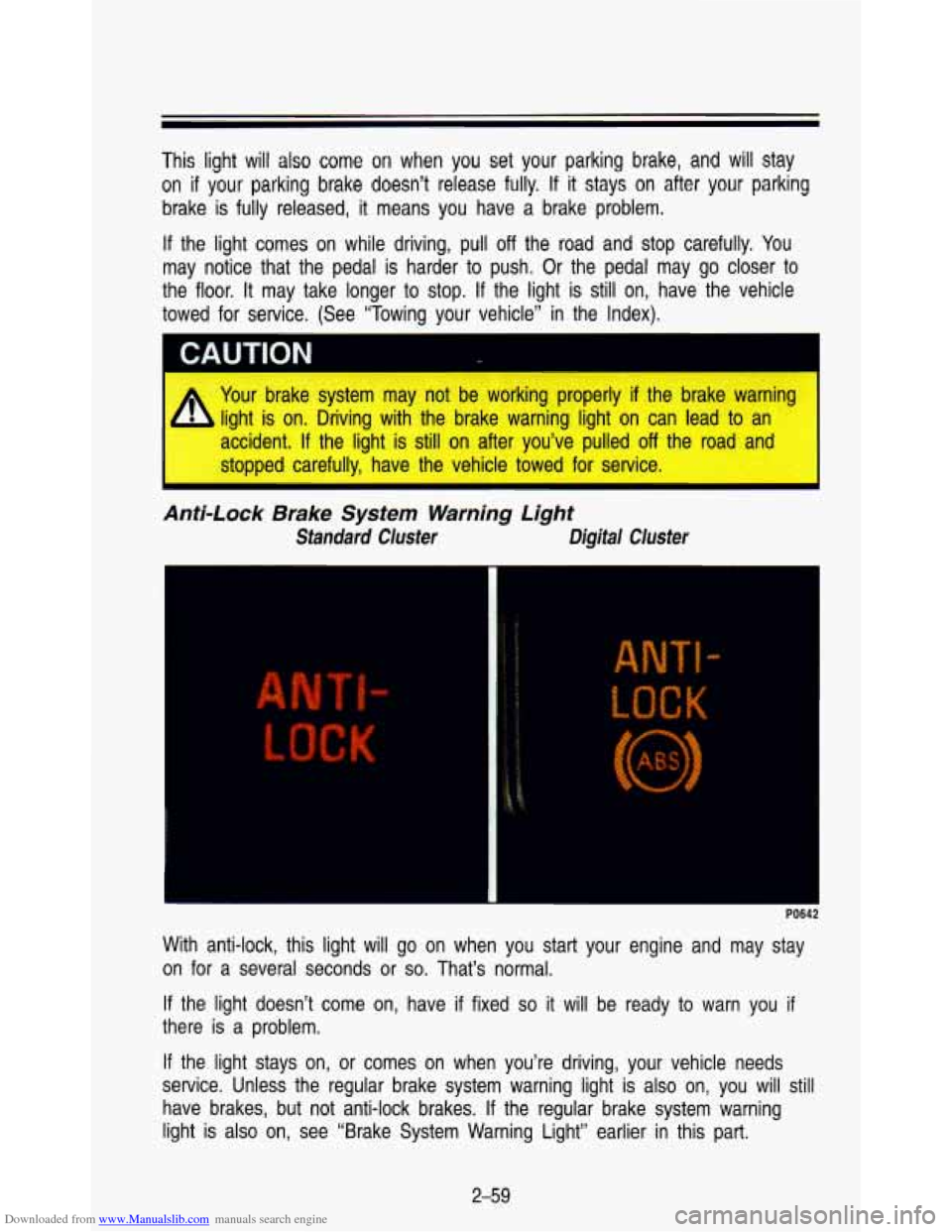
Anti-Lock Brake System Warning Light
Standard Cluster Digital Cluster
r
With anti-lock, this light will go on when you start your engine and may stay
on for a several seconds
or so. That’s normal.
If the light doesn’t come on, have
if fixed so it will be ready to warn you if
there is a problem.
If the light stays on, or comes on when you’re driving, your \
vehicle needs
service. Unless the regular brake system warning light is also \
on, you will
still
have brakes, but not anti-lock brakes. If the regular brake system warning
light is also on, see “Brake System Warning Light” earlie\
r in this part.
2-59
Page 120 of 345
Downloaded from www.Manualslib.com manuals search engine Featurns & Controls
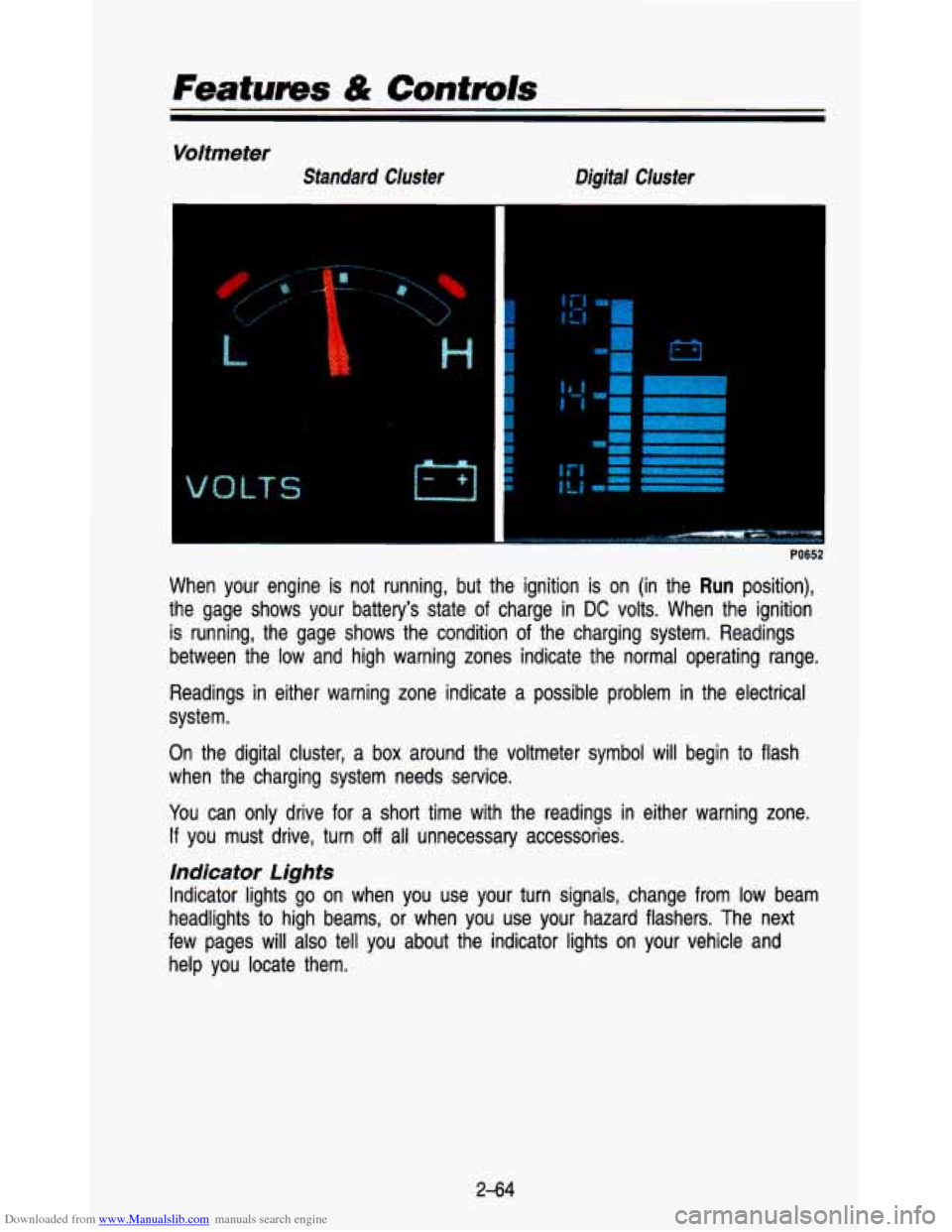
Voltmeter
Standard Cluster Digital Cluster
r
LT S M
I
i
f
r
I
'i I I
I
I I I
PO652
When your engine is not running, but the ignition is on (in \
the Run position),
the gage shows your battery's state
of charge in DC volts. When the ignition
is running, the gage shows the condition of the charging syste\
m. Readings
between the low and high warning zones indicate the normal ope\
rating range.
Readings in either warning zone indicate a possible problem in the electric\
al
system.
On the digital cluster,
a box around the voltmeter symbol will begin to flash
when the charging system needs service.
You can only drive for a
short time with the readings in either warning zone.
If you must drive, turn off all unnecessary accessories.
indicator Lights
Indicator lights go on when you use your turn signals, change \
from low beam
headlights to high beams,
or when you use your hazard flashers. The next
few pages
will also tell you about the indicator lights on your vehicle and
help you locate them.
2-64
Page 156 of 345
Downloaded from www.Manualslib.com manuals search engine Your Driving and fhe Road
-. . *p .. . f@@&
:.&+. -: ., -.. + c.=- .A; _.
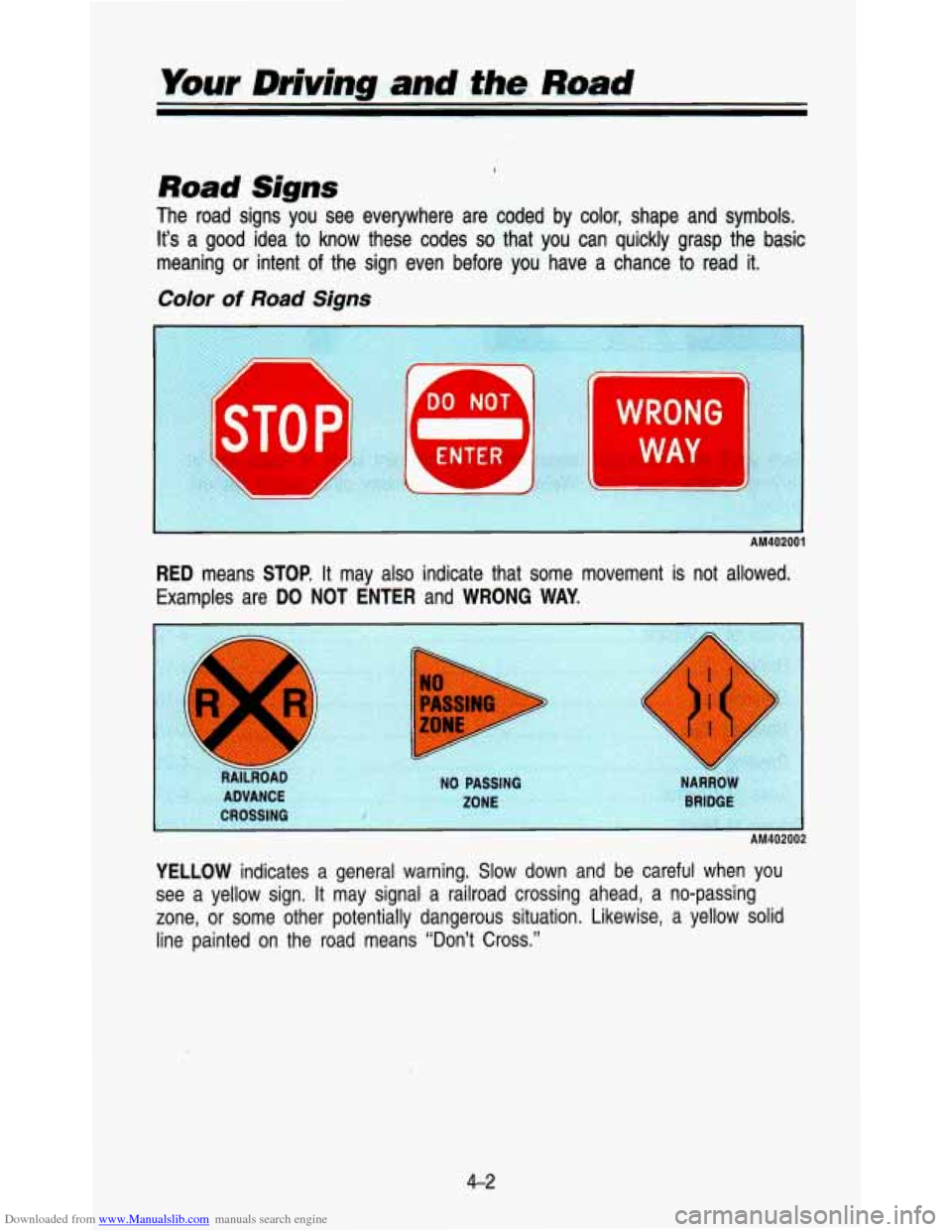
Road Signs
p., :*. - - L.._ .. . ,. r-- . ;I;; - ,’ ’ -I’ - ,
5- ,i ..
The road signs you see everywhere ad Yoded by color, shape and symbols.
It’s a
good idea to know these codes so that you can quickly grasp the basic
meaning or intent of the sign even before you have a chance to read it.
Color of Road Signs
RED means STOP. It may also indicate that some movement is not allowed.
Examples are
DO NOT ENTER and WRONG WAY.
YELLOW indicates a general warning. Slow down and be careful when you
see a yellow sign.
It may signal a railroad crossing ahead, a no-passing
zone,
or some other potentially dangerous situation. Likewise, a yellow solid
line painted on the road means “Don’t Cross.”
4-2
Page 158 of 345
Downloaded from www.Manualslib.com manuals search engine Your Driving and the Road
SWIMMING
AM402006
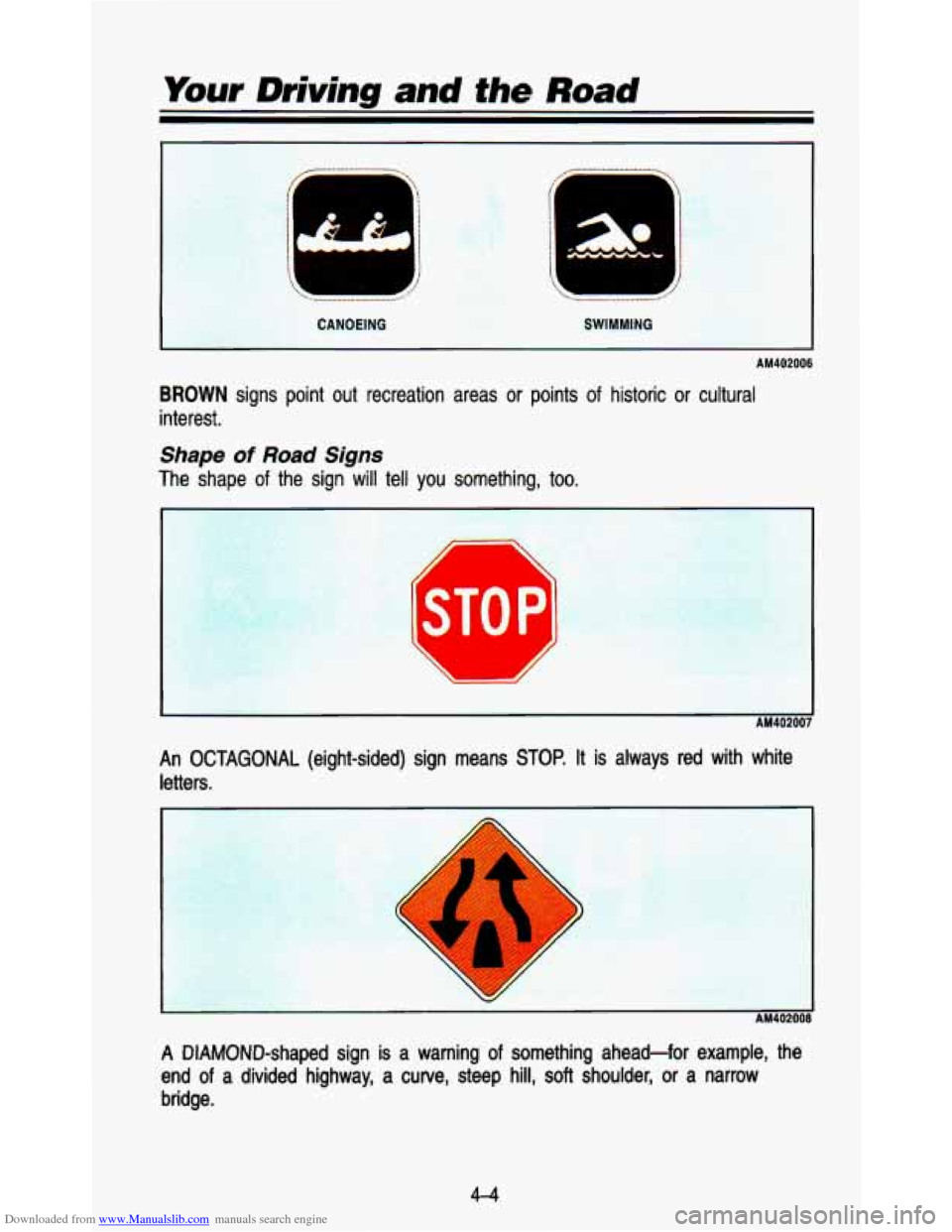
BROWN signs point out recreation areas or points of historic or cultural
interest.
Shape of Road Signs
The shape of the sign will tell you something, too.
An OCTI AL (eight-sided) sign means STOP. It is always red with white
letters. - -
A
A DIAMOND-shaped sign is a warning of something ahead-for example,\
the
end
of a divided highway, a curve, steep hill, soft shoulder, or a narrow
bridge.
4-4
Page 162 of 345
Downloaded from www.Manualslib.com manuals search engine Your Driving and the Road
Turn and lane change signals: Always signal when you plan to turn or
change lanes.
If necessary, you can use hand signals out the window: Left arm \
straight out
for a left turn, down for slow or about-to-stop, and up for \
a right turn.
Slowing down: If time allows, tap the brake pedal once or twice in advance
of slowing or stopping. This warns the driver behind you.
Disabled: Your four-way flashers signal that your vehicle is disabled or is a\
hazard. See “Hazard Warning Flashers” in the Index.
Traffic Officer
The traffic police officer is also a source of important information. The officer’s
signals govern, no matter what the traffic lights or other sig\
ns say.
The next part discusses some of the road conditions you may encounter.
Defensive Driving
The best advice anyone can give about driving is: Drive defens\
ively.
Please start with a very important safety device in your vehic\
le: Buckle up.
(See “Safety Belts in the Index.”)
Defensive driving really means “be ready for anything.’’\
On city streets, rural
roads, or freeways, it means “always expect the unexpected.”
Assume that pedestrians or other drivers are going to be carel\
ess and make mistakes. Anticipate what they might
do. Be ready for their mistakes.
Expect children
to dash out from behind parked cars, often followed by other
children. Expect occupants in parked cars
to open doors into traffic. Watch for
movement in parked cars-someone may be about
to open a door.
Expect other drivers
to run stop signs when you are on a through street. Be
ready to brake if necessary as you go through intersections. You may not
have to use the brake, but
if you do, you will be ready.
If you’re driving through a shopping center parking lot where t\
here are
well-marked lanes, directional arrows, and designated parking are\
as, expect
some drivers to ignore all these markings and dash straight to\
ward one part
of the lot.
Pedestrians can be careless. Watch for them. In general, you m\
ust give way
to pedestrians even
if you know you have the right of way.
Rear-end collisions are about the most preventable of accidents. Yet they are
common. Allow enough following distance.
It’s the best defensive driving
4-0
Page 170 of 345
Downloaded from www.Manualslib.com manuals search engine Brake System Warning Light
Standard Cluster Digital Cluster
PO641
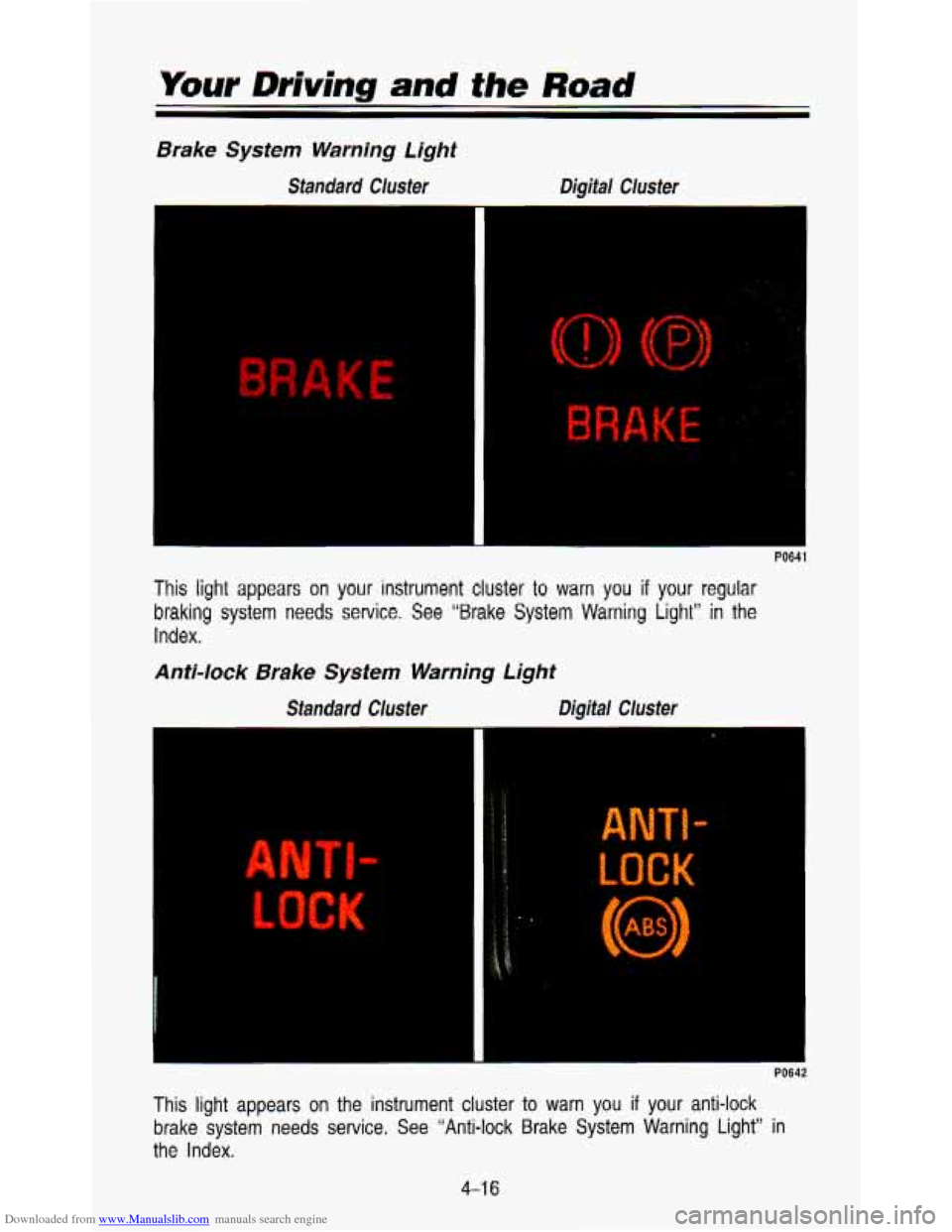
This light appears on your instrument cluster to warn you if your regular
braking system needs service. See “Brake System Warning Light” in the
Index.
Anti-lock Brake System Warning Light
Standard CIusfer Digital Cluster
This light appears on the instrument cluster to warn you if your anti-lock
brake system needs service. See “Anti-lock Brake System Warning Light” in
the Index.
4-1 6
Page 171 of 345

Downloaded from www.Manualslib.com manuals search engine Disc Brake Wear Indicators
Your vehicle has front disc brakes and rear drum brakes. Disc brake\
pads
have built-in wear indicators that make a high-pitched warning sound when
the brake pads are worn and new pads are needed. The sound m\
ay come and go or be heard all the time your vehicle is moving (except when you are
pushing on the brake pedal firmly).
I CAUTION
A The brake wear warning sound means that sooner or later your
4 brakes won’t work well. That could lead to an accident. When you
hear the brake wear warning sound, have your vehicle serviced. \
I
NCTICE
Some driving conditions or climates may cause a brake squeal when the
brakes are first applied or lightly applied. This does not mean something is
wrong with your brakes.
Rear Drum Brakes
Your rear drum brakes don’t have the wear indicators, but if you ever hear a
rear brake rubbing noise, have the rear brake linings inspected\
. Also, the rear
brake drums should be removed and inspected each time the tires are
removed for rotation or changing. When
have the rear brakes inspected, too.
Brake linings should always be replaced
Brake Pedal Travel
See your dealer if the brake pedal does
there
is a rapid increase in pedal travel.
trouble.
Brake Adjustment
Every time you make a brake stop, your you have
the front brakes replaced,
as complete axle sets.
not return to normal height, or
if
This could be a sign of brake
disc brakes adjust for wear.
If your
brake pedal goes down farther than normal, your rear drum brak\
es may need
adjustment. Adjust them by backing up and firmly applying the brakes a few
times.
4-1 7