Page 19 of 386
Downloaded from www.Manualslib.com manuals search engine These symbols are used on warning and indicator lights:
I- I
I I BRAKE I
ENGINE COOLANT
TEMPERATURE I
RADIATOR COOLANT
CHARGING
I ANTILOCK BRAKE I FUEL J ENGINE OIL
PRESSURE ENGINE OIL
TEMPERATURE
Here are some other symbols you may see:
I
r RADIO SELECTOR 1 FUSE I RADIO VOLUME AIR
CONDITIONING I
-I
t
In1
TRUNK'HATCHBACK RELEASE SPEAKER
I LIGHTER
5
Page 132 of 386
Downloaded from www.Manualslib.com manuals search engine ASTROROOF
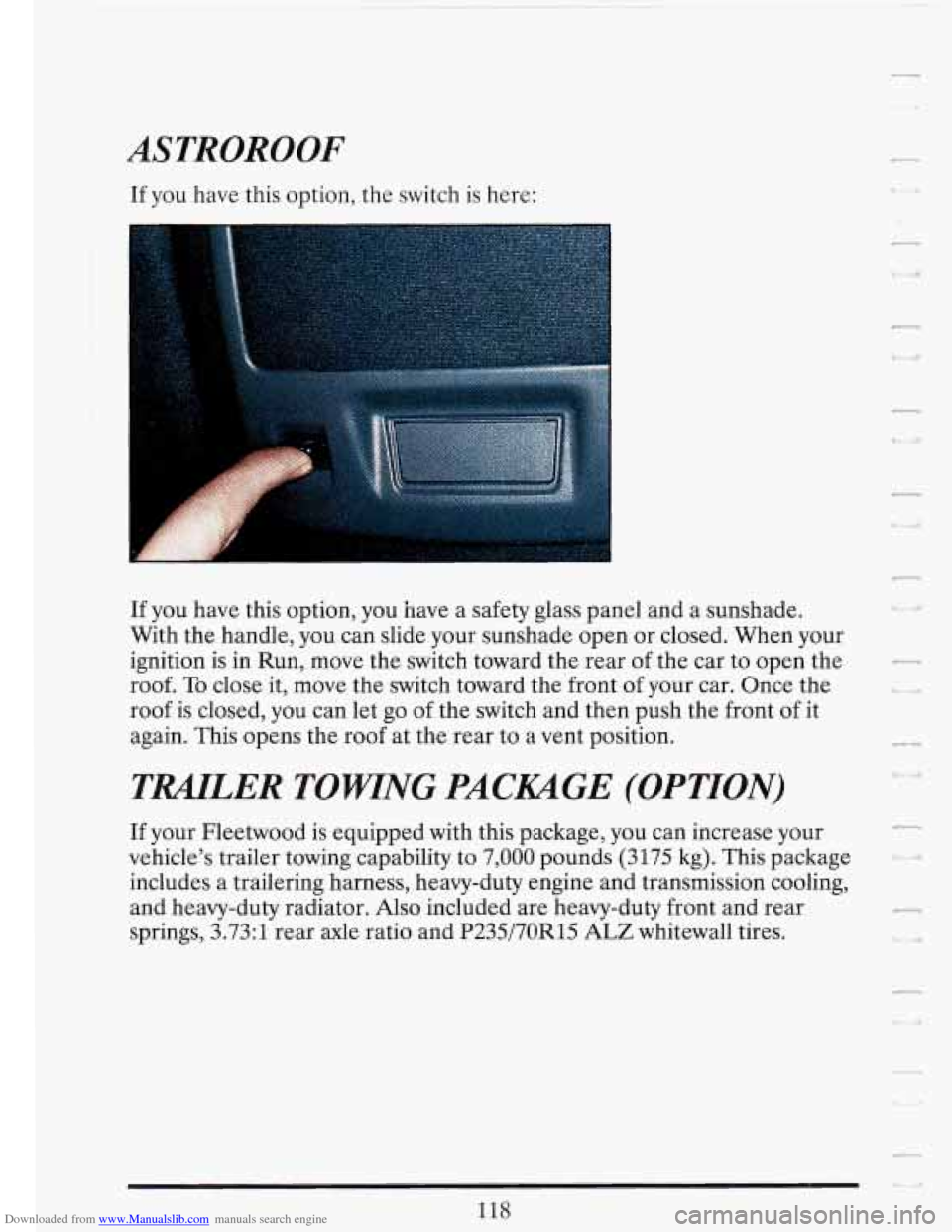
If you have this option, the switch is here:
_.
If you have this option, you have a safety glass panel and a sunshade.
With the handle, you can slide your sunshade open or closed. When your
ignition is
in Run, move the switch toward the rear of the car to open the
roof.
To close it, move the switch toward the front of your car. Once the
roof is closed, you can let
go of the switch and then push the front of it
again. This opens the roof at the rear to a vent position.
TWLER TOWING PACKAGE (OPTION)
If your Fleetwood is equipped with this package, you can increase your 7
vehicle's trailer towing capability to 7,000 pounds (3175 kg). This package '
includes a trailering harness, heavy-duty engine and transmission cooling,
and heavy-duty radiator.
Also included are heavy-duty front and rear
springs, 3.73:l rear axle ratio and P235/70R15
ALZ whitewall tires.
7
n
Page 147 of 386
Downloaded from www.Manualslib.com manuals search engine r
r
Cruise Engaged Light
This light will come on
when your cruise
control is set to a
selected speed.
Low Coolant Warning Light
-- If the coolant level in the radiator is low by 3 quarts (2.8 L) or more this
light will come on.
The light will stay on until you add coolant.
Continuing to drive your vehicle with the “Low Coolant” warning light
See “Engine Coolant” in the Index and have
your vehicle serviced as soon
as you can.
This light will come on when the ignition is on, but the engine is not
running, as a check. It doesn’t have to be fixed right away.
- . on, may result in damage to your engine.
,. ~. .
Page 243 of 386
Downloaded from www.Manualslib.com manuals search engine .- COOLING SYSTEM
-- When you decide it’s safe to lift the hood, here’s what you’ll see:
Coolant recovery tank
-? Radiator pressure cap
Electric engine fans
(If Equipped)
A CAUTION:
An electric fan under the hood can start up even when the
engine is not running and can injure you. Keep hands, clothing
and tools away from any underhood electric fan.
~
If the coolant inside the coolant recovery tank is boiling, don’t do
anything else until it cools down. -
229
Page 244 of 386
Downloaded from www.Manualslib.com manuals search engine The coolant level should be at or above “FULL COLD.” If it isn’t, you
may have a leak in the radiator hoses, heater hoses, radiator, water pump
or somewhere else
in the cooling system.
A CAUTION:
Heater and radiator hoses, and other engine parts, can be very
hot. Don’t touch them.
If you do, you can be burned.
Don’t run the engine if there
is a leak. If you run the engine, it
could lose all coolant. That could cause an engine fire, and you
could be burned. Get any leak fixed before you drive the vehicle.
-
1. .
If there seems to be no leak, check to see if the fan or if equipped electric --
engine fans are running. If the engine is overheating, both fans should be
running.
If they aren’t, your vehicle needs service.
Page 246 of 386
Downloaded from www.Manualslib.com manuals search engine i
A CAUTION:
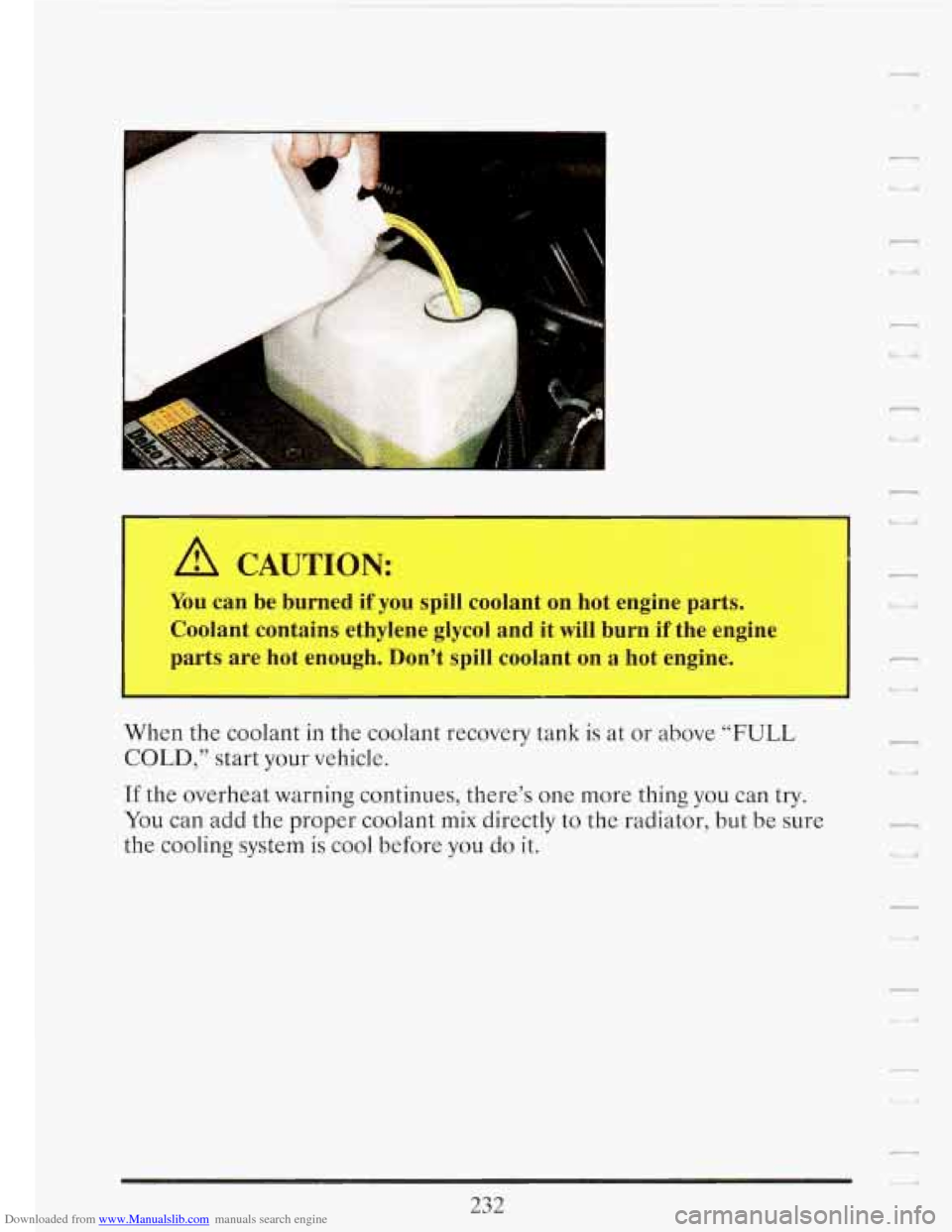
You can be burned if you spill coolant on hot engine parts.
Coolant contains ethylene glycol and
it will burn if the engine
parts are hot enough. Don’t spill coolant on a hot engine.
When the coolant in the coolant recovery tank is at or above “FULL
COLD,” start your vehicle.
If the overheat warning continues, there’s one more thing you can try.
You can add the proper coolant
mix directly to the radiator, but be sure
the cooling system is
cool before you do it.
T
Y
232
Page 247 of 386
Downloaded from www.Manualslib.com manuals search engine A CAUTION:
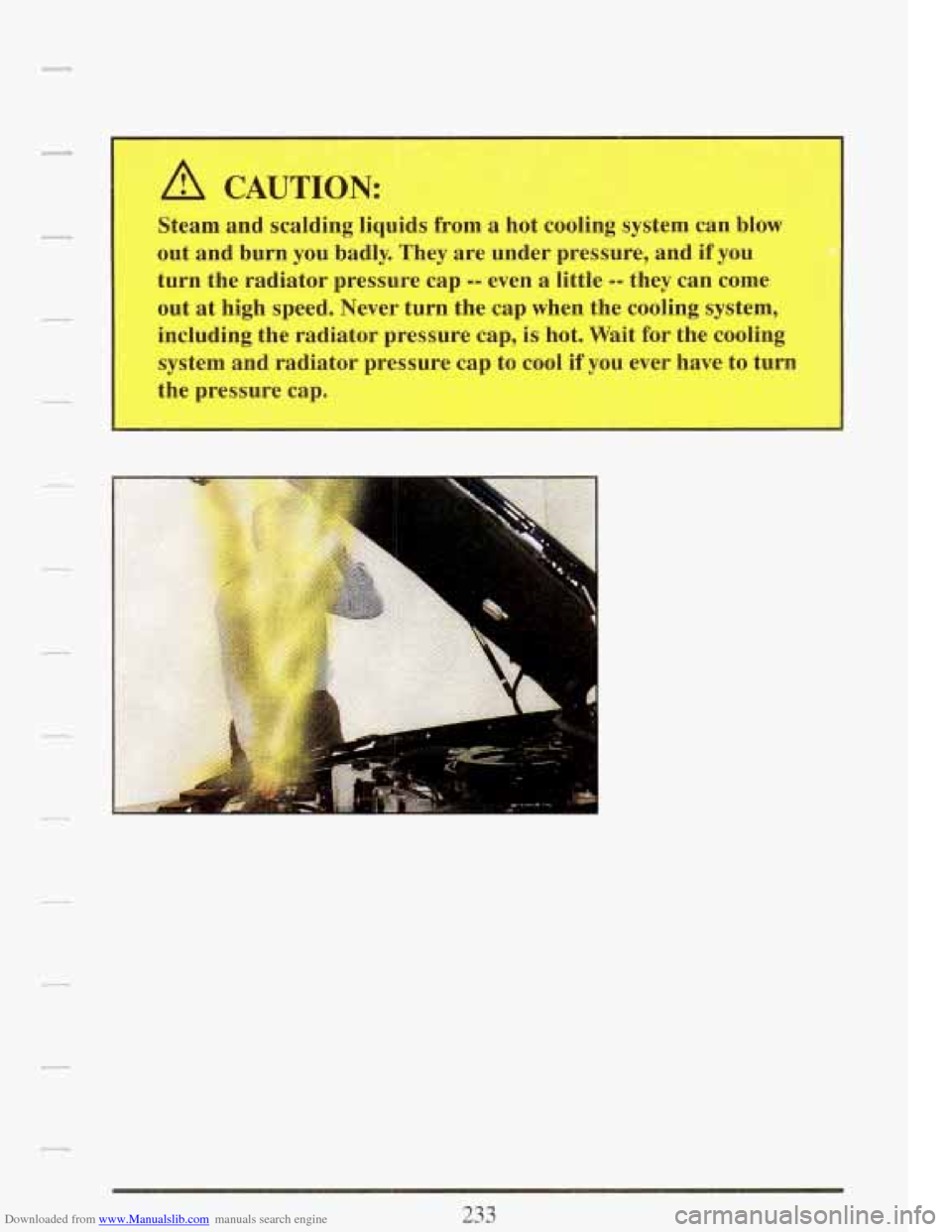
Steam and scalding liquids from a hot cooling system can blow
out and burn you badly. They are under pressure, and if you
turn the radiator pressure cap
-- even a little -- they can come
out at high speed. Never turn the cap when the cooling system,
including the radiator pressure cap, is hot. Wait for the cooling
system and radiator pressure cap to cool if you ever have to turn
the pressure cap.
233
Page 248 of 386
Downloaded from www.Manualslib.com manuals search engine How to Add Coolant to the Radiator
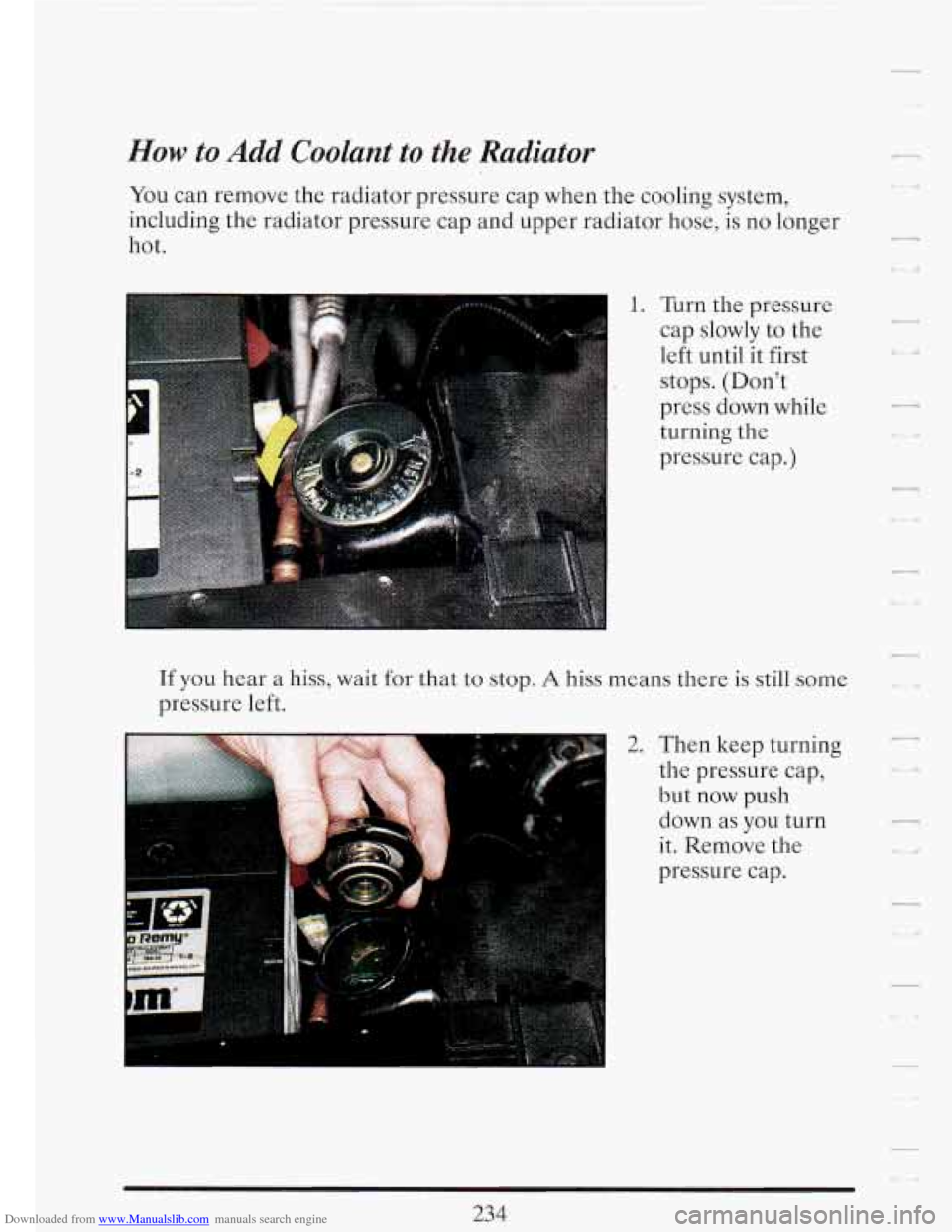
You can remove the radiator pressure cap when the cooling system,
includinp the radiator pressure cap and upper radiator hose, is
no longer
hot.
- 1. Turn the pressure
cap slowly to the
left until it first
stops. (Don’t
press down while turning the
pressure cap.)
r
u
7 ‘I! U
r
U
-
If you hear a hiss, wait for that to stop. A hiss means there is still some .
pressure left.
2. Then keep turning
the pressure cap,
but now push
down as you turn
it. Remove the
pressure cap.
L