Page 10 of 398
Downloaded from www.Manualslib.com manuals search engine 'T - I' 1 i
1
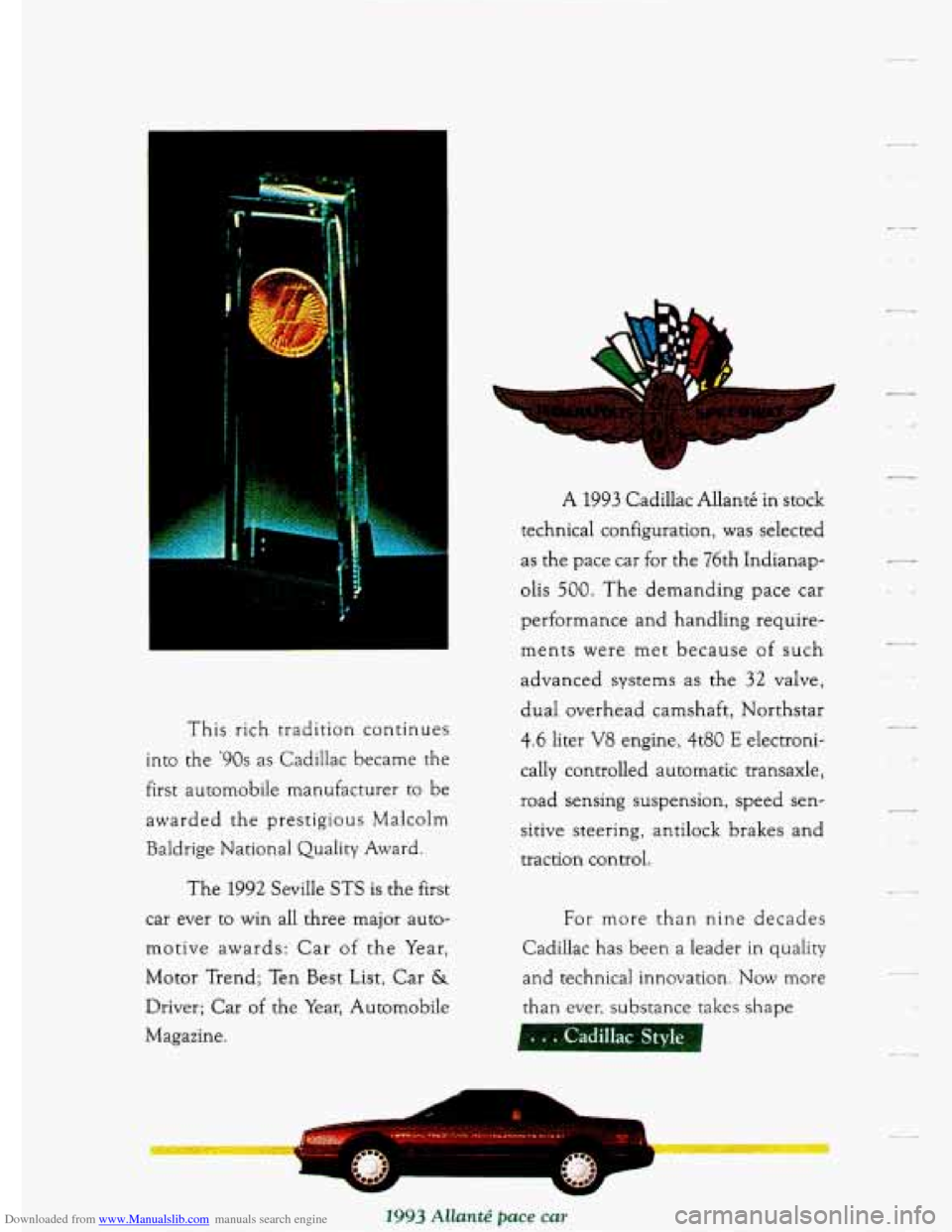
A 1993 Cadillac AllantC in stock
technical configuration, was selected
as the pace car for the
76th Indianap-
olis
500. The demanding pace car
performance and handling require-
ments were met because
of such
advanced systems as the
32 valve,
dual overhead camshaft, Northstar
4.6 liter V8 engine, 4t80 E electroni-
cally controlled automatic transaxle,
road sensing suspension, speed sen-
sitive steering, antilock brakes and
traction control.
This
rich tradition continues
into the
'90s as Cadillac became the
first automobile manufacturer to be
awarded the prestigious Malcolm
Baldrige National Quality Award.
The
1992 Seville STS is the first
car ever to
win all three major auto-
motive awards: Car of the Year,
Motor Trend; Ten Best List, Car
&a
Driver; Car of the Year, Automobile
Magazine.
For more than nine decades
Cadillac has been a leader
in quality
and technical innovation. Now more
than ever, substance takes shape
. . . Cadillac Style j
Page 95 of 398
Downloaded from www.Manualslib.com manuals search engine vel le tan roll, $2-2.~
Don’t I enicle when the engine is runnmg unles
have
to. If you have left the engine running, the vehicle ca
move suddenly.
You or others could be injured. To be sure
vehicle won’t move, when you’re on
fairly level ground, alw
set your parking brake and move the shift lever to
“P” (Par
See “ snifting Into “P” (Park)” in the Index. 11 you are par
L a hill, or if you’re pulling a trailer, also see“Parking o
or “Towing a Trailer” in the Index.
-*- aq .: : - - . .. .h i-” .. .i T
..
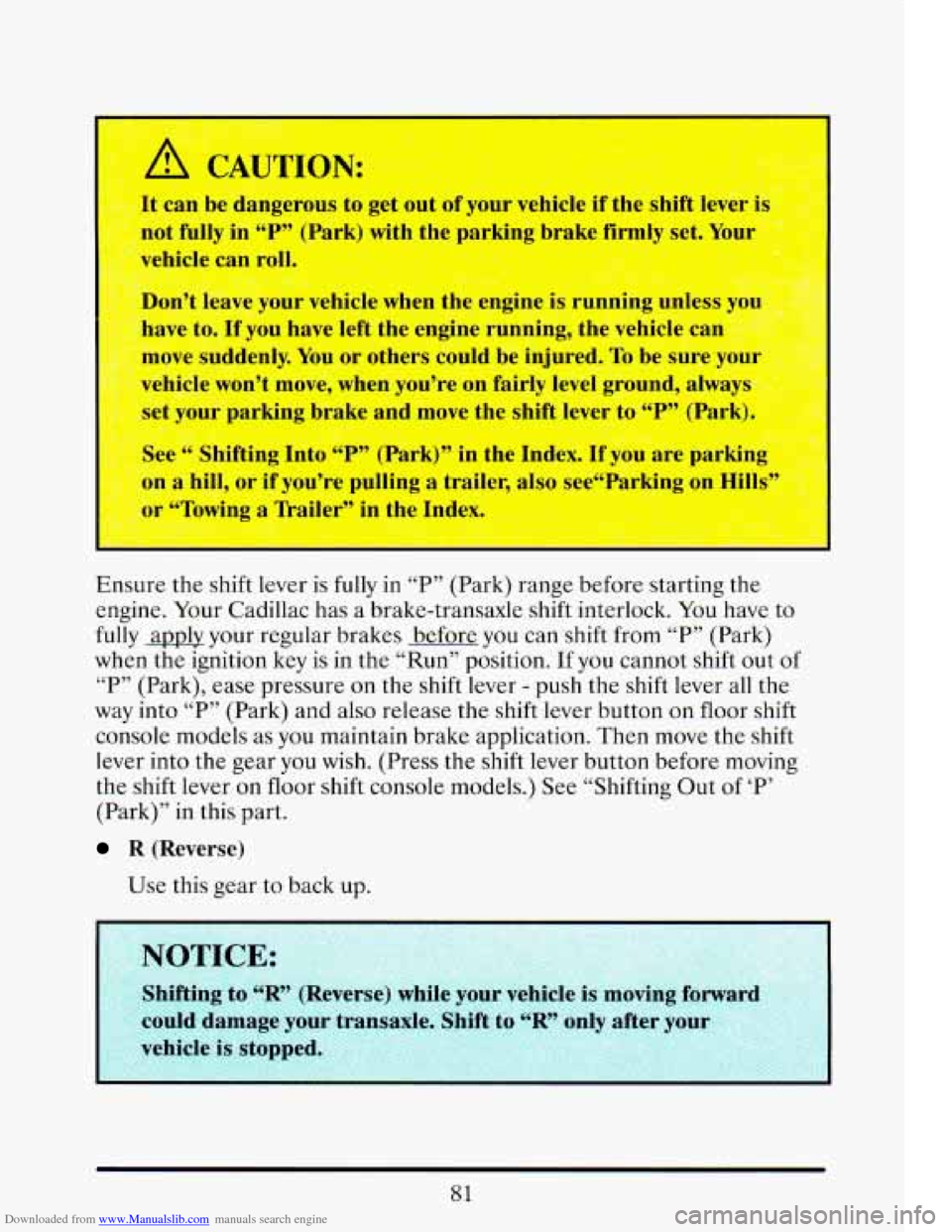
Ensure the shift lever is fully in “P” (Park) range before starting the
engine. Your Cadillac has a brake-transaxle shift interlock. You have to
fully apply your regular brakes before
you can shift from “P” (Park)
when the ignition key is in the “Run” position.
If you cannot shift out of
“P” (Park), ease pressure on the shift lever - push the shift lever all the
way into “P” (Park) and also release the shift lever button on floor shift
console models as you maintain brake application. Then move the shift
lever into the gear you wish. (Press the shift lever button before moving
the shift lever
on floor shift console models.) See “Shifting Out of ‘P’
(Park)” in this part.
R (Reverse)
Use this gear to back up.
81
Page 97 of 398
Downloaded from www.Manualslib.com manuals search engine L NOTIW:
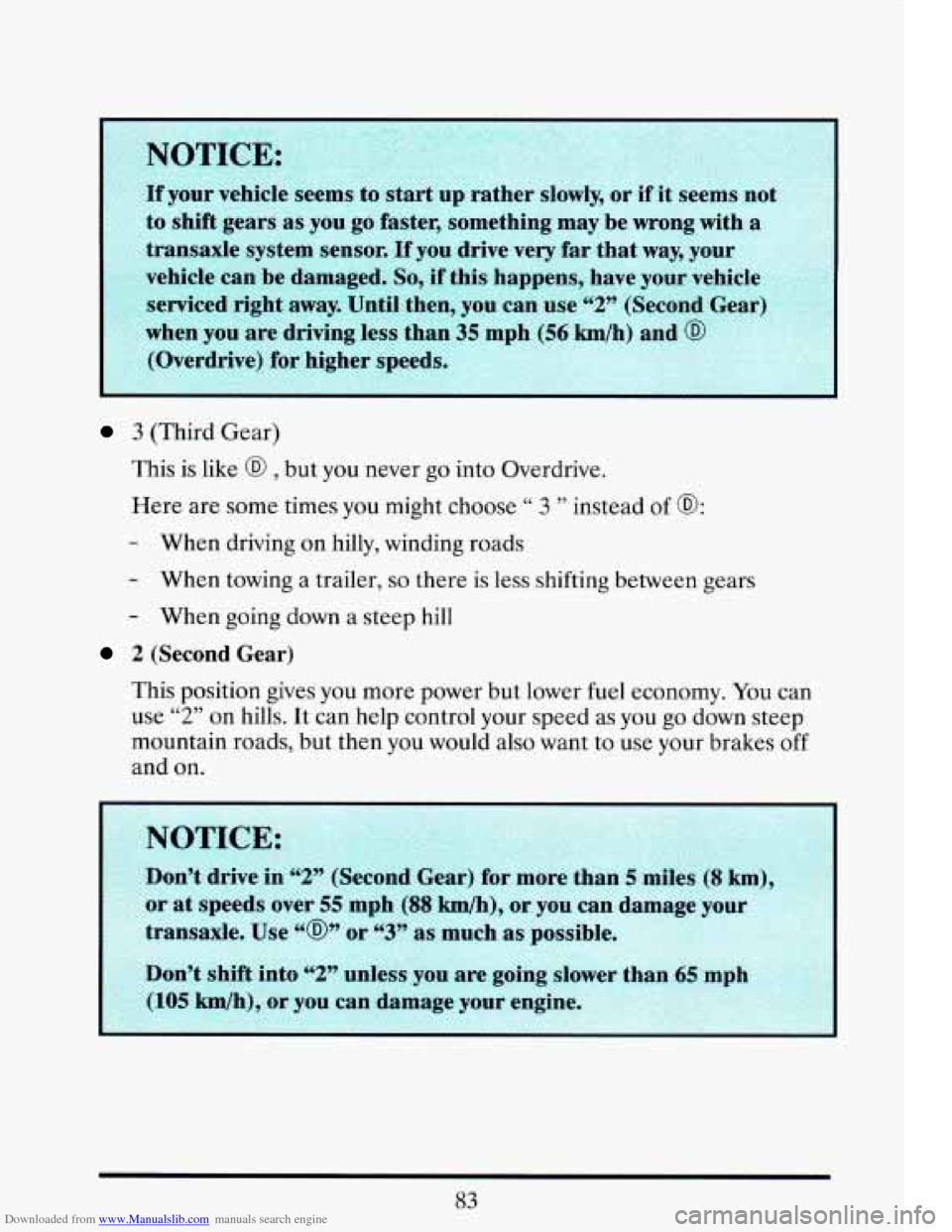
3 (Third Gear)
This is like
@ , but you never go into Overdrive.
Here are some times you might choose
“ 3 ” instead of @:
- When driving on hilly, winding roads
- When towing a trailer, so there is less shifting between gears
- When going down a steep hill
2 (Second Gear)
This position gives you more power but lower fuel economy. You can
use
“2” on hills. It can help control your speed as you go down steep
mountain roads, but then you would also want to use your brakes
off
and on.
nlh
83
Page 115 of 398
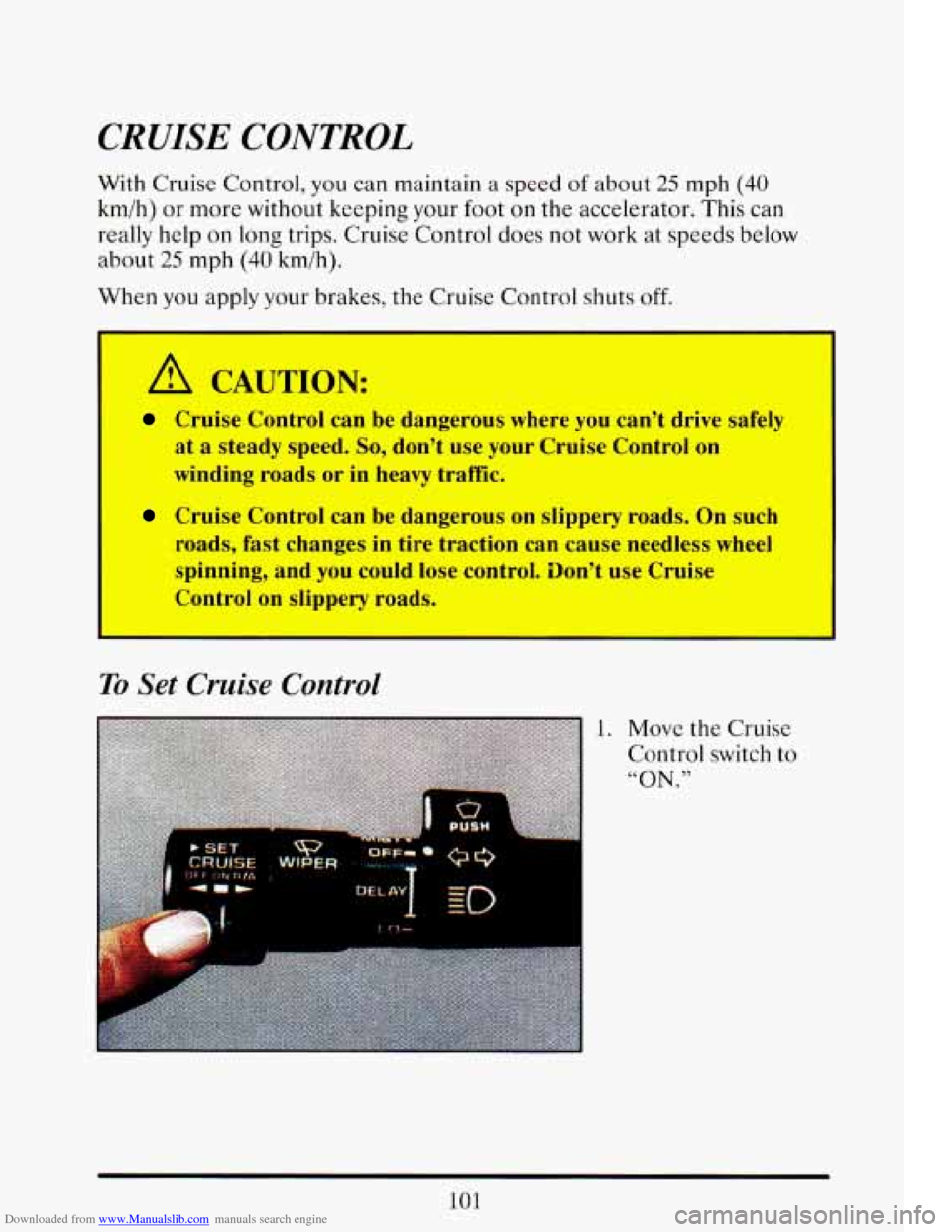
Downloaded from www.Manualslib.com manuals search engine CRUISE CONTROL
With Cruise Control, you can maintain a speed of about 25 mph (40
kmih) or more without keeping your foot on the accelerator. This can
really help on long trips. Cruise Control does not work at speeds below
about
25 mph (40 km/h).
When you apply your brakes, the Cruise Control shuts off.
Cruise Control can be dangerous where you can’t drive safely
at a steady speed.
So, don’t use your Cruise Control on
winding roads or in heavy traffic.
Cruise Control can be dangerous on slippery roads. On such
roads, fast changes in tire traction can cause needless wheel
spinning, and
you could lose control. Don’t use Cruise
Control on slippery roads.
To Set Crucse Control
1. Move the Cruise
Control switch
to
“ON ”
101
Page 133 of 398
Downloaded from www.Manualslib.com manuals search engine GARAGE DOOR OPENER (OPTION)
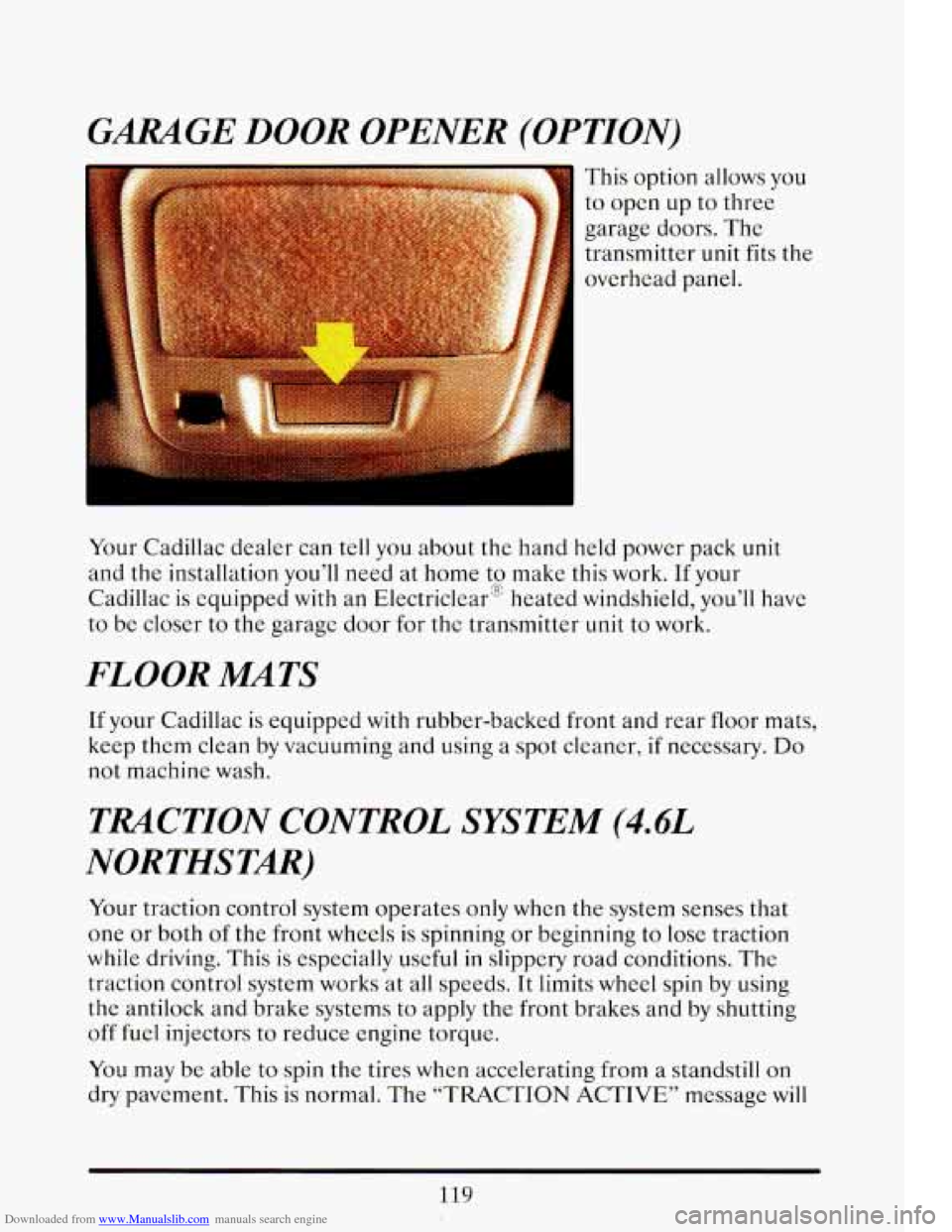
This option allows you
to open up to three
garage doors. The transmitter unit fits the
overhead panel.
Your Cadillac dealer can tell you about the hand held power pack unit
and the installation you’ll need at home to make this work.
If your
CadilIac
is equipped with an Electriclear” heated windshield, you’ll have
to be closer to the garage door for the transmitter unit
to work.
FLOOR MATS
If your Cadillac is equipped with rubber-backed front and rear floor mats,
keep them clean by vacuuming and using a spot cleaner,
if necessary. Do
not machine wash.
TRACTION CONTROL SYSTEM (4.4L
NORTHSTAR)
Your traction control system operates only when the system senses that
one or both of the front wheels
is spinning or beginning to lose traction
while driving. This is especially useful
in slippery road conditions. The
traction control system works at all speeds.
It limits wheel spin by using
the antilock and brake systems to apply the front brakes and by shutting
off
fuel injectors to reduce engine torque.
You may be able to spin the tires when accelerating from a standstill on
dry pavement. This is normal. The “TRACTION ACTIVE” message will
119
Page 139 of 398
Downloaded from www.Manualslib.com manuals search engine I
A CAUTION:
Your brake system may not be working properly if the brake
warning light is
on. Driving with the brake warning light on can
lead to an accident. If the light is still
on after you've pulled off
service. e road and
stopped carefully, have the vehicle towed for
I
Anti-Lock Brake System Warning Light
=
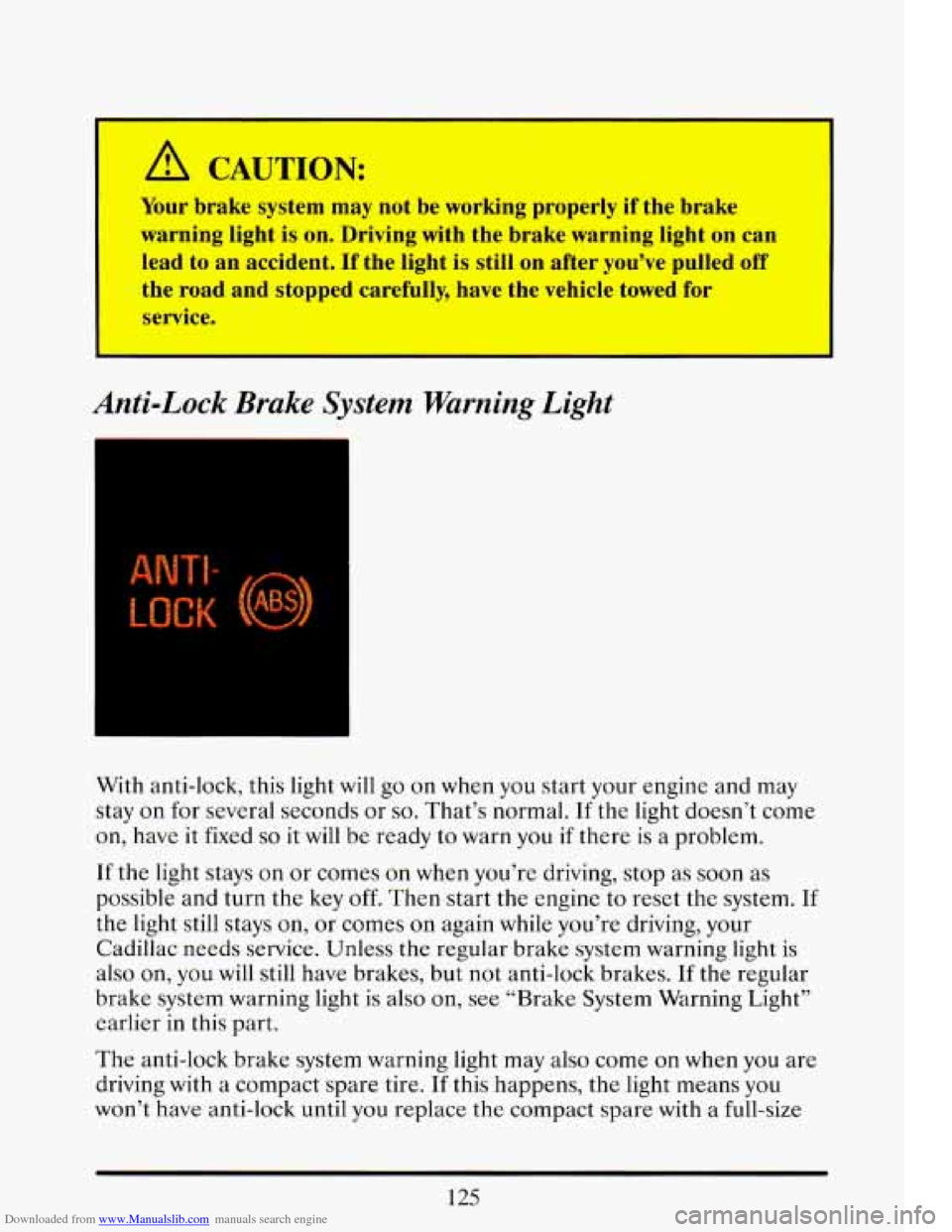
With anti-lock, this light will go on when you start your engine and may
stay
on for several seconds or so. That's normal. If the light doesn't come
on, have it fixed
so it will be ready to warn you if there is a problem.
If the light stays on or comes on when you're driving, stop as soon
as
possible and turn the key off. Then start the engine to reset the system. If
the light still stays on, or comes on again while you're driving, your
Cadillac needs service. -Unless the regular brake system warning light is
also on,
you will still have brakes, but not anti-lock brakes. If the regular
brake system warning light is also on, see "Brake System Warning Light"
earlier in this part.
The anti-lock brake system warning light may also come
on when you are
driving with a compact spare tire.
If this happens, the light means you
won't have anti-lock until you replace the compact spare with a full-size
125
Page 190 of 398
Downloaded from www.Manualslib.com manuals search engine person with a higher BAC might not be able to react quickly enough to
avoid the collision.
There’s something else about drinking and driving that many people
don’t know. Medical research shows that alcohol in a person’s system can
make crash injuries worse. That’s especially true for brain, spinal cord
and heart injuries. That means that if anyone who has been drinking
--
driver or passenger -- is in a crash, the chance of being killed or
permanently disabled
is higher than if that person had not been drinking.
And we’ve already seen that the chance
of a crash itself is higher for
drinking drivers.
I
A CAUTION:
Drinking and then driving is very dangerous. Your reflexes,
perceptions, and judgment will be affected
by even a small
amount of alcohol.
You could have a serious -- or even fatal --
accident if you drive after drinking. Please don’t drink and drive
or ride with a driver who has been drinking. Ride home in a cab;
or if you’re with
a group, designate a driver who will not drink.
CONTROL OF A WHICLE
You have three systems that make your vehicle go where you want it to
go. They are the brakes, the steering and the accelerator.
All three
systems have
to do their work at the places where the tires meet the road.
176
Page 191 of 398
Downloaded from www.Manualslib.com manuals search engine Sometimes, as when you're driving on snow or ice, it's easy to ask more of
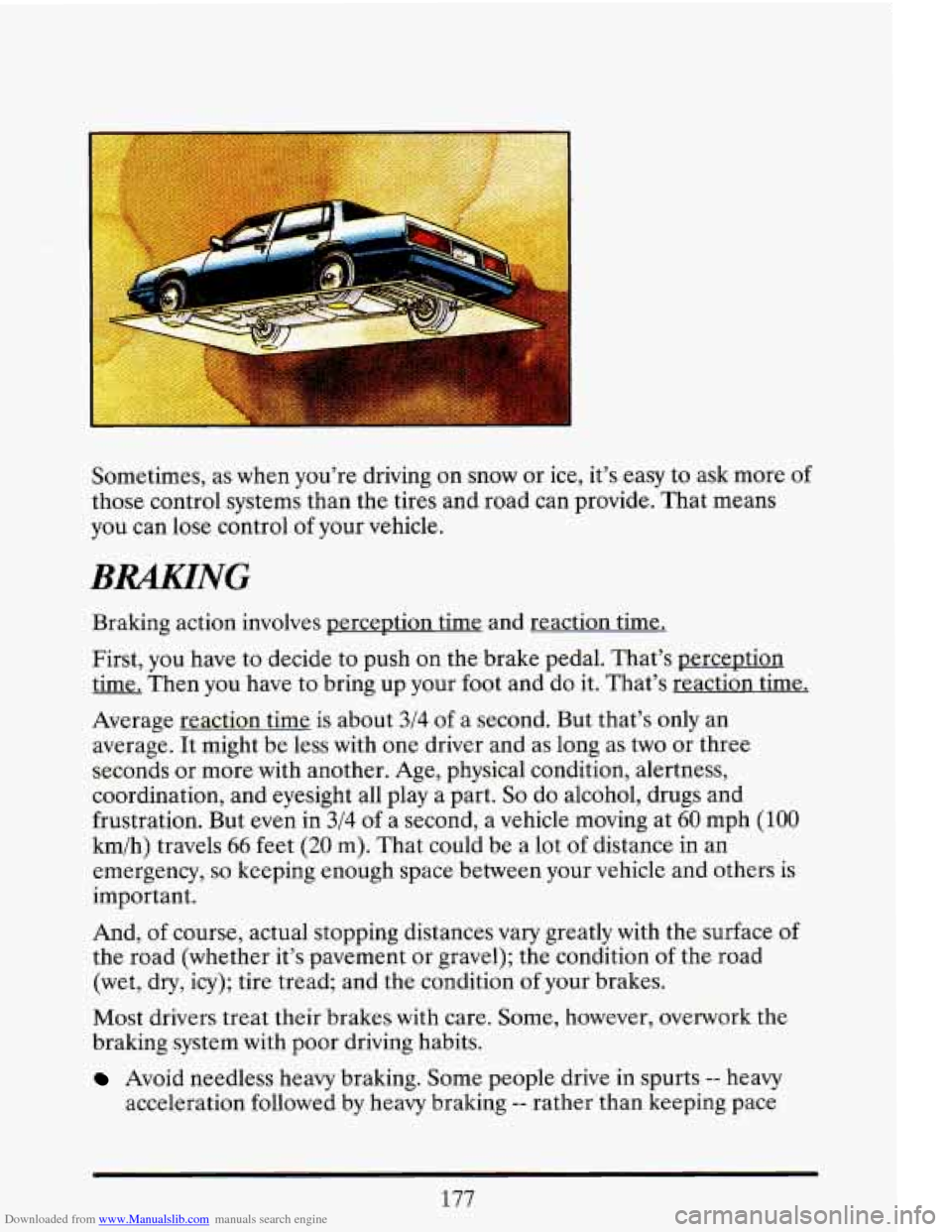
those control systems than the tires and road can provide. Tha\
t means
you can lose control of your vehicle.
BRAKING
Braking action involves p- and reaction time.
First, you have to decide to push on the brake pedal. That's perception
time. Then you have to bring up your foot and do it. That's reaction time.
Average reaction time
is about 3/4 of a second. But that's only an
average. It might be less with one driver and as long as
two or three
seconds or more with another. Age, physical condition, alertness,
coordination, and eyesight all play a part.
So do alcohol, drugs and
frustration. But even in
3/4 of a second, a vehicle moving at 60 mph (100
km/h) travels 66 feet (20 m). That could be a lot of distance in an
emergency,
so keeping enough space between your vehicle and others is
important.
And,
of course, actual stopping distances vary greatly with the surface of
the road (whether it's pavement or gravel); the condition of the road
(wet, dry, icy); tire tread; and the condition
of your brakes.
Most drivers treat their brakes with care. Some, however, overwork the
braking system with poor driving habits.
Avoid needless heavy braking. Some people drive in spurts -- heavy
acceleration followed by heavy braking
-- rather than keeping pace
177