1993 BUICK SKYLARK windshield
[x] Cancel search: windshieldPage 13 of 306

Vehicle Symbols
These are some of the symbols you will. find -on your vehicle.
For example,
these symbols
are used on an
original battery:
CAUTION
INJURY
PROTECT EYES BY
SHIELDING
Q
CAUSTIC
ACID COULD CAUSE
BA~~RY
BURNS AVOID
SPARKS
OR
FLAMES
SPARK
OR ,\I/,
COULD pq
FLAME
EXPLODE BATTERY
These symbols
are important
for you and
your passengers
whenever your
vehicle- is
driven:
FASTEN SEAT 4
BELTS
POWER
WINDOW
These symbols
have to do with
your lights:
SIGNALS e 9
TU-RN
HIGH BEAM
OR = =o
FOG LAMPS # 0
These symbols
are on some of
your controls:
WINDSHIELD ' ' '
. WASHER
CI 0s
-tO -1
WINDSHIELD
WASHER 8
wI*DsHIELDw DEFROSTER
WINDOW
Ltft,
REAR
DEFOGGER
VENTILATING FAN
3f
HEADLAMP -
WIPER
WASHER
EQ
L
~
These symbols
are used
on
warning and
indicator lights:
COOLANT F-
TEMP *-
ENGINE
CHARGING BATTERY
SYSTEM
RADIATOR
a
COOLANT
FUEL @
ENGINE OIL e,
PRESSURE
TEMP
OIL &
ANTILOCK (@)
BRAKE
Here are some
other symbols
you may see:
FUSE
RAD10 k
VOLUME
CONDITIONING
AIR e
HATCHBACK TRUNK
RELEASE
LIGHTER
1-i
HORN
SPEAKER
12
Page 73 of 306

Ignition Key Positions
Your square-headed key
opgs.@gs ,. .r , your ignition lock. ..
This lock gives you five different positions.
Before you put the key in, your ignition will be in the
Lock position. This position locks your ignition, steering
wheel and transaxle. It’s a theft deterrent feature.
The other positions let you perform these functions:
ACC: Accessory lets you’use things like the radio and
the windshield wipers when the engine is
off. To use
“Acc,” push in the key and turn
it toward you. Your
72
Page 91 of 306

Ihrn Signal tCONSS Chime
A chime will sound if your turn signal is left on after
having gone
3/4 of a mile, to remind you to turn your
signal
off.
Operation of Lights
Although your vehicle’s lighting system (headlights,
parking lights, fog lamps, side.marker lights and
taillights) meet all applicable federal lighting
requirements, certain states and provinces may apply their own lighting regulations that may require special
attention before you operate these lights. For example,
some jurisdictions may require that you operate your
lower beam lights with fog lamps at all times, or that
headlights be turned on whenever you must use your
windshield wipers. In addition, most jurisdictions
prohibit driving solely with parking lights, especially at
dawn or dusk. It
is recommended that you check with
you own state or provincial highway authority for
applicable lighting regulations.
Headlight High-Low Beam
To change the headlights
from low beam to high or
high to low, pull the turn
signal lever all the way
toward you. Then release it.
When the high beams are
on, this blue light on the
instrument panel also will
be on.
Flash-To-Pass Feature
It lets you use your high beam headlights to signal a driver in front of you that you want to pass. It works
even
if your headlights are off.
To use it, pull the multifunction lever toward you a little
(but not
so far that you hear a click).
If your headlights are off Your high beam headlights
will
turn on. They’ll stay on as long as you hold the
lever there. Release the lever to turn them
off.
90
I
Page 92 of 306

If your headlights are on, but on low beam: The
system works normally. Just pull the lever until it clicks.
Your headlights will shift to high beam and stay there.
To return to low beam, just pull the lever toward you.
Windshield Wipers
You control the windshield wipers by moving the lever
marked
“WIPER.”
For a single wiping cycle, move the lever down to
“MIST.” Hold it down until the wipers start, then let go.
The wipers will stop after one cycle. If you want more
cycles, hold the lever down to “MIST” longer.
i
For steady wiping at low speed, move the lever to the
“LOW’ position. For high speed wiping, move the lever
further, up to “HIGH” To stop the wipers, move the
lever to “OFF.”
Low Speed Delay Wipers (Option)
You can set the wiper speed for a long or short delay
between wipes. This can be very useful in light rain or
snow. Move the lever to DELAY then, turn the band to
choose the amount of delay.
I A CAUTION:
Damaged wiper blades may prevent you from
seeing well enough
in a storm to drive safely. To
avoid damage, be sure to clear ice and snow
from the wiper blades before using them.
If
they’re frozen to the windshield, carefully loosen
or thaw them.
If your blades do become
damaged, get new blades or blade inserts.
Page 93 of 306

Heavy snow or ice can overload your wipers. A circuit
breaker will stop them until the motor cools. Clear away
snow or ice to prevent an
OVI. ~ ~ J.
Windshield Washer
The top of the wiper lever has the word “WASH’ on it.
’0 spray washer fluid on the windshield, pull the lever
Laward you.
If you have the standard wipers, the wipers will keep
going in
“LO” until you turn the wiper control to “OF’”’’
If you have the Low Speed Delay option, the wipers will
4ear the window and then either stop or return to your
,reset speed.
I A CAUTION:
1 Driving without washer fluid can be
dangerous.
A bad mud splash can block
your vision. You could
hit another vehicle
or
go off the road. Check your washer fluid
level often.
1 In freezing weather, don’t use your washer
until the windshield is warmed. Otherwise
the washer fluid can form ice on the
windshield, blocking your vision.
1
* When usin ated washer fli
Tollow the m turer’s instructions
adding wate
Fill your washer fluid tank only 3/4 f
when it’s very cold. This allows for
expansion, which co
it is completely full.
.. - - , ....,I ,.,,- . . ,/ ,. ,, . .. , .. . I .. ,~ 4’ I 7: ., -:,.. , ,,
92 =
Page 122 of 306

BIL (Bi-level) Windshield Defrost
This
setting allows the outside air to flow through your
Buick in two ways. Cooler air is directed to the upper
portion of your body through the vent outlets. Slightly
warmer air
is directed through the heater ducts and
defroster outlets.
Vent
Using vent will allow outside air to flow through the
instrument panel outlets. Set the temperature knob as
desired.
Heater
On days when it’s cold outside, this setting sends heated
air through the heater ducts and
the windshield defroster
outlets. If you have the engine block heater, you can use
it in cold weather (+2OoF/-8 OC or lower) to heat your
vehicle’s passenger area quicker. The engine block
heater warms the engine coolant which
will ultimately
warm the passenger area more efficiently.
( See “Engine
Block Heater” in the Index.)
Blend
This setting divides the air flow equally between the
heater and the defroster outlets. This setting operates the defroster. Most
of the air comes
out near the windshield. Use defrost when you get fog or
ice on the windshield.
Rear Window Defogger (Option)
The lines you see on the
rear window warm
the
glass. Press the button to
start warming your
.window. Pressing the
button again will shut it off.
If you
turn the rear defogger on while driving at or
above
45 mph (72 km/h), it will stay on as long as that
speed is maintained.
You must press the button to shut
it
off.
121
Page 163 of 306
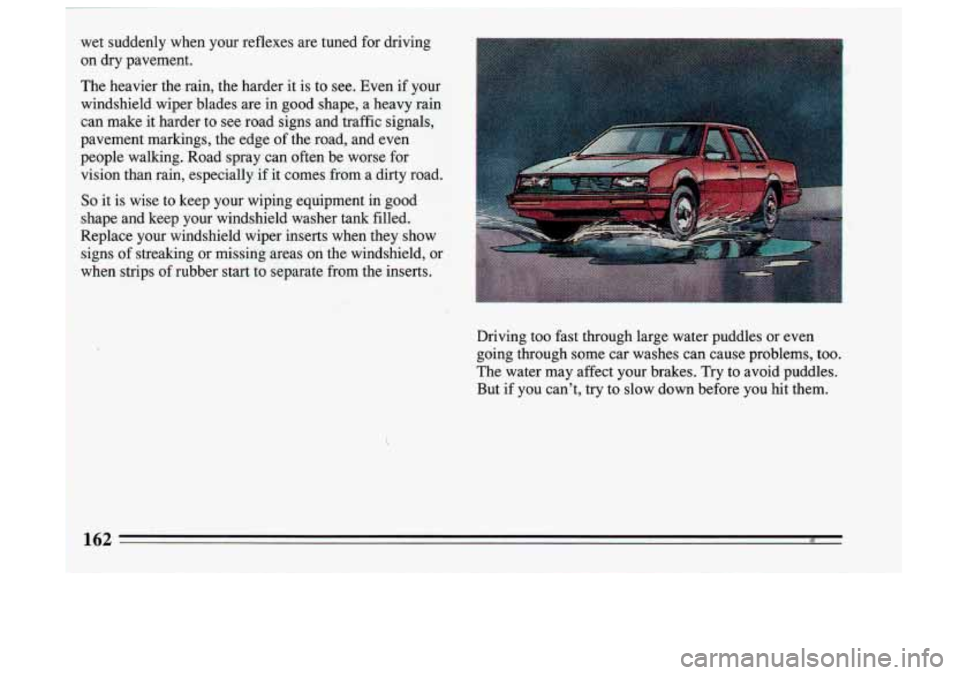
wet suddenly when your reflexes are tuned for driving
on dry pavement.
The heavier the rain, the harder it is to see. Even if your
windshield wiper bladesare in good shape, a heavy rain
can make it harder to see road signs and traffic signals,
pavement markings, the edge of the road, and even
people walking. Road spray can often be worse
for
vision than rain, especially if it comes from a dirty road.
So it is wise to keep your wiping equipment in good
shape and keep your windshield washer tank filled.
Replace your windshield wiper inserts when they
show
signs of streaking or missing areas on the windshield, or
when strips of rubber start to separate from the inserts.
1 L3
Driving too fast through large water puddles or even
going through some car washes can cause problems, too.
The water may affect your brakes. Try to avoid puddles. But
if you can't, try to slow down before you hit them.
Page 165 of 306

Driving in Fog, Mist and Haze
Fog can occur with high humidity or heavy frost. It can
be
so mild that you can see through it for several
hundred feet (meters). Or it might be
so thick that you
can see only a few feet (meters) ahead. It may come
suddenly to an otherwise clear road. And it can be a
major hazard.
When you drive into a fog patch, your visibility will be
reduced quickly. The biggest dangers are striking the vehicle ahead or being struck by the one behind. Try
to
“read” the fog density down the road. If the vehicle
ahead starts to become less clear or, at night,
if the
taillights are harder to see, the fog is probably
thickening. Slow down to give traffic behind you a chance to slow down. Everybody then has a better
chance to avoid hitting the vehicle ahead.
A patch of dense fog may extend only for a few feet
(meters) or for miles (kilometers); you can’tyeally tell
while you’re in it. You can only treat the situation with
extreme care.
One common fog condition
-- sometimes called mist or
ground fog
-- can happen in weather that seems perfect,
especially at night or in the early morning in valley and
low, marshy areas. You can be suddenly enveloped
in
thick, wet haze that may even coat your windshield. You
can often spot these fog patches or mist layers with your
headlights. But sometimes they can be waiting for you
as you come over a hill or dip into a shallow valley.
Start your windshield wipers and washer, to help clear
accumulated road dirt. Slow down carefully.
Tips on Driving in Fog
If you get caught in fog, turn your headlights on low
beam, even in daytime. You’ll see
-- and be seen --
better. Use your fog lights if your vehicle has them.