1993 BUICK SKYLARK radiator
[x] Cancel search: radiatorPage 13 of 306

Vehicle Symbols
These are some of the symbols you will. find -on your vehicle.
For example,
these symbols
are used on an
original battery:
CAUTION
INJURY
PROTECT EYES BY
SHIELDING
Q
CAUSTIC
ACID COULD CAUSE
BA~~RY
BURNS AVOID
SPARKS
OR
FLAMES
SPARK
OR ,\I/,
COULD pq
FLAME
EXPLODE BATTERY
These symbols
are important
for you and
your passengers
whenever your
vehicle- is
driven:
FASTEN SEAT 4
BELTS
POWER
WINDOW
These symbols
have to do with
your lights:
SIGNALS e 9
TU-RN
HIGH BEAM
OR = =o
FOG LAMPS # 0
These symbols
are on some of
your controls:
WINDSHIELD ' ' '
. WASHER
CI 0s
-tO -1
WINDSHIELD
WASHER 8
wI*DsHIELDw DEFROSTER
WINDOW
Ltft,
REAR
DEFOGGER
VENTILATING FAN
3f
HEADLAMP -
WIPER
WASHER
EQ
L
~
These symbols
are used
on
warning and
indicator lights:
COOLANT F-
TEMP *-
ENGINE
CHARGING BATTERY
SYSTEM
RADIATOR
a
COOLANT
FUEL @
ENGINE OIL e,
PRESSURE
TEMP
OIL &
ANTILOCK (@)
BRAKE
Here are some
other symbols
you may see:
FUSE
RAD10 k
VOLUME
CONDITIONING
AIR e
HATCHBACK TRUNK
RELEASE
LIGHTER
1-i
HORN
SPEAKER
12
Page 200 of 306

A CAUTION:
I
An electric fan under the hood can start up even
when the engine is not running and can injure
you. Keep hands, clothing and tools away from
any underhood electric fan.
If the coolant inside the coolant surge tank is boiling,
don’t
do anything else until it cools down.
The coolant level should be at or above
“FULL COLD.”
If it isn’t, you may have a leak in the radiator hoses,
heater hoses, radiator, water pump or somewhere else in
the cooling system.
A CAUTION:
Heater and radiator hoses, and other engine
parts, can be very hot. Don’t touch them. If you
do, you can be burned.
Don’t run the engine if there is a leak. If you run
-le engine, it could lose all coolant. That could
cause an engine fire, and you could be burned.
Nt any leak fixed before you drive the vehicle.
If there seems to be no leak, check to see if the electric
engine fan is running.
If the engine is overheating, the
fan should be running.
If it isn’t, your vehicle needs
service.
199
Page 202 of 306
1
A CAUTION':
Adding only plain water to your cooling system
can be dangerous. Plain water, or some lother
liquid li~ke alcohol, can boil before tihe proper
coolant
mix will. Your whicl'e's CoOilant warning
You can1 be burned if you spill coolant on hot ,,
engilne ~parts. Coolaint contains ethylene glycol
and lit wil~il burn if the enlgine parts are ,hot
enough. hn't spill coolant
on a hot engine. I
system is set for the proper coolant mix. With
plain water or the wron.g, mix, your engi'ne could8 1
get too h,ot but you wouldn't get thie overheat
warning. Your engine could catclh fire and
you or
others could
be burned. Use ;a 50/50 mix of clean
water and a proper antifreeze.
1
I
1-
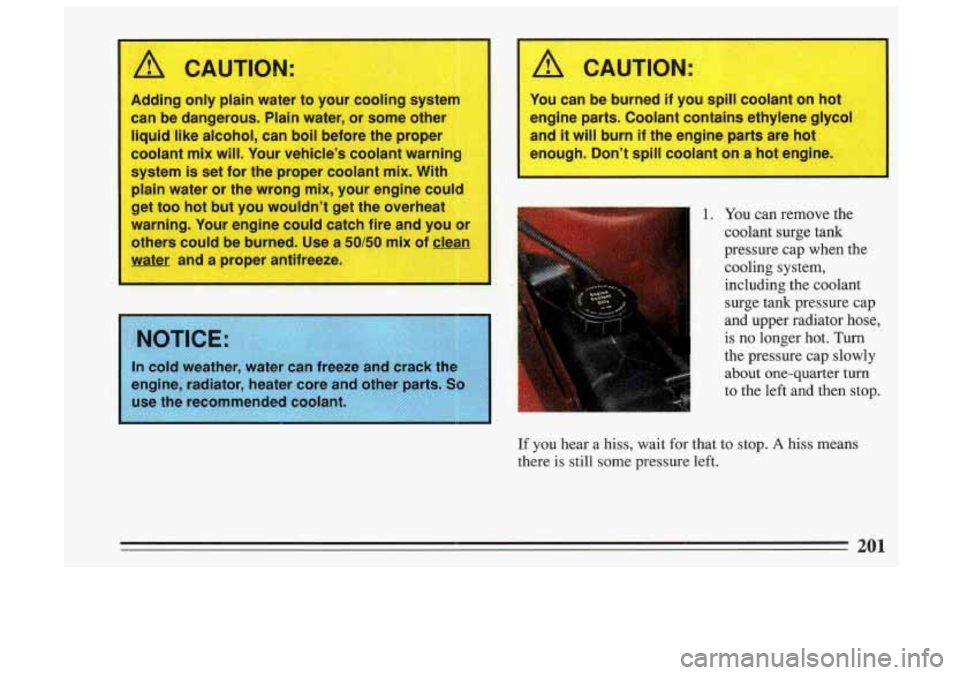
1. You can remove the
coolant surge tank
pressure cap when the
cooling system,
including the coolant
surge
tank pressure cap
and upper radiator hose,
is no longer hot. Turn
the pressure cap slowly
i about one-quarter turn
1 to the left and then stop. I
If you hear a hiss, wait for that to stop. A hiss means
there is still some pressure left.
201
Page 204 of 306
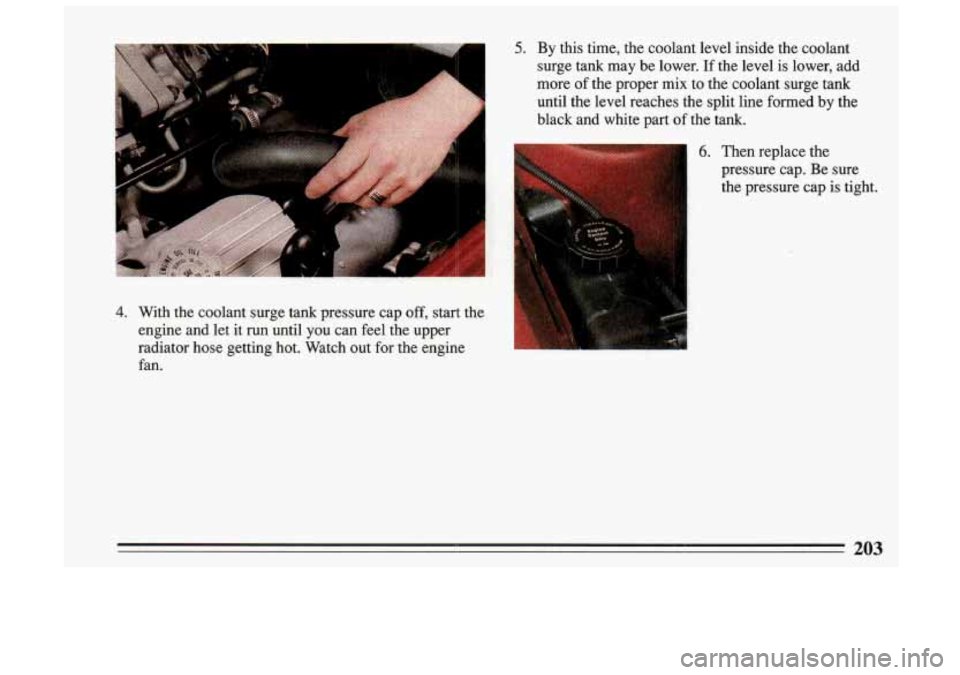
4.
5. By this time, the coolant level inside the coolant
surge tank may be lower. If the level is lower, add
more of the proper mix to the coolant surge tank
until the level reaches the split line formed by the
black and white part of the tank.
With the coolant surge tank pressur\e cap off, start the
engine and let it run until you can feel the upper
radiator hose getting hot. Watch out for the engine
6. Then replace the
pressure cap. Be sure
the pressure cap is tight.
fan.
203
Page 234 of 306
To Add Coolant: If you need more coolant, add the
proper mix at the surge tank, but only when the engine is cool.
A CAUTION:
Turning the surge tank pressure cap when the
engine and radiator are hot can allow steam and
scalding liquids to blow out and burn you badly.
Never turn the surge tank pressure cap
-- even a
little
-- when the engine and radiator are hot.
I
I
1 A CAUTION:
You can be burned if you spill coolant on hot
engine parts. Coolant contains ethylene glycol,
and
it will burn if the engine parts are hot
enough. Don’t spill coolant
on a hot engine.
1
Surge Tank Pressure Cap
pressure-type cap and must be tightly installed
When you replace your surge tank pressure cap, a GM
cap is recommended.
Thermostat
Engine coolant temperature is controlled by a thermostat
in the engine coolant system. The thermostat stops the
flow of coolant through the radiator until the coolant
reaches a preset temperature.
When you replace your thermostat, an
ACS thermostat
is recommended.
233
Page 276 of 306

Inspect hoses and replace if they are cracked,
swollen or deteriorated. Tighten screw-type hose
clamps. Clean the outside of the~radiator and air
conditioning condenser. Wash the pressure cap and
neck.
To help ensure proper operation, we recommend a
pressure test
of both the cooling system and the
pressure cap.
7. Transaxle Service -- Change both the fluid and
filter every
15,000 miles (25 000 km) if the vehicle
is mainly driven under one or more of these
conditions:
0 In heavy city traffic where the outside
temperature regularly reaches
90 F (32 C) or
higher.
0 In hilly or mountainous terrain.
When doing frequent trailer towing. (With some
models, you shouldn’t ever tow a trailer. See
“Towing a Trailer” in the Index.)
Uses such as found in taxi, police car or delivery
service. If you
do’ not use your vehicle under any of these
conditions, change both the fluid and filter every
100,000 miles (160 000 km).
8. Spark Plug Replacement* -- Replace spark plugs
with the proper type. See “Specifications Chart” in
the Index.
9. Spark Plug Wire Inspection (3.3L Code N engine
only)*?
-- Inspect for burns, cracks or other
damage. Check the boot fit at the coils and at the
spark plugs. Replace wires as needed.
10. Air Cleaner Filter Replacement* -- Replace every
30,000 miles
(50 000 km) or more often under dusty
conditions. Ask your dealer for the proper
replacement intervals for your driving conditions.
11. Fuel Tank, Cap and Lines Inspection”? -- Inspect
fuel
tank, cap and lines (including fuel rails and
injection assembly) for damage or leaks. Inspect fuel
cap gasket for an even filler neck imprint or any
damage. Replace parts as needed. Periodic
replacement of the fuel filter is not required.
* An Emission Control Service.
The
U.S. Environmental Protection Agency has determined that the failure to perform this maintenance item will not nullify the emission warranty or limit recall liability prior to the completion of vehicle
useful life. General Motors, however, urges that all recommended maintenance services be performed at the indicated intervals and the maintenance be recorded in “Section EMaintenance Record”.
Page 301 of 306

Power Antenna
..................................... 134
Door Locks
................................... 65
Seat Controls
................................... 16
Steering
..................................... 154
Windows
..................................... 87
Pregnancy. Use
of Safety Belts During ................ 35
Pressure. Tire
................................... 242
Problems on the Road
............................ 185
Publications. Service
............................. 288
Publications Order Form .......................... 291
Push-Starting Your Car
........................... 188
Steering
Fluid
................................ 234
Proper Safety Belt Usage for Adults
.................. 28
Racing. Shifting When Your Engine is
............... 78
Radiator Overheating
............................. 197
Radio. Adding a Two-way
......................... 123
Radio Systems
.................................. 122
Rain. Driving in
................................. 161
Reaction Time
in Braking ......................... 149
Reading Lights
.................................. 10 1
RearBrakes .................................... 153
Rear Door Security Lock
........................... 69
Rear Safety Belt Comfort Guides
.................... 40
Rear Seatbacks. Folding
............................ 20
Rear Window Defogger ........................... 121 Reclining Front Seatbacks
.......................... 16
Recommended Fluids and Lubricants
................. 281
Recovery. Off-Road
.............................. 156
Recreational Vehicle Towing
....................... 179
Remote Fuel Door Release
.......................... 219
Remote Keyless Entry System
....................... 67
Remote Trunk Release
............................. 66
Remote Trunk Release Lockout
...................... 66
Replaceable Light Bulbs
.......................... 262
Replacing Brake System Parts
...................... 237
Replacing Safety Belts
............................. 60
Replacing Tires
................................. 244
Replacing Wheels
............................... 247
Restarting Your Car When It’s Moving
................ 78
Restraint. Child
.................................. 46
Restraint Systems. Checking Your
.................... 59
Restraints. Head .................................. 18
Reverse Gear Position
............................. 78
Ride Control System. Adjustable
..................... 86
“Riding” the Brakes
.............................. 149
Roads. Hill and Mountain
......................... 170
Rocking Your Vehicle
............................ 213
Rotation. Tire
................................... 243
Run (Ignition Key Position)
......................... 73
Running Your Engine While You’re Parked
............ 85
Reporting Safety Defects
.......................... 287
Roadsigns
..................................... 138
Running Lights. Daytime
.......................... 100