Page 260 of 306

~~ Fuse Usage
Amp Description
1.
2.
3.
4.
5.
6.
7.
8.
9.
10.
11.
12.
13.
14.
15.
16.
17.
18.
19.
20.
21. 10
20
20
15
5
5
10
15
15
25
10
20
20
20
30
25 15
20
30
20
20 PRNDL
F/P INJ
STOP HAZ
CTSY
RKE
INST LPS
GAUGES
HORN
ALARM HTR-A/C
RDO IGN
TURN DR LK
TAIL LPS
WDO
WIPER
ERLS
FTP
ACC
IGN ECM HDLP Backup Lamps, Electronic PRNDL Display
Fuel Pump, Fuel Injectors
Stop Lamps, Hazard Flashers
Trunk Lamp,-Door Lock Switches, Power Mirrors
(Automatic Transmission Only) Remote Keyless Entry
Instrument Panel Lighting
Gauges, Rear Defog Relay, Antilock Brake Telltale, Brake Transmi\
ssion Shift Interlock
Horn
Multi-Function Alarm Module
Heater, Air Conditioning, Antilock Brakes, Daytime Running Lamps \
(Canada), Computer Controlled Ride
Radio Power, Cruise Control
Turn Signals
Power Door Lock Relay
.Tail Lamps, Marker Lamps, License Lamps (Circuit Breaker) Power Windows
Windshield Wipers Engine controls
Flash-to-Pass
(U.S. Only)
(Circuit Breaker) Rear Window Defogger, Power Door Locks, Powe\
r Seats, Power Antenna
Ecm, Ignition System (Circuit Breaker) Headlamps
259
Page 264 of 306

. Capacities and Specifications
Engine Code D1 (L40)2 2.3L L-4 (QUAD 4) OHC
Belt Tensions -
Front crankbelt: automatically controlled by an
idler pulley. Tension adjustment should never be
ncessary. Power steering:
450 Newtons
Cooling System Capacity -
10.4 quarts/9.8 liters
Crankcase Capacity -
4 quarts/3.8 liters
Air Conditioning Capaeity(Rl2)4 -
2.63 lbs. (1.19 kilograms)
Fuel Tank Capacity -
15.2 gallons/57.5 liters
Transaxle, Automatic -
Capacity 4 quarts/3.8 liters
Maintenance Item Part Numbers3
Air Filter - AI 172C
Fuel Filter
- GF578
Oil Filter
- PF1225 or PF47
PCV Valve
- CV899C
Spark Plug
- FR3LSK, GAP 0.035”
~~~~
1 8th Character of the Vehicle Identification Number.
z Made in a GM plant in the United States.
3 Part numbers are AC type.
4 Air Conditioning Refrigerant - Not all air conditioning refrigerants are the same. If the air conditioning system in your
vehicle needs refrigerant, be sure the proper refrigerant
is used. If you’re not sure ask your Buick dealer.
263
Page 265 of 306
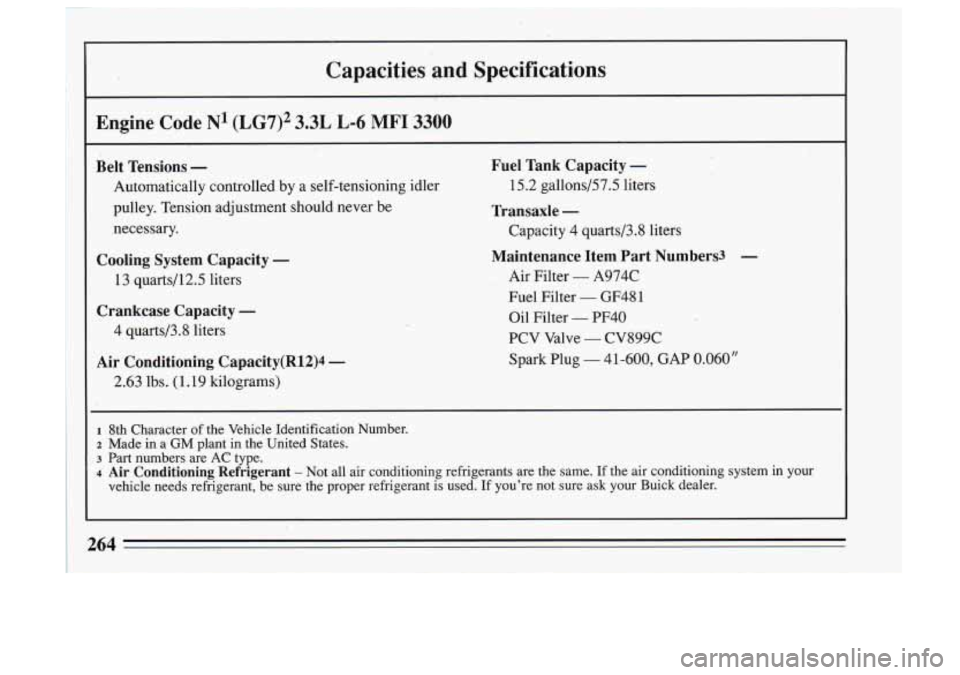
Capacities and Specifications
Engine Code N1 (LG7)2 3.3L L-6 MFI 3300
Belt Tensions -
Automatically controlled by a self-tensioning idler
pulley. Tension adjustment.should new be
necessary.
Cooling System Capacity -
13 quarts/l2.5 liters
Crankcase Capacity -
4 quarts/3.8 liters
Air Conditioning Capacity(R12)d -
2.63 lbs. (1.19 kilograms)
Fuel Tank Capacity -
Transaxle -
15.2 gallons/57.5 liters
Capacity
4 quartd3.8 liters
Maintenance Item Part Numbers3 -
Air Filter - A974C
Fuel Filter
- GF48 1
Oil Filter - PF40
PCV Valve
- CV899C
Spark Plug
- 41-600, GAP 0.060”
1 8th Character of the Vehicle Identification Number.
2 Made in a GM plant in the United States.
3 Part numbers are AC type.
4 Air Conditioning Refrigerant - Not all air conditioning refrigerants are the same. If the air conditioning system in your
vehicle needs refrigerant, be sure the proper refrigerant
is used. If you’re not sure ask your Buick dealer.
264
Page 267 of 306
IMPORTANT:
KEEP ENGINE OIL
AT THE PROPER
LEVEL AND CHANGE
AS
RECOMMENDED ,?.j :i i
Protection
Plan
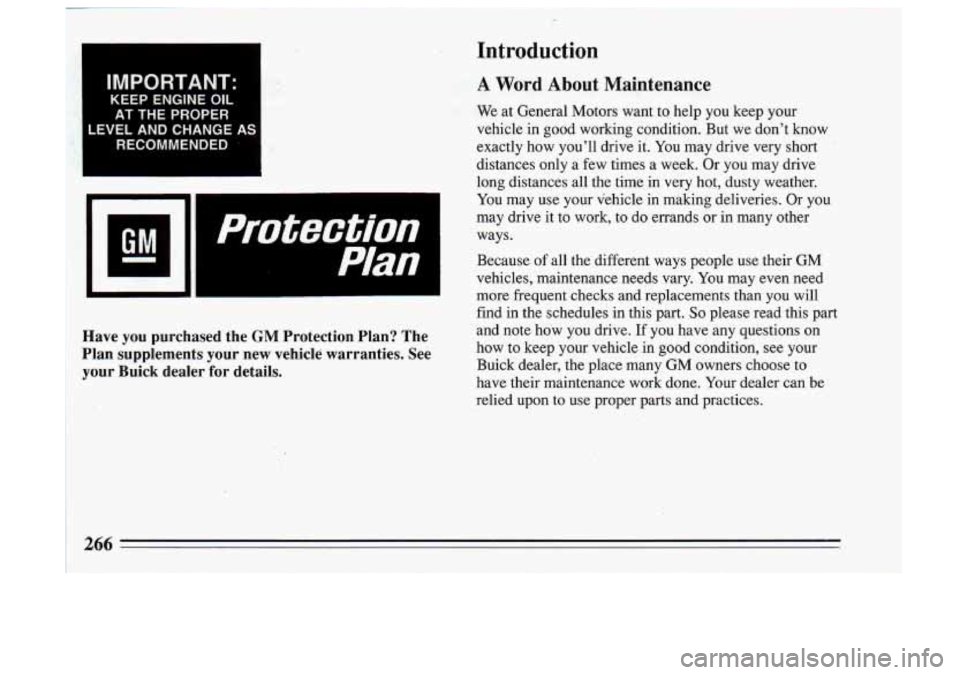
Have you purchased the GM Protection Plan? The
Plan supplements your new vehicle warranties. See your
Buick dealer for details.
/
Introduction
A Word About Maintenance
We at General Motors want to help you keep your
vehicle in good working condition. But we don’t know
exactly how you’ll drive
it. You may drive very short
distances only a few times
a week. Or you may drive
long distances all the time in very hot, dusty weather.
You may use your Vehicle in making deliveries. Or you
may drive
it to work, to do errands or in many other
ways.
Because
of all the different ways people use their GM
vehicles, maintenance needs vary. You may even need
more frequent checks and replacements than you will
find in the schedules in this part.
So please read this part
and note how you drive. If you have any questions on
how to keep your vehicle in good condition, see your
Buick dealer, the place many GM owners choose to
have their maintenance work done.
Your dealer can be
relied upon to use proper parts and practices.
266
Page 270 of 306
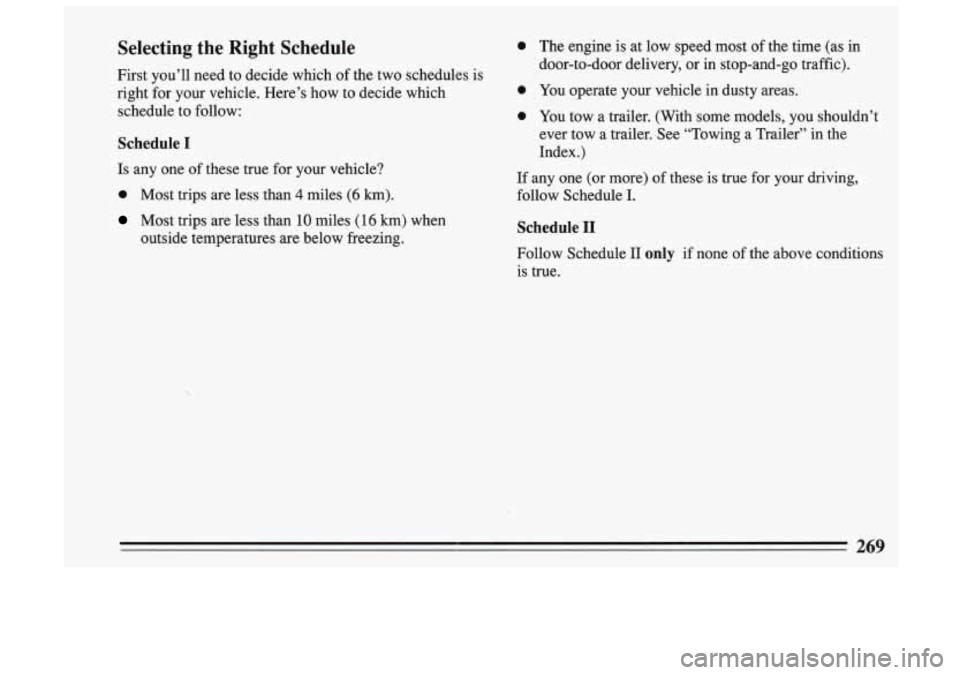
Selecting the Right Schedule
First you’ll need to decide which of the two schedules is
right for your vehicle. Here’s how to decide which
0
schedule to follow: 0
Schedule I
Is any one of these true for your vehicle?
0 Most trips are less than 4 miles (6 km).
Most trips are less than 10 miles (16 km) when
outside temperatures are below freezing.
0 The engine is at low speed most of the time (as in
door-to-door delivery,
or in stop-and-go traffic).
You operate your vehicle in dusty areas.
You tow a trailer. (With some models, you shouldn’t
ever tow a trailer. See “Towing a Trailer” in the
Index.
)
If any one (or more) of these is true for your driving,
follow Schedule I.
Schedule I1
Follow Schedule I1 only if none of the above conditions
is true.
269
Page 271 of 306

I
b Scheduled Maintenance Services Schedule I -
Follow Schedule I if your car is MAINLY driven under one or more of the following conditions:
0 When most trips are less than 4 miles (6 kilometers).
0 When most trips are less. than 10 miles (16 kilometers) and outside temperatures remain below freezing.
0 When most trips indude extended idling and/or frequent low-speed operation as in stop-a\
nd-go traffic.
0 Towing a trailer."?
0 When operating in dusty areas.
Schedule I should also be followed if the car is used for delivery service, police, taxi or other commercial app\
lications.
TO BE SERVICED
(See Explanation of
Scheduled Maintenance Miles (kilometers) or
Services Following Months, Whichever
WHEN
TO PERFORM
Schedules I and 10
Item No. I
Occurs First
1. hgine
Oil & Filter Change months I
Every 3000 mi. (5000 km) or
2. Chassis Lubrication I Every other oil change
3. Throttle Body Mounting At 6 000 mi. (10 000 km)
Bolt Torque*
At
6 000'mi. (10 000 km) and
km) or as necessary
4. Tire & Inspection & then every 15 000 mi. (25 000
Rotation
5. Engine Accessory Drive
Belt(s) Inspection* Every
30 000 mi. (50 000 km) or 24 months.
MILES (000)
3 16 19 112115118121124127130(33136139142145148
5 10
a.
..
0
0
KILOMETERS (000)
65 70 75 80
a...
0 a
270
Page 273 of 306
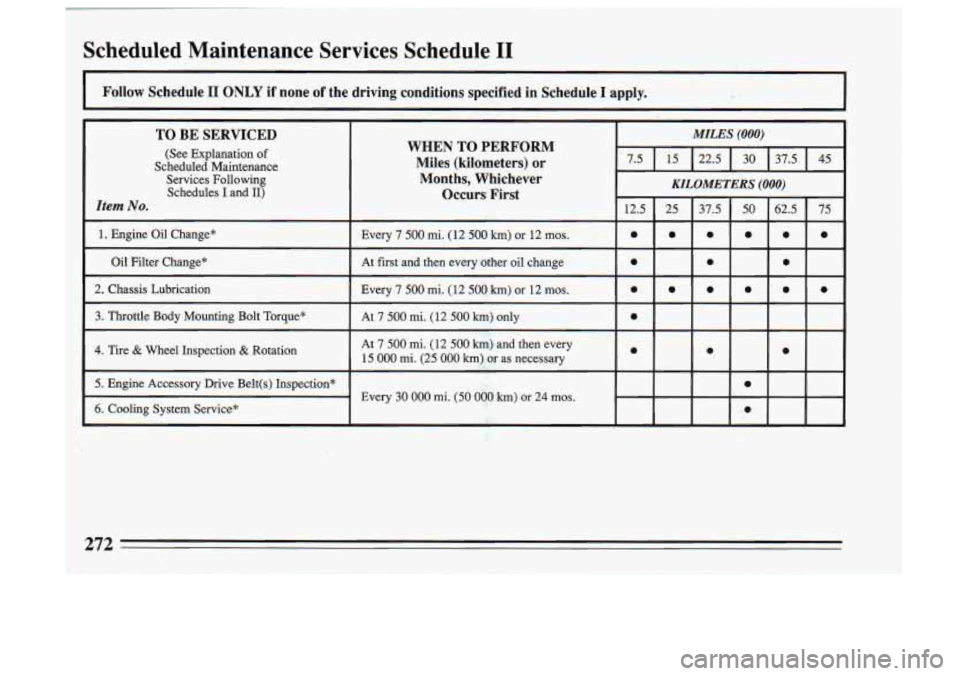
Scheduled Maintenance Services Schedule I1
Follow Schedule I1 ONLY if none of the driving conditions specified in Schedile I apply.
TO BE SERVICED
(See Explanation of
Scheduled Maintenance Services Following Schedules
I and 11)
Item No.
WHEN TO PERFORM
Miles (kilometers) or Months, Whichever Occurs First
MILES (000)
KILOMETERS (000)
12.5 I 25 I 37.5 I 50 I 62.5 I 75
1. Engine Oil Change* Every 7 500 mi. (12 500 km) or 12 mos. e e
Oil Filter Change* At first and then every other oil change 0
2. Chassis Lubrication
Every 7 500 mi. (12 500.-km) or 12 mos. e e
3. Throttle Body Mounting Bolt Torque*
At 7 500 mi. ( 12 500 km). only e
4. Tire & Wheel Inspection & Rotation
I
At 7 500 mi. (12 500 km) and then every
15
000 mi. (25 000 km) or as necessary
5. Engine Accessory Drive Belt(s) Inspection*
6. Cooling System Service* Every
30
000 mi. (50 000 km) or 24 mos.
272
I
Page 275 of 306
Explanation of Scheduled Maintenance equipped with grease fittings, lubricate the
Services suspension and steering linkage.
Below are explanations
of the services listed in $chediie ‘ ‘ 3. Throttle Body Mounting; Bolt Torque (3.3L Code . , I:
I and Schedule 11.
The proper fluids and lubricants to use are listed in
Section
D. Make sure whoever services your vehicle
uses these. All parts should be replaced and all
necessary repairs done before you or anyone else drives
the vehicle.
NOTE:
To determine your engine’s displacement and
code, see “Engine 1dentific.ation” in the Index.
1. Engine Oil and Filter Change* -- Always use SG
Energy Conserving
I1 oils of proper viscosity. The
“SG, designation may be shown alone or in
combination with others, such as “SG/CC”,
“SG/CD” or “SF,
SG, CC,” etc. To determine the
preferred viscosity for your vehicle’s engine (e.g.,
SAE 5W-30 or SAE 10W-30), see “Engine Oil” in
the Index.
2. Chassis Lubrication -- Lubricate the transaxle shift
linkage, parking brake cable guides, underbody
contact points and linkage. If your vehicle is
An Emission Control Service.
N engine only)* -- Che& the torque of the
mounting bolts and/or nuts.
proper wear and maximum tire life, rotate your tires
following the instructions in this manual. See “Tires,
Inspection
& Rotation” in the Index, Check the tires
for uneven wear or damage. If you see irregular or
premature wear, check
the wheel alignment. Check
for damaged wheels also.
5. Engine Accessory Drive Belt@) Inspection --
Inspect the belt(s) for cracks, fraying, wear and
proper tension. Replace as needed.
6. Cooling System Service* -- Drain, flush and refill
the system with new or approved recycled coolant
conforming to GM Specification 1825M. Keep
coolant at the proper mixture as specified. See
“Coolant” in the Index. This provides proper freeze
protection, corrosion inhibitor level and engine operating temperature.
4. Tire and Wheel Rotation and Inspection -- For
The U.S. Environmental Protection Agency has determined that the failure to perform this maintenance item will not nullify the emission war\
ranty or limit recall liability prior to the completion of vehicle
useful life. General Motors, however, urges that all recommended maintenance services be performed at the indicated i\
ntervals and the maintenance be recorded in “Section EMaintenance Record”.
274