Page 230 of 306
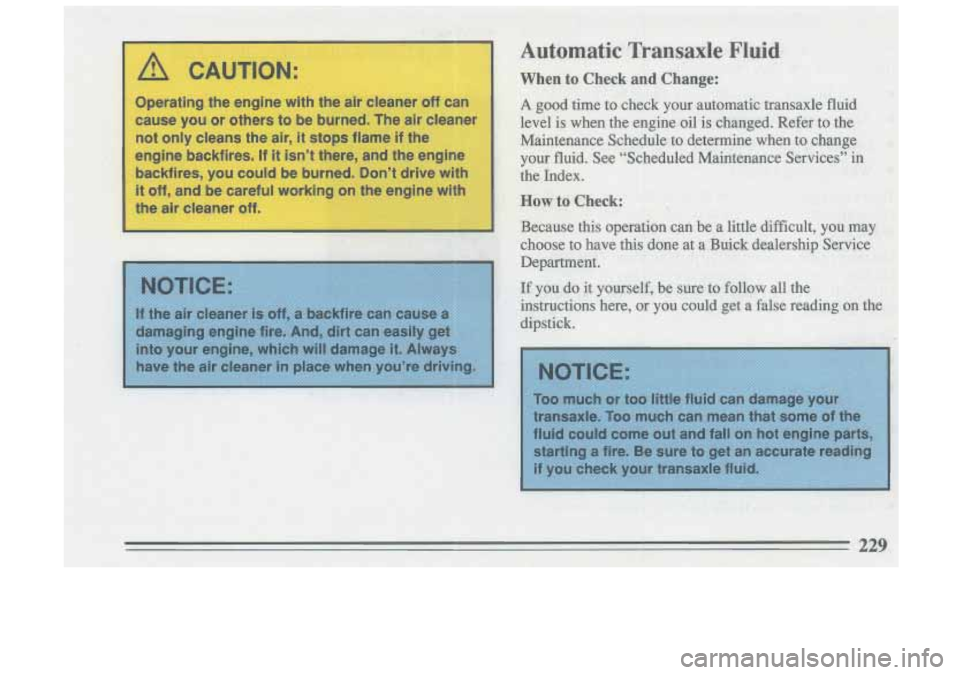
A CAUTION:
Operating the engine with the air cleaner off can
cause you or others to be burned. The air cleaner
not only cleans the air,
it stops flame if the
engine backfires.
If it isn't there, and the engine
backfires, you could be burned. Don't drive with
it off, and be careful working on the engine with
the air cleaner
off-
Page 231 of 306
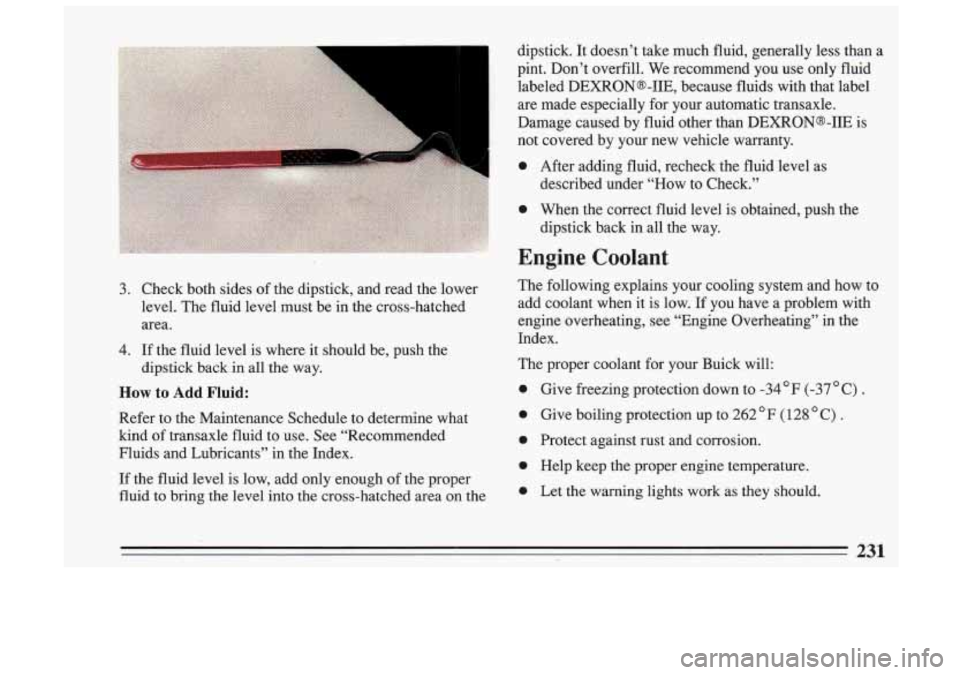
Wait at least 30 minutes before checking the transaxle
fluid level if you have been driving:
When outside temperatures are above 90 ’ F (32 ’ C).
0 At high speed .for quite a while.
In heavy traffic -- especially in hot weather.
While pulling a trailer.
To get the right reading, the fluid should be at normal
operating temperature, which is 180’F to 200’F (82OC
Get the vehicle warmed up by driving about
15 miles
(24 km) when outside temperatures are above 50’F
(1 0 C). If it’s colder than 50 OF (10 ’ C), you may have
to drive longer.
To’check the fluid level:
to 93
“C).
0
e
0
Park your vehicle on
a level place.
Place the
shift lever in “F”’ (Park) with the parking
brake applied.
With your foot on the brake pedal, move the shift
lever through each gear range, pausing for about
three seconds
in each range. Then, position the shift
lever
in “P,’ (Park).
Let the engine
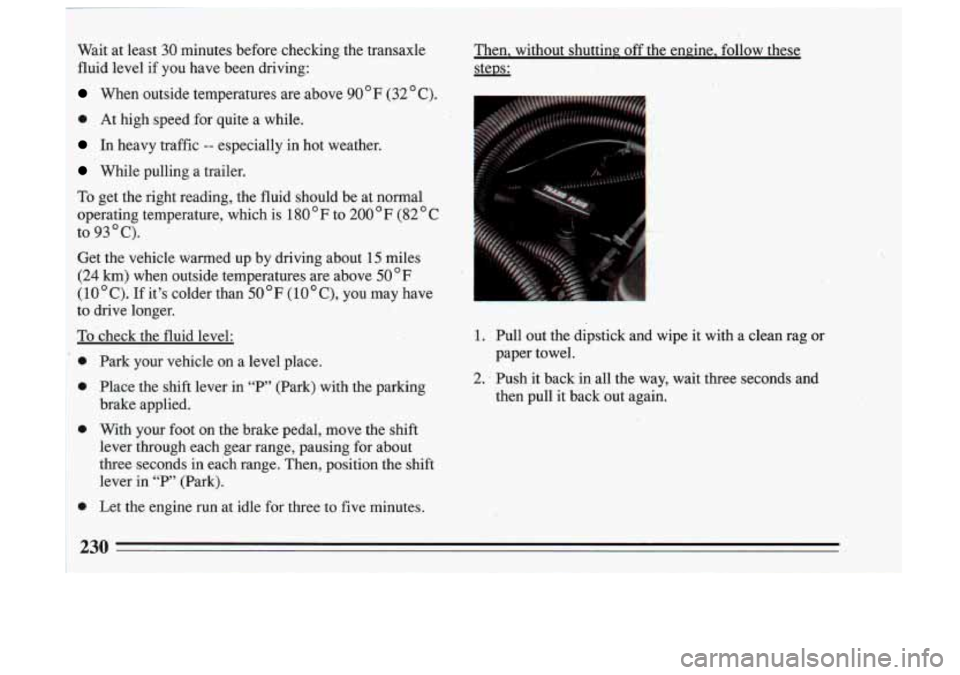
run at idle far three to five minutes. Then; without shutting off the engine, follow these
steps:
.I. Pull out the dipstick and wipe it with a clean rag or
paper towel.
2. . Push it back in all the way, wait three seconds and
then pull it back out again.
Page 232 of 306
0
0
0
0
0
Give freezing protection down to -34°F (-37 "C) .
Give boiling protection up to 262 F (128 " C) .
Protect against rust and corrosion.
Help keep the proper engine temperature.
Let the warning lights work
as they should.
231
Page 233 of 306
~~~x~~~~ of one-half clean water (preferably
distilled) and one-half antifreeze that meets
“GM
Specification 1825-M,” which won’t damage aluminum
parts. You can also use a recycled coolant conforming to
GM Specification 1825-M with a complete coolant-flush
and refill. Use
GM Engine Coolant Supplement (sealer)
with any complete coolant change. If you use these, you
don’t need to add anything else.
n
1 A CAUTION:
Adding only plain water to your cooling system
can be dangerous. Plain water, or some other
liquid like alcohol, can boil before the proper
coolant mix will. Your vehicle’s coolant warning
system is set for the proper coolant mix. With
plain water or the wrong mix, your engine could
get too hot but you wouldn’t get the overheat
warning. Your engine could catch fire and you or
others could be burned. Use a
50150 mix of clean
water and a proper antifreeze.
I
warrantv. Too much water in the mix can freeze
Adding Coolant
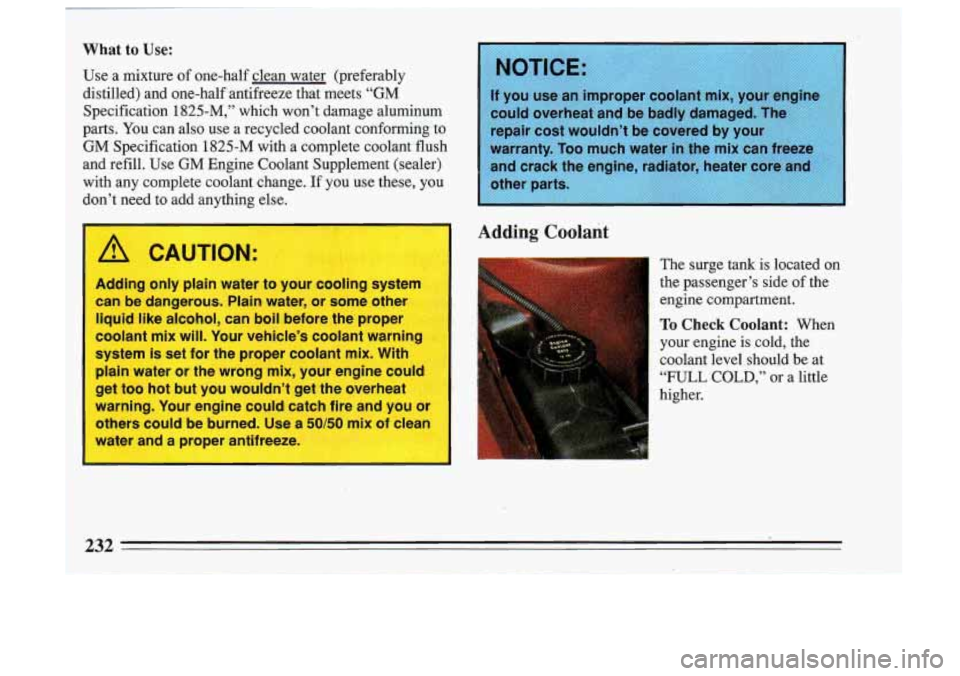
The surge tank is located on
the passenger’s side
of the
engine compartment.
To Check Coolant: When
.your engine is cold, the
coolant level should be at
“FULL COLD,” or a little
higher.
Page 234 of 306
To Add Coolant: If you need more coolant, add the
proper mix at the surge tank, but only when the engine is cool.
A CAUTION:
Turning the surge tank pressure cap when the
engine and radiator are hot can allow steam and
scalding liquids to blow out and burn you badly.
Never turn the surge tank pressure cap
-- even a
little
-- when the engine and radiator are hot.
I
I
1 A CAUTION:
You can be burned if you spill coolant on hot
engine parts. Coolant contains ethylene glycol,
and
it will burn if the engine parts are hot
enough. Don’t spill coolant
on a hot engine.
1
Surge Tank Pressure Cap
pressure-type cap and must be tightly installed
When you replace your surge tank pressure cap, a GM
cap is recommended.
Thermostat
Engine coolant temperature is controlled by a thermostat
in the engine coolant system. The thermostat stops the
flow of coolant through the radiator until the coolant
reaches a preset temperature.
When you replace your thermostat, an
ACS thermostat
is recommended.
233
Page 235 of 306
Power Steering Fluid What to Add:
I
How To Check Power Steering Fluid:
Unscrew the cap and wipe the dipstick with .a clean rag.
Replace the cap and completely tighten it. Then remove
the cap again and look at the fluid level on the dipstick.
When the engine compartment is hot, the level
When the engine compartment is cool, the level
should be at the
“HOT” mark.
should be at the “FULL COLD” mark. Refer
to the Maintenance Schedule
to determine what
kind
of fluid to use. See “Recommended Fluids and
Lubricants”
in the Index.
234
Page 237 of 306
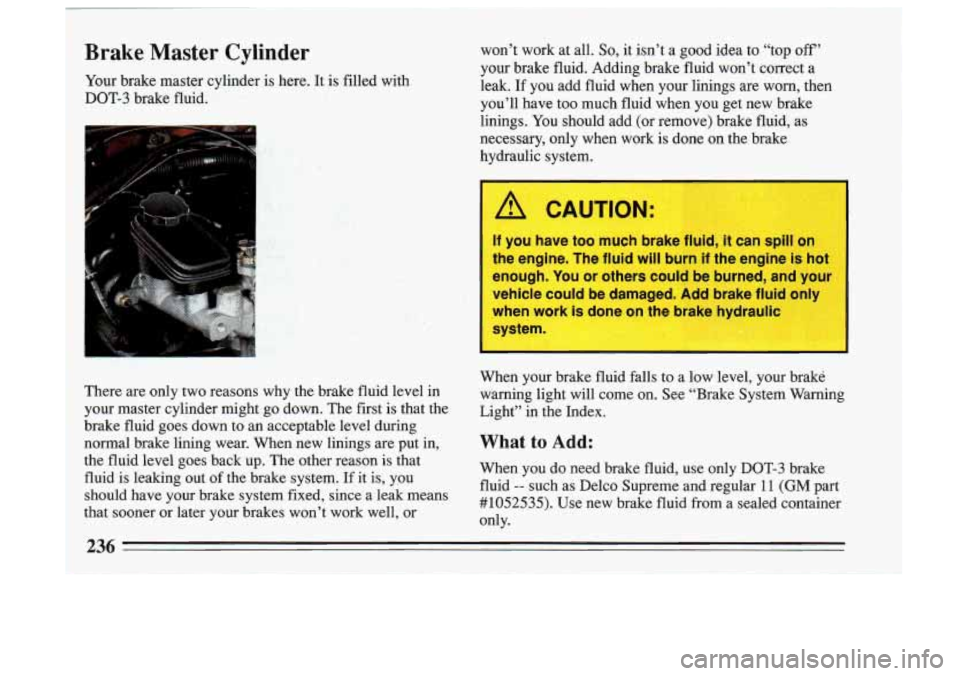
1 Brake Master Cylinder
Your brake master cylinder is here. It is filled with
1 DOT-3 brake fluid. won’t work
at all.
So, it isn’t a good idea to “top off’
your brake fluid. Adding brake. fluid won’t correct a
leak. If you add fluid when your linings are worn, then
you’ll have too much fluid when you get new brake
linings.
You should add (or remove) brake fluid, as
necessary, only when work is done
on the brake
hydraulic system.
I
A CAUTION:
If you have too much brake fluid, it can spill on
the engine. The fluid will burn
if the engine is hot
enough. You or others could be burned, and your
vehicle could be damaged. Add brake fluid only
when work is done on the br,
e hl ‘raulic
system.
1
There are only two reasons why the brake fluid level in
your master cylinder might go down. The first is that the
brake fluid goes down to an acceptable level during
normal brake lining wear. When new linings
are put in,
the fluid level goes back up. The other reason is that
fluid is leaking out
of the brake system. If it is, you
should have your brake system fixed, since a leak means
that sooner or later your brakes won’t work well, or When your brake fluid falls to a low level, your brake
warning light will come on. See “Brake System Warning
Light’’
in the Index.
What to Add:
When you do need brake fluid, use only DOT-3 brake
fluid
-- such as Delco Supreme and regular 11 (GM part
#1052535). Use new brake fluid from a sealed container only.
I
236
Page 258 of 306
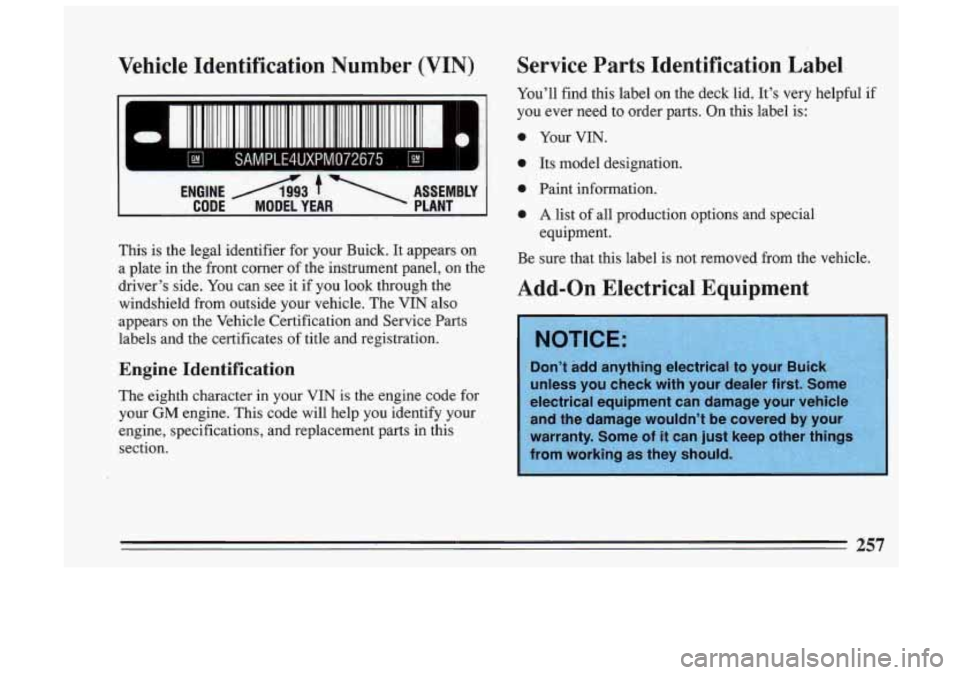
Vehicle Identification Number (VIN)
1111 11111 11. II I I 111 I II 11111 111 I11111 111 IIIIIIIIII II 1111 Ill II
ENGIME A3 t AQEMBLY
CODE MODEL YEAR. PLANT
This is the legal identifier for your Buick. It appears on
a plate in the front corner of the instrument panel, on the
driver’s side. You can see it if you look through the
windshield from outside your vehicle. The
VIN also
appears on the Vehicle Certification and Service Parts
labels and the certificates of title and registration.
Engine Identification
The eighth character in your VIN is the engine code for
your
GM engine. This code will help you identify your
engine, specifications, and replacement parts in this
section.
Service Parts Identification Label
You’ll find this label on the deck lid. It’s very helpful if
you ever .need to order parts. On this label is:
0 Your VIN.
0 Its model designation.
0 Paint information.
0 A list of all production options and special
Be sure that this label is not removed from the vehicle. equipment.
Add-on
Electrical Equipment
257