1993 BUICK SKYLARK brake
[x] Cancel search: brakePage 163 of 306
wet suddenly when your reflexes are tuned for driving
on dry pavement.
The heavier the rain, the harder it is to see. Even if your
windshield wiper bladesare in good shape, a heavy rain
can make it harder to see road signs and traffic signals,
pavement markings, the edge of the road, and even
people walking. Road spray can often be worse
for
vision than rain, especially if it comes from a dirty road.
So it is wise to keep your wiping equipment in good
shape and keep your windshield washer tank filled.
Replace your windshield wiper inserts when they
show
signs of streaking or missing areas on the windshield, or
when strips of rubber start to separate from the inserts.
1 L3
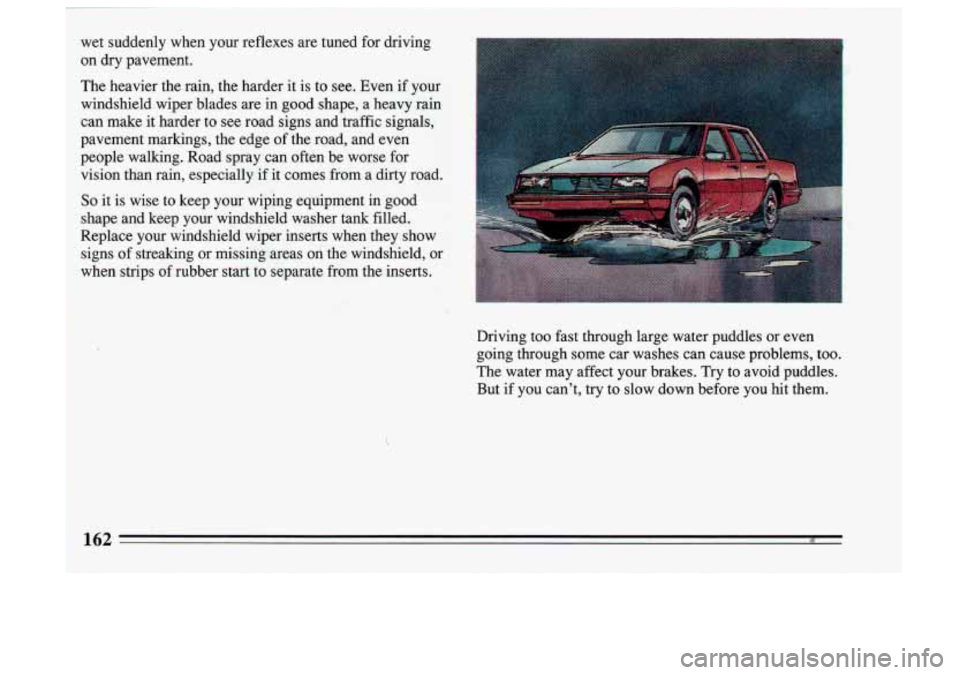
Driving too fast through large water puddles or even
going through some car washes can cause problems, too.
The water may affect your brakes. Try to avoid puddles. But
if you can't, try to slow down before you hit them.
Page 164 of 306

A CAUTION:
Wet brakes can cause accidents. The: ton’t
work well in
a quick stop and may cause pulling
to one side. You could lose control of the vehicle.
After driving through a large puddle of water or
car wash, apply your brake pedal ligh rtil
your brakes work normally.
Hydroplaning
Hydroplaning is dangerous. So much water can build up
under your tires that they can actually ride on the water.
This can happen if the road is wet enough and you’re
going fast enough. When your vehicle is hydroplaning,
it has little or no contact with the road.
You might not be aware of hydroplaning. You could drive
along for some time without realizing your tires aren’t in
constant contact with the road. -You could find out the
hard way: when you have to slow, turn, move out to,pass
-- or if you get hit by a gust of wind. You could suddenly
fiid yourself out of control.
Hydroplaning doesn’t happen often. But it can if your
tires haven’t much tread or if the pressure in ?ne or more
is low. It can happen
if a lot of water is standing on the road. If you can
see reflections from trees, telephone
poles, or other vehicles, and raindrops “dimple” the water’s surface, there could
be hydroplaning.
Hydroplaning usually happens at higher speeds. There
just isn’t a hard and fast rule about hydroplaning. The
best advice is to
slow down when it is raining, and be
careful.
Some Other Rainy Weather Tips
0 Turn on your headlights -- not just your parang
lights
-- to help make you more visible to others.
0 Look for hard-to-see vehicles coming from behind.
You may want to use your headlights even in
daytime if it’s raining hard.
0 Besides slowing down, allow some extra following
distance. And be especially careful when you pass
another vehicle. Allow yourself more clear room
ahead, and
be prepared to have your view restricted
by road spray.
If the road spray is so heavy you are
actually blinded, drop back. Don’t pass until
conditions improve. Going more slowly is better
than having an accident.
Use your defogger if it helps.
Have good tires with proper tread depth. (See “Tires” in the Index.)
163
Page 169 of 306

start bralung. If you must brake on the through lane, and
if there
is traffic close behind you, you can allow a little
extra time and flash your brake lights (in addition to your turn signal) as extra warning that you are about to
slow down and exit.
The exit ramp can be curved, sometimes quite sharply.
The exit speed is usually posted. Reduce your speed
according to your speedometer, not to your sense of
motion. After driving for any distance at higher speeds,
you may tend to think you are going slower than you
actually are. For example,
40 mph (65 km/h) might
seem like only
20 mph (30 km/h). Obviously, this could
lead to serious trouble on a ramp designed for
20 mph
(30 krn/h)!
Driving a Long Distance
Although most long trips today are made on freeways,
there are still many made on regular highways.
Long-distance driving on freeways and regular
highways is the same in some ways. The trip has to be
planned and the vehicle prepared, you drive at
higher-than-city speeds, and there are longer turns
behind the wheel. You’ll enjoy your trip more if you and
your vehicle are
in good shape. Here are some tips for a
successful long trip.
Before Leaving on a Long Trip
Make sure you’re ready. Try to be well rested. If you
must start when you’re not fresh
-- such as after a day’s
work
-- don’t plan to make too many miles that first part
of the journey. Wear comfortable clothing and shoes you
can easily drive in.
Is your vehicle ready for a long trip? If you keep it
serviced and maintained, it’s ready to go. If it needs
service, have it done before starting out. Of course,
you’ll find experienced and able service experts in
Buick dealerships all across North America. They’ll be
ready and willing to help
if you need it.
Here are some things you can check before a trip:
0 Windshield Washer Fluid: Is the reservoir full? Are
all windows clean inside and outside?
WiDer Blades: Are they in good shape/
Fuel, Engine Oil, Other Fluids: Have you checked
all levels?
0 Lights: Are they all working? Are the lenses clean?
0 Tires: They are vitally important to a safe,
trouble-free trip. Is the tread good enough for long-distance driving?
Are the tires all inflated to the
recommended pressure?
168
Page 171 of 306
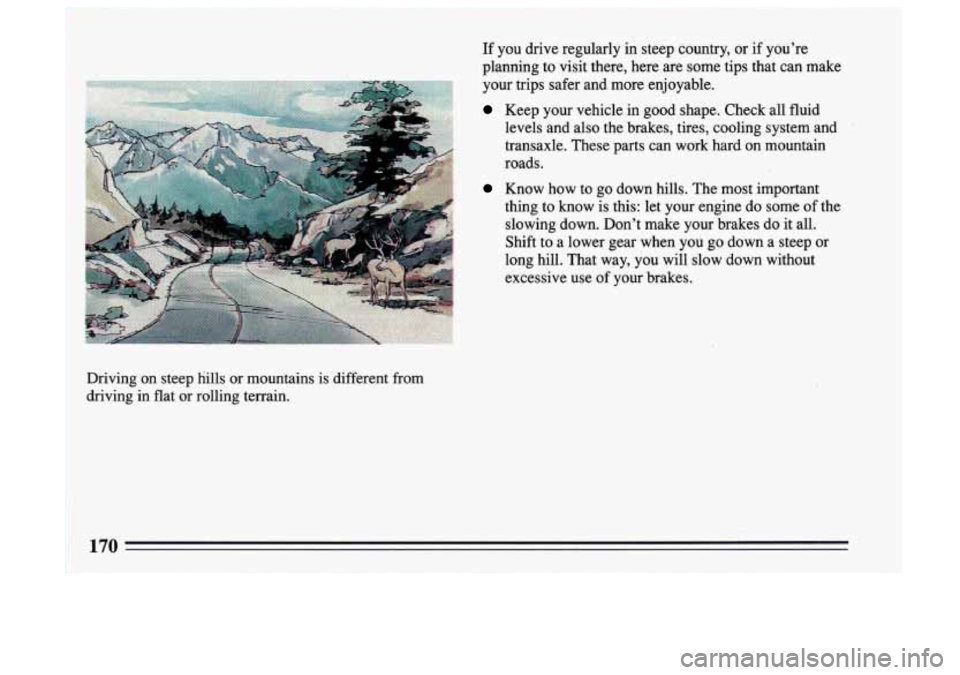
Driving on steep hills or mountains is different from
driving in flat or rolling terrain. If you
drive regularly in steep country, or if you’re
planning to visit there, here are some tips that can make
your trips safer and more enjoyable.
Keep your vehicle in good shape. Check all fluid
levels and also the brakes, tires, cooling system and
transaxle. These parts can work hard on mountain
roads.
Know how to go down hills. The most important
thing to know is this: let your engine do some of the
slowing down. Don’t make your brakes do it all.
Shift to a lower gear when you go down a steep or
long hill. That way, you will slow down without
excessive use of your brakes.
I 170
Page 172 of 306
1 CAUTION:
If you don’t shift down, your brakes COL., get so
hot that they wouldn’t work well. You would then
have poor braking or even none going down a
3‘
hill. You could crash. Shift down to let your
engine assist your brakes on a steep downhi
Know.how to go uphill. Drive in the highest gear
possible.
slope.
I.
A CAUTION:
Coasting downhill in “N” (Neutr; or with the
ignition off is dangerous. Your brakes will have
to do all the work of slowing down. They cou
get
so hot that they wouldn’t work well. You
could crash. Always have your engine running
and your vehicle
in gear when you go downh
Stay in your own lane when driving on two-lane
roads in hills or mountains. Don’t swing wide or cut
across the center
of the road. Drive at speeds that let
you stay in your own lane. That way, you won’t be surprised by a vehicle coming toward you in the
same lane.
It takes longer to pass another vehicle when you’re
going uphill. You’ll want to leave extra room to pass.
If a vehicle is passing you and doesn’t have enough
room, slow down to make it easier €or the other
vehicle to get by.
..
1
I As you go over the top of a hill, be alert. There could
be something in your lane, like a stalled car or an
accident.
of special problems. Examples are long grades,
I
passing or no-passing zones, a falling rocks area, or 1
winding roads. Be alert to these and take appropriate
action.
I You may see highway signs on mountains that warn
Winter driving can present special problems. See
“Winter Driving” in the Index.
171
Page 173 of 306
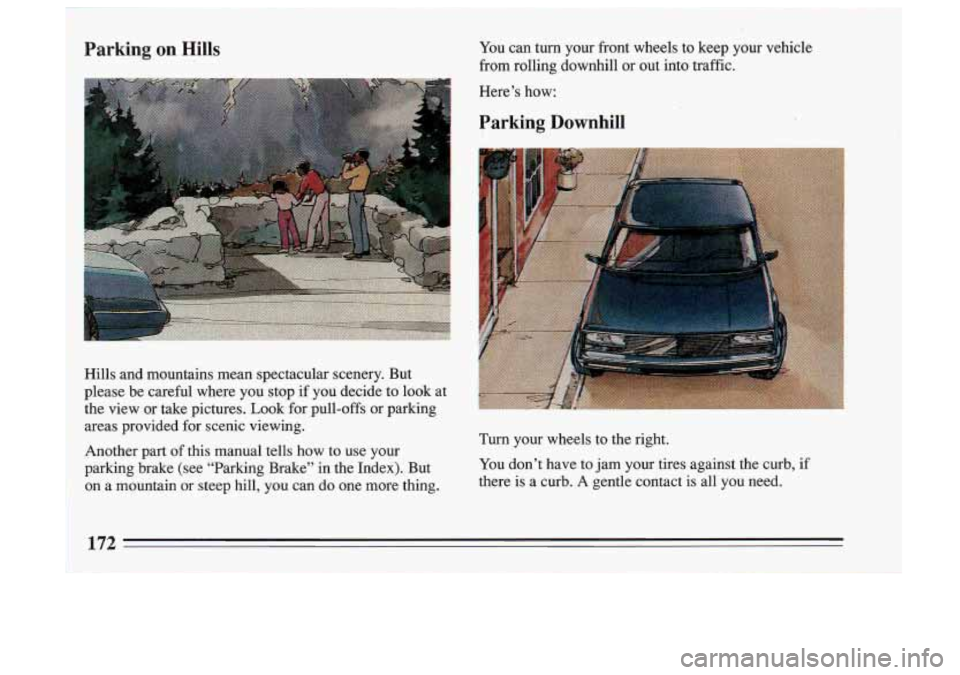
You can turn your front wheels to keep your vehicle
from rolling downhill
or out into traffic.
Hills and mountains mean spectacular scenery. But
please be careful where you stop
if you decide to look at
the view or take pictures. Look for pull-offs or parking
.-,‘‘e:;$ ’ - .I_ @Z
$$ 1 areas provided for scenic viewing.
Another
part of this manual tells how to use your
parking brake (see “Parking Brake” in the Index). But
.2f,iiiR
i ~ on a mountain or steep hill, you cm do one more thing. Turn your wheels
to the right.
You don’t have to
jam your tires against the curb, if
there is
a curb. A gentle contact is all you need.
172
Page 175 of 306
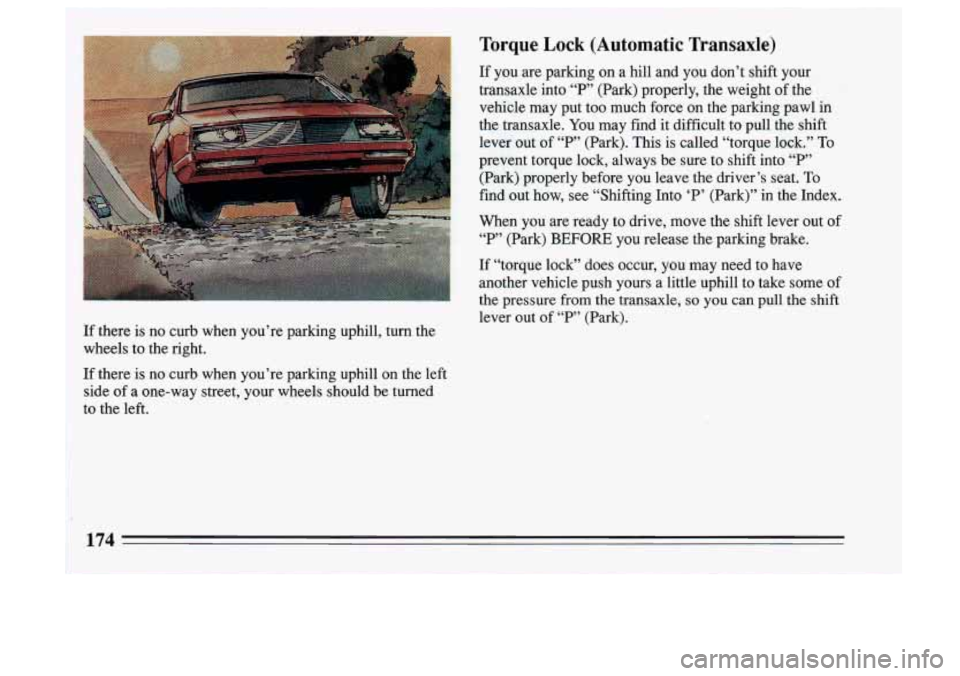
If there is no curb when you’re parking uphill, turn the
wheels to the right.
If there is no curb when you’re parking uphill on the left
side of a one-way street, your wheels should be turned
to the left.
Torque Lock (Automatic Transaxle)
If you are parking on a hill and you don’t shift your
transaxle into“‘F” (Park) properly, the weight
of the
vehicle may put too much force on the parking pawl in
the transaxle. You may find it difficult to pull the shift
lever out of
T“ (Park). This is called “torque lock.” To
prevent torque lock, always be sure to shift into “P”
(Park) properly before you leave the driver’s seat. To
find out how, see “Shifting Into ‘P’ (Park)” in t\
he Index.
When you are ready to drive, move the shift lever out of
“P” (Park) BEFORE you release the parking brake.
If “torque lock” does occur, you may need to have
another vehicle push yours a little uphill to take some of
the pressure
from the transaxle, so you can pull the shift
lever out of
“P” (Park).
174
Page 178 of 306
remain icy when the surrounding roads are clear. If
you see a patch of ice ahead of you, brake before you
are on it. Try not to brake while you’re actually on
the ice, and avoid sudden steering maneuvers.
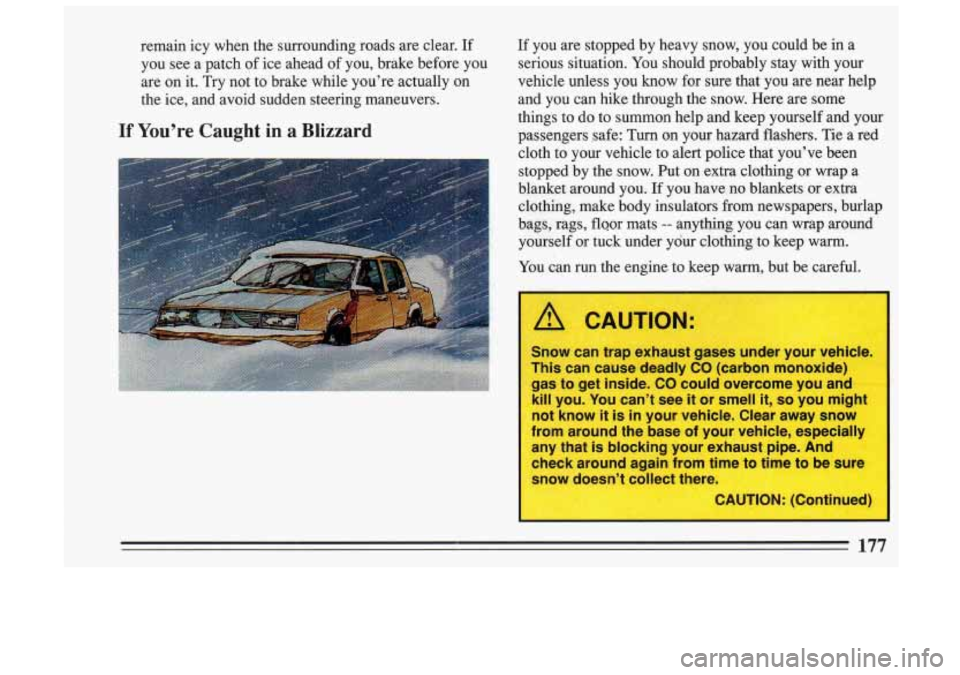
If You’re Caught in a Blizzard
If you are stopped by heavy snow, you could be in a
serious situation. You should probably stay with your
vehicle unless you know for sure that you are near help
and you can hike through the snow. Here are some
things to do to summon help and keep yourself and your
passengers .safe: Turn on your hazard flashers. Tie a red cloth to your vehicle to alert police that you’ve been
stopped by the snow. Put on extra clothing
or wrap a
blanket around you.
If you have no blankets or extra
clothing, make body insulators from newspapers, burlap
bags, rags, flsor mats
-- anything you can wrap around
yourself
or tuck under your clothing to keep warm. I
You can run the engine to keep warm, but be careful.
I
A CAUTION:
dnow can trap exhaust gases under your vehicle
This can cause deadly
CO (carbon monoxide)
gas to get inside. CO could overcome you and
kill you. You can’t see
it or smell it, so you might
not know
it is in your vehicle. Clear away snow
from around the base of your vehicle, especia”--
any that
is blocking your exhaust pipe. And
check around again from time to time to be’su
snow doesn’t collect there.
177