1993 BUICK SKYLARK change time
[x] Cancel search: change timePage 158 of 306

So here are some tips for passing:
0
0
0
0
“Drive ahead.” Look down the road, to the sides, and
to crossroads for situations that might affect your
passing patterns. If you have any doubt whatsoever
about making a successful pass, wait for a better
time.
Watch for traffic signs, pavement markings, and lines. If you can see a sign up ahead that might
indicate a turn or an intersection, delay your pass.
A broken center line usually indicates it’s all right to
pass (providing the road ahead is clear). Never cross
a solid line on your side of the lane or a double solid
line, even if the road seems empty of approaching
traffic.
If you suspect that the driver of the vehicle you want
to pass isn’t aware of your presence, tap the horn a
couple of times before passing.
Do not get too close to the vehicle you want to pass
while you’re awaiting an opportunity. For one thing,
following too closely reduces your area of vision,
especially if you’re following a larger vehicle. Also,
you won’t have adequate space if the vehicle ahead suddenly slows or stops. Keep back a reasonable
distance.
0 When it looks like a chance to pass is coming up,
start to accelerate but stay in the right lane and don’t
get too close. Time your move
so you will be
increasing speed as the time comes to move into the
other lane. If the way is clear to pass, you will have a
“running start” that more than makes up for the
distance you would lose by dropping back. And if
something happens to cause you to cancel your pass,
you need only slow down and drop back again and
wait for another opportunity.
If other cars are lined up to pass a slow vehicle, wait
your turn. But take care that someone isn’t trying to
pass you as you pull out to pass the slow vehicle.
Remember to glance over your shoulder and check
the blind spot.
Check your mirrors, glance over your shoulder, and start your left lane change signal before moving out
of the right lane to pass. When you are far enough
ahead of the passed ‘vehicle to see
its front in your
inside mirror, activate your right lane change signal
and move back into the right lane. (Remember that your right outside mirror is convex. The vehicle you
just passed may seem to be farther away from you
than it really is.)
157
Page 159 of 306

0
0
0
Try not to pass more than one vehicle at a time on
two-lane roads. Reconsider before passing the next
vehicle.
Don’t overtake a slowly moving vehicle too rapidly.
Even though the brake lights are not flashing, it may
be slowing down or starting to turn.
If you’re being passed, make it easy for the
following driver to get ahead of you. Perhaps you
can ease a.little to the right.
Loss of Control
Let’s review what driving experts say about what
happens when the three control systems (brakes, steering and acceleration) don’t have enough friction where the
tires meet the road to do what the driver has asked.
In any emergency, don’t give up. Keep trying to steer
and constantly seek an escape route or area of less
danger.
Skidding
In a skid, a driver can lose control of the vehicle.
Defensive drivers avoid most skids by taking reasonable
care suited to existing conditions, and by not
“overdriving” those conditions. But skids are always
possible. The three types
of skids correspond
to your Buick’s
three control systems. In the braking skid your wheels
aren’t rolling.
In the steering or cornering skid, too
much speed or steering in a curve causes tires to slip and
lose cornering force. And in the acceleration skid too
much throttle causes the driving wheels to spin.
A cornering skid and an acceleration skid are best
handled by easing your foot off the accelerator pedal.
If your vehicle starts to slide (as when you- turn a corner
on a wet, snow- or ice-covered road), ease your foot
off
the accelerator pedal as soon as you feel the vehicle start
to slide. Quickly steer the way you want the vehicle to
go. If you start steering quickly enough, your vehicle
will straighten out. As it does, straighten the front
wheels.
Of course, traction is reduced when water, snow, ice,
gravel, or other material is on the road. For safety, you’l\
l
..
want to slow down and adjust your driving to these
conditions. It is important to slow down on slippery
surfaces because stopping distance will be longer and
vehicle control more limited.
While driving on a surface with reduced traction, try
your best to avoid sudden steering, acceleration, or
braking (including engine braking by shifting to a lower gear). Any sudden changes could cause the tires to slide.
You may not realize the surface is slippery until your
I
Page 170 of 306

0
0
Weather Forecasts: What’s the weather outlook
along your route? Should you delay your trip a short
time to avoid a major storm system?
Maps: Do you have up-to-date maps?
On the Road
Unless you are the only driver, it is good to share the
driving task with others. Limit turns behind the wheel to
about
100 miles (160 km) or two hours at a sitting.
Then, either change drivers or stop for some refreshment
like coffee, tea or soft drinks and some limbering up.
But do stop and move around. Eat lightly along the way.
Heavier meals tend to make some people sleepy.
On two-lane highways or undivided multilane highways
that do not have controlled access;you’ll want to watch
for some situations not usually found on freeways.
Examples are: stop signs and signals, shopping centers with direct access to the highway, no passing zones and
school zones, vehicles turning left and right
off the road,
pedestrians, cyclists, parked vehicles, and even animals.
Highway Hypnosis
Is there actually such a condition as “highway hypnosis”?
Or is it just plain falling asleep at the wheel? Call it
highway hypnosis, lack of awareness, or whatever.
I
There is something about an easy stretch of road with the
same scenery, along with the hum of the tires on the road,
the drone of the engine, and the rush of the wind against
the vehicle that can make you sleepy. Don’t let it happen
to you!
If it does, your vehicle can leave the road in
than a second, and you could crash and be injured.
What can you do about highway hypnosis? First, be
aware that it can happen.
Then here are some tips:
0
0
0
0
Make sure your vehicle is well ventilated, with a
comfortably cool interior.
Keep your eyes moving. Scan the road ahead and
to
the sides. Check your rearview mirrors frequently and your instruments from time to time.
This can help you
avoid a fixed stare.
Wear good sunglasses in bright light. Glare can cause
drowsiness. But don’t wear sunglasses at night. They will drastically reduce your overall vision at the very
time you need all the seeing power you have.
If you get sleepy, pull
off the road into a rest, service,
or parking area and take a nap, get some exercise, or
both. For safety, treat drowsiness on the highway as
an emergency.
As in any driving situation, keep pace with traffic and
allow adequate following distances.
169
Page 180 of 306

Towing a Trailer
A CAUTION:
If you don’t use the correct equipment and drive
properly, you can lose control when you pull
a
trailer. For example, if the trailer is too heavy. the
brakes may not work well
-- or even at all. Yo
and your passengers could be seriously injured.
Pull
a trailer only if you have followed all the
steps in this section.
i ~ ~, ~~ ~~
~~~ ~~ before you pull a trailer.
Your
car can tow a trailer.
To identify what the vehicle
trailering capacity is for your vehicle, you should read
the information in “Weight of the Trailer”. that appears
I later in this section. But trailering is different than just
driving your vehicle by itself. Trailering means changes
I in. handling, durability, and fuel economy. Successful,
safe trailering takes correct equipment, and it has to be
I used properly.
That’s the reason for this section. In it are many
time-tested, important trailering tips and safety rules. Many of these are important for your safety and that of
I your passengers. So please read this section carefully
Load-pulling components such as the engine, transaxle, wheel assemblies, and tires are forced to work harder
against the drag of the added weight. The engine is
greater loads, generating extra heat. What’s more, the
trailer adds considerably to wind resistance, increasing
the pulling requirements.
All of that means changes in:
ulling a trailer improper1 required to operate at relatively higher speeds and under
Do not tow a trailer if your vehicle is equipped with the
0 Handling
2.3 Liter, L4 engine. Durability
Fuel economy
179
Page 210 of 306
A CAUTION:
Rust: or 'dirt on the wheel, or on the parts to
which it is fastened, can make the wheel nuts
become loose after a time. The w~heel could come
off and cause an accident. When you change
a
wheel, remove any rust or dirt from the places
whiere the wheel attach'es to
the vehicle. In an
emergency, you can use a doth olr a paper towel
to do this; but. be swe to :use a scraper or wire
Ibr'ush later, if
you need inl. to get all the rust or "
dirt off.
1
Never use oil or grease on studs or nuts. If you
do, the n"s might come loose. Your wheel cou!l
fall oEf, causing a serious accidenlt.
_I
I
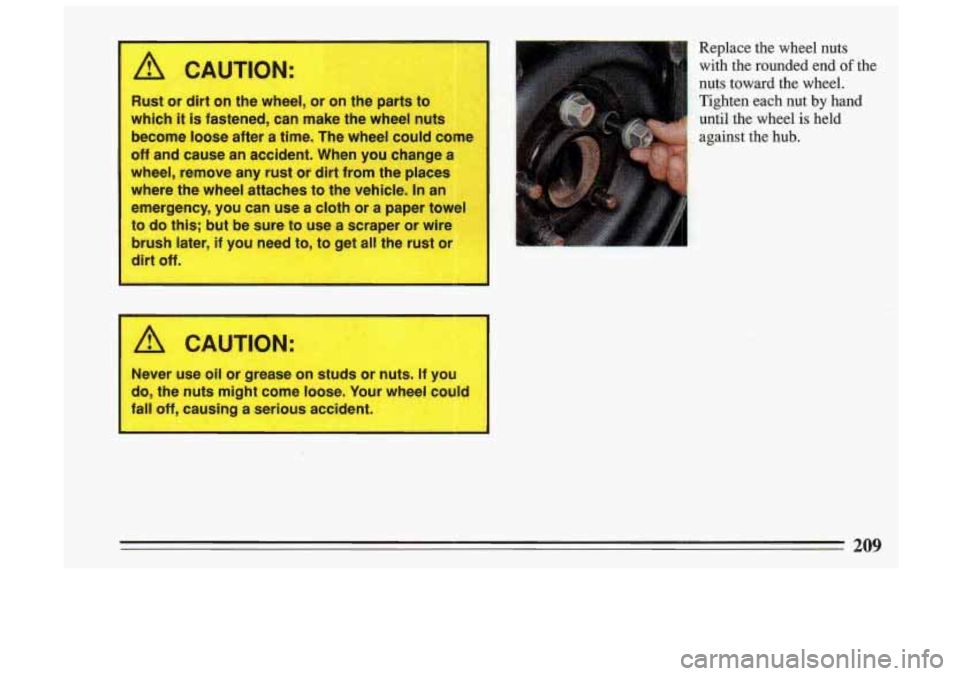
Replace the wheel nuts
with the rounded end
of the
nuts toward the wheel. Tighten each nut by hand
until the wheel is held
against the hub.
209
Page 228 of 306
0 It’s below freezing outside and most trips are less
than
10 miles (16 km).
0 The engine is at low speed most of the time (as in
door-to-door delivery, or in stop-and-go traffic).
0 You tow a trailer often.
0 Most trips are through dusty places.
If any one
of these is true for your vehicle, then you
need to change your oil and filter every
3,000 miles (5
000 km) or 3 months -- whichever comes first.
If none of them is true, change the oil every 7,500 miles
(12
500 km) or 12 months -- whichever comes first.
Change the filter at the first oil change and at every
other oil change after that.
Engine Block Heater: An engine block heater can be a
big help if you have to park outside in very cold weather, -20
F (-29 C) or colder. If your vehicle has
this option, see “Engine Block Heater.” in the Index.
What to Do with Used Oil:
I sed engine oil contains things that have caused
skin cancer in laboratory animals. Don’t let used
oil stay on your skin for very long. Clean your
skin and nails with soap and water,
or a good
hand cleaner. Wash
or properly throw away
c-othing
or rags containing used engine oil.
Used oil can be a real threat to the environment. Don’t
ever dispose of it by pouring it on the ground, into
sewers, or into streams or bodies of water. Instead,
recycle it by taking it to a place that collects used
oil. If
you have a problem propeily disposing of your used oil,
ask your dealer, a service station or a local recycling center for help.
227
Page 238 of 306

Replacing Brake System Parts
The braking system on a modern vehicle is complex. Its
many parts have to be of top quality and work well
together
if the vehicle is to have really good braking.
Vehicles we design and test have top-quality GM brake balance between
your front
and rear brakes can change,
for the worse. The braking performance you’ve come to
expect. can change in many other ways
if someone puts
in the wrong replacement brake parts.
Battery
Every new Buick has a Delco Freedoms battery. You
never have to add water to one
of these. Whenit’s time
for a new battery, we recommend
a Delco Freedoms
battery. Get one that has the catalog number shown on
the original battery’s label.
Vehicle Storage
If you’re not going to drive your vehicle for 25 days or
more, take
off the black, negative (-) cable from the
battery. This will help keep your battery from running
parts in them, as your Buick does when it is new. When
4 A CAUTION:
you replace parts of your braking system -- for example,
when your brake linings wear down and you have to
have new ones put in
-- be sure you get new genuine
GM replacement parts. If you don’t, your brakes may no
longer work properly. For example, if someone puts in
brake linings that are wrong for your vehicle, the
1 Batteries have acid that can burn you and gas
that can explode. You can be badly hurt
if you
aren’t careful. See “Jump Starting” in the Index
for tips on working around a battery without
getting hurt.
237
Page 267 of 306
IMPORTANT:
KEEP ENGINE OIL
AT THE PROPER
LEVEL AND CHANGE
AS
RECOMMENDED ,?.j :i i
Protection
Plan
Have you purchased the GM Protection Plan? The
Plan supplements your new vehicle warranties. See your
Buick dealer for details.
/
Introduction
A Word About Maintenance
We at General Motors want to help you keep your
vehicle in good working condition. But we don’t know
exactly how you’ll drive
it. You may drive very short
distances only a few times
a week. Or you may drive
long distances all the time in very hot, dusty weather.
You may use your Vehicle in making deliveries. Or you
may drive
it to work, to do errands or in many other
ways.
Because
of all the different ways people use their GM
vehicles, maintenance needs vary. You may even need
more frequent checks and replacements than you will
find in the schedules in this part.
So please read this part
and note how you drive. If you have any questions on
how to keep your vehicle in good condition, see your
Buick dealer, the place many GM owners choose to
have their maintenance work done.
Your dealer can be
relied upon to use proper parts and practices.
266