Page 57 of 340
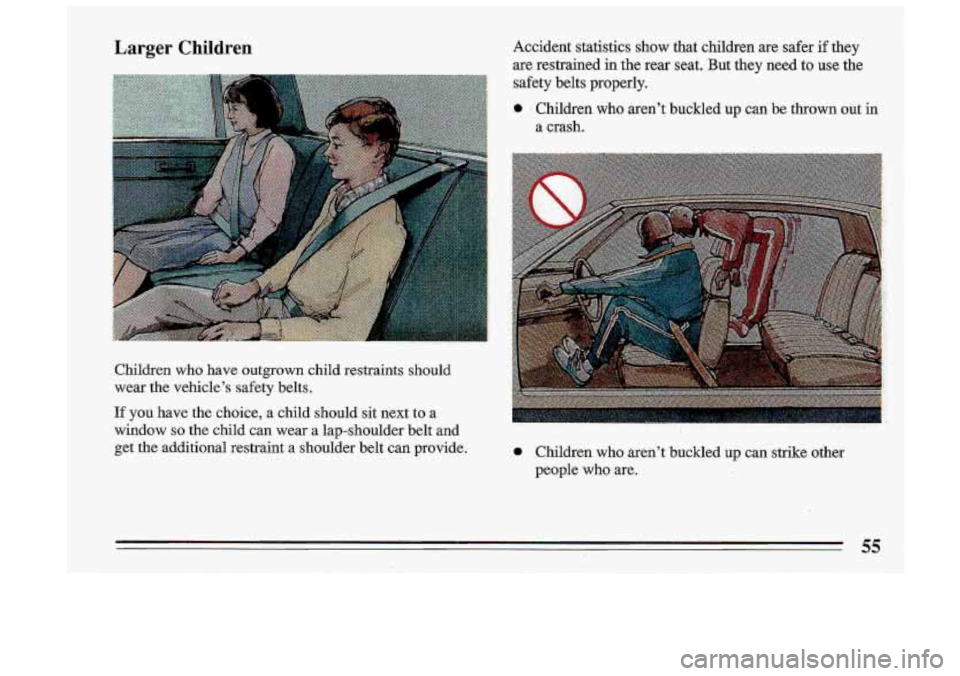
Larger Children Accident statistics show that children are safer if they
are restrained in
the rear seat. But they need to use the
safety belts. properly.
0 Children who aren’t buckled up can be thrown out in
a crash.
Children
who have outgrown child restraints should
wear the vehicle’s safety belts..
If you have the choice, a child should sit next to a
window so the child can wear -a lap-shoulder belt and
get the additional restraint a shoulder belt can provide. 0 Children who aren’t buckled up can strike ather
people who are.
55
Page 60 of 340
Checking Your Restraint Systems
Now and then, make sure all your belts, buckles, latch
plates, retractors, anchorages and reminder systems are
working properly.
Look for any loose parts or damage.
If you sei anything that might keep a restraint system
from doing its
job, have it repaired.
Replacing Safety Belts After a Crash
If you've had a crash, do you need new belts?
After
a very minor collision,'nothing may be necessary.
But if the belts were stretched, as they would be if worn
during
a more severe crash, then you need new belts.
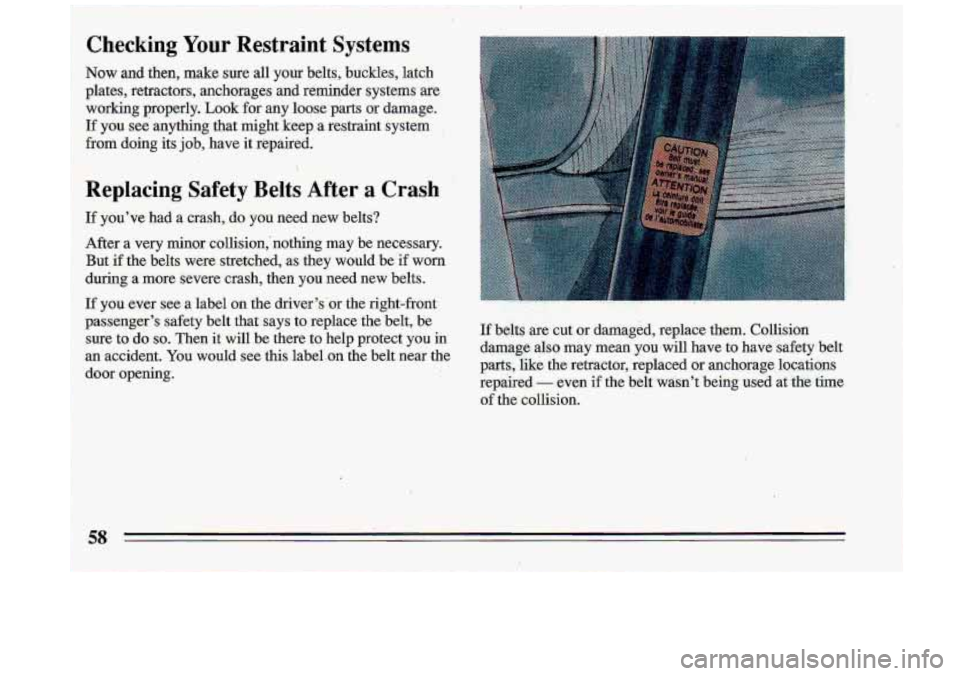
If you ever see a label on the driver's -or the right-front
passenger's safety belt that says to replace the belt, be
sure to do
so. Then it will be there to help protect you in
an accident. You would see this 1abel.on the belt near the
door opening. If belts are cut. or damaged, replace them. Collision
damage'also may mean' you.wil1 have to have safety belt
parts, like the retractor, -replaced or anchorage, 1ocatia-s
repaired
- even if the belt wasn't being used at the time
of the collision.
58
Page 89 of 340
Power Windows
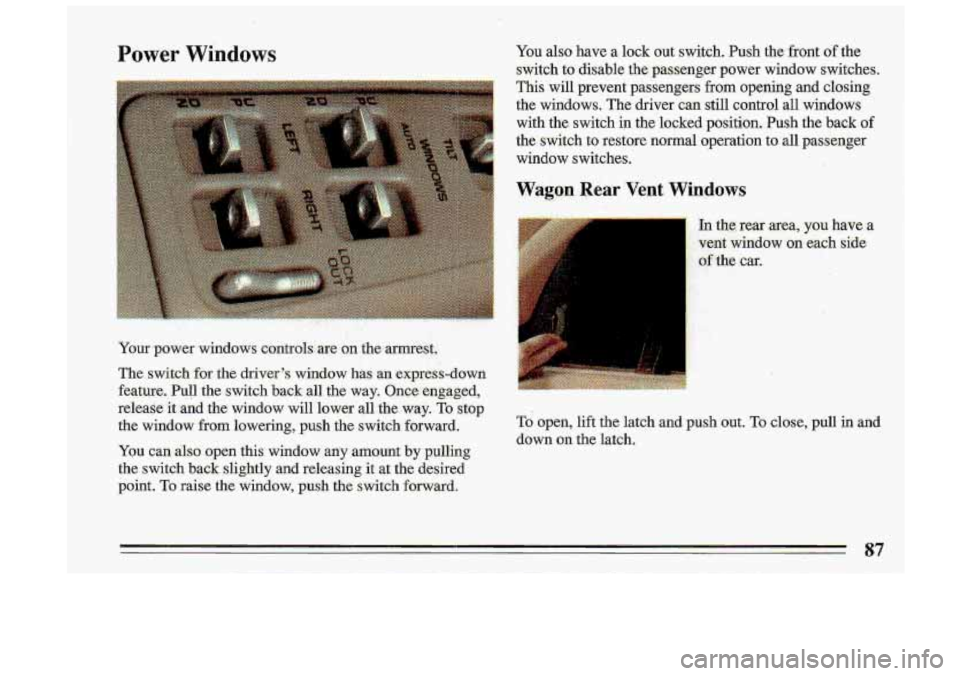
Your power W~~~QWS contmls~ are on the armrest.
The switch
for %he driver's window has an express-down
feature.
Pull the switch back all the way. Onee engaged,
release it.and the window will lower all the way.
To Stop
the window from lowering, push the switch forward.
You
can also open this window any amount by pulling
the switch back .slightly and releasing
it at the desired
point.
To raise the window, push the switch forward. You
also have a lock out switch. Push the front
of the
switch to disable the passenger power window switches.
This will prevent passengers from opening and closing
the windows. The driver can still control all windows
with the switch in the locked position. Push the back
of
the switch to restore normal operation to all passenger
window switches.
Wagon .Rear Vent Windows
In the, rear area, you have a
vent window on.each side
;' of the car..
To open, lift the latch and push out. To close, pull in and
down on the latch.
87
Page 148 of 340
RCL
Press :RCL to see what-track is playing. Press it again
within
5 seconds ,to see how long 'the CD has been
playing,.
The track number also appears
when you change the
volume or when a new track starts to play.
COMP
Pressing the COMP button makes soft and loud passages
nearly equal in volume. I.
RDM
The RDM button means random and when it is pressed,
it
will play the tracks in random order rather than
sequential
1,2,3.. .orden
REV
Press and hold REV to return rapidly to a favorite
passage. Release it
to play the passage.
FWD
Press and hold FWD to advance quickly within a track.
Release it to resume playing. Watch the graphic display
to stop at a specific passage.
PREV
Press PREV to hear the previous track. If you hoId this
button,or press it more than once, the dis.c. w-j&g&turn
t
previous tracks.
NEXT
Press NEXT to hear the next track instead of waiting
until the present track
is finished. If you hold this
button, or-press it more than once, the disc will advance
further.
STlPL
Press ST/PL (Stop/Play) and the disc will stop and the
radio
will play. Press ST/PL again to restart the disc at
the point where it stopped.
Press the
PWR button or turn the ignition key off to stop
the disc player. The disc stays in the player
and will
resume playing
at the point where it stopped.
EJECT
Press EJECT and the-disc will eject and the radio will
play. The disc will start at track
1 when you reinsert it.
146
Page 156 of 340
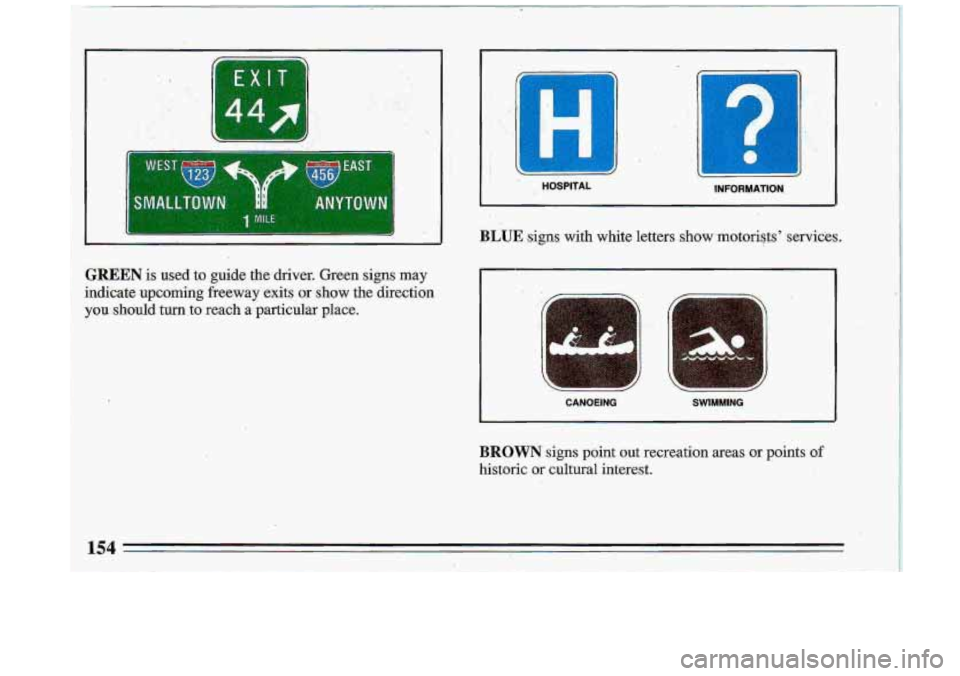
449
GREEN is used to guide the driver. Green signs may
indicate ,upcoming freeway exits or show the direction
you should turn to reach a particular place.
3 H
HOSPITAL INFORMATION,
BLUE signs with white letters show motorists' services.
r
...... .
CANOEING SWIMMING
BROWN signs point out recreation areas or points of
historic or cultural interest.
154
Page 166 of 340
Braking
Braking action- involves perceDtion time and reaction
’time.
First, you have to decide to push on the brake pedal.
That’s perception time. Then -you have to bring
up your
foot and do it. That’s reaction-time.
-
Average reaction time is about 314 ‘of a second. But
that’s only -an average. It might be less with one driver
and as
long as two or.three seconds or .more with
another.
a part. So do alcohol,
drugs and frustration. .But even in
3/4 0f.a second, a
vehicle moving at
60 mph (1 00 h/h) travels 66 feet: (20
m). That could. be a lot of distance in an-emergency, so
keeping enough- space between your vehicle and-others
is important.
And, of course, actual stopping distances vary greatly
with the saiface- of the raad.(whether it’s pavement or
gavel); the condition of the road (wFt, dry, icy); tire
tread; and
the condition of your brakes.
Most -drivers treat their brakes with care. Some,
however; overwork the braking system with poor
driving habits.
* Avoid needless heavy braking. Some people drive in spurts
- heavy acceleration followed by heavy
braking
- rather than keeping pace with traffic. This
is a mistake. Your brakes may not have time to cool
between hard stops. Your brakes will wear out much faster if you do a lat of heavy braking.
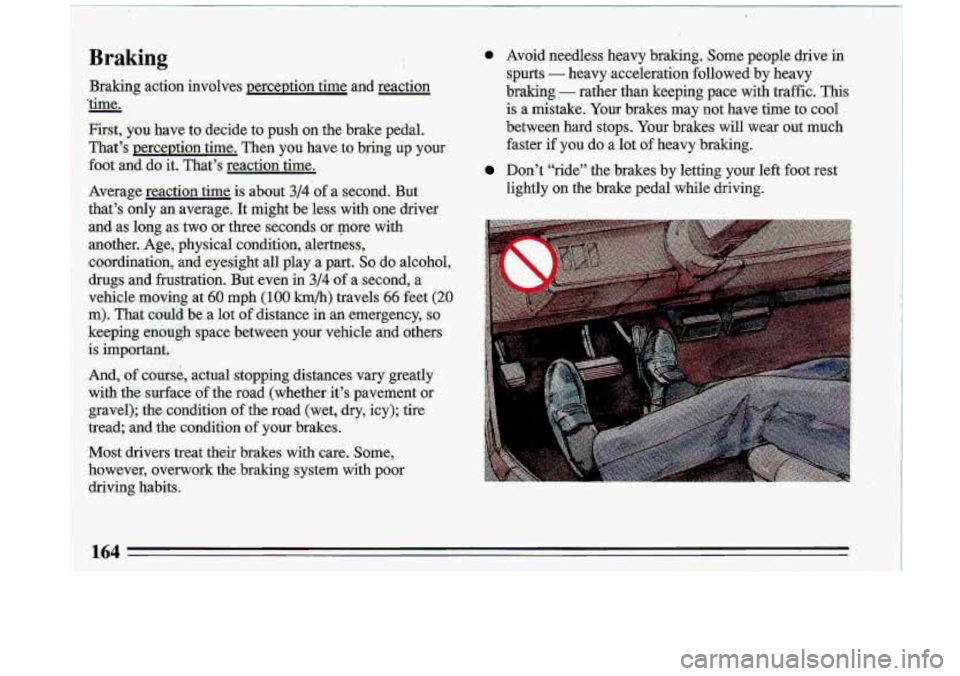
Don’t “ride” the brakes by letting your left foot rest
lightly on the brake pedal while driving.
Page 177 of 340

vehicle is skidding. Learn to recognize warning clues -
such as enough water, ice or packed snow on the road to
make a “mirrored surface’’
- and slow .down when you
.have any doubt.
Remember: Any anti-lock braking system (ABS) helps
avoid only the braking skid. Steer the way you want
to
go-
Driving at Night
Night driving is more dangerous than day driving. One
reason is that some drivers are likely to be impaired
-
by alcohol or drugs, with night vision prob1ems;or by
fatigue.
Here are some tips on night driving.
0
0
0
0
a
0
0
Drive defensively. Remember, this is the most
dangerous time.
Don’t drink and drive. (See “Drunken Driving.” in
the Index for more on this problem.)
Adjust your inside rearview mirror to reduce the
glare from headlights behind you.
Since’ you can’t see as well,
you may need to slow
down and
keep more space between you and other
vehicles. It’s hard to tell how fast the vehicle ahead
is going just
by looking at its taillights,
Slow down, especially on higher speed roads. Your
headlights can light up only
so much road ahead.
In remote areas, watch for animals.
If you’re tired, pull
off the road in a safe place and
rest.
175
I
.!
I
Page 187 of 340
I
!i 1 I
I
0
0
Wear good sunglasses in bright light. Glare can.
cause drowsiness.
But don’t wear sunglasses at I
night. They will drastically reduce your overall
vision at the very time you need all the seeing power
you have.
If you get sleepy, pull
off the road into a’rest, service,
or parking area and take a nap, get some exercise,
or
both. For safety, treat drowsiness on the highway as.
1
an emergency.
As in any driving situation, keep pace with traffic and
allow adequate following distances.
185