Page 161 of 340
Your Own Signals Defensive Driving
Drivers signal
to others, too. It’s not only more polite,
it’s safer ‘to let other drivers know what you are doing.
And in some places the law requires driver signals.
Turn and lane change signals. Always signal when you
plan to turn or change lanes.
If necessary, you can
use hand signals out the window:
Left arm straight out for
a left turn, down- for slow or
about-to-stop, and up for a right turn.
Slowing. down. If time allows, tap the brake pedal once
or twice
in advance of slowing or stopping. This warns
the driver behind you.
Disabled. Your -four-way flashers signal that your
vehicle is disabled or is a hazard. See “Hazard Warning
Flasher” in the Index.
Traffic Officer
The traffic police officer is also a source of important
information.
The officer’s signals govern, no matter
what the traffic lights or other signs say.
The next section discusses some of the road conditions
you
may encounter. The
best advice anyone can give about driving is: Drive
i
defensively. !
Please start with a very important safety device in your
Buick: Buckle up. (See “Safety Belts” in the Index.) i
Defensive driving really means “be ready for anything.”
On city streets, rural roads, or freeways, it means
“always expect the unexpected.”
Assume that pedestrians or other drivers are going to be
careless and make mistakes. Anticipate what they might
do. Be ready for their mistakes.
Expect children to dash out from behind parked cas,
often-followed by other children. Expect occupants
in
parked cars to open doors into traffic., Watch for
movement
in parked cars - someone may be about to
open a door.
Expect other drivers to run stop signs when. you are on a
through street. Be ready to brake if necessary
as you go
through intersections. You may not have
to use the
brake, but if you do, you will be ready.
If you’re driving through a shopping center parking lot
where there are well-marked lanes, directional arrows,
and designated parking areas, expect.some drivers to
159
__
Page 170 of 340
I
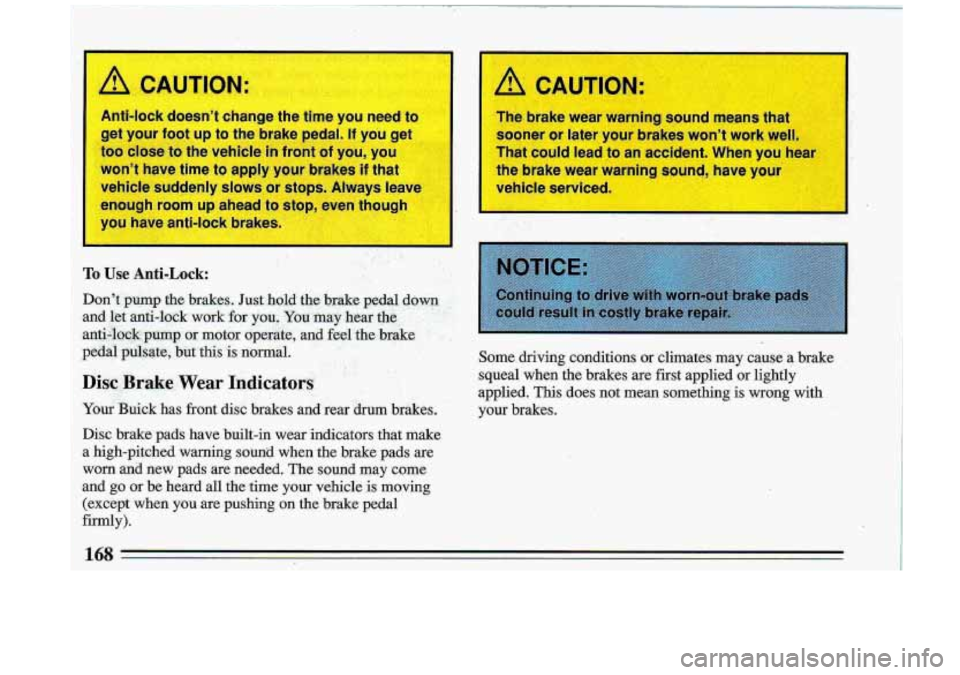
1 /! CAUTION: A CAUTION:
The brake wear warn g s
sooner or later your brakes won’t work well
That could lead
to an accident. When you hear
the brake wear warning
-- -3 your
vehicle serviced. -. --I - ,~
I
Some driving conditions or climates may cause a brake
squeal when the brakes are first applied or lightly
applied. This
does not mean something is wrong with
your brakes.
Page 177 of 340

vehicle is skidding. Learn to recognize warning clues -
such as enough water, ice or packed snow on the road to
make a “mirrored surface’’
- and slow .down when you
.have any doubt.
Remember: Any anti-lock braking system (ABS) helps
avoid only the braking skid. Steer the way you want
to
go-
Driving at Night
Night driving is more dangerous than day driving. One
reason is that some drivers are likely to be impaired
-
by alcohol or drugs, with night vision prob1ems;or by
fatigue.
Here are some tips on night driving.
0
0
0
0
a
0
0
Drive defensively. Remember, this is the most
dangerous time.
Don’t drink and drive. (See “Drunken Driving.” in
the Index for more on this problem.)
Adjust your inside rearview mirror to reduce the
glare from headlights behind you.
Since’ you can’t see as well,
you may need to slow
down and
keep more space between you and other
vehicles. It’s hard to tell how fast the vehicle ahead
is going just
by looking at its taillights,
Slow down, especially on higher speed roads. Your
headlights can light up only
so much road ahead.
In remote areas, watch for animals.
If you’re tired, pull
off the road in a safe place and
rest.
175
I
.!
I
Page 183 of 340
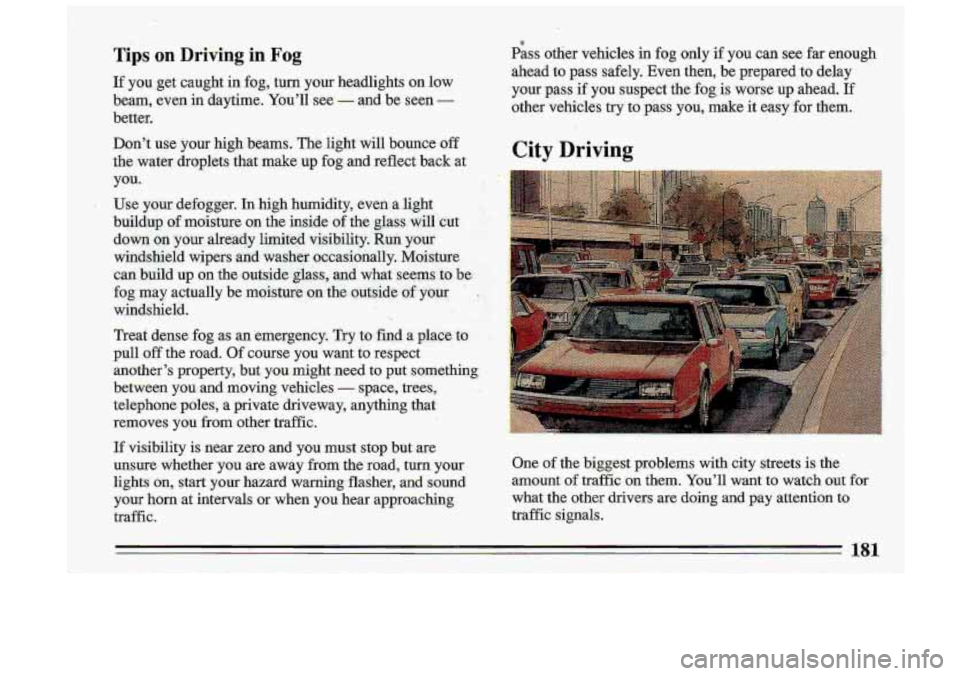
Tips on Driving in Fog
If you get caught in fog, turn your headlights on low
beam, even in daytime. You’ll see
- and be seen -
better.
Pass other vehicles in fog only if you can see far enough
ahead to pass safely. Even then, be prepared to delay
your pass if you suspect the
fog.is worse up ahead. If
other vehicles try to pass you, make it easy for them.
*
If visibility is near zero and you must stop but are
unsuTe whether you are away
from the road, turn your
lights on, start
your hazard warning flasher, and sound
your
Born at intervals or when you hear approaching
traffic. One
of the
biggest problems with city streets is the
amount of traffic
on them. You’ll want to watch out for
what the other drivers are doing and pay attention
to
traffic signals.
181
Page 193 of 340
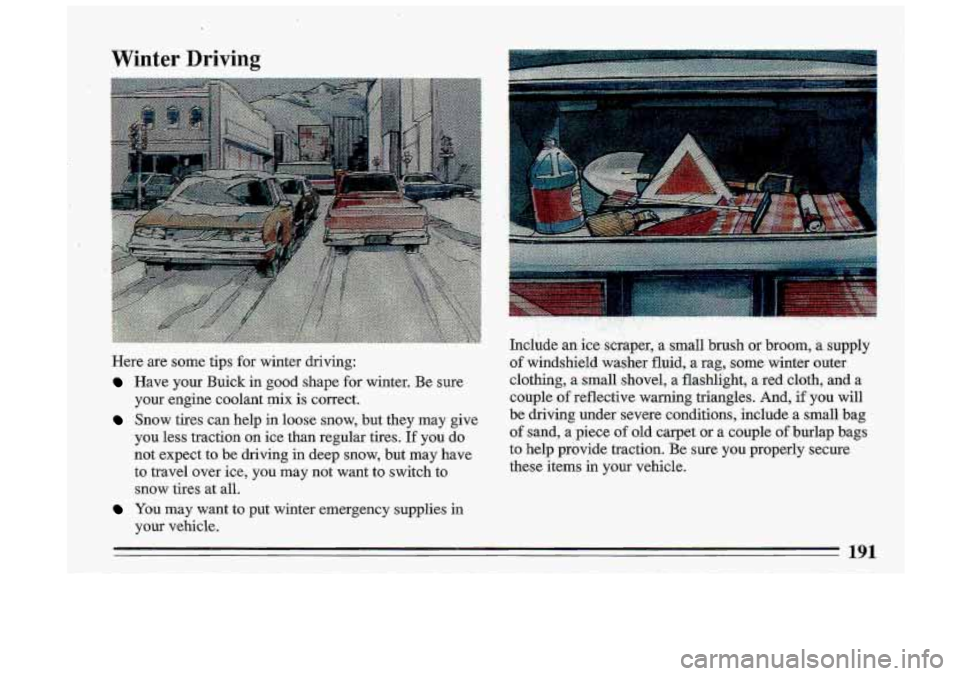
Winter Driving
Here are some tips for winter driving:
Have your Buick in good shape for winter. Be sure
your engine coolant mix is co-rrect.
Snow tires. can help in loose snow, but they may give
you less traction on ice than regular tires. If you do
not expect to be driving
in deep snow, but may have
to travel over ice,
you may not want to switch to
snow tires at all.
You may want to put winter emergency supplies in
your vehicle.
I
I
.. . ..
Include an.ice:scrapGq a small brush .or broom, a supply
of'windshield washer fluid,
a rag, some winter outer
clothing,
a small shovel, a flashlight, a, red. cloth,. and a
couple
.of reflective warning triangles. And, if you will
be driving under:severe conditions, include a small bag
of sand, a piece of ,old carpel .or a couple of burlap. bags
to help provide traction. Be sure y.ou properly secure
these items in your vehicle.
Page 207 of 340
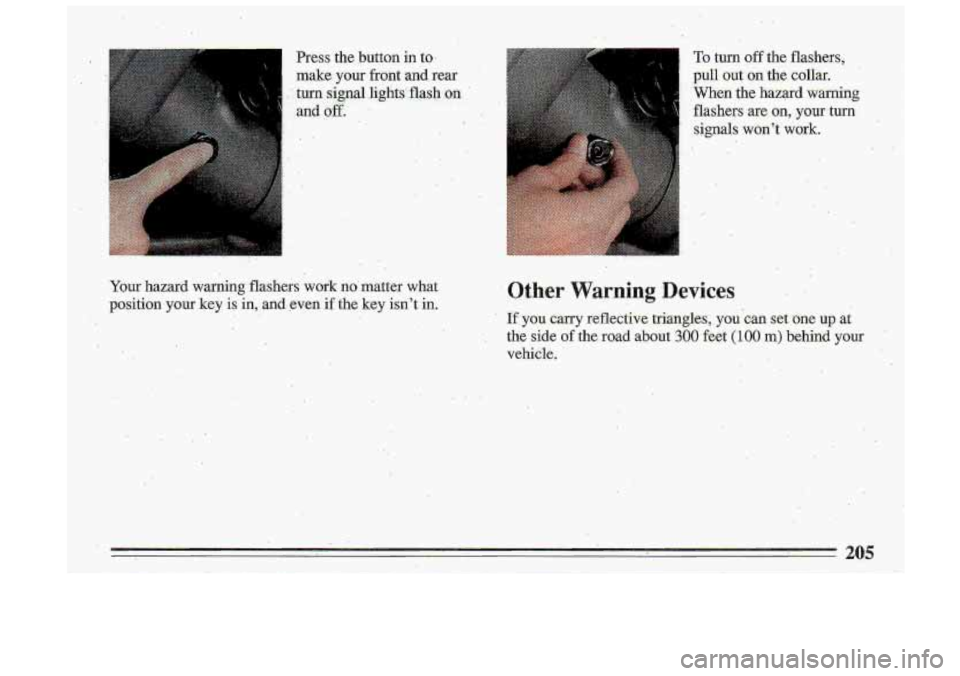
7 Press the button in to. ~ make your front and, rear
i : turn s$gnal .lights' flash on
and
off. .. . ,.
,.
I .'
Your hazard warning -flashers work no' matter wnat
position your key is in, and even if the key isn't in.
To turn off the flashers,
pull out on the collar.
When the hazard
warning
flashers are on, your turn
signals won't work.
Other Warning Devices
If you carry reflective triangles; you can set one up at
the side
of the road about 300 feet (100 m) behind your
vehicle.
205
Page 240 of 340
Compact Spare T,ire
Although the compact spare was fully inflated when
your vehicle -was new, it can lose air after a time. Check
the inflation pressure regularly. It should be
60 psi (420
Pa). The compact spare is made to g6 up to 3,000 miles
(50,OO km), so you can finish your trip and have. your
full-size tire repaired
or replaced where you want. Of
course, it’s best to replace your spare with a full-size ti\
re
as soon as you can. Your spare will last longer and be in
good shape in case you need it again.
Your anti-1ock.brake system warning light -may come on
when you are driving with a compact spare. See
“Anti-Lock Brake System Waming Light”
in the Index.
Don’t-use
your compact spare on some other vehicle. And don’t mix your compact spare or wheel
with other
wheels or tires. They. won’t
fit.. Keep your spare and its
wheel together.
., ,. .. .. , ...
L CAUTIOF
s J a Jal , a we, or orner equlpmenr in rn
passenger compartment of the vehicle could
cause injury. In
a sudden stop or collision,
loose equipment could strike someone. Store al
these
in the proper place
3s
Page 329 of 340
Acc (Ignition Key Position) ........................ 74
Adding Brake Fluid
.................................. 262
Coolant
.............................. 2 19.222. 257
Electrical Equipment
.......................... 287
Engineoil
................................... 249
Power Steering Fluid
.......................... 260
Transmission Fluid ............................ 254
Windshield Washer Fluid
....................... 261
Additives, Engine Oil
............................. 251
Adjustment, Brake
............................... 169
Adult Safety Belt Usage
............................ 27
AirBag
.......................................... 35
Aircleaner
...................................... 253
Air Conditioner
............................. 127, 132
Air Outlets
..................................... 126
Alcohol, Driving Under the Influence of
.............. 160
Alcohol in Gasoline ..................... ........ 243
Aluminum Wheels, Cleaning
....................... 284
AM Radio Reception
............................. 134
AM Stereo Radio Reception
....................... 135
Antenna Care
................................... 149
Antifreeze
...................................... 257
Antilock Brakes
.................................. 166
Antilock Brake System Warning Light
........... 121, 166
...
Part 9 Index
Anti-Theft Tips ................................... 72
Anti-Theft Feature. Delco
LOC I1 ..................... 147
Appearance Care
................................ 249
Appearance Care and Materials
..................... 286
Armrest. Storage
................................ 112
Ashtrays ........................................ 110
Assist Handles
.............................. 102. 113
Audio Systems
.................................. 134
Automatic Air Conditioning System
................. 129
Automatic Door Locks
............................. 64
Automatic Overdrive
.............................. 79
Automatic Pull-Down Feature
....................... 65
Automatic Transmission
........................... 78
Automatic Transmission Fluid
...................... 254
Automatic Transmission Torque Lock
................ 190
Axle. Rear
..................................... 256
Baby. Holding a
................................. 46
Battery
........................................ 264
Battery Cables. Starting With
....................... 206
Battery Warning Light ............................ 118
Blizzard. If You’re Caught In A
..................... 193
BloodAlcoholLevel
............................. 162
“Blowout”. Tire
................................. 224