Page 30 of 340
..' ',: . ,.:
i '. ,
..
Ipi'"
I.
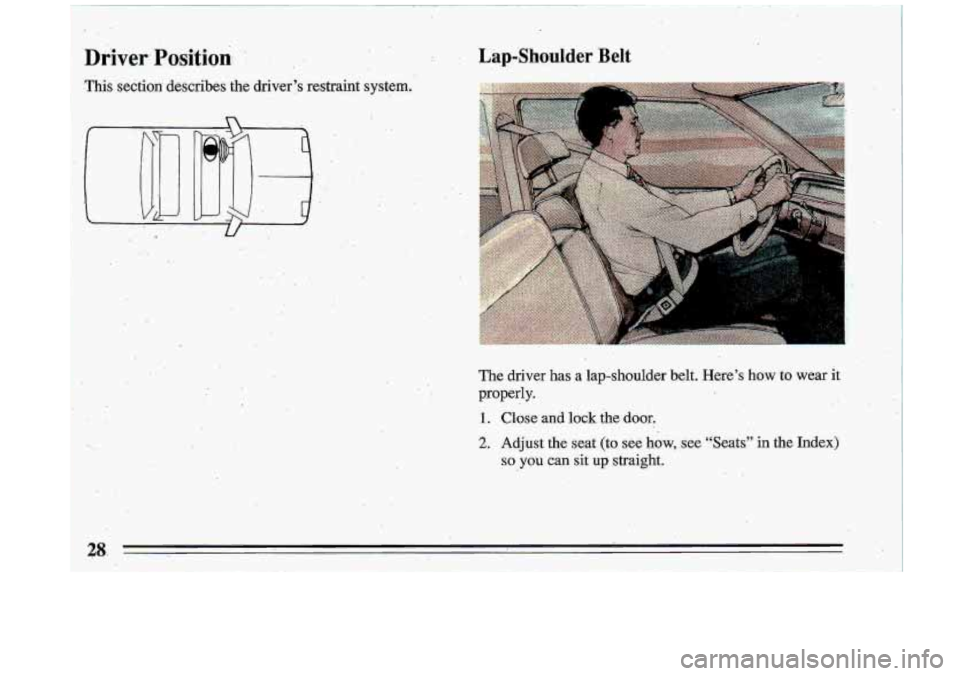
The driver has a lap-shoulder belt. Here's how tu wear it
properly.
1. Close arrd lock the door.
2. ,Adjust the seat (to. see how, .see "Seats'' in ,the Index)
so you.' can sit up straight.
Page 31 of 340
I
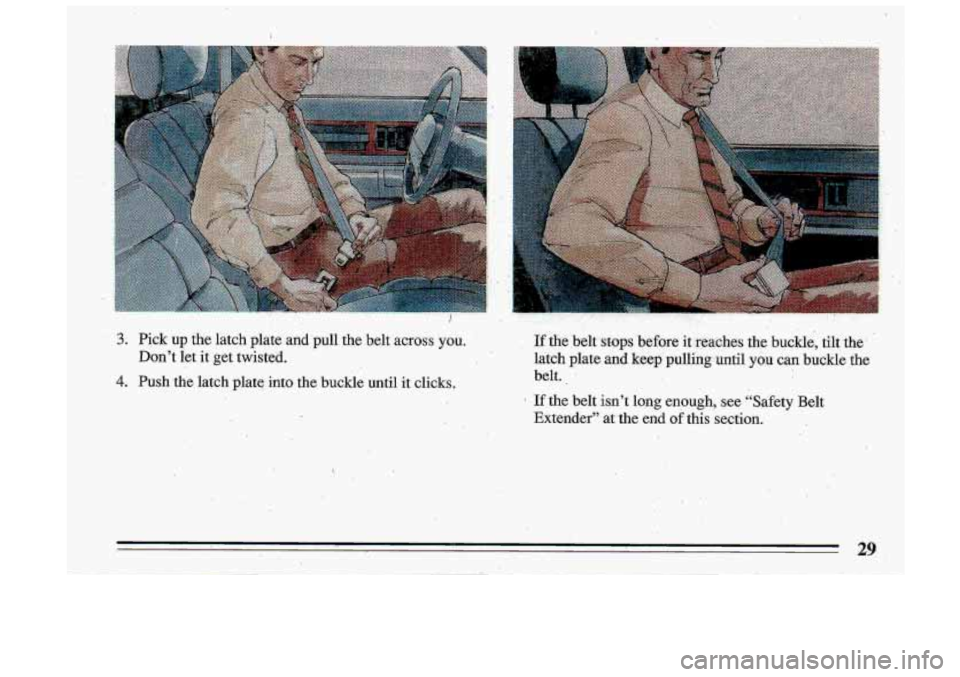
3. Pick up the latch plate and pull the belt across you.
Don’t let it get twisted.
4. Push the latch plate into .the buckle until it clicks.
,-
If the ,belt, stops before it .reaches the buckle, tilt. the ’
latch plate and keep pulling-until you can buckle the
belt.
I
’ If the belt isn’t long ,enough, see “Safety Belt
Extender” at the end
of this .section.
29
--
Page 33 of 340
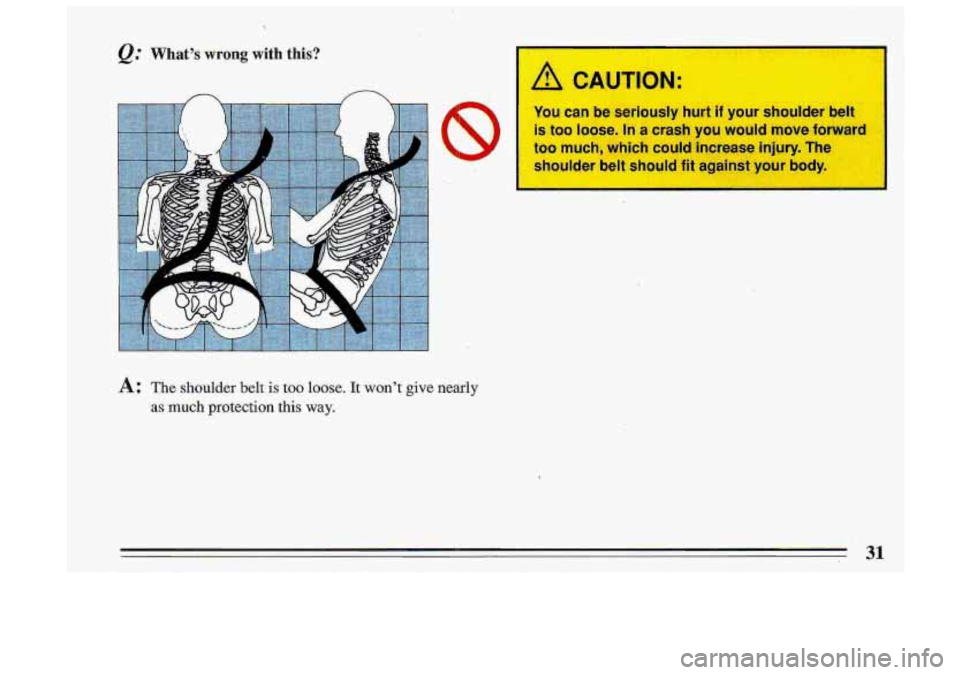
@ What’s wrong with this?
A: The shoulder belt-is too loose. It won’t give nearly
as much protection this way.
A CA ITION:
You can be seriously hurt if your shoulder belt
is
too loose. In a crash you would move forward
too much, which could increase injury. The
sh llder f--It s’ luld fit agains
31
Page 34 of 340
...
n
..
.. _1 ..
.:,-,
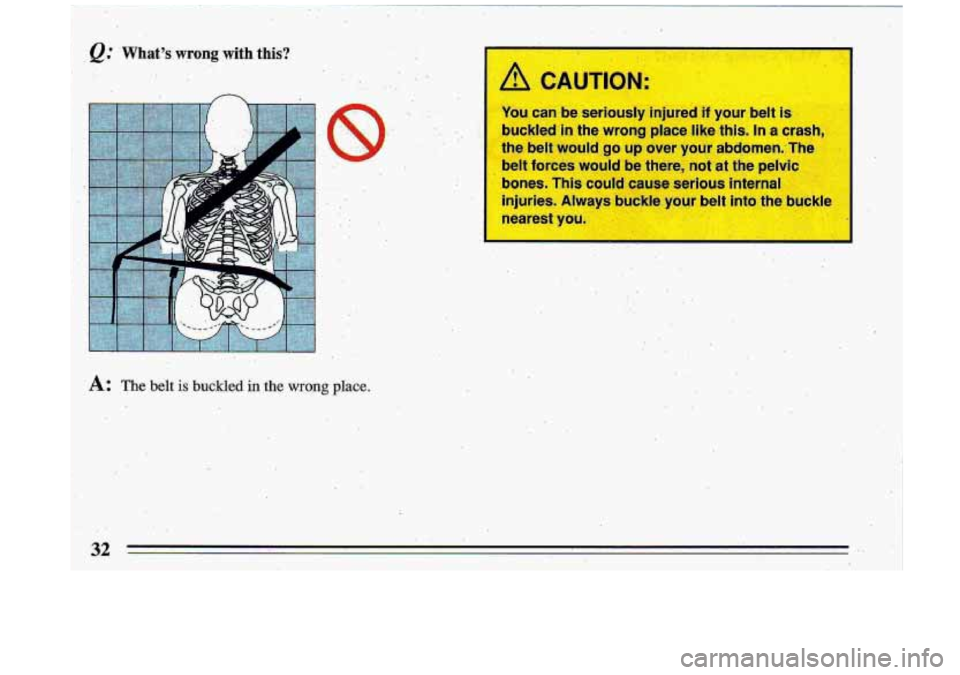
A: The belt is buckled in the wrong place:
A CP
You can be seriously injured if your belt is
buckled in the wrong place like this. In a crasl
the belt would
go up over your abdomen:T'
belt forces
would be there, not at the pelvic
bones.
This could cause serious internal
injuries.
Alw IS buc . . r belt into the buckle
nearest you,
32 ..
Page 35 of 340
&: What-’s .wrong with this?
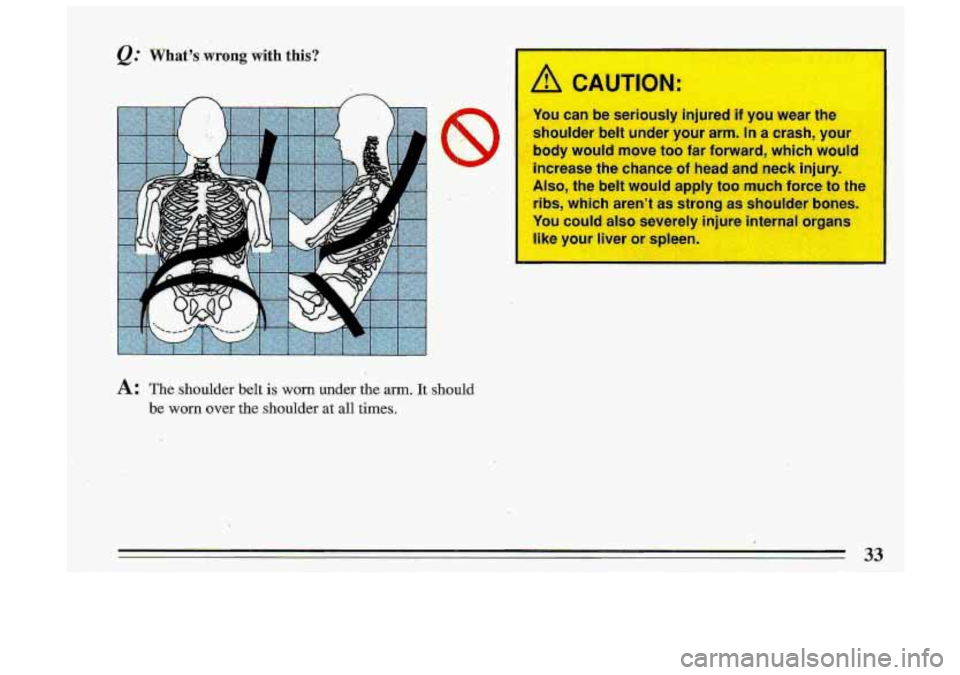
A: The shoulder belt is worn under the arm. It should
be worn over the shoulder at all times.
A CAUTION:
You can be seriously injured if you wear the
shoulder belt under your arm. In a crash, your
body would move too far forward, which woul
Also, the belt would apply too much force to the
ribs, which aren’t
as strong as shoulder bones.
I increase the chance of head and neck injury.
I YOU could also severely i
lik- -!our liver or spleen.
I
33
Page 36 of 340
Q.‘ What’s wrong with-this?
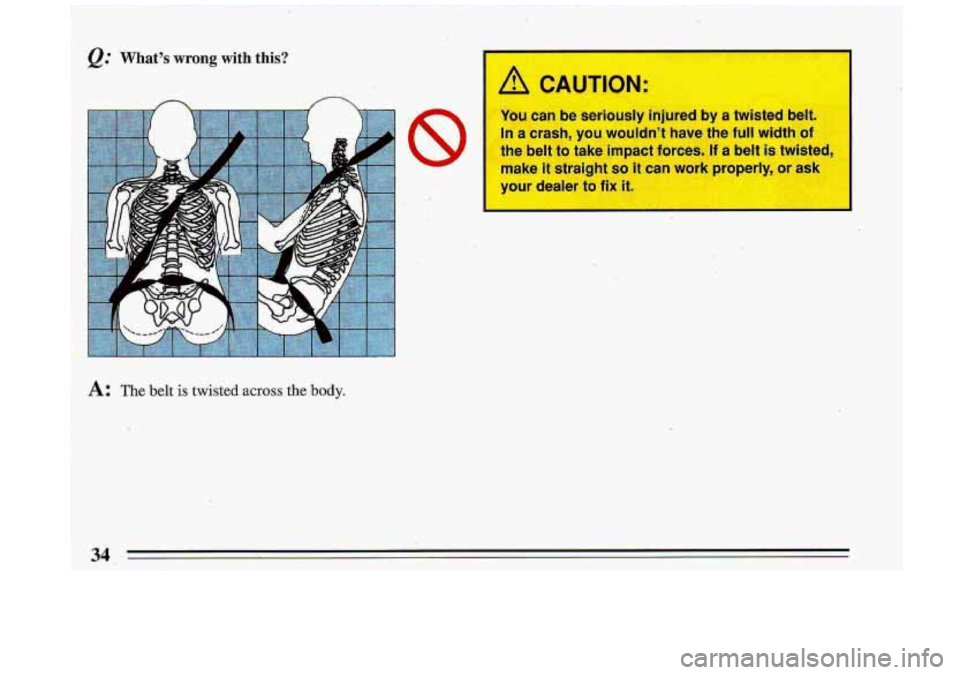
A.: The belt is twisted ~CTOSS the .body.
I CAUTION:
You can be seriously injured by a twisted belt.
In a crash,
you wouldn’t have the full width c
the belt to take impact forces. If a belt is twisted,
make it straight
so it can work proper1 or ask
your dealer to
fix it.
Page 37 of 340
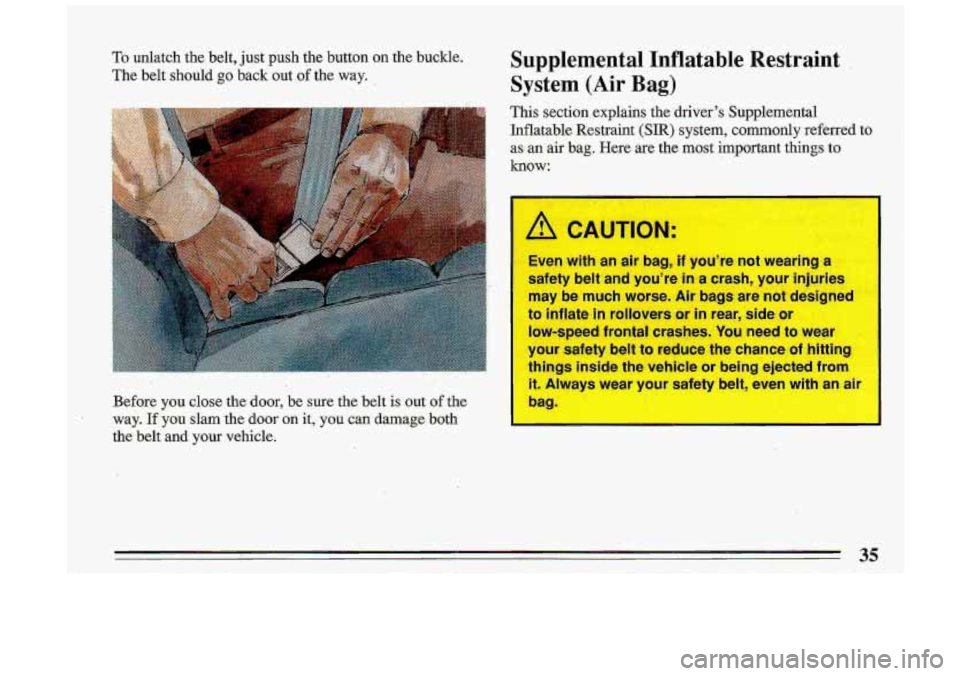
To unlatch the belt, just push the button on the buckle.
The belt should
go back out of the way. ,
Before you, close the door, be sure the belt is out of the
way.
If you slam the door on it, you can damage both
the belt and your vehicle.
Supplemental Inflatable Restraint
System
(Air Bag)
This section .explains the driver’s Supplemental
Inflatable Restraint
(SIR) system, commonly referred to
as an air bag. Here are the most important things
to
know:
A CAUTION:
Even with an air bag, if you’re not wearing a
safety belt and you’re
in a crash, your injuries
may be much worse. Air bags are
not designed
to inflate
in rollovers or in rear, side or
low-speed frontal crashes.
You need to wear
your safety belt to reduce the chance of hitting
things inside the vehicle
or being ejected from
it. Alwavs wear vaur safety belt, even with an air
bag.
35
I
Page 38 of 340
A CAUTION:
Air bags inflate with great force, faster than the
blink
of an eye. If you’re too clo~se to an inflating
air bag,
it could seriously injure you. §afety
belts help keep you
in position for an air bag
inflation
in a crash. Always wear your safety
belt, even with an air bag, and
sit as far back as
you’cat rhile
stil- laintaining cc -rol of your
vehicle
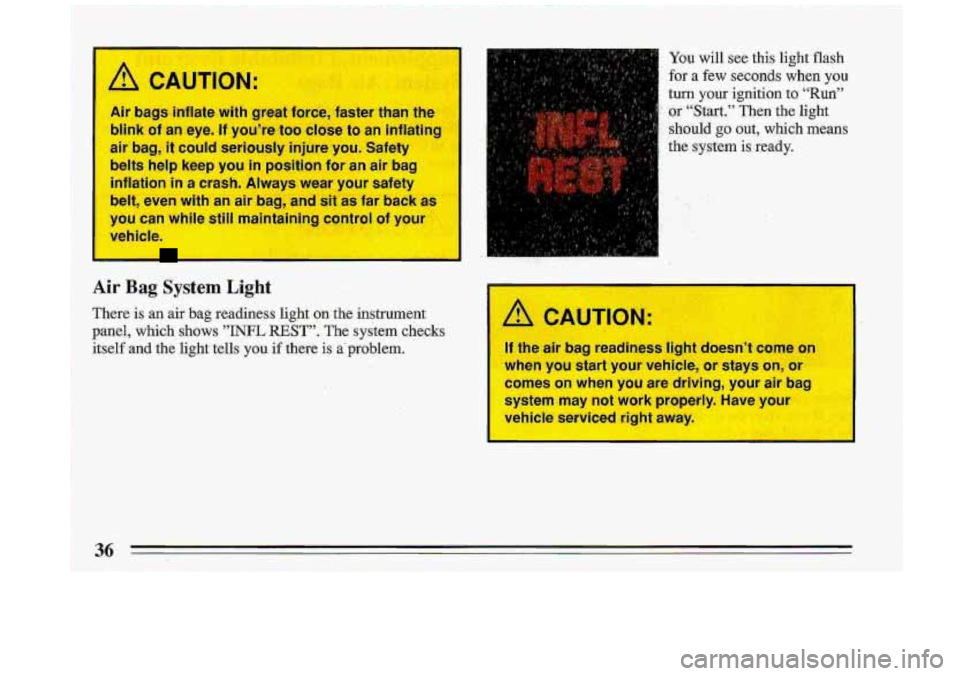
b B; - System Light
There is an air bag readiness light on the instrument
panel, which shows
”INFL REST”. The system checks
igdf..ad .fie. light tells you if there is a.problem,. You
will see this light flash
for a few seconds when you
turn your ignition to “Run”
or “Start.” Then the light
should
g.6 out, which means
the system is ready.