1993 BUICK RIVIERA flat tire
[x] Cancel search: flat tirePage 12 of 324
HowtoUsethisManual ................................................................
This part tells you how to use your manual and includes safety and vehicle damage warnings & symbols.
SeatsandSafetyBelts ..................................................................
This part tells you how to use your seats and safety belts properly.
Featuresandcontrols ..................................................................
This part explains how to start and operate your Buick.
This part tells you how to adjust the ventilation
& comfort controls and how to operate your sound system.
YourDrivingandtheRoad ..............................................................
Here you’ll find helpful information and tips about the road and how to drive under different conditions.
ProblemsontheRoad ..................................................................
This part tells you what to do if you have a problem while driving, such as a flat tire or engine overheating.
ServiceandAppearanceCare ............................................................
Here the manual tells you how to keep your Buick running properly and looking good.
Maintenanceschedule ..................................................................
This part tells you when to perform vehicle maintenance and what fluids and lubrica\
nts to use.
Customer Assistance Information ........................................................
This part tells you how to contact Buick for assistance and how to get service publications. It also gives
you information on “Reporting Safety Defects.”
Index ........................................................................\
........
Here’s an alphabetical listing of almost every subject in this manual. You can use it to quickly find
something
you want to read.
Comfort Controls and Audio Systems .....................................................
10
13
59
117
139
183
215
269
289
297
Page 174 of 324
~ Before Leaving on a
Long Trip 0 Weather Forecasts: What’s the weather outlook along
your route? Should
you delay your trip a short time
Make sure you’re ready. Try to be well rested. If you to avoid a major storm system?
must start when you’re not fresh
-- such as after a day’s
work
-- don’t plan to make too many miles that first part 0 Maps: Do you have up-to-date maps?
I
of the journey. Wear comfortable clothing and shoes you
can easily drive in. On the Road
Is your vehicle ready for a long trip? If you keep it
serviced and maintained, it’s ready to go. If it needs
service, have it done before starting out. Of course,
you’ll find experienced and able service experts in
Buick dealerships all across North America. They’ll be
ready and willing to help if
you need it.
Here are
some things you can check before a trip:
0 Windshield Washer Fluid: Is the reservoir full? Are
all windows clean inside and outside?
0 Wiper Blades: Are they in good shape!
0 Fuel, Engine Oil, Other Fluids: Have you checked all
levels?
0 Lights: Are they all working? Are the lenses clean?
0 Tires: They are vitally important to a safe,
trouble-free trip.
Is the tread good enough for
long-distance driving?
Are the tires all inflated to the
recommended pressure? Unless you
are the only driver, it is good to share
the
driving task with others. Limit turns behind the wheel to
about
100 miles (160 km) or two hours at a sitting.
Then, either change drivers or stop for some refreshment
like coffee, tea or soft drinks and some limbering up. But do stop and move around. Eat lightly along the way.
Heavier meals tend to make some people sleepy.
On two-lane highways or undivided multilane highways
that do not have controlled access, you’ll want to watch for some situations not usually found on freeways.
Examples are: stop signs and signals, shopping centers with direct access to the highway, no passing zones and school zones, vehicles turning left and right off the road,
pedestrians, cyclists, parked vehicles. td even animals.
Highway Hypnosis
Is there actually such a condition as “highway
hypnosis”?
Or is it just plain falling asleep at the wheel?
Call
it highway hypnosis, lack of awareness, or
whatever.
172
Page 175 of 324
There is something about an easy stretch of road with
the same scenery, along with the hum of the tires on the
road, the drone of the engine, and the
rush of the wind
against the vehicle that can make you sleepy. Don't let it
happen to you! If it does, your vehicle can leave the
road in less than a second. and you could crash and be
injured.
What can you do about highway hypnosis? First, be
aware that
it can happen.
Then here are some tips:
0 Make sure your vehicle is well ventilated, with a
comfortably cool interior.
0 Keep your eyes moving. Scan the road ahead and to
the sides. Check your rearview mirrors frequently
and your instruments from time to time. This can
help you avoid a fixed stare.'
Wear good sunglasses in bright light. Glare can
cause drowsiness. But don't wear sunglasses at
night. They will drastically reduce your overall vision at the very time you need all the seeing power
you have.
If you get sleepy, pull off the road into a rest, service,
or parking area and take a nap, get some exercise, or
both. For safety, treat drowsiness on the highway as
an emergency.
As in any driving situation, keep pace with traffic and
allow adequate following distances.
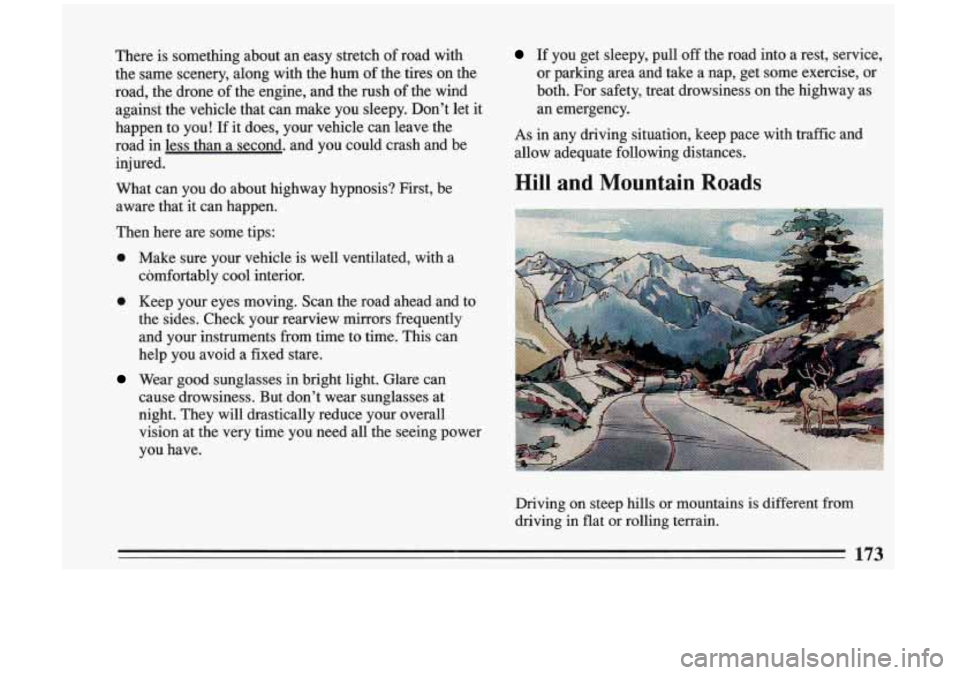
Hill and Mountain Roads
Driving on steep hills or mountains is different from
driving in flat or rolling terrain.
'I
173
Page 206 of 324
I
8.
If a Tire Goes Flat
It’s unusual for a tire to “blow out” while you’re driving,
especially if you maintain your tires properly.
If air goes
out of a tire, it’s much more likely to lepk out slowly.
But if you should ever have a “blowout,” here are a few\
tips about what to expect and what to do:
If a front tire fails, the flat tire will create a drag that
pulls the vehicle toward that side. Take your foot
off the
accelerator pedal and grip the steering wheel firmly.
Steer to maintain lane position, then gently brake to a
stop well out of the traffic lane.
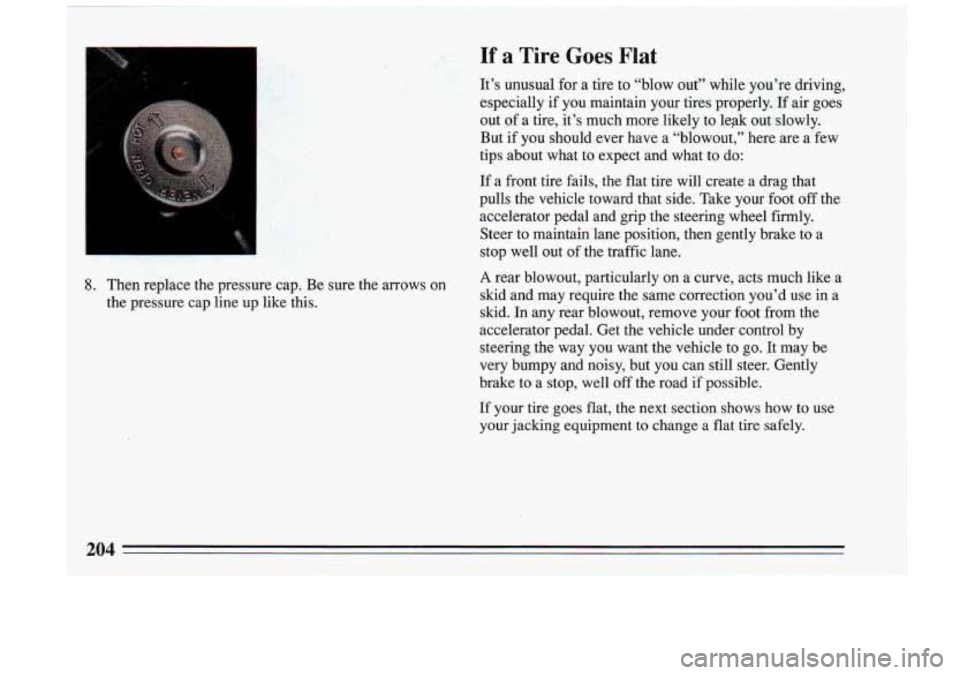
Then replace the pressure cap. Be sure the arrows on
the pressure
cap line up like this.
A rear blowout, particularly on a curve, acts much like a
skid and may require the same correction you’d use in
a
skid. In any rear blowout, remove your foot from the
accelerator pedal. Get the vehicle under control by
steering the way you want the vehicle
to go. It may be
very bumpy and noisy, but you can still steer. Gently
brake to a stop, well
off the road if possible.
If your tire goes flat, the next section shows how to use
your jacking equipment to change a flat tire safely.
204
____
Page 210 of 324
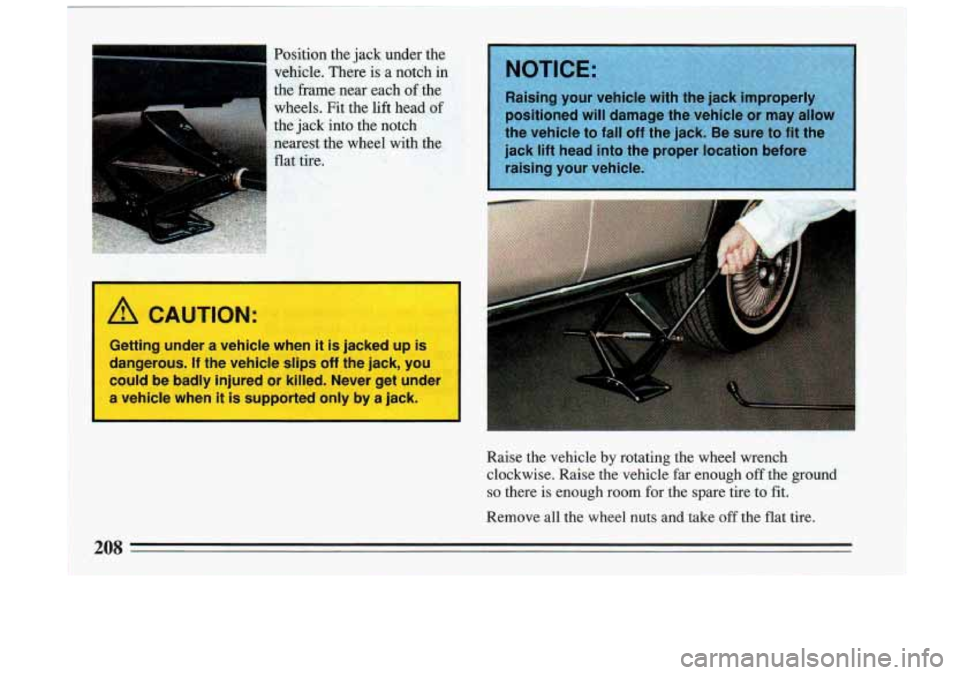
-1 Position the jack under the
3
vehicle. There is a notch in
thk frame near each of the
A CAUTION:
Getting under a vehicle when it is jacked up is
dangerous.
If the vehicle slips off the jack, you
could be badly injured
or kill,ed. Never get under
a vehicle when it
is supported only by a jack.
Raise the vehicle by rotating the wheel wrench
clockwise. Raise the vehicle far enough
off the ground
so there is enough room for the spare tire to fit.
Remove all the wheel nuts and take
off the flat tire.
20s
Page 213 of 324
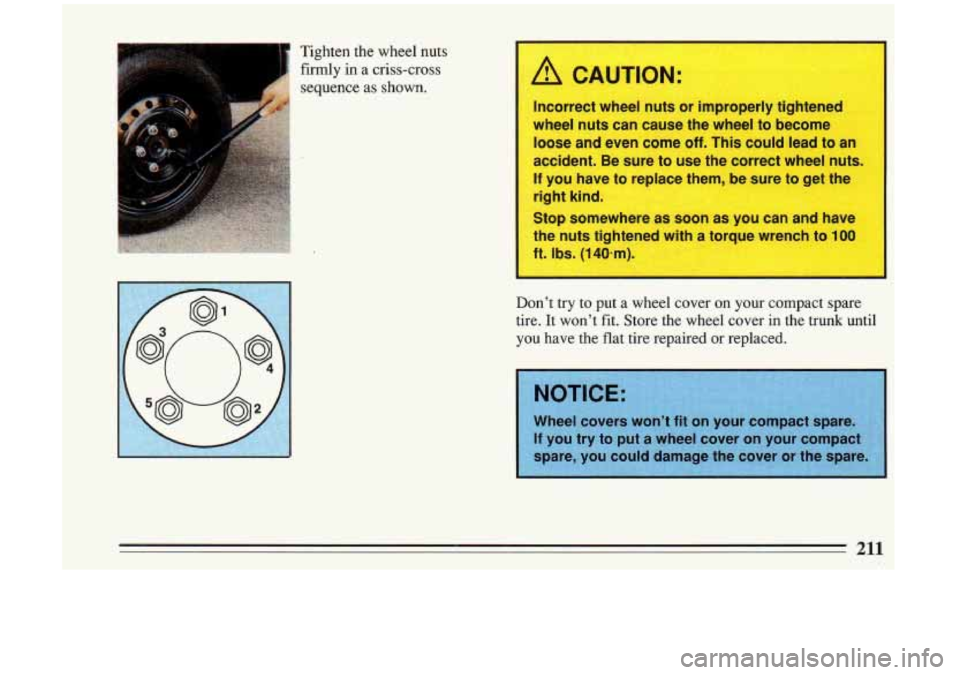
Tighten the wheel nuts
firmly in a criss-cross
sequence as
shown. A CAUTION:
Incorrect wheel nuts or improperly tightened
wheel nuts can cause the wheel to become
loose and even come
off. This could lead to an
accident. Be sure to use the correct wheel nuts.
If you have to replace them, be sure to get the
right kind.
Stop somewhere as soon as you can and have
the nuts tightened with a torque wrench to
100
ft. Ibs. (140.m).
Don't try to put a wheel cover on your compact spare
tire. It won't fit. Store the.whee1 cover
in the trunk until
you have the flat tire repaired
or replaced.
Page 214 of 324
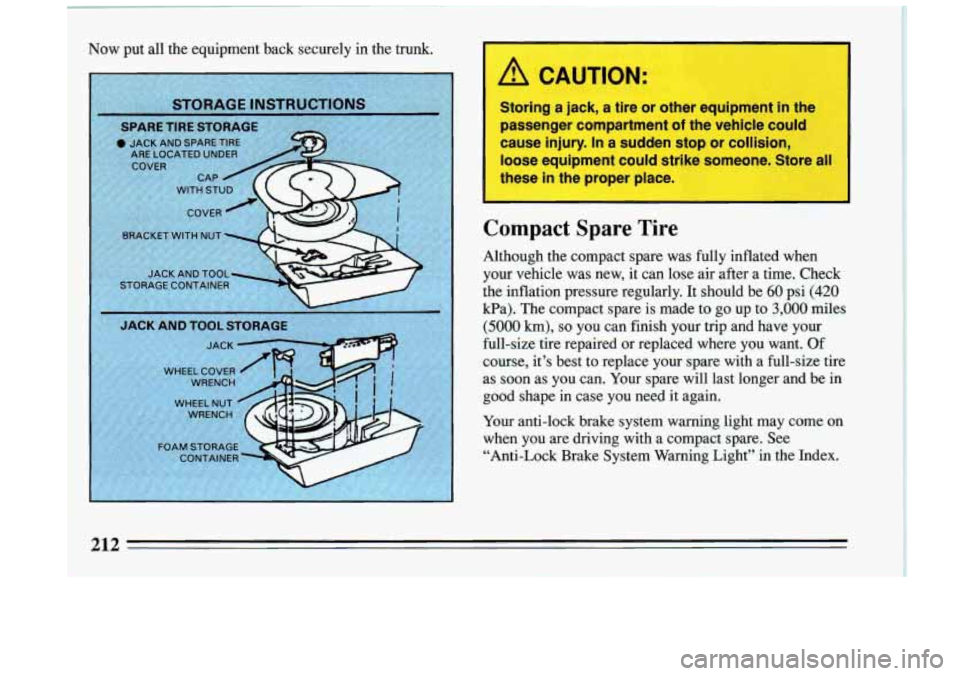
Now put all the equipment back securely in the trunk.
Compact Spare Tire
Although the compact spare was fully inflated when
your vehicle was new, it can lose air after a time. Check
the inflation pressure regularly. It should be
60 psi (420
kPa). The compact spare is made to go up to 3,000 miles
(5000 km), so you can finish your trip and have your
full-size tire repaired or replaced where you want.
Of
course, it’s best to replace your spare with a full-size ti\
re
as soon as you can. Your spare will last longer and be in
good shape in case you need it again.
Your anti-lock brake system warning light may come on
when you are driving with a compact spare. See
“Anti-Lock Brake System Warning Light” in the Index.
212
Page 244 of 324
Remove the bulb from the Loading Your Vehicle
bulb socket by turning it
counterclockwise.
%I OCCUPANTS VEHICLE CAP. WT.
I
TIRE-LOADING INFORMATION,
FRT. CTR. RR. TOTAL
LBS. KG
MAX. LOADING & GVWR SAME AS VEHICLE
CAPACITY WEIGHT XXX COLD
TIRE
TIRE SIZE SPEED PRESSURE
RTG PSI/KPa
FRT.
RR.
SPA.
IF TIRES ARE HOT, ADD 4PS1128KPa
SEE OWNER'S MANUAL FOR ADDITIONAL
1 Install a new bulb into the socket turning it clockwise INFORMATION 111-p ?j$##..:,
(right) until it is locked in place. Insert the socket into \
the lamp and turn it clockwise (right) to lock it into
place. Reverse the instructions to replace the taillamp assembly.
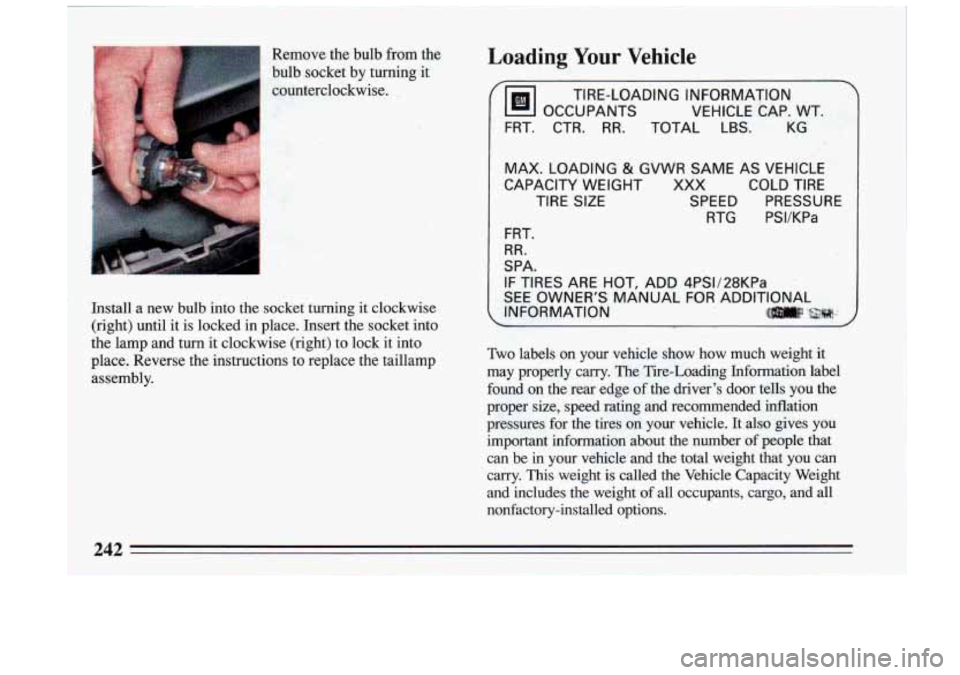
Two labels on your vehicle show how much weight it
may properly carry. The Tire-Loading Information label
found on the rear edge of the driver's door tells you the
proper size, speed rating and recommended inflation
pressures for the tires on your vehicle. It also gives you
important information about the number of people that can be in your vehicle and the total weight that you can
carry. This weight is called the Vehicle Capacity Weight
and includes the weight
of all occupants, cargo, and all
nonfactory-installed options.
242