Page 115 of 324
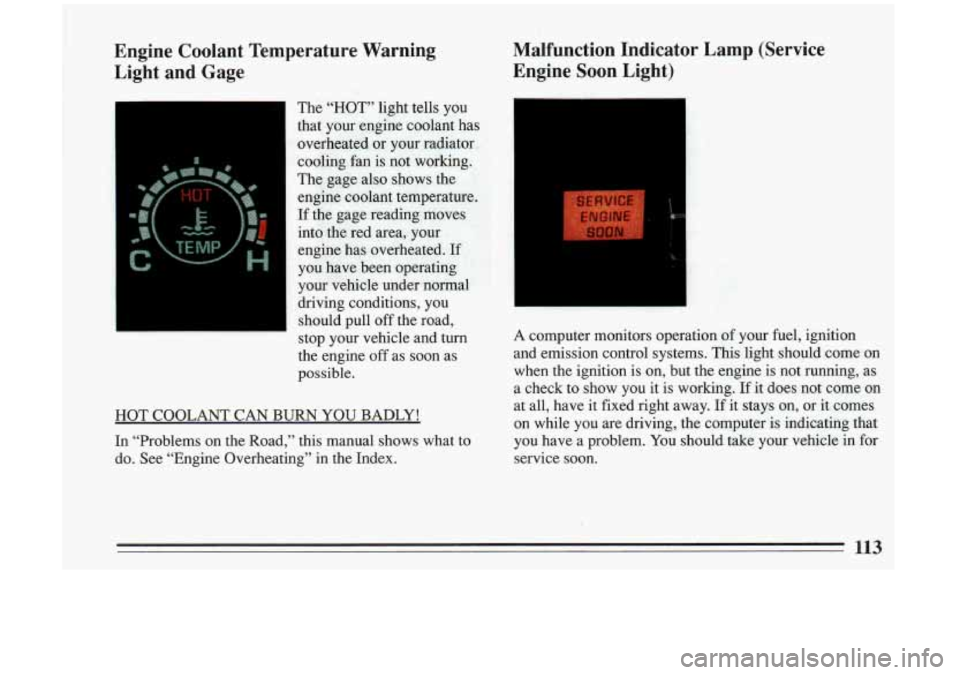
Engine Coolant Temperature Warning
Light and Gage Malfunction Indicator Lamp (Service
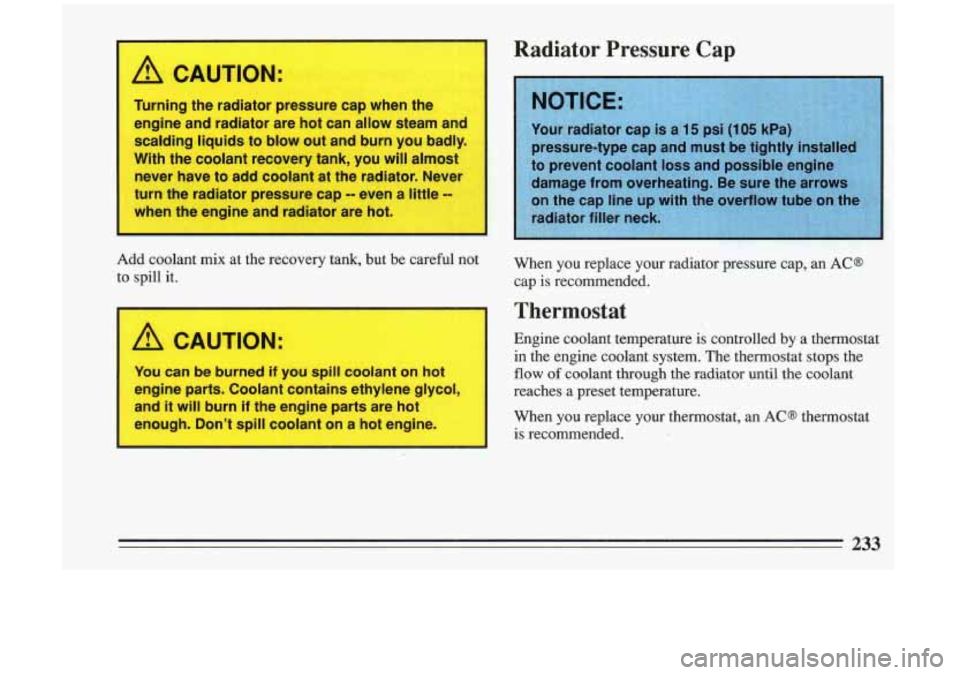
Engine Soon Light)
the engine off as soon as
possible.
HOT COOLANT CAN
BURN YOU BADLY!
In “Problems on the Road,” this manual shows what to
do. See “Engine Overheating” in the Index. A computer monitors operation
of your fuel, ignition
and emission control systems. This light should come on when the ignition
is on, but the engine is not running, as
a check to show you it
is working. If it does not come on
at all, have it fixed right away. If it stays
on, or it comes
on while you are driving, the computer is indicating that
you have a problem. You should take your vehicle in for
service soon.
113
Page 122 of 324
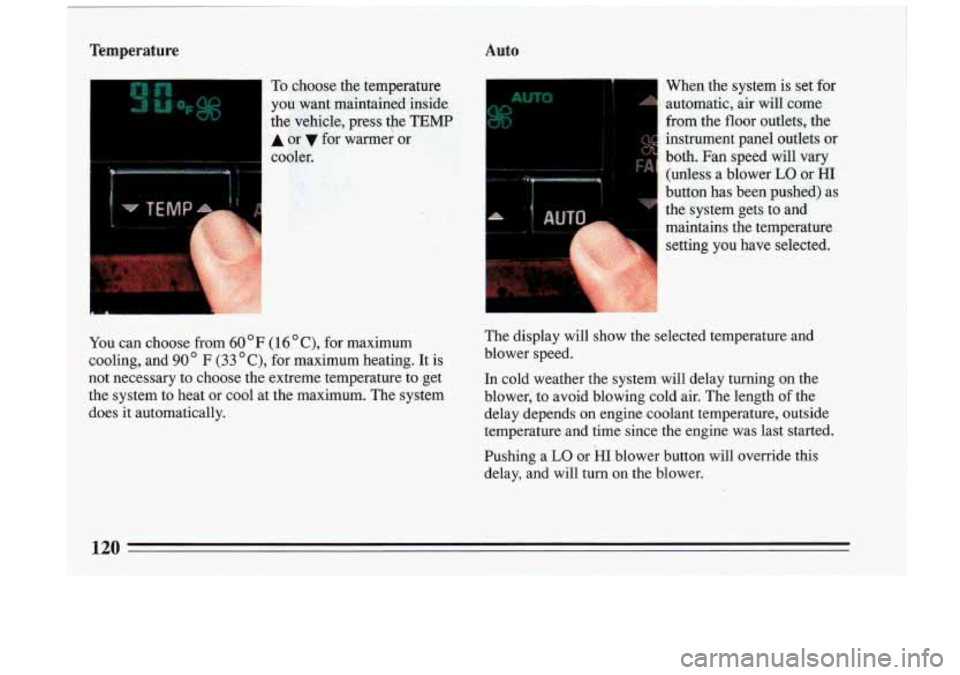
Auto
I- - To choose the temperature When the system is set
far
you- want maintained inside automatic, air
will come
the vehicle, press the
TEMP from the floor outlets, the
A or for warmer or instrument panel outlets or
cooler. both. Fan speed will vary
(unless a blower
LO or HI
:.if, button has been pushed) as
the system gets to and
maintains the temperature setting you have selected.
-
,..I . .
a
~
You can choose from 60 OF (1 6 " C), for maximum
1 cooling, and 90' F (33 "C), for maximum heating. It is The display will show the selected temperature and
blower speed.
! not necessary to choose the extreme temperature to get In cold weather the system will delay turning on the
the system to heat
or cool at the maximum. The system
blower, to avoid blowing cold air. The length of the
does it automatically. delay depends
on engine coolant temperature, outside
temperature and time since the engine was last started.
Pushing a
LO or HI blower button will override this
delay, and will turn on the blower.
120
Page 198 of 324
Engine Overheating
You willi find a coolant temperature gage and the
warning light about a hot engine on your Buick
instrument panel.
If Steam Is Coming From Your Engine:
I
A CAUTION:
Steam from an overheated engine can burn you
badly, even if you just open the hood. Stay away
from the engine if you see or hear steam
coming from
it. Just turn it off and get everyone
away from the vehicle until
it cools down. Wait
until there is no sign of steam or coolant before
opening the hood.
If you keep driving when your engine is
overheated, the liquids in it can catch fire. You
or others could be badly burned. Stop your
engine if
it overheats, and get out of the vehicle
until the engine is cool.
If No Steam Is Coming From Your Engine:
If you get the overheat warning but see or hear no
steam, the problem may not be too serious. Sometimes
the engine can get a little too hot when you:
Climb a long hill on a hot day.
Stop after high speed driving.
Id.le for long periods in traffic.
If you get the overheat warning with no sign of steam,
try this for a minute or
so:
1. Turn off your air conditioner.
2. Turn on your heater to full hot at the highest fan
3. Try to keep your engine under load (in a drive gear
speed and open the window as necessary.
where the engine runs slower).
Page 233 of 324
are made especially for your automatic transaxle.
Damage caused by fluid other than
DEXRONs-IIE is
not covered by your new vehicle warranty.
After adding fluid, recheck the fluid level as
described under
“How to Check.”
When the correct fluid level is obtained, push the
dipstick back in all the way.
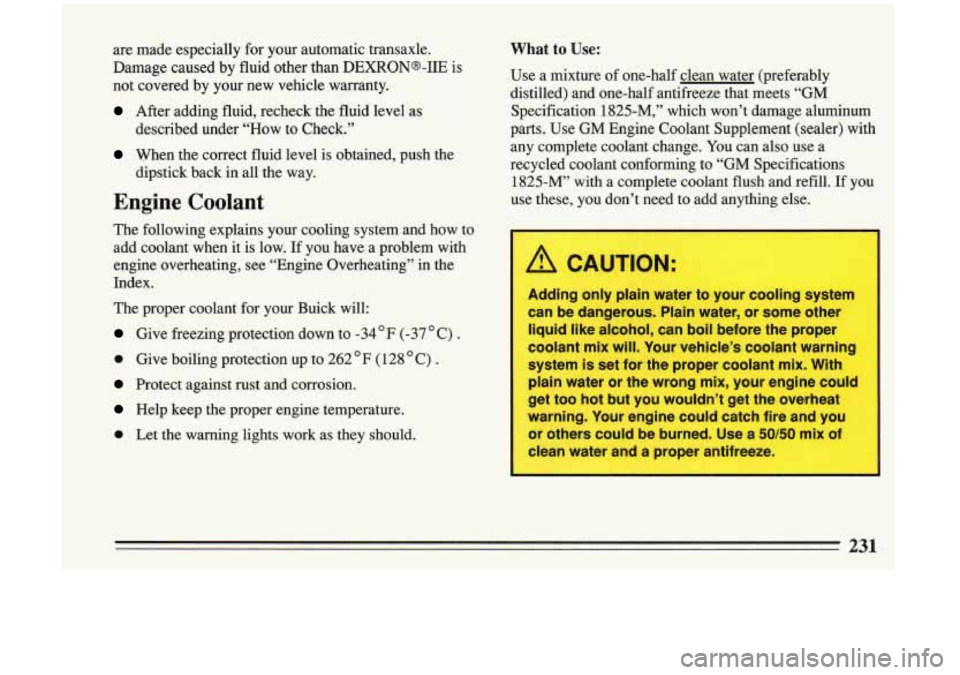
Engine Coolant
The following explains your cooling system and how to
add coolant when it is low. If you have a problem with
engine overheating, see “Engine Overheating” in the
Index.
The proper coolant for your Buick
will:
Give freezing protection down to -34’F (-37 ’ C) .
0 Give boiling protection up to 262 ’ F ( 128 ’ C) .
Protect against rust and corrosion.
Help keep the proper engine temperature.
0 Let the warning lights work as they should.
What to Use:
Use a mixture of one-half clean water (preferably
distilled) and one-half antifreeze that meets “GM Specification 1825-M,” which won’t damage aluminum
parts. Use GM Engine Coolant Supplement (sealer) with
any complete coolant change. You can also use a
recycled coolant conforming to “GM Specifications
1825-M” with a complete coolant flush and-refill.
If you
use these, you don’t need to add anything else.
Adding only plain water to your cooling system
can be dangerous. Plain water, or some other
liquid like alcohol, can boil before the proper
coolant mix will. Your vehicle’s coolant warnin!
system
is set for the proper coolant mix. With
plain water or the wrong mix, your engine coul
get
too hot but you wouldn’t get the overheat
warning. Your engine could catch fire and you
or others could be burned. Use a
50150 mix of
clean water and
a proper antifreeze.
231
Page 235 of 324
A CAUTION:
Turning the radiator pressure cap when the
engine and radiator are hot can
allow steam and
scalding liquids to blow out and burn you badly.
With the coolant recovery tank, you
will almost
never have to add coolant at the radiator. Never
turn the radiator pressure cap
-- even a little --
when the engine and radiator are hot.
Add coolant mix at the recovery tank, but be careful not
to spill it.
A CAUTION:
You can be burned if you spill coolant on hot
engine parts. Coolant contains ethylene glycol,
and it
will burn if the engine parts are hot
enough. Don’t spill coolant on a hot engine.
Radiator Pressure Cap
When you replace your radiator pressure cap, an ACS
cap
is recommended.
Thermostat
Engine coolant temperature is controlled by a thermostat
in the engine coolant system. The thermostat stops ,the
flow of coolant through the radiator until the coolant
reaches a preset temperature.
When you replace your thermostat, an AC@ thermostat
is recommended. I
233