1993 BUICK RIVIERA belt
[x] Cancel search: beltPage 63 of 324
When a new Riviera is delivered, the dealer removes the
plugs from the keys, and gives them to t,he first owner.
However, the ignition key may not have a plug.
Each plug has a code
on it that tells your dealer or a
qualified locksmith how to make extra keys. Keep the
plugs in a safe place. If you lose your keys, you'll be
able to have new ones made easily using these plugs. If
your ignition keys don't have plugs, go to your Buick
dealer for the correct kev code
if you need a: new
ignition key.
Door Locks
A CAUTION:
Unlocked doors can be dangerous.
Passengers
-- especially children -- can easily
open the doors and fall out. When a
doo
locked, the inside handle won3 open it.
Outsiders can easily enter throwgh an unlocked
door when you slow down or stop your vehicle.
This may not be
so obvious: Yrou inscrease the
chance of being thrown out of the vehicle in a
crash if the doors aren't locked. Wear safety
belts properly, lock your doors, and
you will be
far better off whenever you drive your vehicle,
61
Page 149 of 324

Your Own Signals
Drivers signal to others, too. It’s not only more polite,
it’s safer to let other drivers know what you are doing.
And in some places the law requires driver signals.
urn and lane change signals. Always signal when you
plan to turn or change lanes.
If necessary, you can use hand signals out the window:
Left arm straight out for a left turn, down for slow or
about-to-stop, and up for a right turn.
Slowing down. If time allows, tap the brake pedal once
or twice in advance of slowing or stopping. This warns
the driver behind you.
Disabled. Your four-way flashers signal that your
vehicle is disabled or is a hazard. See “Hazard Warning
Flasher” in the Index.
Traffic Officer
The traffic police officer is also a source of important
information. The officer’s signals govern, no matter
what the traffic lights or other signs say.
The next section discusses some of the road conditions
you may encounter.
Defensive Driving
The best advice anyone can give about driving is: Drive
defensively.
Please start with
a very important safety device in your
Buick: Buckle up. (See “Safety Belts” in the Index.)
Defensive driving really means “be ready for anything.”
On city streets, rural roads, or freeways, it means
“always expect the unexpected.”
Assume that pedestrians or other drivers are going to be
careless and make mistakes. Anticipate what they might
do. Be ready for their mistakes.
Expect children to dash out from behind parked cars, often- followed by other children. Expect occupants in
parked cars to open doors into traffic. Watch for
movement in parked cars
-- someone may be about to
open a door.
Expect other drivers to run stop signs when
you are on a
through street. Be ready to brake if necessary as you go
through intersections. You may not have to use the
brake, but
if you do, you will be ready.
If you’re driving through a shopping center parking lot
where there are well-marked lanes, directional arrows,
and designated parking areas, expect some drivers to
147
Page 161 of 324
either hand. But you have to act fast, steer quickly, and
just as quickly straighten the wheel once
you have
avoided the object. You must then be prepared to steer
back to your original lane and then brake to a controlled
stop.
Depending on your speed, this can be rather violent for
an unprepared driver. This is one
of the reasons driving
experts recommend that you use your safety belts and
keep both hands on the steering wheel.
The fact that such emergency situations are always
possible is a good reason to practice defensive driving at
all times.
Off-Road Recovery
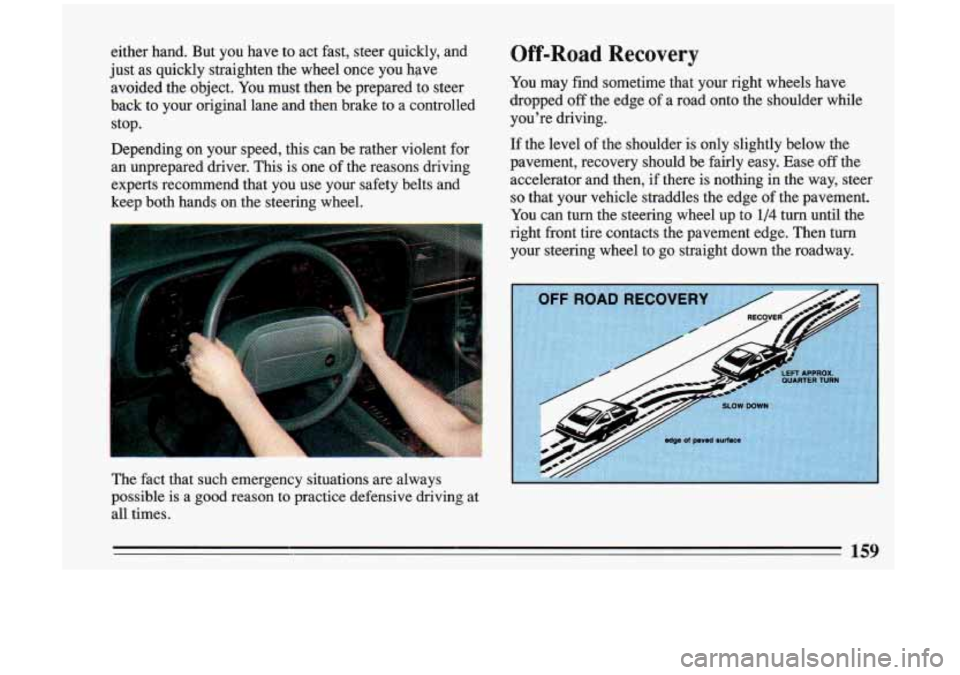
You may find sometime that your right wheels have
dropped
off the edge of a road onto the shoulder while
you’re driving.
If the level of the shoulder is only slightly below the
pavement, recovery should be fairly easy. Ease
off the
accelerator and then, if there is nothing in the way, steer
so that your vehicle straddles the edge of the pavement.
You can turn the steering wheel
up to 1/4 turn until the
right front tire contacts the pavement edge. Then turn
your steering wheel to
go straight down the roadway.
159
Page 250 of 324
Buying New .Tires
To find out what kind and size of tires you need, look at
:the Tire-Loading Information label.
The tires installed on your vehicle when it was new had
a Tire Performance Criteria Specification (TPC Spec)
number on each tire’s sidewall. When you get new tires,
:get ones with that same TPC Spec number. That way,
*your vehicle will continue to have tires that are designed
to give proper endurance, handling, speed rating,
traction, ride and other things during normal service on
your vehicle. If your tires have an all-season tread
design, the TPC number will be followed by a
“MS’,
(for mud and snow).
;If you ever replace your tires with those not having a
!.TPC Spec number, make sure they are the same size,
load rdnge, speed rating and construction type (bias,
bias-belted or radial) as your original tires.
, A CAUTION:
Mixing tires could cause you to lose control
while driving.
If you mix tires of different sizes
or types (radial and ‘bias-belted tires), the
1 vehicle may not handle properly, and you cou’ ’
have a crash. Be sure to use the same size ana
type tires on all four wheels.
It’s
all right to drive with your compact spa
though. It was developed for use
on your
vehicle.
~1
Uniform Tire Quality Grading
The following information relates to the system
developed by the United States National Highway
Traffic Safety Administration which grades tires by
treadwear, traction and temperature performance. (This
applies only to vehicles~ sold.in the United States.)
Treadwear
The treadwear grade is a comparative rating based on
the wear rate of the tire when tested under controlled
conditions on a specified government test course. For
example, a tire graded
150 would wear one and a half
248
Page 258 of 324
Care of Safety Belts
Keep belts clean and dry.
A CAUTION:
Do not bleach or dye safety belts. If you do, it
may severely weaken them. In a crash they
might not be able to provide adequate
protection. Clean safety belts only with mild
soap and lukewarm water.
Glass
Glass should be cleaned often. GM Glass Cleaner (GM
Part
No. 1050427) or a liquid household glass cleaner
will remove normal tobacco smoke and dust films.
Don’t use abrasive cleaners on glass, because they may
cause scratches. Avoid placing decals on the inside rear
window, since they may have to be scraped
off later. If
abrasive cleaners are used on the inside of the rear
window, an electric defogger element may be damaged.
Any temporary license should not be attached across the
defogger grid.
I
Cleaning the Outside of the
Windshield and Wiper Blades
If the windshield is not clear after using the windshield
washer, or if the wiper blade chatters when running, wax
or other material may be on the blade or windshield.
Clean the outside
of the windshield with GM
Windshield Cleaner, Bon-Ami Powders (GM Part
No.
105001 1). The windshield is clean if beads do not form
when you rinse it with water.
Clean the blade by wiping vigorously with a cloth
soaked in full strength windshield washer solvent. Then
rinse the blade with water.
Wiper blades should be checked on a regular basis and
replaced when worn.
Cleaning the Outside of Your Buick
The paint finish on your vehicle provides beauty, depth
of color, gloss retention and durability.
Washing Your Vehicle
The best way to preserve your vehicle’s finish is to keep
it clean by washing it often with lukewarm or cold
water.
Page 276 of 324
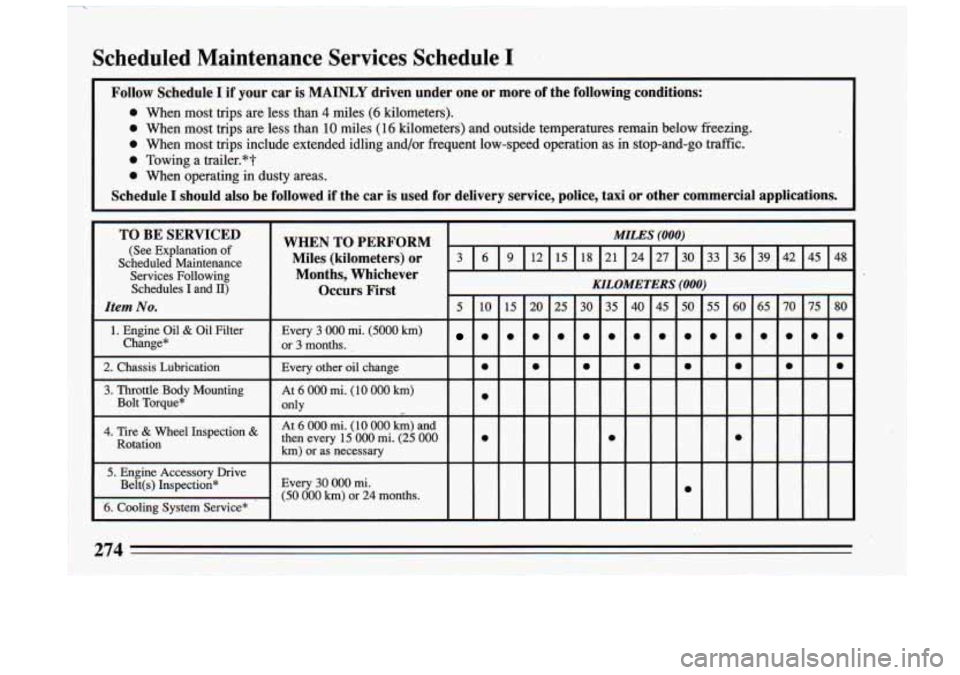
Scheduled Maintenance Services Schedule I
Follow Schedule I if your car is MAINLY driven under one or more of the following conditions:
0 When most trips are less than 4 miles (6 kilometers).
0 When most trips are less than 10 miles (16 kilometers) and outside temperatures remain below fieezing.
0 When most trips include extended idling and/or frequent low-spee\
d operation as in stop-and-go traffic.
0 Towing a trailer.*?
0 When operating in dusty areas.
Schedule I should also be followed if the car is used for delivery service, police, taxi or other commercial applications.
TO BE SERVICED
(See Explanation of
Scheduled Maintenance
Services Following
Schedules
I and n)
Item No.
1. Engine Oil & Oil Filter
Change*
2. Chassis Lubrication
3. Throttle Body Mounting
Bolt Torque*
4. Tire
& Wheel Inspection &
Rotation
5. Engine Accessory Drive Belt(s) Inspection*
6. Cooling System Service*
WHEN TO PERFORM
Miles (kilometers) or Months, Whichever MILES (000)
Occurs First
k
Every 3 000 mi. (5000 km)
or 3 months. , I
Every other oil change
At
6 000 mi. (10 000 km)
only
I
At 6 000 mi. (10 000 km) and
then every
15 000 mi. (25 000
km) or as necessary I
Every 30 000 mi.
(50 000 km) or 24 months.
KILOMETERS (000)
30 35
00
0
0
..
45 50 55
000
0
0
65 70
00
0
274
Page 278 of 324
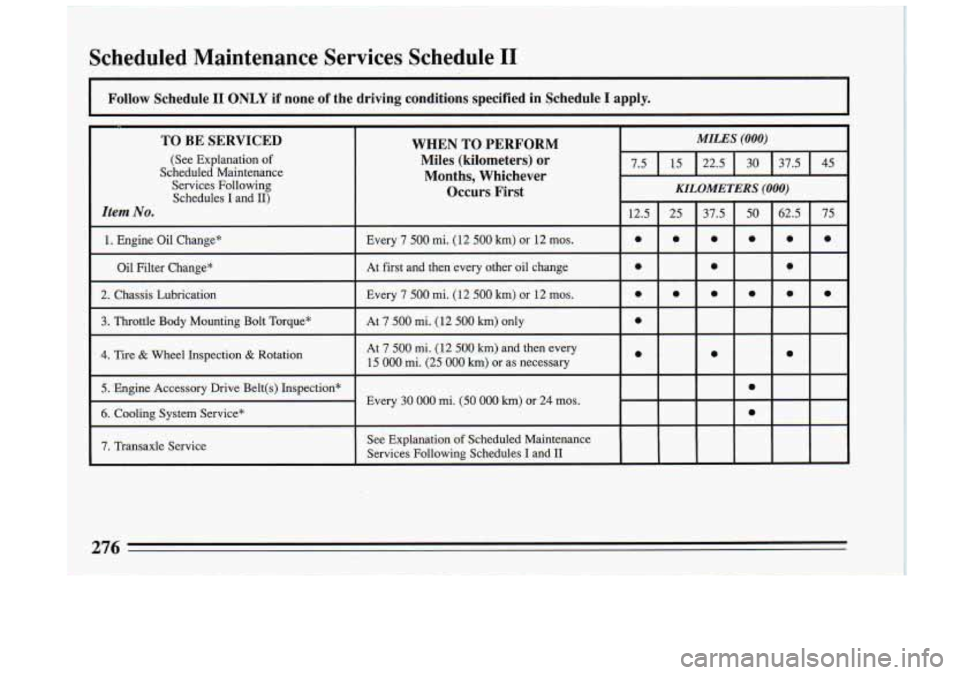
~ Scheduled Maintenance Services Schedule I1
~
~ .
I
Follow Schedule
I1 ONLY if none of the driving conditions specified in Schedule I apply.
TO BE SERVICED
(See Explanation of
Scheduled Maintenance Services Following Schedules
I and II)
Item No.
1. Engine Oil Change*
Oil Filter Change*
2. Chassis Lubrication
3. Throttle Body Mounting Bolt Torque*
4. Tire & Wheel Inspection & Rotation
5. .Engine Accessory Drive Belt(s) Inspection*
6. Cooling System Service*
7. Transaxle Service
WHEN TO PERFORM
Miles (kilometers) or
7.5
Months, Whichever Occurs First
12.5
Every
7 500 mi. (12 500 km) or 12 mos. 0
At first and then every other oil change 0
Every 7 500 mi. (12 500 km) or 12 mos. 0
At 7 500 mi. (12 500 km) only 0
At 7 500 mi. (12 500 km) and then every
15
000 mi. (25 000 km) or as necessary 0
Every 30 000 mi. (50 000 km) or 24 mos.
See Explanation of Scheduled Maintenance
Services Following Schedules
I and I1
MILES (000)
KILOMETERS (000)
276 -
Page 299 of 324
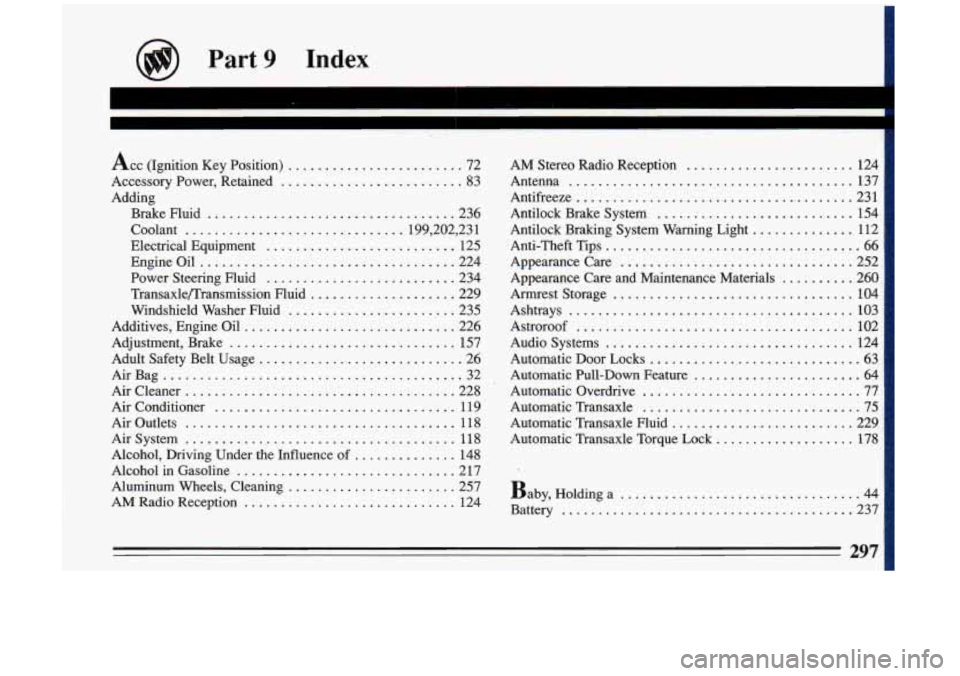
Part 9 Index
I
I
Acc (Ignition Key Position) ........................ 72
Accessory Power. Retained
......................... 83
Adding Brake Fluid
.................................. 236
Coolant
.............................. 199.202. 23 1
Electrical Equipment
.......................... 125
Power Steering Fluid
.......................... 234
Transaxle/Transmission Fluid
.................... 229
Windshield Washer Fluid
....................... 235
Additives. Engine Oil
............................. 226
Adjustment. Brake
............................... 157
Adult Safety Belt Usage
............................ 26
AirBag
......................................... 32
Aircleaner
..................................... 228
Airconditioner
................................. 119
Airoutlets
..................................... 118
Airsystem
..................................... 118
Alcohol. Driving Under the Influence of
.............. 148
Alcohol in Gasoline
.............................. 2 17
Aluminum Wheels. Cleaning
....................... 257
AM Radio Reception
............................. 124
Engineoil
................................... 224
. ..
K . . B
AM Stereo Radio Reception ....................... 124
Antenna
....................................... 137
Antifreeze
...................................... 231
Antilock Brake System
........................... 154
Anti-Theft Tips
................................... 66
Appearance Care
................................ 252
Armrest Storage
................................. 104
Astroroof
...................................... 102
Audio Systems
.................................. 124
Automatic Door Locks
............................. 63
Automatic Pull-Down Feature
....................... 64
Automatic Overdrive
.............................. 77
Automatic Transaxle
.............................. 75
Automatic Transaxle Fluid
......................... 229
Automatic Transaxle Torque Lock
................... 178
Antilock Braking System Warning Light
.............. 112
Appearance Care and Maintenance Materials
.......... 260
Ashtrays
....................................... 103
Baby. Holding a
................................. 44
Battery
........................................ 237