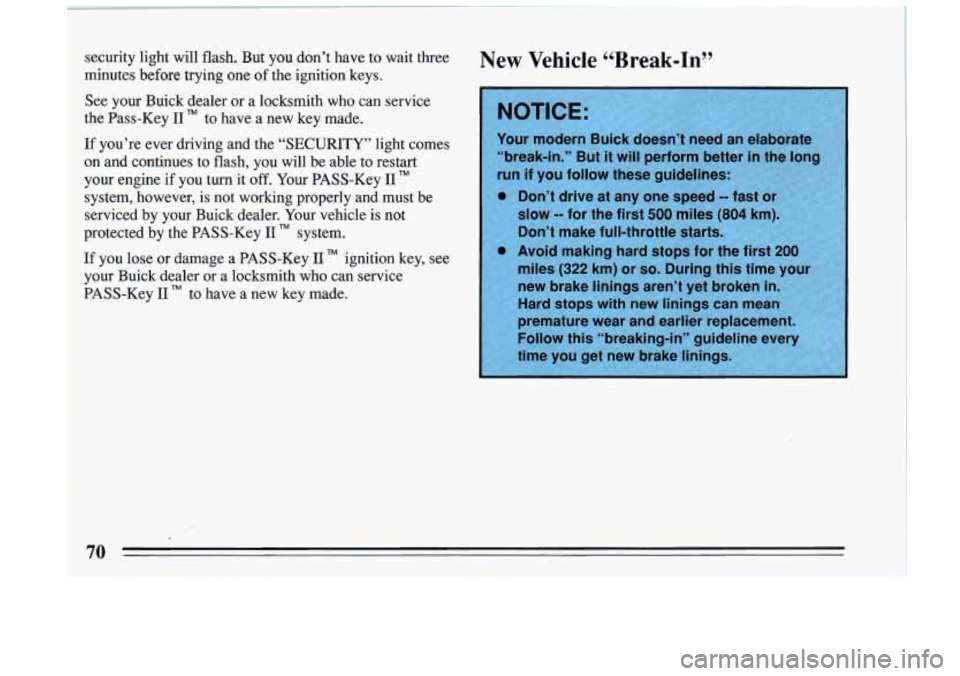
Page 69 of 324
Parking at Night: Park in a lighted spot, close all
windows and lock your vehicle. Remember to keep your
valuables out of sight. Put them in a storage area, or take
them with you.
Parking Lots: If
you park in a lot where someone will be
watching your vehicle, it’s best to lock it up and take
your keys. But what if you have to leave your ignition
key? What if you have to leave something valuable in
your vehicle?
0
0
0
0
Put your valuables in a storage area, like your trunk
or glove box.
Lock the glove box.
Lock all the doors except the driver’s.
Then take the door key with you.
Universal Theft Deterrent (Option)
If your Buick has this option, it has a theft deterrent
alarm system. With this system, the “SECURITY” light
will flash as you open the door (if your ignition is
off).
This light reminds you to arm the theft deterrent system.
Here’s how to do it:
1.
2.
3.
Open the door.
Lock the door with the power door lock switch or
Remote Keyless Entry System. The “SECURITY”
light should come on and stay on.
Close all doors. The “SECURITY” light ‘should go
off.
If a door or the trunk is opened without the key or
Remote Keyless Entry System the alarm will go off. It
will also go off
if a door lock or the trunk lock is
damaged. Your vehicle’s lights will flash and the horn
will sound for several minutes, then will go
off to save
battery power.
Remember, the theft deterrent system won’t arm if you lock the doors with a key or manual door lock. It arms
only
if you use a power door lock switch or Remote
Keyless Entry System. You should also remember that
you can start your vehicle with the correct ignition key
67
Page 71 of 324
PASS-Key I1 TM
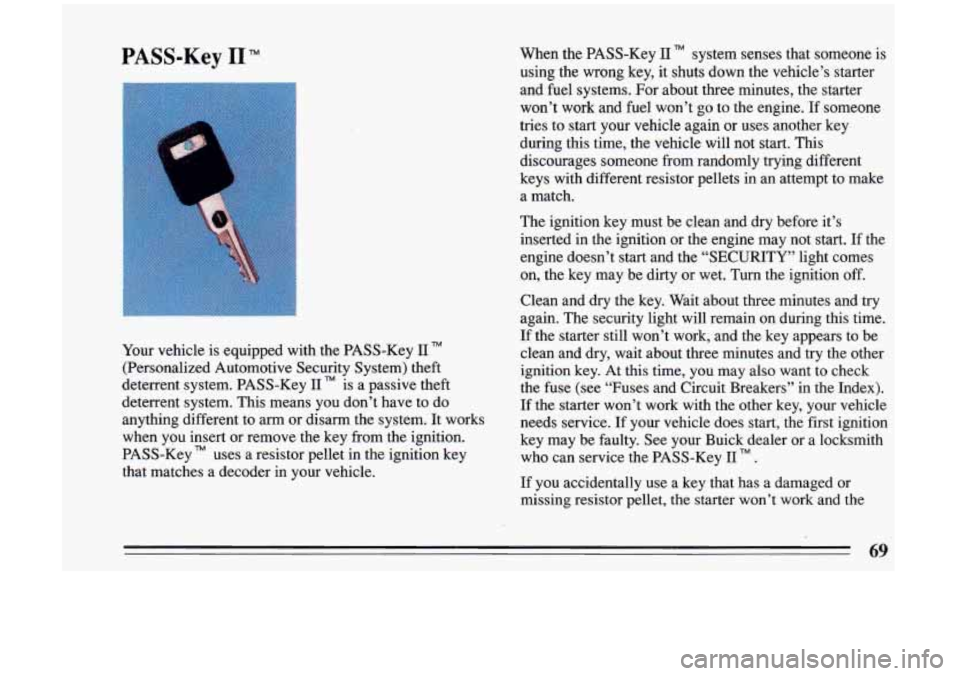
Your vehicle is equipped with the PASS-Key I1
(Personalized Automotive Security System) theft
deterrent system. PASS-Key
11 TM is a passive theft
deterrent system. This means you don’t have to do
anything different to arm or disarm the system. It works when you insert or remove the key from the ignition.
PASS-Key
TM uses a resistor pellet in the ignition key
that matches a decoder in your vehicle. When
the PASS-Key
I1 TM system senses that someone is
using the wrong key, it shuts down the vehicle’s starter
and fuel systems. For about three minutes, the starter
won’t work and fuel won’t
go to the engine. If someone
tries to start your vehicle again or uses another key during this time, the vehicle will not start. This
discourages someone Erom randomly trying different
keys with different resistor pellets in an attempt to make
a match.
The ignition key must be clean and dry before it’s
inserted in the ignition or the engine may not start. If the
engine doesn’t start and the “SECURITY” light comes
on, the key may be dirty or wet. Turn the ignition
off.
Clean and dry the key. Wait about three minutes and try
again. The security light will remain on during this time. If the starter still won’t work, and the key appears to be
clean and dry, wait about three minutes and try the other
ignition key. At this time, you may also want
to check
the fuse (see “Fuses and Circuit Breakers” in the Index).
If the starter won’t work with the other key, your vehicle
needs service. If your vehicle does start, the first ignition
key may be faulty. See your Buick dealer or
a locksmith
who can service the PASS-Key I1
.
If you accidentally use a key that has a damaged or
missing resistor pellet, the starter won’t work and the
69
Page 72 of 324
Se6urity light will flash. But you don’t have to wait three
minutes before trying one
of the ignition keys.
See
your Buick dealer or a locksmith who can service
the Pass-Key
11 TM to have a new key made.
If you’re ever driving and the “SECURITY” light comes on and continues to flash,
you will be able to restart
your engine if
you turn it off. Your PASS-Key 11 TM
system, however, is not working properly and must be
serviced by your Buick dealer. Your vehicle is not
protected
by the PASS-Key 11 system.
If you lose
or damage a PASS-Key 11 ignition key, see
your Buick dealer or a locksmith who can service
PASS-Key I1
TM to have a new key made.
70
Page 80 of 324
1 (First Gear) Parking Brake
This position gives you even more power (but lower
fuel economy) than
“2.” You can use it on very steep
hills, or in deep snow or mud. If the selector lever is
put in
“1,” the transaxle won’t shift into first gear
until the vehicle is going slowly enough.
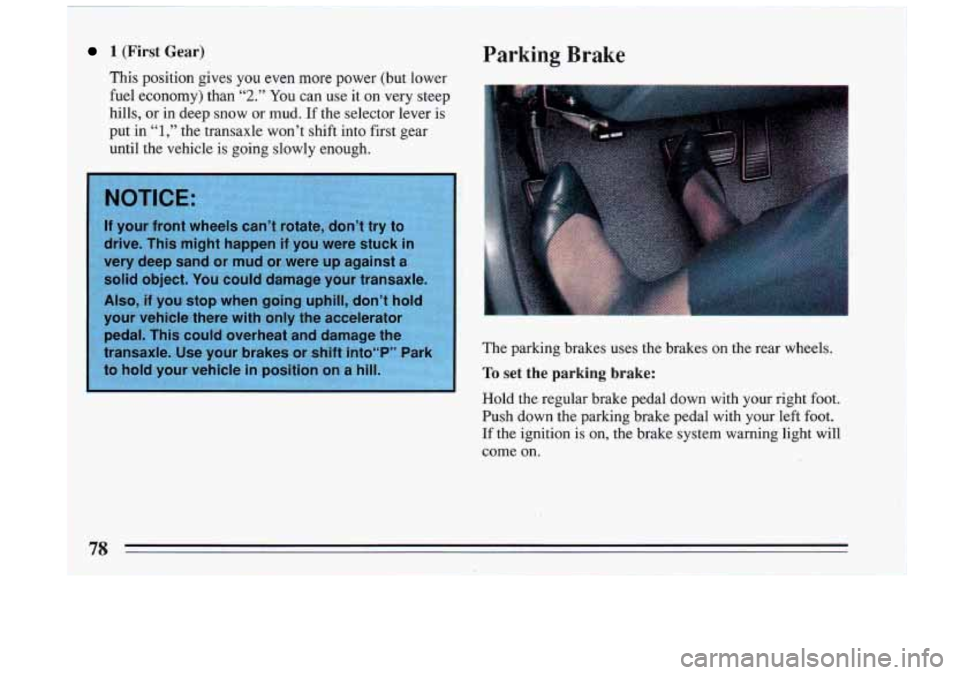
The parking brakes uses the brakes on the rear wheels.
To set the parking brake:
Hold the regular brake pedal down with your right foot.
Push down the parking brake pedal with your left foot.
If the ignition is on, the brake system warning light will
come on.
Page 87 of 324
1Ai
The Turn SignallHeadlight Beam
Lever nrn Signal and Lane Change Indicator
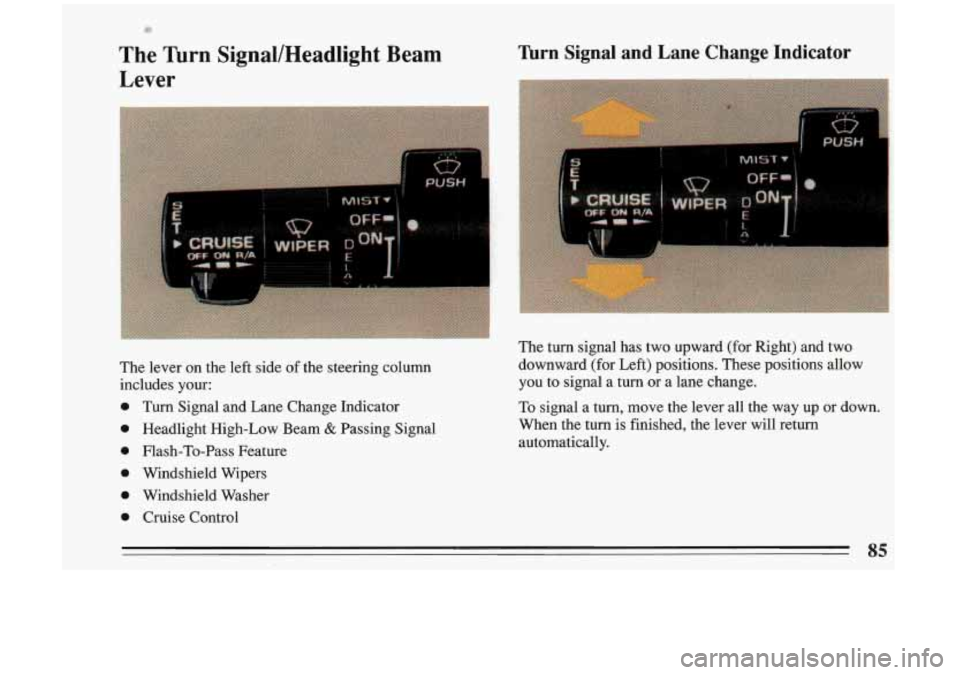
The lever an the left side of the steering column
includes
your:
0 Turn Signal and Lane Change Indicator
0 Headlight High-Low Beam & Passing Signal.
0 Flash-To-Pass Feature
6 Windshield Wipers
0 Windshield Washer
0 Cruise Control The turn signal has two upward (for Right) and two
downward (for Left) positions. These positions allow
you to signal a turn or a lane change.
To signal a turn, move the lever all the way up or down.
When the turn is finished, the lever will return
automatically.
85
Page 88 of 324
L
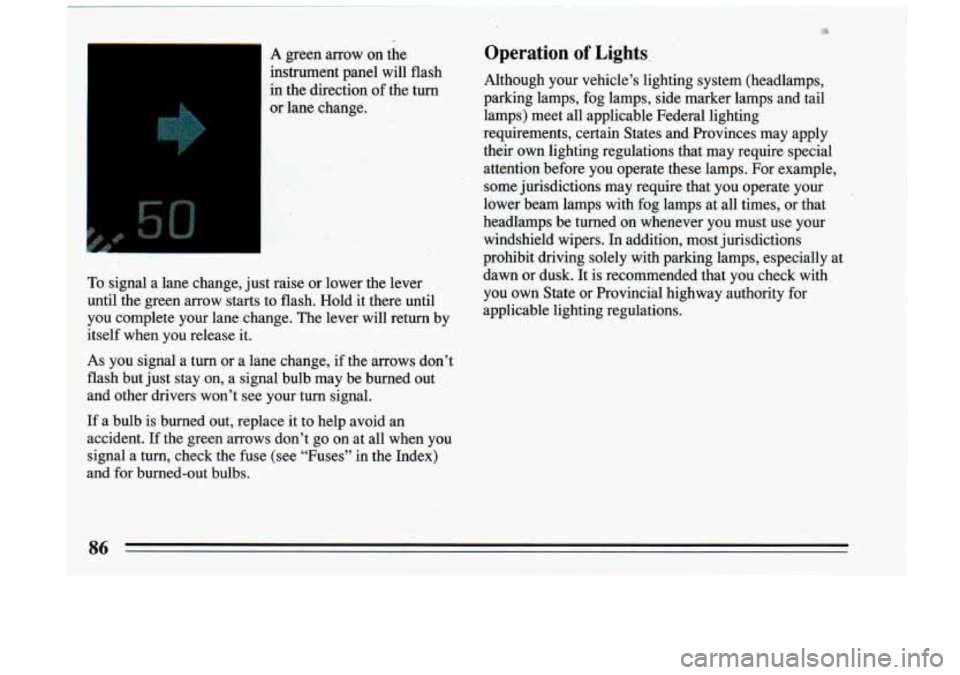
in the direciion of the turn
or lane change.
To signal a lane change, just raise or lower
the lever
until the green arrow starts to flash. Hold it there until
you complete your lane change. The lever will return by
itself when you release it.
As you signal a turn or a lane change, if the arrows don’t
flash but just stay on, a signal bulb may be burned out
‘and other drivers won’t see your turn signal.
Operation of Lights.
Although your vehicle’s lighting system (headlamps,
parking lamps, fog lamps, side marker lamps and tail
lamps) meet all applicable Federal lighting
requirements, certain States and Rovinces may apply
their
own lighting regulations that may require special
attention before you operate these lamps. For example,
some jurisdictions may require that you operate your
lower beam lamps with fog lamps at all times, or that
headlamps be turned on whenever you must use your
windshield wipers. In addition, most jurisdictions
prohibit driving solely with parking lamps, especially at
dawn or dusk. It is recommended that you check with you own State or Provincial highway authority
for
applicable lighting regulations.
1
If a bulb is burned out, replace it to help avoid an
accident.
If the green arrows don’t go on at all when you
signal a turn, check the fuse (see “Fuses” in the Index)
hnd-fQr bumed-Qvt bulbs. i
3
Page 89 of 324
Headlight High-Low Beam
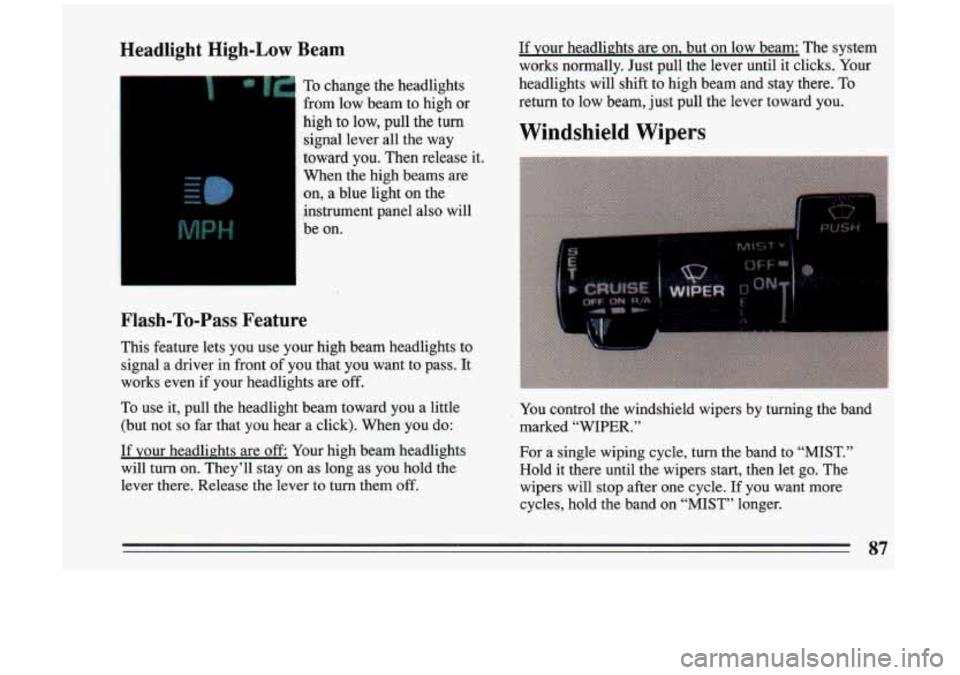
To change the headlights
from low beam to high or
high to low, pull the turn signal lever all the way
toward
you. Then release it.
When the high beams are
on, a blue light on the
instrument panel also will
be on.
If your headlights are on, but on low beam: The system
works normally. Just pull the lever until it clicks. Your
headlights will shift to high beam and stay there. To
return to low beam, just pull the lever toward you.
Windshield Wipers
Flash-To-Pass Feature
This feature lets you use your high beam headlights to
signal a driver in front of you that
you want to pass. It
works even if your headlights are
off.
To use it, pull the headlight beam toward you a little
(but not
so far that you hear a click). When you do:
If your headlights are off Your high beam headlights
will
turn on. They’ll stay on as long as you hold the
lever there. Release the lever to turn them
off.
.
. . . ~
You control the windshield wipers by turning the band
marked “WIPER.”
For a single wiping cycle, turn the band to
“MIST.”
Hold it there until the wipers start, then let go. The
wipers will stop after one cycle. If
you want more
cycles, hold the band on
“MIST” longer.
87
Page 90 of 324
You can set the wiper speed for a long or short delay
between wipes. This can be very useful
in light rain or
snow. Turn the
band to choose the delay time. The
closer to
“LO,” the shorter the delay.
For steady wiping at low speed,
turn the band away
from
you to the “LO” position. For high speed wiping,
turn the band further, to “HI.” To stop the wipers, move
$he band to
“OFF.”
A CAUTION:
Damaged wiper blades may prevent you fro!..
seeing well enough to drive safely.
To avoid
damage, be sure to clear ice and snow from the
wiper blades before using them.
If they’re
frozen to the windshield, carefully loosen or
I
thaw them. If your blades do become damaged,
get new blades or blade inserts.
Heavy snow or ice can overload your wipers. A circuit
breaker will stop them until the motor cools. Clear away
,snow or ice to prevent an overload.
Windshield Washer
At the top of the multifunction lever there’s a paddle
with the word
“PUSH” on it. To spray washer fluid on
the windshield, just push the paddle for less than a
second. The washer will spray several times, then stop.
Unless they are already turned on, the wipers will
operate at low speed for several sweeps, then turn
off.
To get more fluid on the windshield, push and .hold the
paddle. Spraying will continue as long as the paddle is
held.
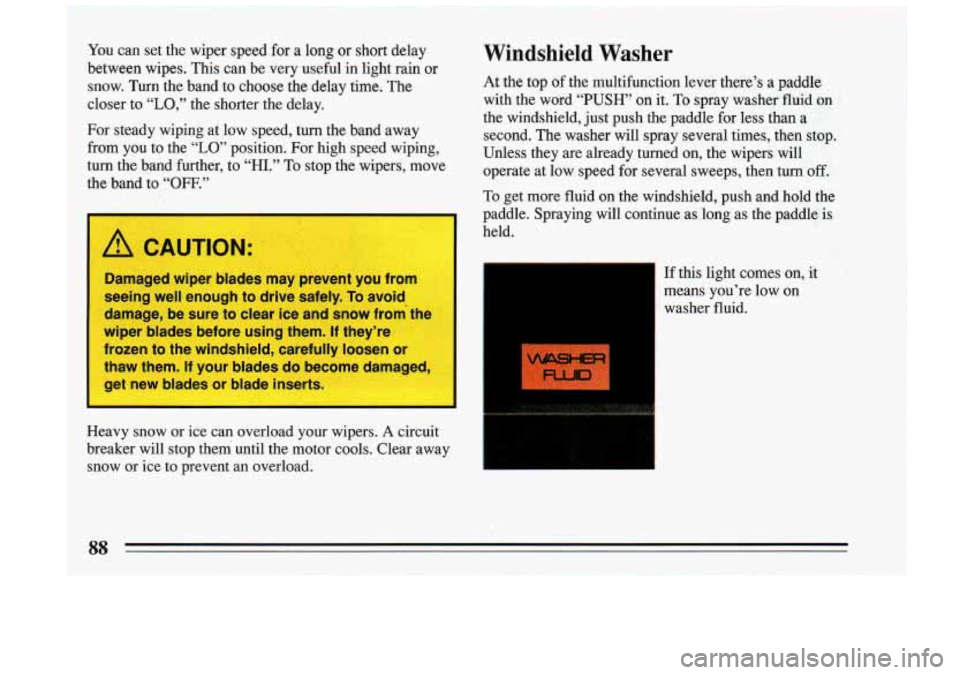
If this light comes on, it
means you’re low on
I washer fluid.
m