Page 220 of 324
I
Gasolines for Cleaner Air
Your use of gasoline with detergent additives will help
prevent deposits from forming in your engine and fuel
system. That helps keep your engine in tune and your
emission control system working properly. It’s good €or
your vehicle, and you’ll be doing your part for cleaner
air.
Many gasolines are now blended with materials called oxygenates. General Motors recommends that you use
gasolines with these blending materials, such as MTBE
and ethanol. By doing
so, you can help clean the air,
especially in those parts
of the country that have high
carbon monoxide levels.
In addition, some gasoline suppliers are now producing
reformulated gasolines. These gasolines are specially
designed to reduce vehicle emissions. General Motors
recommends that you use reformulated gasoline. By
doing
so, you can help clean the air, especially in those
parts of the country that have high Ozone levels.
You should ask your service station operators if their
gasolines contain detergents and oxygenates, and if they
have been reformulated
to reduce vehicle emissions.
Fuels in Foreign Countries
If you plan on driving in another country outside the
U.S. or Canada, unleaded fuel may be hard to find. Do
not use leaded gasoline. If you use even one tankful,
your emission controls won’t work well or at all. With
continuous use, spark plugs can get fouled, the exhaust system can corrode, and your engine oil can deteriorate
quickly. Your vehicle’s oxygen sensor will be damaged.
All of that means costly repairs that wouldn’t be covered
by your warranty.
To check on fuel availability, ask an auto club, or
contact a major oil company that does business in the
country where you’ll be driving.
You can also write us at the following address for
advice. Just tell us where you’re going and give your
Vehicle Identification Number
(VIN).
General Motors of Canada Ltd.
International Export Sales
P.O. Box 828
Oshawa, Ontario L1H 7N1, Canada
218
Page 226 of 324
Engine Oil
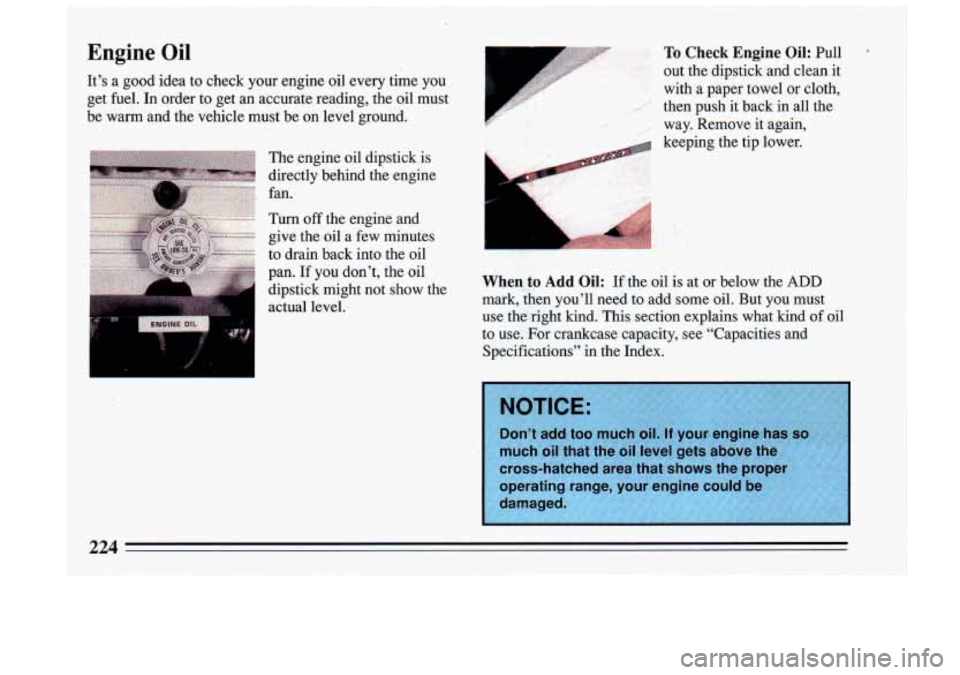
It’s a good idea to check your engine oil every time you
get fuel.
In order to get an accurate reading, the oil must
be warm and the vehicle must be on level ground.
The engine
oil dipstick.is
directly behind the engine
fan..
Turn off the engine and
give the oil a
few minutes
to drain back into the oil
pan.
If you don’t, the oil
dipstick might not show the
actual level.
To Check Engine Oil: Pull ’
1 out the dipstick and clean it
with a paper towel or cloth,
I.ii’ ” then push it back in all the
.. , way. Remove it again,
When to Add Oil: If the oil is at or below the ADD
mark, then you’ll need to add some oil. But you must
use tlwright kind. This section explains what kind
of oil
to use. For crankcase capacity, see “Capacities and
Specifications”
in the Index.
Page 231 of 324
Automatic Transaxle Fluid
When to Check and Change:
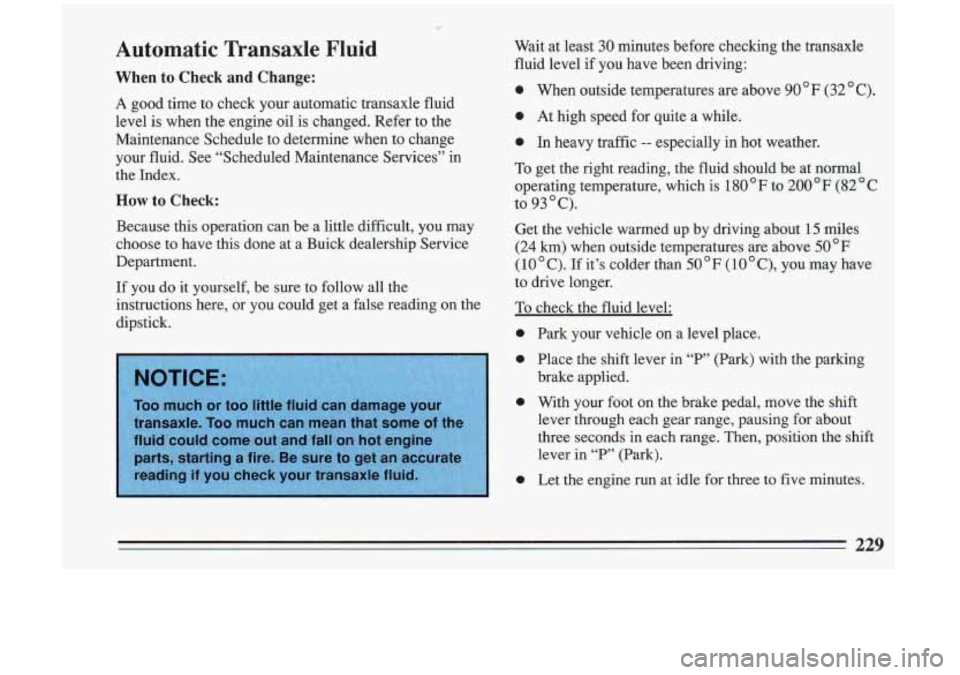
A good time to check your automatic transaxle fluid
level is when the engine oil is changed. Refer to the
Maintenance Schedule to determine when
to change
your fluid. See “Scheduled Maintenance Services” in
the Index.
How to Check:
Because this operation can be a little difficult, you may
choose to have this done at a Buick dealership Service
Department.
If you do it yourself, be sure to follow all the
instructions here, or you could get a false reading on the
dipstick.
Page 232 of 324
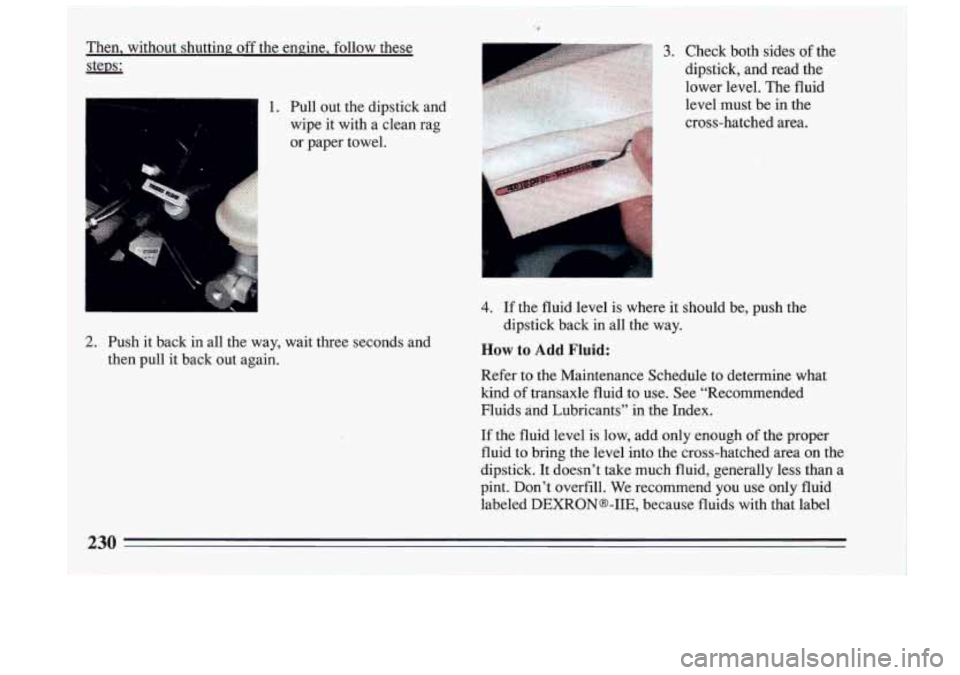
Then, without shutting off the engine, follow these
stem:
1. Pull out the dipstick and
wipe it with a clean rag
or paper towel.
2. Push it ‘back in aa the way, wait three seconds and
I :then pull it back out again.
3. Check both sides ofthe
dipstick, and read the
lower level. The fluid
level must be
.in the
cross-hatched
mea.
P
4. If the fluid level is where it should be, push the
How to Add Fluid:
dipstick back in all the way.
Refer
to the Maintenance Schedule to determine what
kind of transaxle fluid to
use. See “Recommended
Fluids and Lubricants” in the Index.
If the- fluid level is low, add only enough of the proper
fluid
to bring the level into the cross-hatched area on the
dipstick. It doesn’t take much fluid, generally less than a \
pint. D,on’t overfill. We recommend you use only fluid
labeled DEXRONB-IIE, because fluids with that label
230
I
Page 233 of 324
are made especially for your automatic transaxle.
Damage caused by fluid other than
DEXRONs-IIE is
not covered by your new vehicle warranty.
After adding fluid, recheck the fluid level as
described under
“How to Check.”
When the correct fluid level is obtained, push the
dipstick back in all the way.
Engine Coolant
The following explains your cooling system and how to
add coolant when it is low. If you have a problem with
engine overheating, see “Engine Overheating” in the
Index.
The proper coolant for your Buick
will:
Give freezing protection down to -34’F (-37 ’ C) .
0 Give boiling protection up to 262 ’ F ( 128 ’ C) .
Protect against rust and corrosion.
Help keep the proper engine temperature.
0 Let the warning lights work as they should.
What to Use:
Use a mixture of one-half clean water (preferably
distilled) and one-half antifreeze that meets “GM Specification 1825-M,” which won’t damage aluminum
parts. Use GM Engine Coolant Supplement (sealer) with
any complete coolant change. You can also use a
recycled coolant conforming to “GM Specifications
1825-M” with a complete coolant flush and-refill.
If you
use these, you don’t need to add anything else.
Adding only plain water to your cooling system
can be dangerous. Plain water, or some other
liquid like alcohol, can boil before the proper
coolant mix will. Your vehicle’s coolant warnin!
system
is set for the proper coolant mix. With
plain water or the wrong mix, your engine coul
get
too hot but you wouldn’t get the overheat
warning. Your engine could catch fire and you
or others could be burned. Use a
50150 mix of
clean water and
a proper antifreeze.
231
Page 234 of 324
Adding Coolant
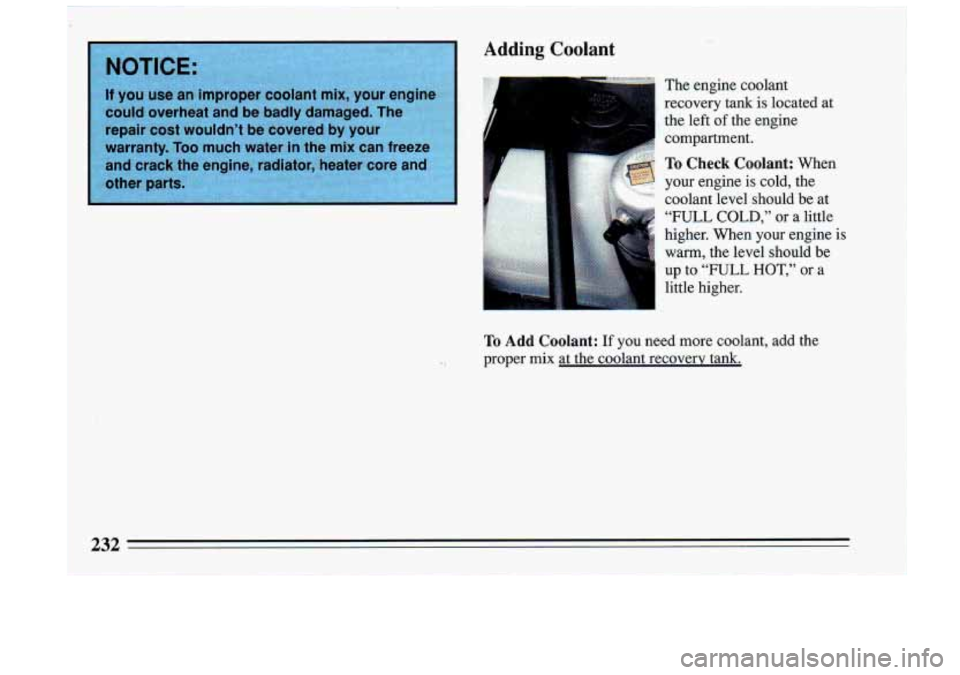
The engine coolant
recovery tank is located at
the left
of the engine
compartment.
To Check Coolant: When
your engine is cold, the
coolant level should be at
“FULL COLD,” or a little
higher. When your engine
is
warm, the level should be
up to
“FULL HOT,” or a
little higher.
To Add Coolant: If you need more coolant, add the
proper mix at the coolant recovery
tank.
232
Page 236 of 324
i Power Steering Fluid I
What to Add:
Refer to the Maintenance Schedule to determine what
kind
of fluid to use. See “Recommended Fluids and
Lubricants”
in the Index.
I
i
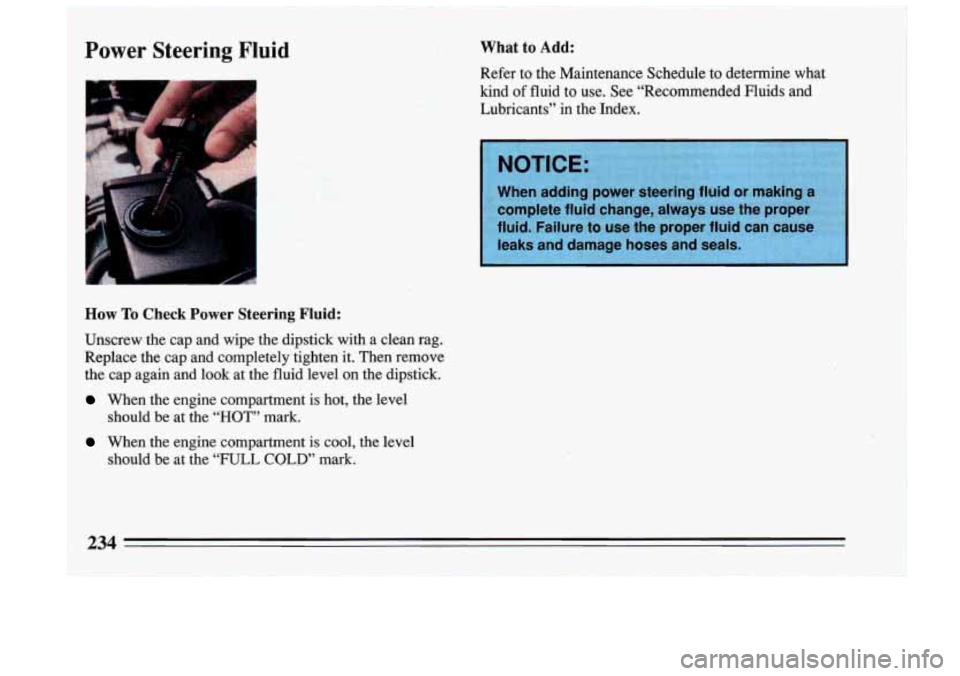
How To Check Power Steering Fluid:
~ Unscrew the cap and wipe the dipstick with a clean rag.
: Replace the cap and completely tighten it. Then remove
~ the cap again and look at the fluid level on the dipstick.
When the engine compartment is hot, the level
When the engine compartment is cool, the level should be
at
the “HOT” mark.
should be at the
“FULL COLD” mark.
I
Page 272 of 324
IMPORTANT:
KEEP ENGINE OIL
AT THE PROPER
LEVEL AND CHANGE AS
RECOMMENDED
This part covers the maintenance required for your Buick. Your vehicle needs these services to retain its
safety, dependability and emission control performance.
Plan
Have you purchased the GM Protection Plan? The
Plan supplements your new vehicle warranties. See
your Buick dealer for details.
Introduction
A Word About Maintenance
We at General Motors want to help you keep your
vehicle in good working condition. But we don't know
exactly how you'll drive it. You may drive very short
distances only a few times a week.
Or you may drive
long distances all the time in very hot, dusty weather.
You may use your vehicle in making deliveries. Or you
may drive it to work, to do errands or in many other
ways.
Because of all the different ways people use their GM
vehicles, maintenance needs vary. You may even need
more frequent checks and replacements than you
will
find in the schedules in this part. So please read this part
and note how you drive.
If you have any questions on
how to keep your vehicle in good condition, see your Buick dealer, the place many GM owners choose to
have their maintenance work done. Your dealer can be
relied upon to use proper parts and practices.