1993 BUICK REGAL traction control
[x] Cancel search: traction controlPage 88 of 308
Cruise Control (Option)
I
A CAUTION:
Cruise Control can be dangerous where
you can’t drive safely at
a steady speed.
So, don’t use your Cruise Control on
winding roads or in heavy traffic.
Cruise Control can be dangerous on
slippery roads. On such roads, fast
changes in tire traction can cause needless
wheel spinning, and you could lose
control. Don’t use Cruise Control
on
slippery roads.
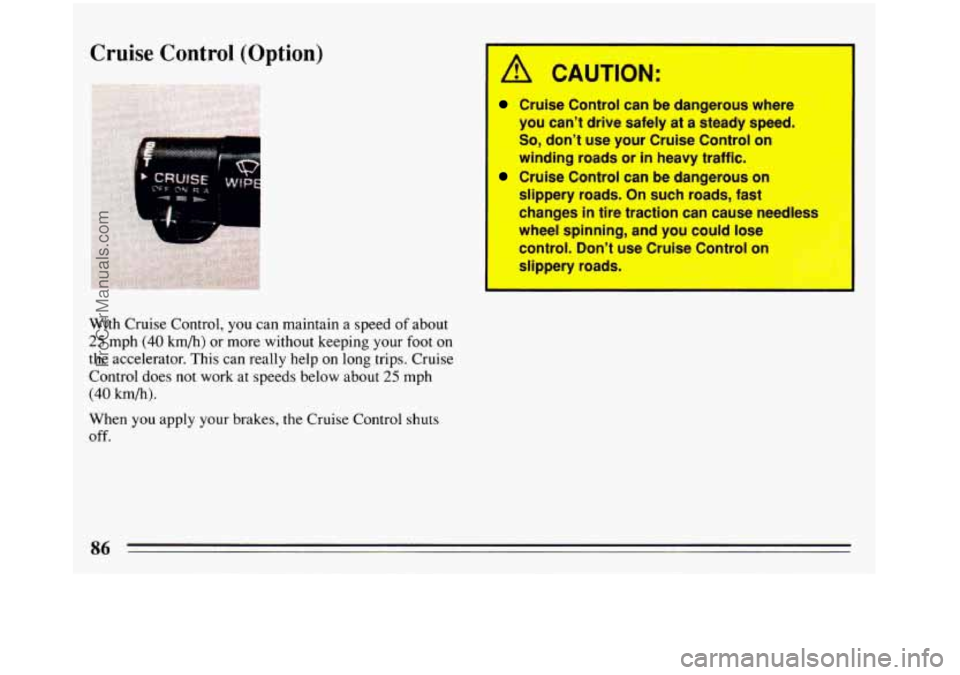
With Cruise Control, you can maintain a speed of about
25 mph (40 km/h) or more without keeping your foot on
the accelerator. This can really help on long trips. Cruise
Control
does not work at speeds below about 25 mph
(40 h/h).
When you apply your brakes, the Cruise Control shuts
off.
86
ProCarManuals.com
Page 146 of 308
That could be off the road, into the very thing you were
trying to avoid,
or into traffic.
If you don’t have anti-lock, use
a “squeeze” braking
technique. This will give
you maximum braking while
maintaining steering control. You do this by pushing on
the brake pedal with steadily increasing pressure.
In an emergency
you will probably want to “squeeze”
the brakes hard without locking the wheels. If you hear
or feel the wheels sliding, ease off the brake pedal. This
will help you retain steering control.
(If
you & have anti-lock, it’s different: see Index under
“Anti-lock Brake System.”) In
many emergencies,
steering can help
you more than even the very best
braking.
Steering
Power Steering
If you lose power steering assist because the engine
stops or the system fails to function, you can steer but
it
will take much more effort.
Steering Tips
Driving on Curves
It’s important to take curves at a r8 easonable speed.
A lot of the “driver lost control” accidents mentioned on
the news happen
on curves. Here’s why:
Experienced driver or beginner, each of us is subject to
the same laws of physics when driving on curves. The
traction of the tires against the road surface makes it
possible for the vehicle to change its path when
you turn
the front wheels. If there’s
no traction, inertia will keep
the vehicle going in the same direction. If you’ve ever
tried to steer a vehicle on wet ice,
you’ll understand this.
The traction you can get in a curve depends on the
condition of your tires and the road surface, the angle at
which the curve is banked, and your speed. While
you’re in a curve, speed
is the one factor you can
control.
Suppose you’re steering through
a sharp curve. Then
you suddenly apply the brakes. Both control systems --
steering and braking -- have to do their work where the
tires meet the road. Unless you have four-wheel
anti-lock brakes, adding the hard braking can demand
too much
of those places. You can lose control.
The same thing can happen if you’re steering through a
sharp curve and you suddenly accelerate.
Those two control systems
-- steering and acceleration --
can overwhelm those places where the tires meet the
road and make you lose control.
144
ProCarManuals.com
Page 151 of 308
the accelerator pedal as soon as you feel the vehicle start
to slide. Quickly steer the way you want the vehicle to
go. If you start steering quickly enough, your vehicle
will straighten
out. As it does, straighten the front
wheels.
Of course, traction is reduced when water, snow, ice,
gravel, or other material is on the road. For safety, you’ll
want to slow down and adjust your driving to these
conditions.
It is important to slow down on slippery
surfaces because stopping distance will be longer and
vehicle control more limited.
While driving on a surface with reduced traction, try
your best to avoid sudden steering, acceleration, or
braking (including engine braking
by shifting to a lower
gear). Any sudden changes could cause the tires to slide.
You may not realize the surface is slippery until your
vehicle is skidding. Learn to recognize warning clues
--
such as enough water, ice or packed snow on the road to
make a “mirrored surface” -- and slow down when you
have any doubt.
If you have the anti-lock braking system, remember: It
helps avoid only the braking skid. If you do not have
anti-lock, then in a braking skid (where the wheels are
no longer rolling), release enough pressure on the brakes
to get the wheels rolling again. This restores steering
control. Push the brake pedal down steadily when you have
to stop suddenly.
As long as the wheels are rolling,
you will have steering control. Steer the way you want
to go.
Driving at Night
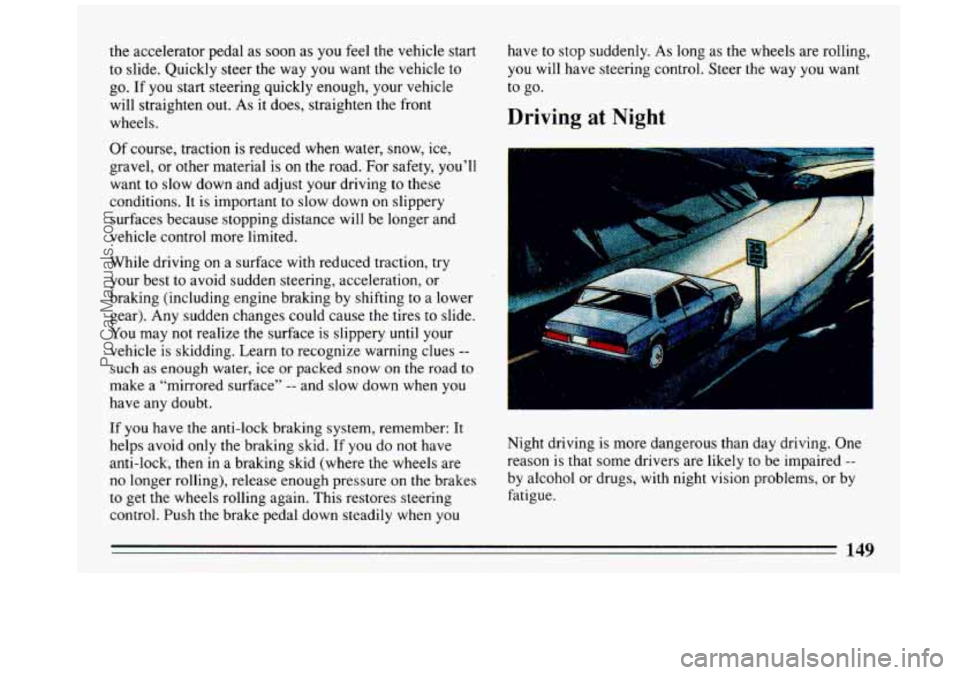
Night driving is more dangerous than day driving. One
reason is that some drivers are likely
to be impaired --
by alcohol or drugs, with night vision problems, or by
fatigue.
149
ProCarManuals.com
Page 246 of 308
0 The tire has a puncture, cut, or other damage that
can’t be repaired well because
of the size or location
of the damage.
Buying New Tires
To find out what kind and size of tires you need, look at
the Tire-Loading Information label.
The tires installed on your vehicle when it was new had
a Tire Performance Criteria Specification (TPC Spec)
number on each tire’s sidewall. When you get new tires,
get ones with that same TPC Spec number. That way,
your vehicle will continue to have tires that are designed
to give proper endurance, handling, speed rating,
traction, ride and other things during normal service on
your vehicle.
If your tires have an all-season tread
design, the TPC number
will be followed by a “MS”
(for mud and snow).
If you ever replace your tires with those not having a
TPC Spec number, make sure they are
the same size,
load range, speed rating and construction type (bias,
bias-belted or radial) as your original tires.
A CA
I Mixing ur
ITION:
coui4 au 1 you IO lose c
while driving. If you m~x tires of different sizes or
types (radial and bias-belted tires), the vehicle
may not handle properly, and you could have a
;k :.
crash. Be sure to use the .LLL same .n size and type ;:L*:..% , T.,-?<’
though. It was developed for limited use on YOUI‘..~
vehicle.
I
Uniform Tire Quality Grading
The following information relates to the system
developed by the United States National Highway
Traffic Safety Administration which grades tires by
treadwear, traction and temperature performance. (This
applies only to vehicles sold in the United States.)
Treadwear
The treadwear grade is a comparative rating based on
the wear rate of the tire when tested under controlled
conditions on a specified government test course. For
example, a tire graded
150 would wear one and a half (1
244
ProCarManuals.com
Page 247 of 308
1/2) times as well on the government course as a tire
graded
100. The relative performance of tires depends
upon the actual conditions of their use, however, and
may depart significantly from the norm due to variations
in driving habits, service practices and differences
in
road characteristics and climate.
Traction - A, B, C
The traction grades, from highest to lowest are: A, B,
and C. They represent the tire’s ability to stop on wet
pavement as measured under controlled conditions on
specified government test surfaces of asphalt and
concrete.
A tire marked C may have poor traction
performance.
Warning: The traction grade assigned to this tire
is based
on braking (straight-ahead) traction tests and does not
include cornering (turning) traction.
Temperature - A, B, C
The temperature grades are A (the highest), B, and C,
representing the tire’s resistance to the generation of
heat and its ability to dissipate heat when tested under
controlled conditions on a specified indoor laboratory
test wheel. Sustained high temperature can cause the
material
of the tire to degenerate and reduce tire life, and
excessive temperature can lead to sudden tire failure. The
grade
C corresponds to a level of performance
which all passenger car tires must meet under the
Federal Motor Vehicle Safety Standard
No. 109. Grades
B and A represent higher levels of performance on the
laboratory test wheel than the minimum required by law.
Warning: The temperature grade for this tire
is
established for a tire that is properly inflated and not
overloaded. Excessive speed, underinflation, or
excessive loading, either separately or
in combination,
can cause heat buildup and possible tire failure.
These grades are molded
on the sidewalls of passenger
car tires.
While the tires available
as standard or optional
equipment
on General Motors vehicles may vary with
respect to these grades, all such tires meet General
Motors performance standards and have been approved
for use on General Motors vehicles. All passenger type
(P Metric) tires must conform to Federal safety
requirements
in addition to these grades.
Wheel Alignment and Tire Balance
The wheels on your vehicle were aligned and balanced
carefully at the factory to give
you the longest tire life
and best overall performance.
245
ProCarManuals.com