Page 219 of 308
Filling Your Tank The cap is behind a hinged door on the left side of your
vehicle.
11ne vapor IS nlghly Tlarnrnao
violently, and that can cause very Dad injuries.
Don’t smoke if you’re near gasoline or refuelin
your vehicle. Keep sparks, flames, (rr4erials away
+rqm ga-line. ~~2;: LMk
While refueling, hang the cap inside the fuel door.
To take off the cap, turn it slowly to the kft
(counterclockwise).
217
ProCarManuals.com
Page 220 of 308
A CAUTION:
If you get gasoline on you and then something
ignites it, you could be badly burned. Gasoline
can spray out on you if you open the fuel filler
cap too quickly, This spray can happen if your
tank is nearly full, and: is more likely in hot
weather. Open the fuel filler cap slowly and wait
for any “hiss” noise to stop. Then unscrew the
cap all the way.
When you put the cap back on, turn it to the right until
you hear a clicking noise.
If you need a new cap, be sure to get the right
type. Your dealer can get one for you.
If you get
the wrong type, it may not fit
or have proper
venting, and your fuel tank and emissions system might be damaged.
Checking Things Under the Hood
Hood Release
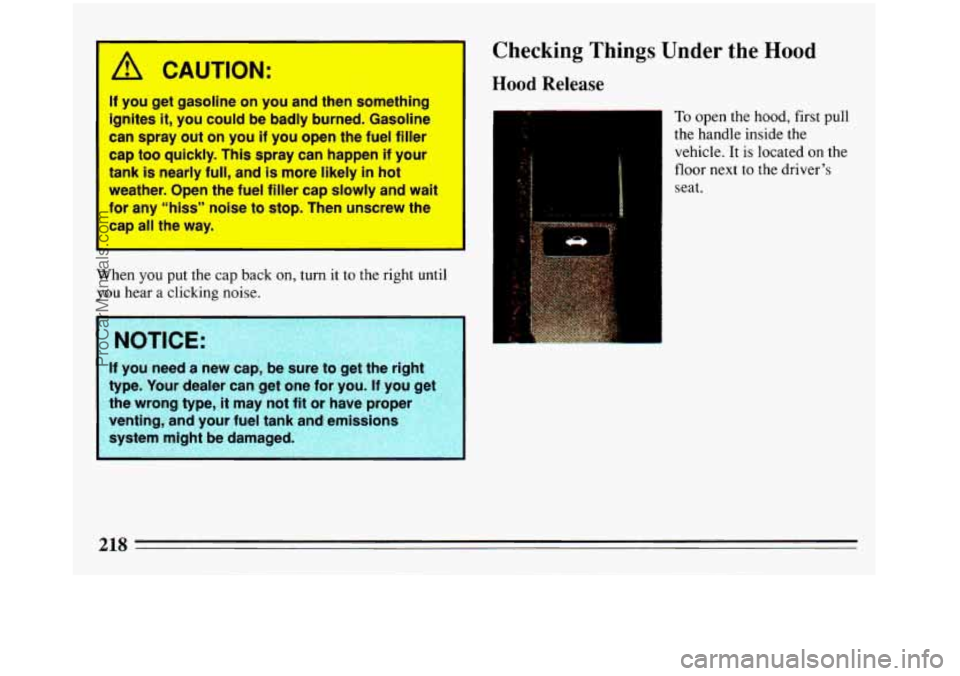
To open the hood, first pull
the handle inside the
vehicle. It is located on the
floor next to the driver’s
seat.
218
.-
ProCarManuals.com
Page 222 of 308
Before closing the hood, be sure all the filler caps are on
properly.
Then just pull the hood down and close it firmly.
Engine Oil
If the “LOW OIL” light on the instrument panel comes
on, it means you need to check your engine oil level
right away.
You should check your engine oil level
regularly, the light
is an added reminder. It’s
a good idea to check your engine oil every time you
get fuel.
In order to get an accurate reading, the oil must
be warm and the vehicle must be
on level ground.
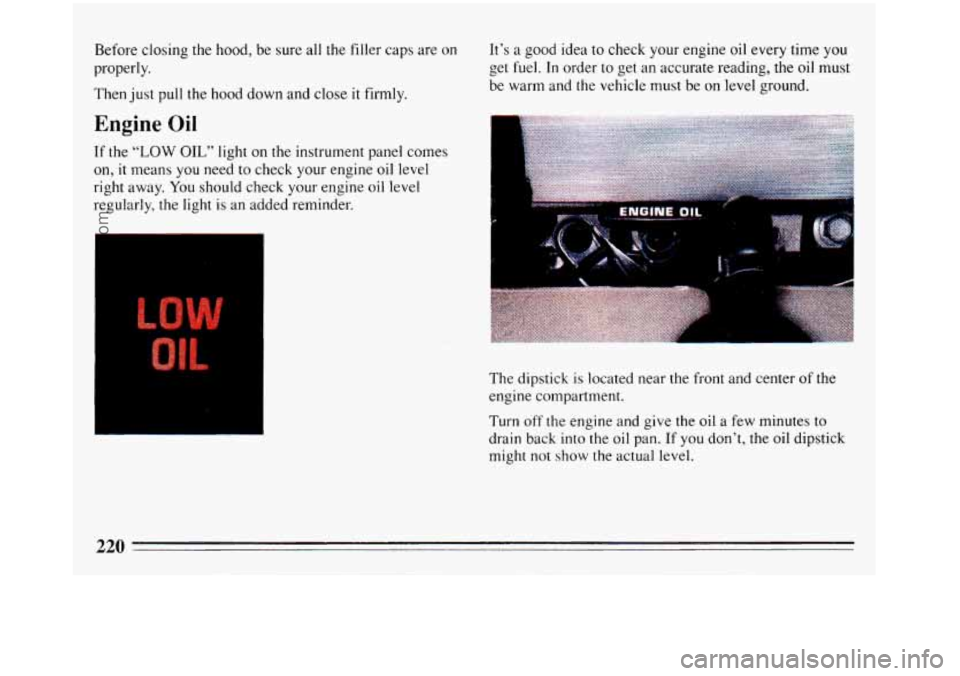
The dipstick is located near the front and center
of the
engine compartment.
Turn
off the engine and give the oil a few minutes to
drain back into the oil pan. If you don’t, the oil dipstick
might not show the actual level.
ProCarManuals.com
Page 225 of 308

RECOMMENDED SAE VISCOSITY GRADE ENGINE OILS
FOR BEST FUEL ECONOMY AND COLD STARTING, SELECT THE LOWEST
SAE VISCOSITY GRADE
OIL FOR THE EXPECTED TEMPERATURE RANGE.
HOT
WEATHER I
"F r
k100 -
+80 -
+60 -
+40 -
+20 -
0-
- +38
- +27
. +16
- +4
- -7
- -18
1
COLD
WEATHER
-- I' -- SA SAE 5W-30 PREFERRED
IF NEITHER SAE 5W-30 NOR SAE 1OW-30 GRADE OILS ARE AVAILABLE, SAE 30 GRADE MAY BE USED AT TEMPERATURES
ABOVE 40 DEGREES F (4 DEGREES C).
ANY OTHER GRADE OIL NOT RECOMMENDED
DO NOT USE SAE 1OW-40, SAE 2OW-50 OR
0 If you have the 3.1L engine use: SAE 5W-30
As shown in the viscosity chart, SAE 5W-30 is best
for your vehicle. However, you can use
SAE 1OW-30
if it's going to be O°F (-18OC) or above.
These numbers on an oil container show its viscosity,
or
thickness. Do not use other viscosity oils such as SAE
low-40 or SAE 20W-50.
0 Energy Conserving I1
Oils with these words on the container will help you
save fuel.
This doughnut-shaped logo (symbol) is used
on most oil
containers to help you select the correct oil.
You should look for this on the oil container, and use
only those oils that display the logo.
GM Goodwrench@
oil (in Canada, GM Engine Oil)
meets all the requirements for your vehicle.
Engine Oil Additives: Don't add anything to your oil.
Your Buick dealer is ready to advise if you think
something should be added.
223
ProCarManuals.com
Page 241 of 308
and the total weight that you can carry. This weight is
called the Vehicle Capacity Weight and includes the
weight
of all occupants, cargo, and all
nonfactory-installed options.
/
MFD BY GENERAL MOTORS CORP
DATE GVWR GAWR FRT GAWR
RR
THIS VEHICLE CONFORMS TO ALL APPLI-
CABLE
U.S. FEDERAL MOTOR VEHICLE
SAFETY, BUMPER, AND THEFT PREVENTION
STANDARDS
IN EFFECT ON THE DATE OF
MANUFACTURE SHOWN ABOVE.
And, if you do have a heavy load, you should spread it
out. Don’t carry more than
167 pounds (76 kilograms)
in your trunk .
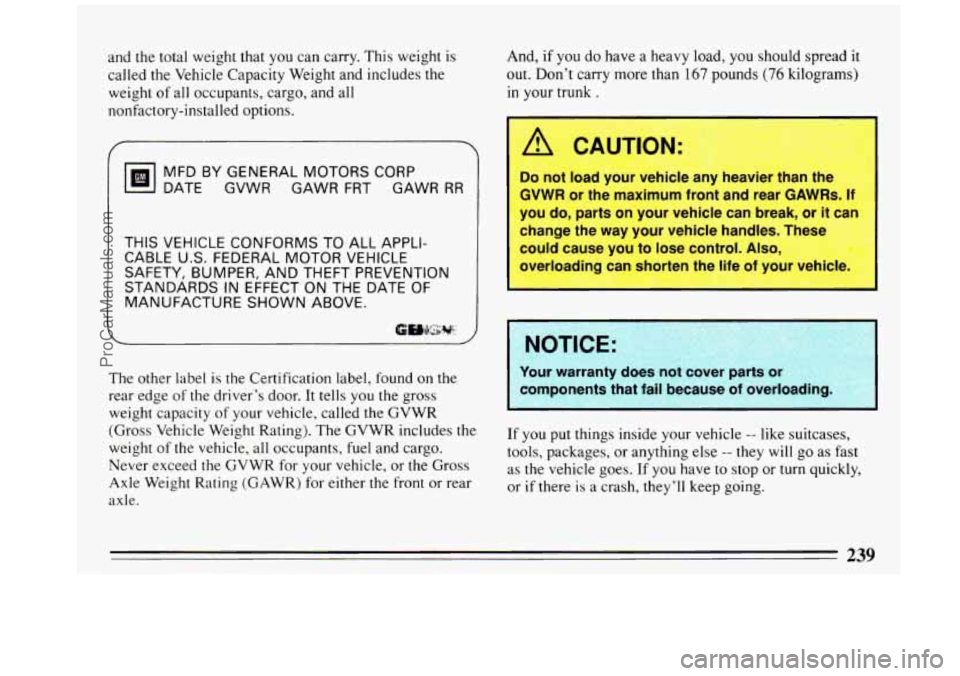
The other label is the Certification label, found on the
rear edge
of the driver’s door. It tells you the gross
weight capacity of your vehicle, called the
GVWR
(Gross Vehicle Weight Rating). The GVWR includes the
weight
of the vehicle, all occupants, fuel and cargo.
Never exceed the GVWR for your vehicle, or the Gross
Axle Weight Rating (GAWR) for either the front or rear
axle.
A CAUTION:
Do not load your vehicle any heavier than the
GVWR or the maximum front and rear GAWRs.
If
you do, parts on your vehicle can break, or it me-
change the way your vehicle handles. These
could cause you to lose control. Also,
--yloadPq can short- th- life
of yonfr ~e~;~’~
Your warranty
does not cover parts or
components that fail because of overloading.
If you put things inside your vehicle -- like suitcases,
tools, packages, or anything
else -- they will go as fast
as the vehicle goes. If
you have to stop or turn quickly,
or
if there is a crash, they’ll keep going.
1
239
ProCarManuals.com
Page 255 of 308
White Sidewall Tires
Your Buick dealer has a GM White Sidewall Tire
Cleaner. You can use a stiff brush with it.
Weatherstrips
These are places where glass or metal meets rubber.
Silicone grease there will make them last longer, seal
better, and not stick or squeak. Apply silicone grease
with a clean cloth at least every six months.
Sheet Metal Damage
If your vehicle is damaged and requires sheet metal
repair or replacement, make sure the body repair shop
applies anti-corrosion material to the parts repaired or
replaced to restore corrosion protection.
Foreign Material
Calcium chloride and other salts, ice melting agents,
road oil and tar, tree sap, bird droppings, chemicals from
industrial chimneys, and other foreign matter can
damage your vehicle’s finish
if they remain on painted
surfaces. Use cleaners that are marked safe for painted
surfaces for these stains.
Finish Damage
Any stone chips, fractures or deep scratches in the finish
should be repaired right away. Bare metal will corrode
quickly and may develop into a major repair expense.
Minor chips and scratches can be repaired with touch-up
materials available from your dealer or other service
outlets. Larger areas
of finish damage can be corrected
in your dealer’s body and paint shop.
Underbody Maintenance
Chemicals used for ice and snow removal and dust
control can collect on
the underbody. If these are not
removed, accelerated corrosion (rust) can occur
on the
underbody parts such as fuel lines, frame, floor pan, and
exhaust system even though they have corrosion
protection.
At least every spring,
flush these materials from the
underbody with plain water. Clean any areas where mud
and other debris can collect. Dirt packed in closed areas
of the frame should be loosened before being flushed.
Your dealer or an underbody vehicle washing system
can do
this for you,
253
ProCarManuals.com
Page 261 of 308
10
10
15
10
Electrical Center
Passenger Side - Underhood
Amp Description
18. 20 Fuel Injectors (3.8L)
19.
15 Trunk Release
20. 20 ECM; Fuel Pump
21. 10 ECM (3.8L)
22. 3
Cooling Fan Relay (3.8L)
23. Not Used
24. Direct Ignition System
25. Fuel Injectors (3.1 L)
26. Not Used
27. Ignition
28. TCC; Primary Cooling Fan (3.1 L)
Relay
29.
30.
31.
32.
33.
Fusible Elements
34. 60 Starter Solenoid
35. 60 Cooling Fan
37. 60 Cooling Fan
36. 60 Blower Motor
38. 30 Fuse Block Fuel Pump
Cooling Fan Control
(3.8L)
Secondary Cooling Fan
Primary Cooling Fan
A/C Clutch Coil
This electrical center is also under the hood on the
passenger side.
259
ProCarManuals.com
Page 265 of 308
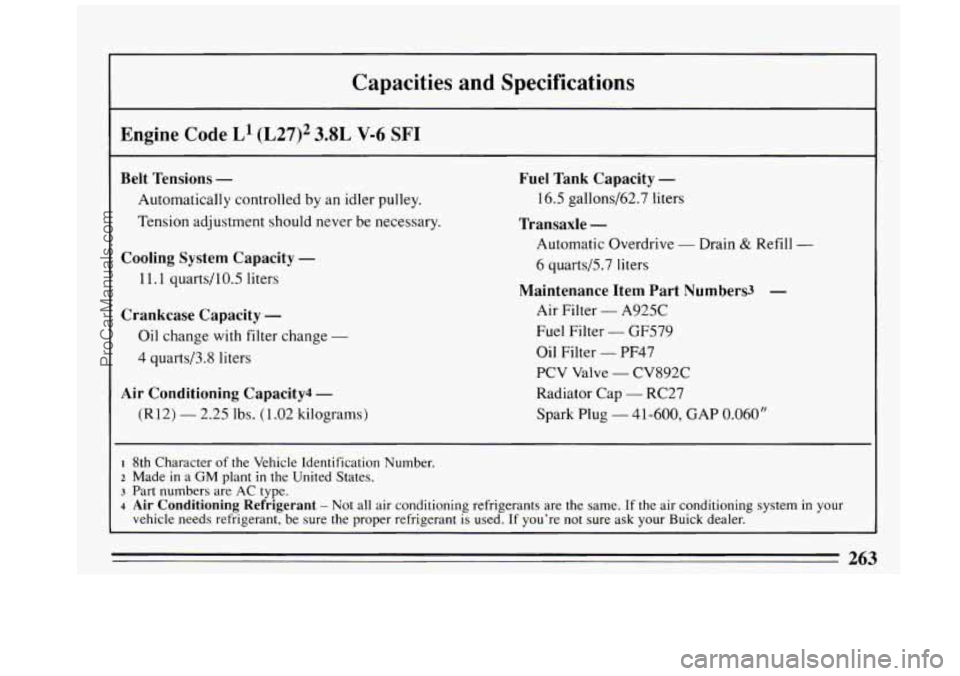
Capacities and Specifications
Engine Code L1 (L27)2 3.8L V-6 SF1
Belt Tensions - Fuel Tank Capacity -
Automatically controlled by an idler pulley.
16.5 gallons/62.7 liters
Tension adjustment should never be necessary.
Transaxle -
Automatic Overdrive - Drain & Refill -
6 quarts/5.7 liters
Maintenance Item Part Numbers3 -
Air Filter - A925C
Fuel Filter
- GF579
Oil Filter
- PF47
PCV Valve
- CV892C
Radiator Cap
- RC27
Spark Plug
- 41-600, GAP 0.060”
Cooling System Capacity -
11.1 quarts/l0.5 liters
Crankcase Capacity -
Oil change with filter change -
4 quarts/3.8 liters
Air Conditioning Capacity4 -
(R12) - 2.25 lbs. (1.02 kilograms)
-
4 Air Conditioning Refrigerant - Not all air conditioning refrigerants are the same. If the air conditioning system in your
vehicle needs refrigerant, be sure the proper refrigerant
is used. If you’re not sure ask your Buick dealer.
~ ~~
I 8th Character of the Vehicle Identification Number.
2 Made in a GM plant in the United States.
3 Part numbers are AC tvDe.
263
ProCarManuals.com