1993 BUICK REGAL parking brake
[x] Cancel search: parking brakePage 104 of 308

Brake System Warning Light
(a)(!)
BRAKE
Your Buick’s hydraulic
brake system is divided into
two parts. If one part isn’t
working, the other part can
still work and stop you. For
good braking, though, you
need both parts working well.
If the warning light goes on, there could be a brake
problem. Have your brake system inspected right away.
This light should come on as you start the vehicle.
If it
doesn’t come on then, have it fixed
so it will be ready to
warn you if there’s a problem. This
light will also come on when you set your parking
brake, and will stay on if your parking brake doesn’t
release fully. If it stays
on after your parking brake is
fully released, it means you have a brake problem. If the
light comes on while driving, pull off the road and stop
carefully. You may notice that the pedal is harder
to
push. Or, the pedal may go closer to the floor. It may
take longer to stop.
If the light is still on, have the
vehicle towed for service. (See “Towing Your Vehicle”
in the Index.)
A CAUTION:
Your brake system may not be working properly
if the brake warning light is on. Driving with the
brake warning light on can lead to an accident.
If
the light is still on after you’ve pulled off the road
and stopped carefully, have the vehicle towed fo
service.
aw,Tp 1 e- c -
102
ProCarManuals.com
Page 137 of 308
Defensive driving really means “be ready for anything.”
On city streets, rural roads, or freeways, it means
“always expect the unexpected.’’
Assume that pedestrians or other drivers are going to be
careless and make mistakes. Anticipate what they might
do. Be ready for their mistakes.
Expect children to dash out from behind.parked cars, often followed by other children. Expect occupants in
parked cars to open doors into traffic. Watch for
movement in parked cars
-- someone may be about to
open a door.
Expect other drivers to run stop signs when you are on a
through street. Be ready to brake if necessary as
you go
through intersections. You may not have to use the
brake, but if you do, you will be ready.
If you’re driving through a shopping center parking lot
where there are well-marked lanes, directional arrows,
and designated parking areas, expect some drivers
to
ignore all these markings and dash straight toward one
part
of the lot.
Pedestrians can be careless. Watch for them. In general,
you must give way to pedestrians even if
you know you
have the right of way.
Rear-end collisions are about
the most preventable of
accidents. Yet they are common. Allow enough following distance.
It’s the best defensive driving
maneuver, in both city and rural driving. You never
know when the vehicle in front of you is going to brake
or turn suddenly.
Here’s a final bit
of information about defensive driving.
The most dangerous time for driving in the
U.S. is very
early
on Sunday morning. In fact, GM Research studies
show that the most and the least dangerous times for
driving, every week, fall on the same day. That day is
Sunday. The most dangerous time is Sunday from
3 a.m.
to
4 a.m. The safest time is Sunday from 10 a.m. to 11
a.m. Driving the same distance
on a Sunday at 3 a.m.
isn’t just a little more dangerous than
it is at 10 a.m. It’s
about 134 times more dangerous!
That leads to the next section.
Drunken Driving
Death and injury associated with drinking and driving is
a national, tragedy. It’s the number one contributor
to the
highway death toll, claiming thousands of victims every
year. Alcohol takes away three things that anyone needs
to drive a vehicle:
Judgment
0 Muscular Coordination
0 Vision
135
ProCarManuals.com
Page 165 of 308
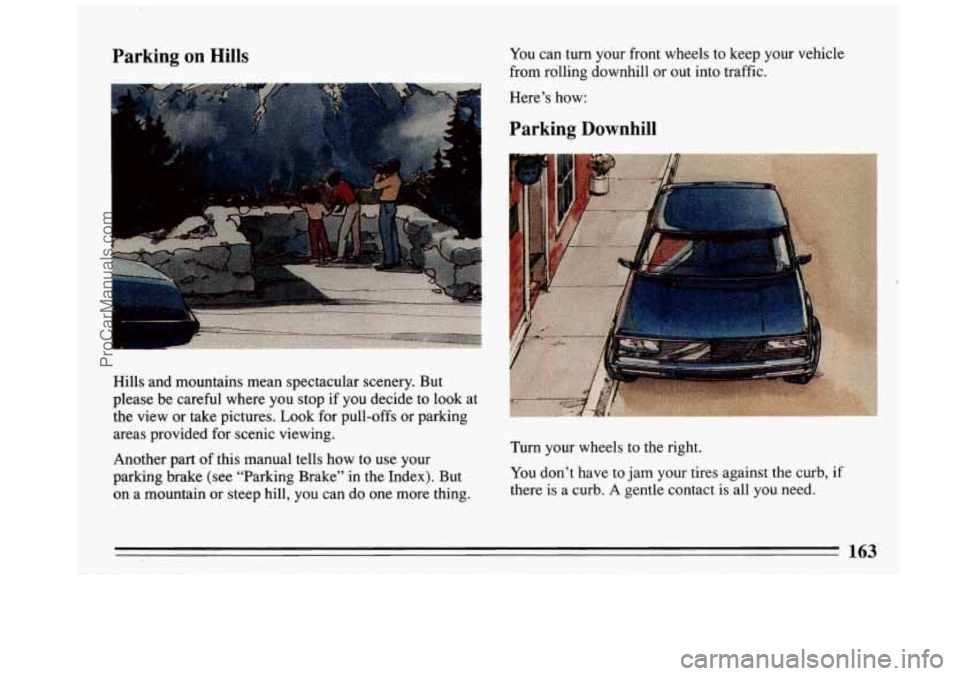
Parking on Hills You can turn your front wheels to keep your vehicle
from rolling downhill or out into traffic.
Hills and mountains mean spectacular scenery. But
please be careful where you stop if you decide to look at
the view or take pictures. Look for pull-offs or parking
areas provided for scenic viewing.
Another part of this manual tells how to use your
parking brake (see “Parking Brake” in the Index). But
on a mountain or steep hill, you can do one more thing. Turn
your wheels to the right.
You don’t have to jam your tires against the curb, if
there
is a curb. A gentle contact is all you need.
163
ProCarManuals.com
Page 167 of 308
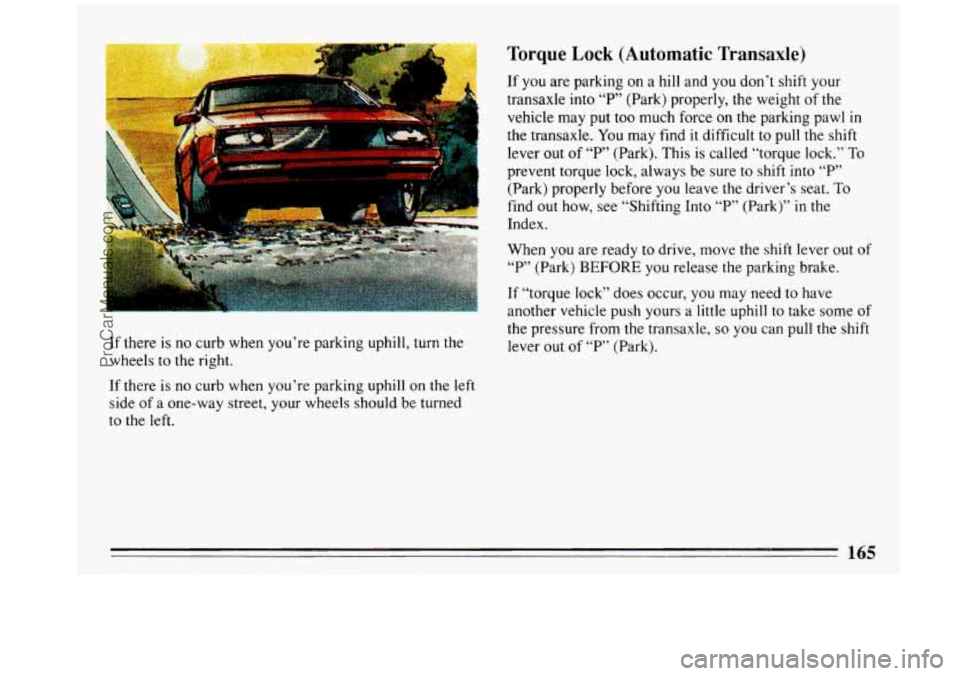
If there is no curb when you’re parking uphill, turn the
wheels to the right.
If there is
no curb when you’re parking uphill on the left
side of a one-way street, your wheels should be turned
to the left.
Torque Lock (Automatic Transaxle)
If you are parking on a hill and you don’t shift your
transaxle into
“P” (Park) properly, the weight of the
vehicle may put
too much force on the parking pawl in
the transaxle. You may find it difficult to pull the shift
lever out
of “P” (Park). This is called “torque lock.” To
prevent torque lock, always be sure to shift into “P”
(Park) properly before you leave the driver’s seat.
To
find out how, see “Shifting Into “P” (Park)” in the
Index.
When
you are ready to drive, move the shift lever out of
“P” (Park) BEFORE you release the parking brake.
If “torque lock” does occur,
you may need to have
another vehicle push yours a little uphill to take some
of
the pressure from the transaxle, so you can pull the shift
lever out of “P” (Park).
ProCarManuals.com
Page 177 of 308
Parking on Hills
You really should not park your vehicle, with a trailer
attached, on a hill. If something goes wrong, your rig
could start to move. People can be injured, and both
your vehicle and the trailer can be damaged.
But if
you ever have to park your rig on a hill, here’s
how to do it:
1.
2.
3.
4.
5.
Apply your regular brakes, but don’t shift into “P’
(Park) yet.
Have someone place chocks under the trailer wheels.
When the wheel chocks are in place, release the
regular brakes until the chocks absorb the load.
Reapply the regular brakes. Then apply your parking
brake, and then shift to “P” (Park).
Release the regular brakes.
When You Are Ready to Leave After
Parking on
a Hill
1. Apply your regular brakes and hold the pedal down
while you:
Start your engine;
Shift into a gear; and
0 Release the parking brake.
2. Let up on the brake pedal.
3. Drive slowly until the trailer is clear of the chocks.
4. Stop and have someone pick up and store the chocks.
Maintenance When Trailer Towing
Your vehicle will need service more often when you’re
pulling a trailer. See the Maintenance Schedule for more
on this. Things that are especially important in trailer
operation are automatic transaxle fluid (don’t overfill),
engine oil, belt, cooling system, and brake adjustment.
Each
of these is covered in this manual, and the Index
will help you find them quickly. If you’re trailering, it’s
a good idea to review these sections before
you start
your trip.
Check periodically to see that all hitch nuts and bolts are
tight.
175
ProCarManuals.com
Page 183 of 308

1 CAUTION:
You could be injured if the vehicles roll. Set the
parking brake firmly on each vehicle. Put an
automatic transaxle
in “P” (Park) or a manual
transaxle
in “N” (Neutral).
3. Turn off the ignition on both vehicles. Turn off all
lights that aren’t needed, and radios. This will avoid
sparks and help save both batteries. And it could
save your radio!
4. Open the hoods and locate the batteries.
I
I A CAUTION:
An electric fan can start up even wheVv the engine
is not running and can injure you. Keep hands,
clothing and
tools away from any underhooc‘
electric
fan.
Find the positive (+) and negative (-) terminals on
each battery.
Your Buick has a remote positive (+)jump starting
terminal. The terminal is on the same side
of the
engine compartment as your battery.
You should always use the remote positive (+)
terminal instead of the positive (+) terminal on your
battery.
To uncover the remote positive (+) terminal, lift the
red plastic cap.
181
ProCarManuals.com
Page 188 of 308
0
0
0
0 0
0
'AA"TT
To help avoid injury to you or others:
Never let passengers ride
in a vehicle that
is being towed.
Never tow faster than safe or posted
speeds.
Never tow with damaged parts not fully
secured.
Never get under your vehicle after
it has
been lifted by the tow truck.
Always use separate safetv chains on each
side when towing
a vehic ~
Never use "J" hnnks- Use T-hanks i
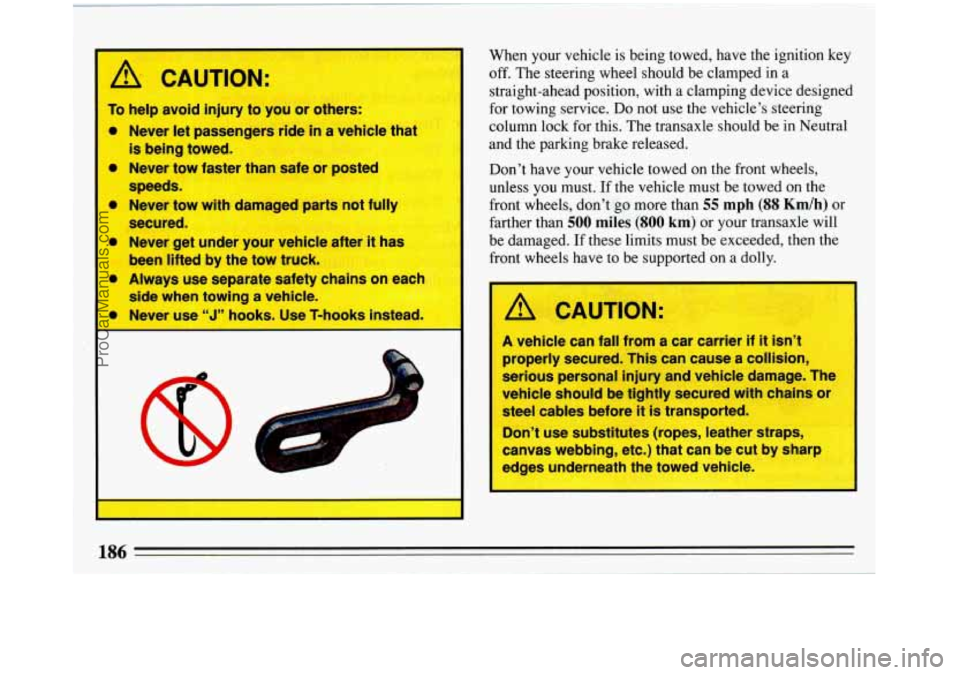
When your vehicle is being towed, have the ignition key
off. The steering wheel should be clamped in a
straight-ahead position, with a clamping device designed
for towing service.
Do not use the vehicle's steering
column lock for this. The transaxle should be in Neutral
and the parking brake released.
Don't have your vehicle towed on the front wheels,
unless
you must. If the vehicle must be towed on the
front wheels, don't
go more than 55 mph (88 Km/h) or
farther than
500 miles (800 km) or your transaxle will
be damaged.
If these limits must be exceeded, then the
front wheels have to be supported
on a dolly.
/1 CAUTION:
A vehicle can fall from a car carrier if it isn't
properly secured. This can cause a collision,
serious personal injury and vehicle damage. The
vehicle should be tightly secured with chains or
steel cables before
it is transported.
Don't use substitutes (ropes, leather straps,
canvas webbing, etc.) that can be cut by sharp
edges underneath the towed vehicle.
186
ProCarManuals.com
Page 203 of 308
If a Tire Goes Flat
It’s unusual for a tire to “blow out” while you’re driving,
especially if you maintain your tires properly. If air goes
out
of a tire, it’s much more likely to leak out slowly.
But if
you should ever have a “blowout,” here are a few
tips about what to expect and what
to do:
If a front tire fails, the flat tire will create a drag that
pulls the vehicle toward that side. Take your foot off
the
accelerator pedal and grip the steering wheel firmly.
Steer
to maintain lane position, then gently brake to a
stop well out
of the traffic lane.
A rear blowout, particularly on a curve, acts much like a
skid and may require the same correction you’d use in a
skid. In any rear blowout, remove your foot fromthe
accelerator pedal. Get the vehicle under control by
steering the way you want the vehicle to go. It may be
very bumpy and noisy, but you can still steer. Gently
brake to a stop, well
off the road if possible.
If your tire goes flat, the next section shows how to use
your jacking equipment to change a flat tire safely.
Changing a Flat Tire
If a tire goes flat, avoid further tire and wheel damage
by driving slowly
to a level place. Turn on your hazard
warning flashers.
A CAUTION:
Changing a tire can cause an injury. The vehicle
can slip off the jack and roll over you or other
people. You and they could be badly injured. Find
a level place to change your tire. TO help prevent
be
! licle from moving:
. the parking brake firmly.
L. Put the shift lever in “P” (Park).
3. Turn off the engine.
To be even more certain the vehicle won’t move,
you can put chocks at the front and rear of
th
tire farthest away from the one being ehangec
That would be the tire
on the other side nG the
vehicle, at the
opposit- md. ;
201
ProCarManuals.com