1993 BUICK REGAL instrument panel
[x] Cancel search: instrument panelPage 96 of 308
Courtesy Lights
When any door is opened, several lights turn on. They
make it easy for you to enter and leave the car. The
courtesy lights
go off when the doors are closed.
The interior courtesy lights can be turned on by sliding
the light switch to INT or by sliding the switch to
OFF.
You can also change the brightness of the instrument
panel lights by sliding the switch between
OFF and
BRT.
The instrument panel lights
will come on when a door is
opened and closed. The instrument panel lights
will
automatically go off after approximate1.y 30 seconds,
unless the headlights or parking lights have been turned
on.
Mirrors
Inside Mirror
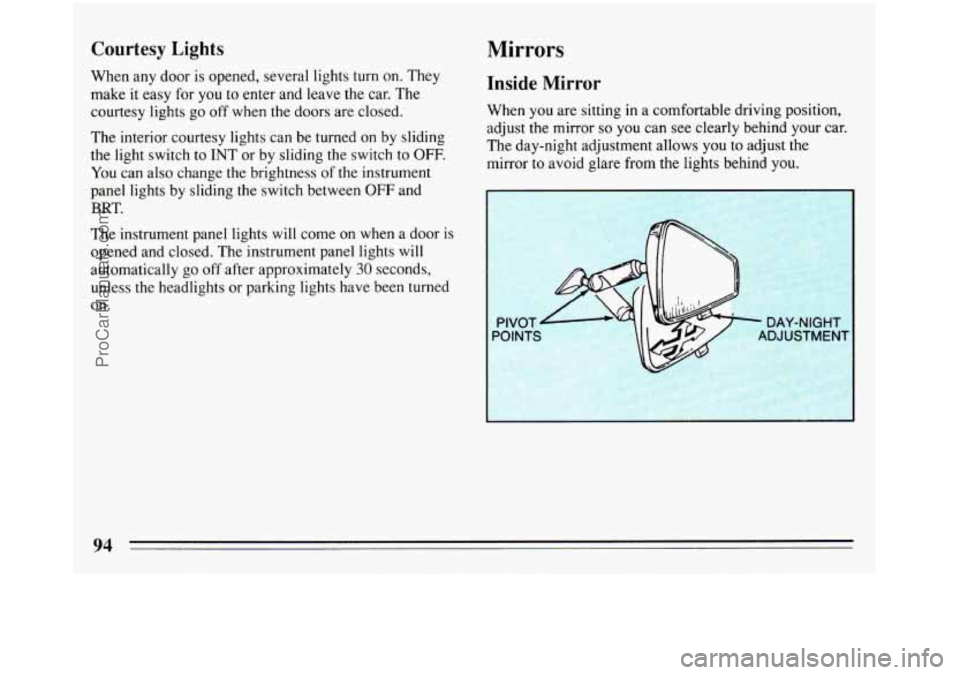
When you are sitting in a comfortable driving position,
adjust the mirror
so you can see clearly behind your car.
The day-night adjustment allows you to adjust the
mirror to avoid glare
from the lights behind you.
94
ProCarManuals.com
Page 101 of 308
Luggage Carrier (Option)
If you have the optional luggage carrier, you can load
things
on the deck lid of your vehicle. The luggage
carrier has slats attached to the deck lid, a rear rail, and
tiedowns.
NOTICE:
Loading cargo that weighs more than 50 Ibs (23
kg) on the luggage carrier may damage your
vehicle. When you carry large things, never let
them hang over the rear or the sides
of your
vehicle. Load your cargo
so that it rests on the
slats and does not scratch
or damage the
vehicle. Put the cargo against the rear rail and
fasten
it securely to the luggage carrier.
\ia , -~~”,~,,””,,~,~~.~,~~--.~~~,,~, L ,,*., ’L <““
The Instrument Panel: Your
Information System
Don’t exceed the maximum vehicle capacity when
loading your Buick. For more information on vehicle
capacity and loading, see “Loading Your Vehicle” in the
Index.
To prevent damage or loss of cargo as you’re driving,
check now and then to make sure the luggage carrier
and cargo are still securely fastened. Your
instrument panel is designed to let you know at
a
glance how your car is running. You’ll know how fast
you’re going, how much fuel you’re using, and many
other things you’ll need to now to drive safely and
economically.
Speedometer and Odometer
Your speedometer lets you see your speed in both miles
per hour (mph) and kilometers per hour (km/h). Your
odometer shows how far your vehicle has been driven,
in either miles (used
in the U.S.) or kilometers (used in
Canada).
Your Buick has
a “tamper-resistant odometer.” On the
standard odometer, if you can
see silver lines between
99
ProCarManuals.com
Page 106 of 308
HOT COOLANT CAN BURN YOU BADLY!
In “Problems on the Road,” this manual shows what to
do. See “Engine Overheating”
in the Index.
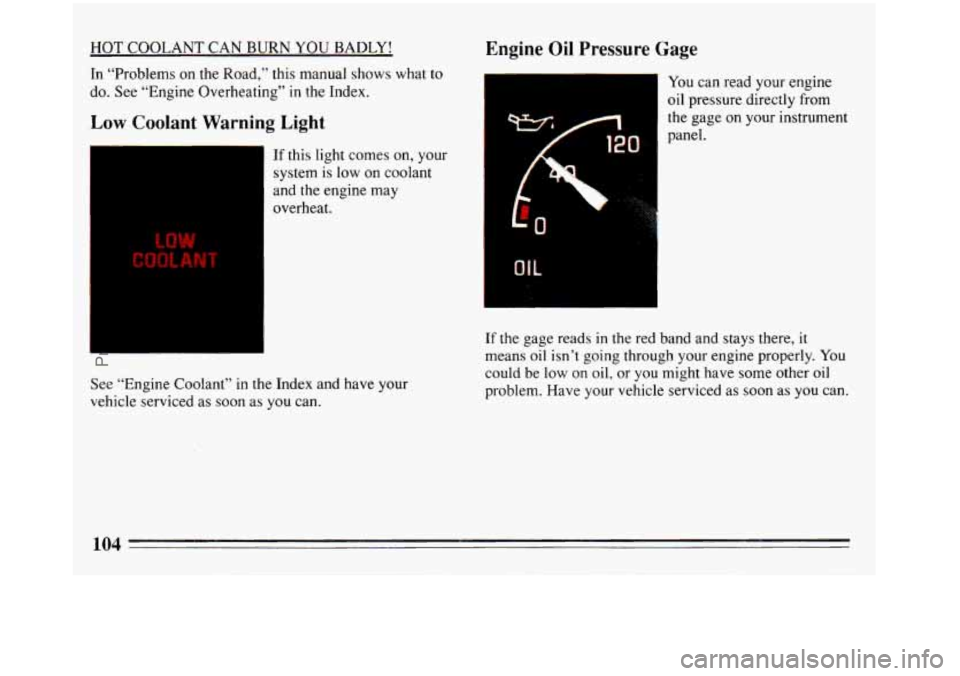
Low Coolant Warning Light
If this light comes on, your
system is low
on coolant
and the engine may
overheat.
See “Engine Coolant” in the Index and have your
vehicle serviced as soon
as you can.
Engine Oil Pressure Gage
OIL
I
You can read your engine
oil pressure directly from
the gage on your instrument
panel.
If the gage reads in the red band and stays there, it
means oil isn’t going through your engine properly.
You
could be low on oil, or you might have some other oil
problem. Have your vehicle serviced as soon as you can.
ProCarManuals.com
Page 113 of 308
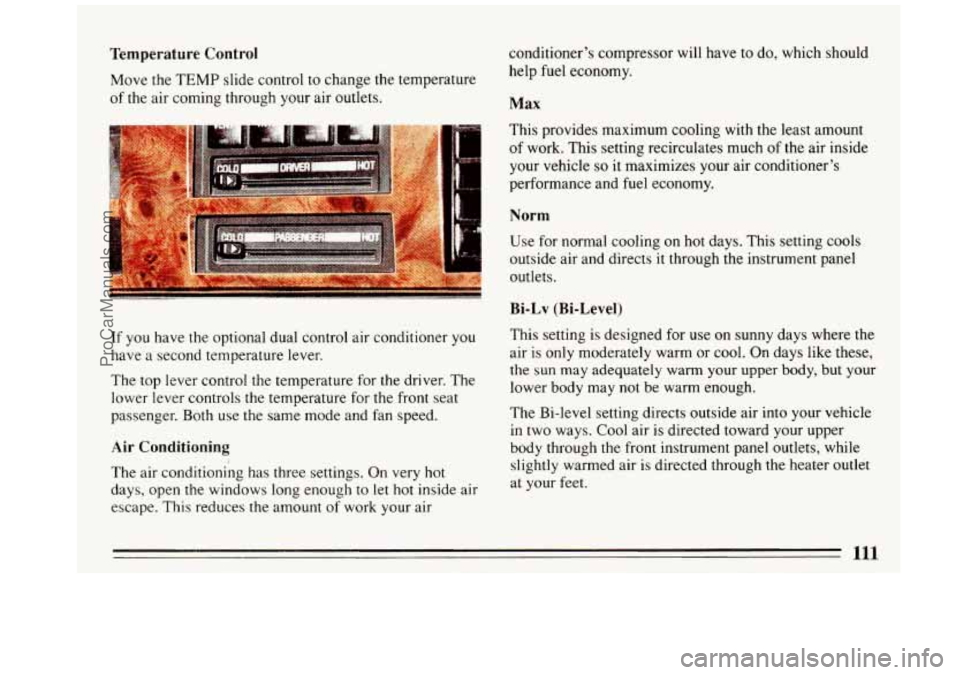
Temperature Control
Move the TEMP slide control to change the temperature
of the air coming through your air outlets. conditioner’s
compressor will have to do, which should
help fuel economy. Max
This provides maximum cooling with the least amount
of work. This setting recirculates much of the air inside
your vehicle
so it maximizes your air conditioner’s
performance and fuel economy.
Norm
Use for normal cooling on hot days. This setting cools
outside air and directs it through the instrument panel
outlets.
Bi-Lv (Bi-Level)
If you have the optional dual control air conditioner you
have a second temperature lever.
The top lever control the temperature for the driver. The
lower lever controls the temperature for the front seat
passenger. Both use
the same mode and fan speed.
Air Conditioning
The air conditioning has three settings. On very hot
days, open
the windows long enough to let hot inside air
escape.. This reduces the amount of work your air This setting
is designed for
use on sunny days where the
air is only moderately warm or cool. On days like these,
the
sun may adequately warm your upper body, but your
lower body may not be warm enough.
The Bi-level setting directs outside air into your vehicle
in two ways.
Cool air is directed toward your upper
body through the front instrument panel outlets, while
slightly warmed air is directed through the heater outlet
at your feet.
111
ProCarManuals.com
Page 114 of 308
The air conditioner compressor operates in all Air
Conditioning positions, and
the Defrost position when
the outside temperature is above 40'F (4.5 "C).
Ventilation
For mild outside temperatures, when little heating or
cooling
is needed, press the VENT button. Air will flow
through the instrument panel outlets. Use the air outlets
to turn on, adjust and turn
off the air flow. Adjust the
TEMP lever to control the temperature.
Heating
When outside temperatures are cold, press the button
marked HTR and slide the
TEMP lever toward HOT to
send heated air through the floor outlets.
Defog
When your windshield is foggy, press the DEFOG
button to direct most of the air flow toward the
windshield. When it's
50 F ( 10 C) or warmer, the
system will provide cooled air.
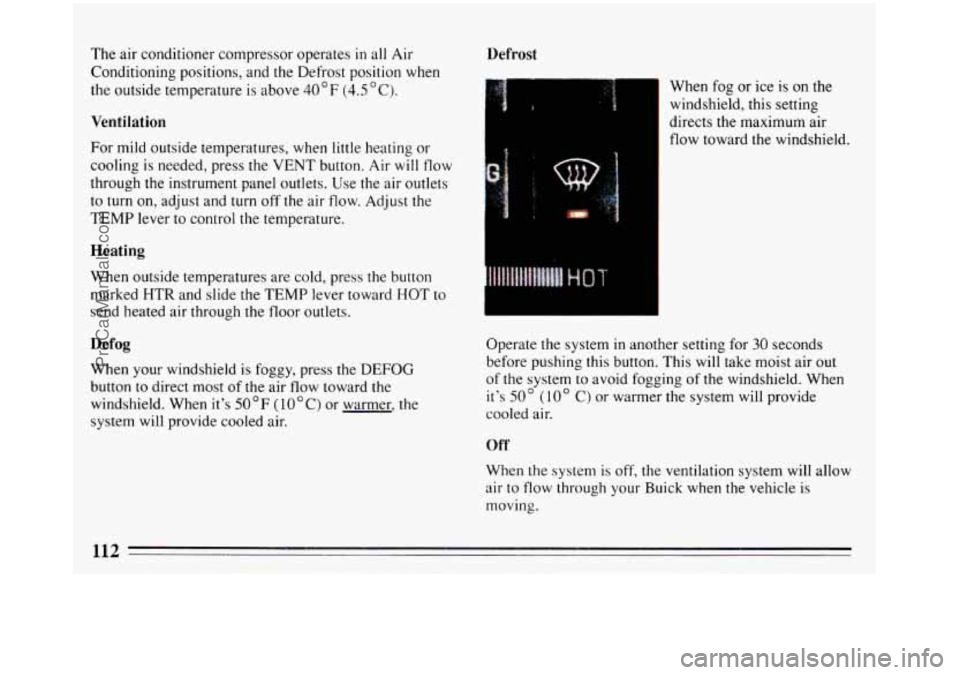
Defrost
When fog or ice is on the
windshield, this setting
directs the maximum air
flow toward the windshield.
Operate the system
in another setting for 30 seconds
before pushing this button.
This will take moist air out
of the system
to avoid fogging of the windshield. When
it's
50' (10" C) or warmer the system will provide
cooled air.
Off
When the system is off, the ventilation system will allow
air to flow through your Buick when the vehicle is
moving.
112
ProCarManuals.com
Page 142 of 308

“Riding” your brakes can cause th%m to overhed
to the point that they won’t work well. You might
not be able to stop your vehicle in time to avoid
an accident.
If you “ride” your brakes, they will
get
so hot they will require a lot of pedal force to,
SI0 lown. Avoid “rid a’’ the brak . ...4.L,::z .I_ : ,+ . ., ., ii: = ‘ :. 3 .
.. c. -.
I
“Riding” the brakes rs them out K%ch faster.
You would need costly brake replacement much
I
sooner th
economy.
I
If you keep pace with the traffic and allow realistic
following distances, you will eliminate a lot of
unnecessary braking. That means better braking and
longer brake life.
0 If your engine ever stops while you’re driving, brake
normally but don’t pump your brakes.
If you do, the
pedal may get harder to push down.
If your engine
stops, you will still have some power brake assist.
But you will
use it when you brake. Once the power
assist is used up, it may take longer to stop and the
brake pedal will be harder to push.
Anti-Lock Brakes (Option)
If your Buick has this system, your Buick has an
advanced electronic braking system that will help
prevent skidding.
If you have an anti-lock brake system (ABS), the brake
pedal will say
so. And this light on the instrument panel
will go
on when you start your vehicle.
When you start your vehicle
and begin to drive away,
you may hear a momentary motor or clicking noise. And
you may even notice that your brake pedal moves a little
while this is going on. This is the
ABS system testing
itself. If you have your foot
on the brake pedal, this
check won’t happen until the vehicle goes about
4 mph
(6 km/h) or until you take your foot off the brake pedal.
After an
ABS stop, you may hear a clicking noise the
next time the vehicle goes about 4 mph (6 km/h).
ProCarManuals.com
Page 176 of 308
Following Distance
Stay at least twice as far behind the vehicle ahead as you
would when driving your vehicle without a trailer. This
can help you avoid situations that require heavy braking
and sudden turns.
Passing
You’ll need more passing distance up ahead when
you’re towing a trailer. And, because you’re a good deal
longer,
you’ll need to go much farther beyond the
passed vehicle before
you can return to your lane.
Backing Up
Hold the bottom of the steering wheel with one hand.
Then, to move the trailer to the left, just move that hand
to the left. To move the trailer to the right, move your
hand to the right. Always back up slowly and, if
possible, have someone guide you.
Making Turns
When you’re turning with a trailer, make wider turns
than normal.
Do this so your trailer won’t strike soft
shoulders, curbs, road signs, trees, or other objects.
Avoid jerky or sudden maneuvers. Signal well in
advance.
firn Signals When Towing a Trailer
When you tow a trailer, your vehicle has to have a
different turn signal flasher and extra wiring. The green
arrows on your instrument panel will flash whenever
you signal a turn or lane change. Properly hooked up,
the trailer lights will also flash, telling other drivers
you’re about to turn, change lanes or stop.
When towing a trailer, the green arrows
on your
instrument panel will flash for turns even if the bulbs on
the trailer are burned out.
Thus, you may think drivers
behind you are seeing your signal when they are not.
It’s
important to check occasionally to be sure the trailer
bulbs are still working.
Driving On Grades
Reduce speed and shift to a lower gear before you start
down a long or steep downgrade. If
you don’t shift
down, you might have to use your brakes
so much that
they would get hot and no longer work well.
On a long uphill grade, shift down and reduce your
speed to around
45 mph (70 km/h) to reduce the
possibility of engine and transaxle overheating.
If you are towing a trailer that weighs more than
1,000
pounds ( 450 kg), and you have an automatic transaxle
with Overdrive, you may prefer to drive in
“D” instead
of Overdrive
(or, as you need to, a lower gear).
174
ProCarManuals.com
Page 194 of 308
Engine Overheating
You will find a coolant temperature gage on your
Buick's instrument panel.
You may also find a low coolant warning light
on your
Buick instrument panel.
If Steam Is Coming From Your Engine:
A CAUTION:
Steam from an overheated engine can burn you
badly, even
if you just open the hood. Stay away
from the engine
if you see or hear steam coming
from it. Just turn
it off and get everyone away
from the vehicle until it cools down. Wait
until
there is no sign of steam or coolant before
opening the hood.
'* -7ou keep driving when your engine is
overheated, the liquids
in it can catch fire. You or
others could be badly burned. Stop your engine
if it overheats, and get out of the vehicle until the
engine is cool.
If your engine catch
driving with
no coolant, your vehicle can be
badly damaged. The costly repairs
w?uld not b
covered by your warranty. ,, , 1 ,.
I If No Steam Is Coming From Your Engine:
If you get the overheat warning but see or hear no
steam,
the problem may not be too serious. Sometimes
the engine can get a little too hot when you:
0 Climb a long hill on a hot day.
0 Stop after high speed driving.
0 Idle for long periods in traffic.
Tow a trailer.
ProCarManuals.com