1993 BUICK REGAL change wheel
[x] Cancel search: change wheelPage 172 of 308
Then, shut the engine off and close the window almost
all the way to preserve the heat. Start the engine again
and repeat this only when you
feel really uncomfortable
from the cold. But do it as little
as possible. Preserve the
fuel as long as you can.
To help keep warm, you can get
out
of the vehicle and do some fairly vigorous exercises
every half hour
or so until help comes.
If You’re Stuck in Deep Snow
This manual explains how to get the vehicle out of deep
snow without damaging it. See “Rocking Your Vehicle”
in the Index.
Towing a Trailer
(n CAUTION:
If you don’t use the correct equipment and drive
properly, you can
lose control when you pull a
trailer. For example,
if the trailer is too heavy, the
brakes may not work well
-- or even at all. You
and your passengers could be seriously injured.
Pull a trailer only if you have followed all the
steps
in this section.
I NOTICE:
Pulling a trailer improperly can damage your
vehicle and result
in costly repairs not covered
by your warranty.
To pull a trailer correctly, follov
the advice in this section. ‘I
Your vehicle can tow a trailer. To identify what the
vehicle trailering capacity is for your vehicle, you
should read the information in “Weight
of the Trailer”
that appears later in this section. But trailering is
different than just driving your vehicle by itself.
Trailering means changes in handling, durability, and
fuel economy. Successful, safe trailering takes correct
equipment, and it has
to be used properly.
That’s the reason for this section. In
it are many
time-tested, important trailering tips and safety rules.
Many
of these are important for your safety and that of
your passengers.
So please read this section carefully
before
you pull a trailer.
Load-pulling components such as the engine, transaxle,
wheel assemblies, and tires are forced to work harder
against the drag of the added weight. The engine is
required to operate at relatively higher speeds and under
greater loads, generating extra heat. What’s more, the
170
- -
ProCarManuals.com
Page 176 of 308
Following Distance
Stay at least twice as far behind the vehicle ahead as you
would when driving your vehicle without a trailer. This
can help you avoid situations that require heavy braking
and sudden turns.
Passing
You’ll need more passing distance up ahead when
you’re towing a trailer. And, because you’re a good deal
longer,
you’ll need to go much farther beyond the
passed vehicle before
you can return to your lane.
Backing Up
Hold the bottom of the steering wheel with one hand.
Then, to move the trailer to the left, just move that hand
to the left. To move the trailer to the right, move your
hand to the right. Always back up slowly and, if
possible, have someone guide you.
Making Turns
When you’re turning with a trailer, make wider turns
than normal.
Do this so your trailer won’t strike soft
shoulders, curbs, road signs, trees, or other objects.
Avoid jerky or sudden maneuvers. Signal well in
advance.
firn Signals When Towing a Trailer
When you tow a trailer, your vehicle has to have a
different turn signal flasher and extra wiring. The green
arrows on your instrument panel will flash whenever
you signal a turn or lane change. Properly hooked up,
the trailer lights will also flash, telling other drivers
you’re about to turn, change lanes or stop.
When towing a trailer, the green arrows
on your
instrument panel will flash for turns even if the bulbs on
the trailer are burned out.
Thus, you may think drivers
behind you are seeing your signal when they are not.
It’s
important to check occasionally to be sure the trailer
bulbs are still working.
Driving On Grades
Reduce speed and shift to a lower gear before you start
down a long or steep downgrade. If
you don’t shift
down, you might have to use your brakes
so much that
they would get hot and no longer work well.
On a long uphill grade, shift down and reduce your
speed to around
45 mph (70 km/h) to reduce the
possibility of engine and transaxle overheating.
If you are towing a trailer that weighs more than
1,000
pounds ( 450 kg), and you have an automatic transaxle
with Overdrive, you may prefer to drive in
“D” instead
of Overdrive
(or, as you need to, a lower gear).
174
ProCarManuals.com
Page 187 of 308
Towing Your Vehicle
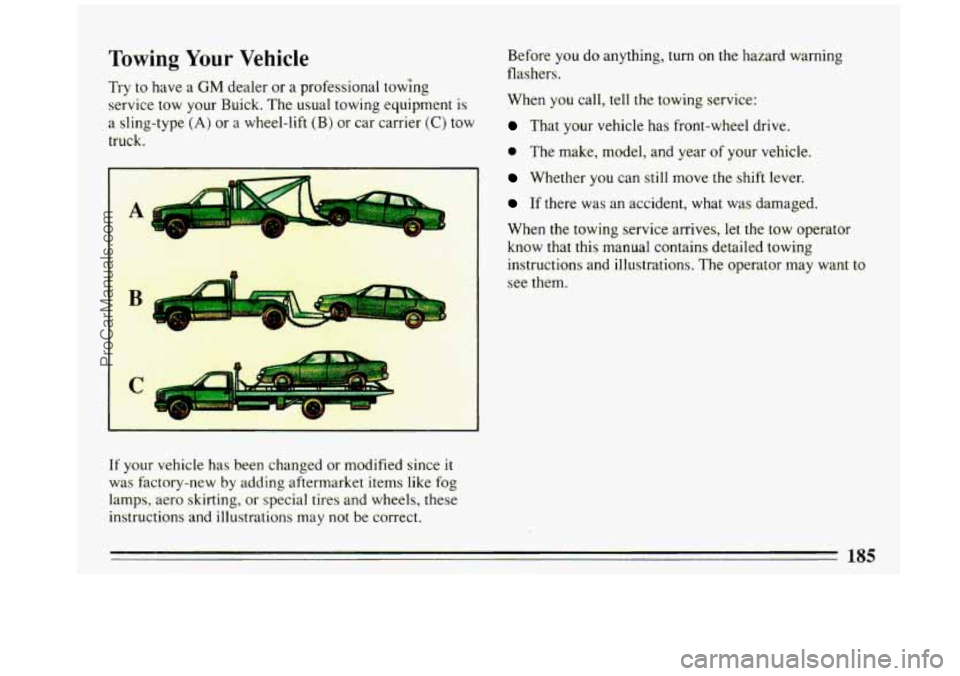
Try to have a GM dealer or a professional towing
service tow your Ruick. The usual towing equipment
is
a sling-type (A) or a wheel-lift (B) or car carrier (C) tow
truck.
If your vehicle has been changed or modified since it
was factory-new by adding aftermarket items like fog
lamps, aero skirting, or special tires
and wheels, these
instructions and illustrations may not
be correct. Before
you do anything,
turn on the hazard warning
flashers.
When you call, tell the towing service:
That your vehicle has front-wheel drive.
0 The make, model, and year of your vehicle.
Whether you can still move the shift lever.
If there was an accident, what was damaged.
When
the towing service arrives, let the tow operator
know that this manual contains detailed towing
instructions and illustrations. The operator may want to
see them.
ProCarManuals.com
Page 203 of 308
If a Tire Goes Flat
It’s unusual for a tire to “blow out” while you’re driving,
especially if you maintain your tires properly. If air goes
out
of a tire, it’s much more likely to leak out slowly.
But if
you should ever have a “blowout,” here are a few
tips about what to expect and what
to do:
If a front tire fails, the flat tire will create a drag that
pulls the vehicle toward that side. Take your foot off
the
accelerator pedal and grip the steering wheel firmly.
Steer
to maintain lane position, then gently brake to a
stop well out
of the traffic lane.
A rear blowout, particularly on a curve, acts much like a
skid and may require the same correction you’d use in a
skid. In any rear blowout, remove your foot fromthe
accelerator pedal. Get the vehicle under control by
steering the way you want the vehicle to go. It may be
very bumpy and noisy, but you can still steer. Gently
brake to a stop, well
off the road if possible.
If your tire goes flat, the next section shows how to use
your jacking equipment to change a flat tire safely.
Changing a Flat Tire
If a tire goes flat, avoid further tire and wheel damage
by driving slowly
to a level place. Turn on your hazard
warning flashers.
A CAUTION:
Changing a tire can cause an injury. The vehicle
can slip off the jack and roll over you or other
people. You and they could be badly injured. Find
a level place to change your tire. TO help prevent
be
! licle from moving:
. the parking brake firmly.
L. Put the shift lever in “P” (Park).
3. Turn off the engine.
To be even more certain the vehicle won’t move,
you can put chocks at the front and rear of
th
tire farthest away from the one being ehangec
That would be the tire
on the other side nG the
vehicle, at the
opposit- md. ;
201
ProCarManuals.com
Page 208 of 308
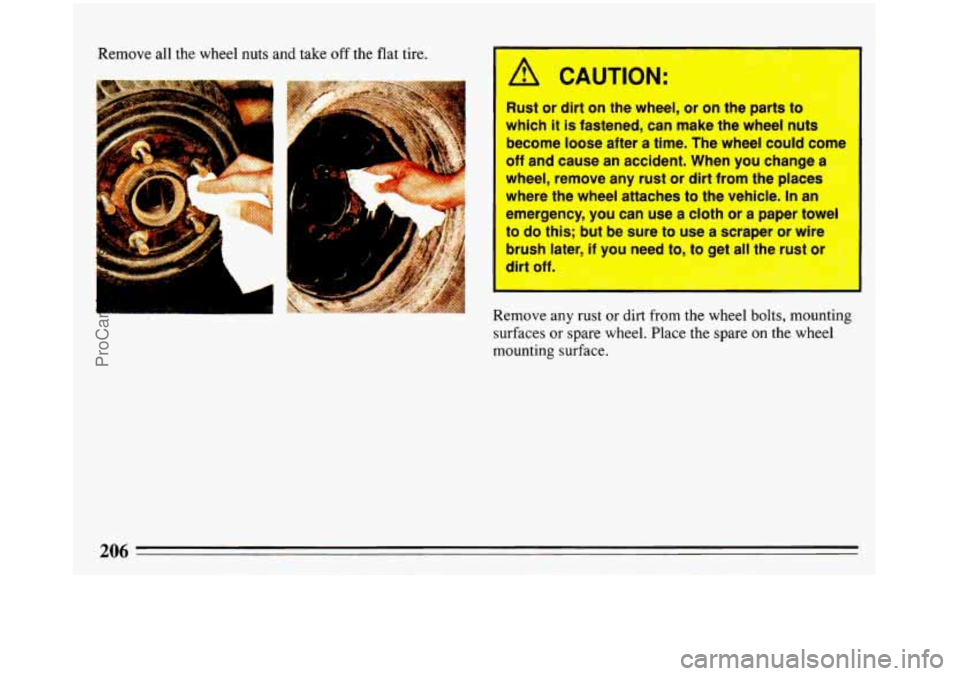
Remove all the wheel nuts and take off the flat tire.
iP
A CAUTION:
Rust or dirt on the wheel, or on rne parts to
which it is fastened, can make the wheel nuts
become loose after
a time. The wheel could come
off and cause an accident. When you change a
wheel, remove any rust or dirt from the places
where the wheel attaches to the vehicle.
In an
emergency, you can
use a cloth or a paper towel
to
do this; but be sure to use a scraper or wire
brush later,
if you need to, to get all the rust or
dirt off.
Remove any rust or dirt from the wheel bolts, mounting
surfaces
or spare wheel. Place the spare on the wheel
mounting surface.
206
ProCarManuals.com
Page 245 of 308
A CAW’ON
Rust or dirt on a wheel, or on the parts to which
it is fastened, can make wheel nuts become
loose after a time. The wheel could come off
a-”
cause an accident. When you change a wheel,
remove any rust or dirt from places where the
wheel attaches to the vehicle.
In an emergency,
you can use a cloth
or a paper towel to do this;
but be sure to use a scraper or wire brush later, if
you need to, to get all the rust or dirt off. (See
“nhanging a Flat
in the Index.)
I
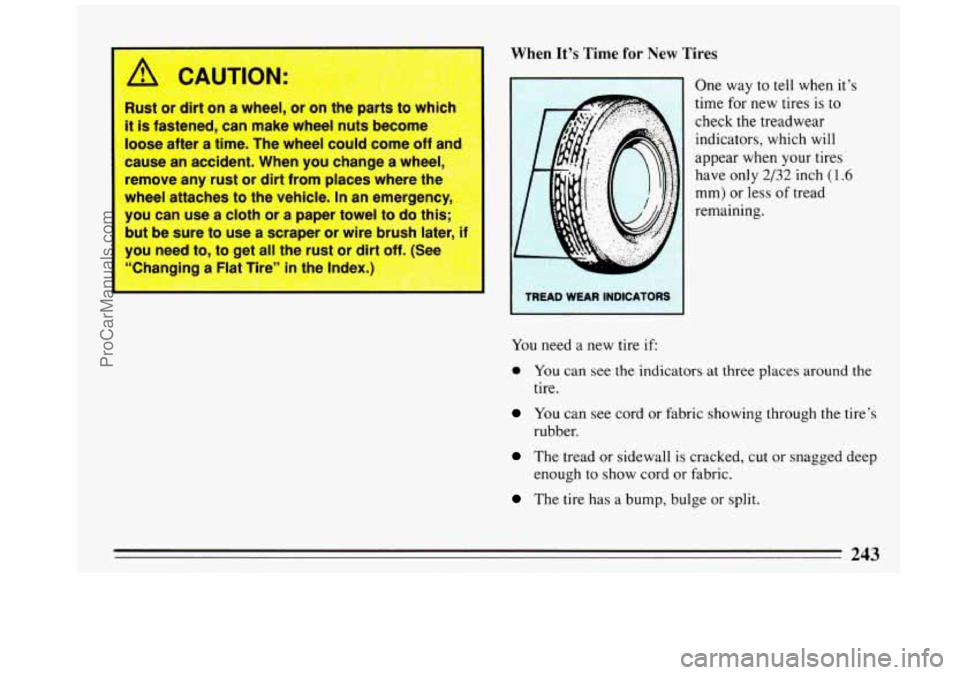
When It’s Time for New Tires
b One wav to tell when it’s r’
time for new tires is to
check
the treadwear
indicators, which will
appear when your tires
have only
2/32 inch (1.6
mm) or less of tread
remaining.
I TREAD WEAR INDICATORS I
You need a new tire if
0 You can see the indicators at three places around the
tire.
You can see cord or fabric showing through the tire‘s
rubber.
The tread or sidewall is cracked, cut or snagged deep
enough to show cord or fabric.
The tire has a bump, bulge or split.
243
ProCarManuals.com
Page 272 of 308
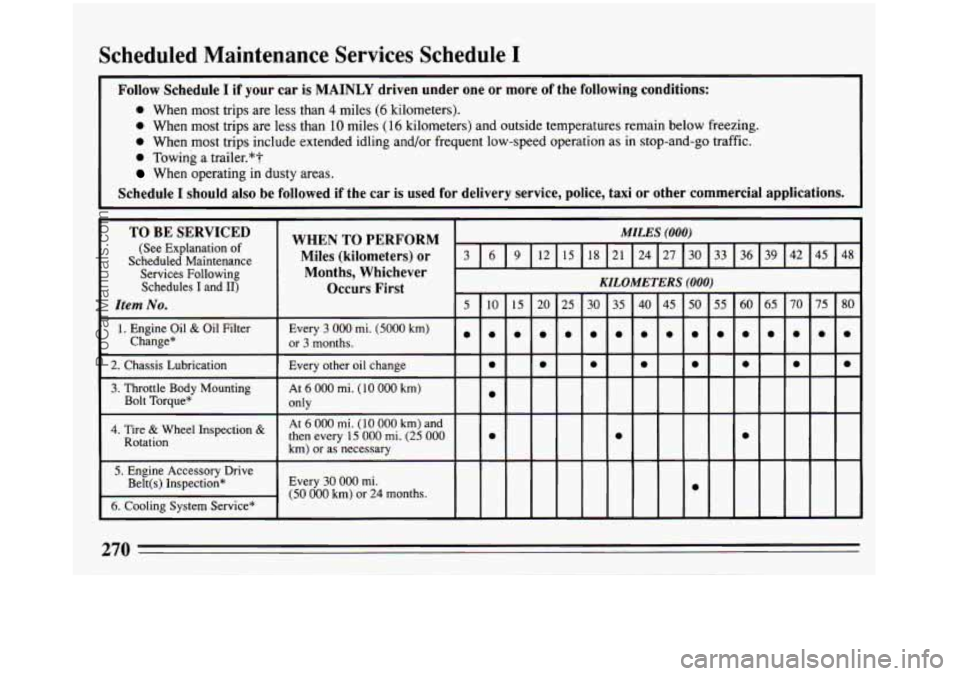
Scheduled Maintenance Services Schedule I
Follow Schedule I if your car is MAINLY driven under one or more of the following conditions: I
0 When most trips are less than 4 miles (6 kilometers).
0 When most trips are less than 10 miles (16 kilometers) and outside temperatures remain below freezing.
0 When most trips include extended idling and/or frequent low-speed operation as in stop-and-go traffic.
0 Towing a trailer.*?
When operating in dusty areas.
Schedule I should also be followed if the car is used for delivery service, police, taxi or other commercial applications.
TO BE SERVICED
(See Explanation of
Scheduled Maintenance
Services Following Schedules
I and 11)
Item No.
1. Engine Oil & Oil Filter
Change*
2. Chassis Lubrication
3. Throttle Body Mounting Bolt Torque*
4. Tire & Wheel Inspection &
Rotation
5. Engine Accessory Drive
' Belt(s) Inspection*
6. Cooling System Service*
65 70 75 80
0.00
0 0
270
ProCarManuals.com
Page 274 of 308
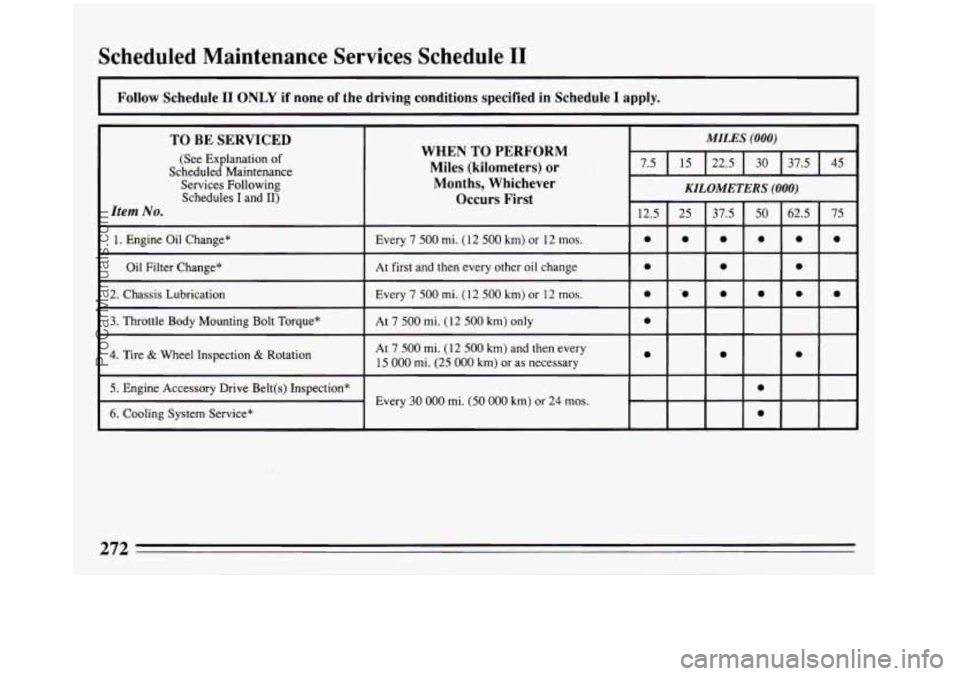
Scheduled Maintenance Services Schedule I1
IIONLY if none of the driving conditions specified in Schedule I apply.
TO BE SERVICED
(See Explanation of
Scheduled Maintenance
Services Following Schedules
I and 11)
Item No.
1. Engine Oil Change*
Oil Filter Change*
2. Chassis Lubrication
3. Throttle Body Mounting Bolt Torque*
4. Tire & Wheel Inspection & Rotation
5. Engine Accessory Drive Belt(s) Inspection*
6. Cooling System Service*
WHEN TO PERFORM
Miles (kilometers)
or
Months, Whichever
Occurs First
I MILES (000)
lm
KILOMETERS (
Every 7 500 mi. (12 500 km) or 12 mos. 1~101010 ~~
At first and then every other oil change
Every
7 500 mi. (12 500 km) or 12 mos.
At 7 500 mi. (12 SO0 km) only
At
7 500 mi. (12 SO0 km) and then every
15 000 mi. (25 000 km) or as necessary 1.1 1.1
I I I 0 Every 30 000 mi. (SO 000 km) or 24 mos. I I I
I I I 0
+
272
ProCarManuals.com