Page 259 of 340
Wait at least 30 minutes before checking the transaxle
fluid level if you have been driving:
When outside temperatures are above 90°F (32 C).
At high speed for quite a while.
In heavy traffic -- especially in hot weather.
0 While pulling a trailer.
To get the right reading, the fluid should be at normal
operating temperature, which is
1 80 F to 200 F
(82OC to 93OC).
Get
the vehicle warmed up by driving about 15 miles
(24 km) when outside temperatures .are above
50 F
(10OC). If it’s colder than 50°F (lO°C), you may have
to drive longer.
To check the fluid level:
Park your vehicle on a level place.
0 Place the shift lever in “P’ (Park) with the parking
brake applied.
0 With your foot on the brake pedal, move the shift
lever through each gear range, pausing for about three seconds
in each range. Then, position the shift
lever
in “P’ (Park).
0 Let the engine run at idle for three to five minutes.
Then, without shutting off the engine, follow these
steps:
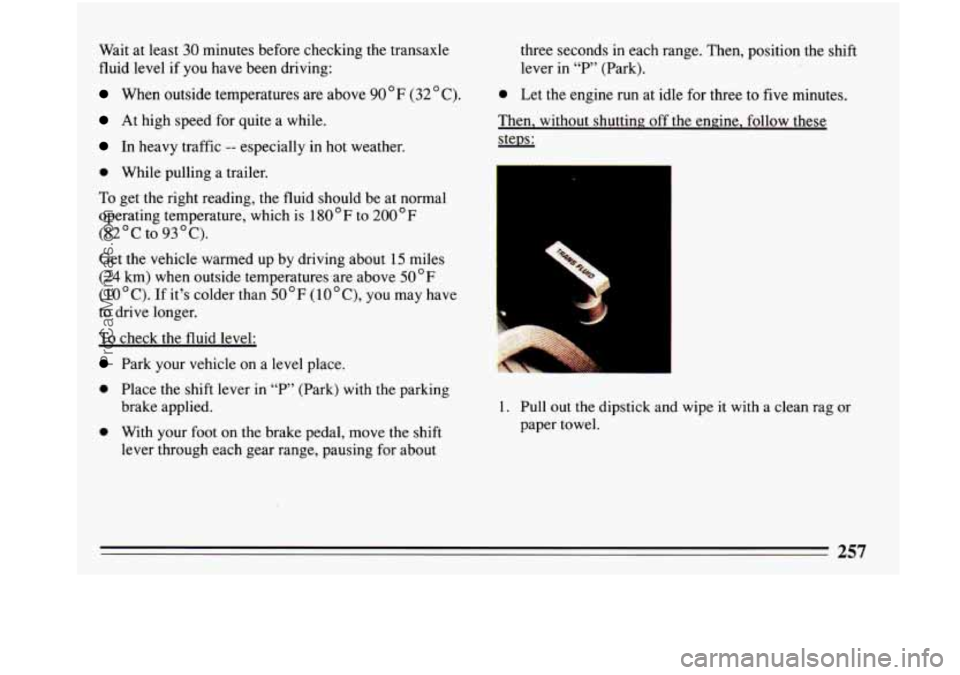
1. Pull out the dipstick and wipe it with a clean rag or
paper towel.
ProCarManuals.com
Page 260 of 340
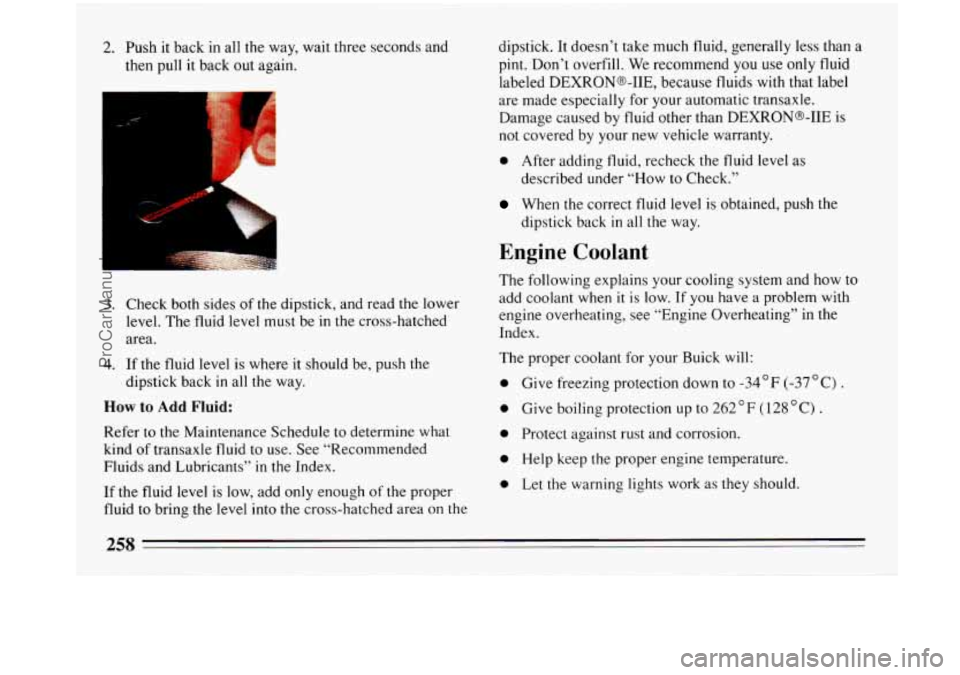
2. Push it back in all the way, wait three seconds and
then pull it back out again.
3. Check both sides of the dipstick, and read the lower
level. The fluid level must be in the cross-hatched
area.
4. If the fluid level is where it should be, push the
dipstick back
in all the way.
How to Add Fluid:
Refer to the Maintenance Schedule to determine what
kind of transaxle fluid to use. See “Recommended
Fluids and Lubricants” in the Index.
If the fluid level is low, add only enough of the proper
fluid to bring the level
into the cross-hatched area on the dipstick, It
doesn’t take much fluid, generally less than a
pint. Don’t overfill. We recommend
you use only fluid
labeled DEXRONWIE, because
fluids with that label
are made especially for your automatic transaxle.
Damage caused by fluid other than DEXRONB-IIE is
not covered by your new vehicle warranty.
0 After adding fluid, recheck the fluid level as
described under “How to Check.”
When the correct fluid level is obtained, push the
dipstick back
in all the way.
Engine Coolant
The following explains your cooling system and how to
add coolant when
it is low. If you have a problem with
engine overheating, see “Engine Overheating” in the
Index.
The proper coolant for your Buick will:
0 Give freezing protection down to -34°F (-37 “C) .
0 Give boiling protection up to 262 F ( 128 ” C) .
0 Protect against rust and corrosion.
0 Help keep the proper engine temperature.
0 Let the warning lights work as they should.
ProCarManuals.com
Page 274 of 340
When to Check: Check your tires once a month or
more.
Don’t forget your compact spare tire. It should be at
60
psi (420 Ha).
How to Check: Use a good quality pocket-type gage to
check tire pressure. Simply looking
at the tires will not
tell you the pressure, especially
if you have radial tires --
which may look properly inflated even if they’re
underinflated.
i
If your tires have valve caps, be sure to put them back
on. They help prevent leaks by keeping out dirt and
moisture.
Tire Inspection and Rotation
To make your tires last longer, have them inspected and
rotated at the mileages recommended
in the
Maintenance Schedule. See “Scheduled Maintenance Services” in the Index. Use
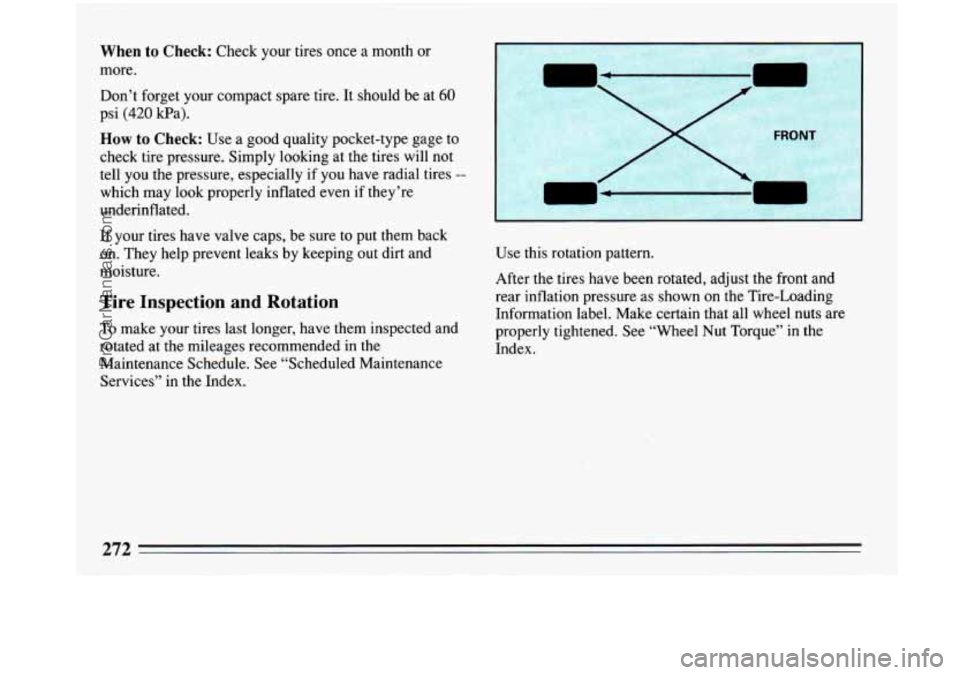
this rotation
pattern.
After the tires have been rotated, adjust the front and
rear inflation pressure as shown on the Tire-Loading
Information label. Make certain that all wheel nuts are
properly tightened. See “Wheel Nut Torque”
in the
Index.
ProCarManuals.com
Page 277 of 340
1/2) times as well on the government course as a tire
graded
100. The relative performance of tires depends
upon the actual conditions
of their use, however, and
may depart significantly from the norm due to variations
in driving habits, service practices and differences in
road characteristics and climate.
Traction - A, B, C
The traction grades, from highest to lowest are: A, B,
and C. They represent the tire’s ability to stop on wet
pavement as measured under controlled conditions
on
specified government test surfaces of asphalt and
concrete.
A tire marked C may have poor traction
performance.
Warning: The traction grade assigned to this tire is based
on braking (straight-ahead) traction tests and does not
include cornering (turning) traction.
Temperature - A, B, C
The temperature grades are A (the highest), B, and C,
representing the tire’s resistance to the generation of
heat and its ability
to dissipate heat when tested under
controlled conditions
on a specified indoor laboratory
test wheel. Sustained high temperature can cause the
material of the tire to degenerate and reduce tire
life, and
excessive temperature can lead to sudden tire failure. The grade
C corresponds to a
level of performance
which all passenger car tires must meet under the
Federal Motor Vehicle Safety Standard
No. 109. Grades
B and A represent higher levels of performance on the
laboratory test wheel than the minimum required by law.
Warning: The temperature grade for this tire is
established for a tire that is properly inflated and not
overloaded. Excessive speed, underinflation, or
excessive loading, either separately or in combination,
can cause heat buildup and possible tire failure.
Those grades are molded on the sidewalls
of passenger
car tires.
While the tires available as standard or optional
equipment on General Motors vehicles may vary with
respect to these grades, all such tires meet General
Motors performance standards and have been approved
for use on General Motors vehicles. All passenger type
(P Metric) tires must conform to Federal safety
requirements
in addition to these grades.
Wheel Alignment and Tire Balance
The wheels on your vehicle were aligned and balanced
carefully at the factory to give you the longest tire life
and best overall performance.
275
ProCarManuals.com
Page 313 of 340
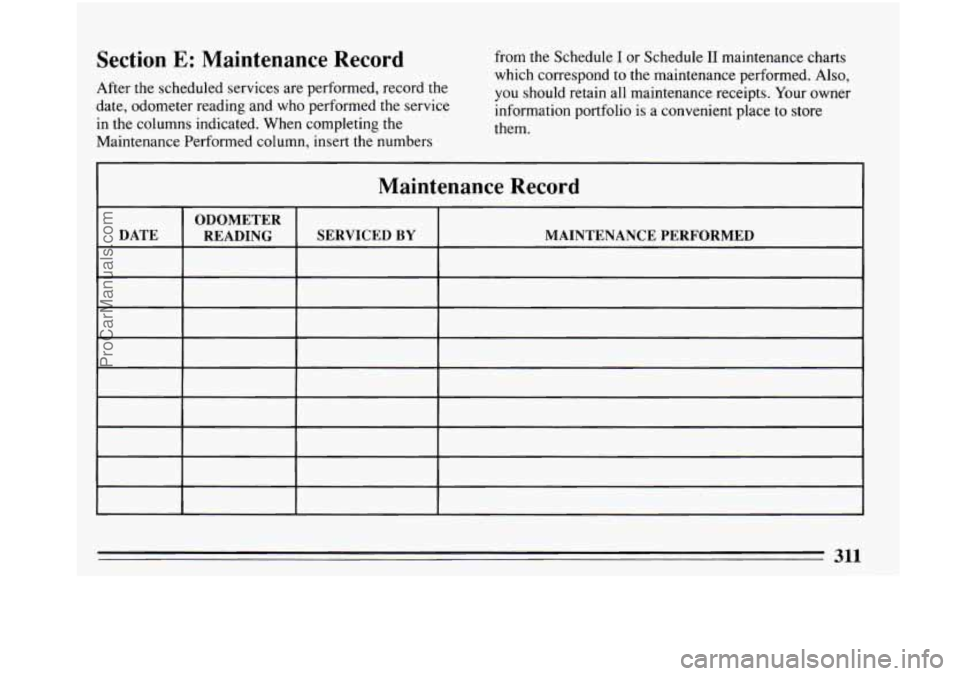
Section E: Maintenance Record
After the scheduled services are performed, record the
date, odometer reading and who performed
the service
in the columns indicated. When completing the
Maintenance Performed column, insert the numbers from
the Schedule I or
Schedule I1 maintenance charts
which correspond
to the maintenance performed. Also,
you should retain all maintenance receipts. Your owner
information portfolio
is a convenient place to store
them.
Maintenance Record
ODOMETER
DATE MAINTENANCE PERFORMED
READING SERVICED
BY
ProCarManuals.com
Page 315 of 340
@) Part 8 Customer Assistance Information
1
m
Here you will find out how to contact Buick if you need assistance. This part also tells you how to obtain service
publications and how to report any safety defects.
Part
8 includes:
Customer Satisfaction
Customer Assistance for Hearing/Speech Impaired
........................................ 3 14
Reporting Safety Defects ............................................................ 3 15
ServicePublications ................................................................ 316
Customer Satisfaction Procedure
Your satisfaction and goodwill are important to your
dealer and Buick. Normally, any problems with the sales
transaction or the operation of your vehicle will be
resolved by your dealer’s Sales or Service Departments.
Sometimes, however, despite the best intentions of all
concerned, misunderstandings can occur. If your
concern has not been resolved
to your satisfaction, the
following steps should be taken: STEP
ONE
-- Discuss your problem with a member of
dealership management. Complaints can often be
quickly resolved at that level. If the matter has already
been reviewed with the Sales, Service, or Parts Manager,
contact the owner
of the dealership or the General
Manager.
313
ProCarManuals.com