Page 79 of 340
Move your shift lever to “P” (Park) or “N” (Neutral).
Your engine won’t start in any other position
-- that’s a
safety feature. To restart when you’re already moving,
use “N” (Neutral) only.
Don’t try to shift to “P” (Park) if your Buic
moving.
If you do, you could damage the :
transaxle. Shift to “P” (Park) only when y
To start your 3.8 Liter (Code L) engine:
1. Don’t push the accelerator pedal before starting your
engine. In some other vehicles
you might need to do
this, but because of your vehicle’s computer systems,
you don’t.
starts,
let go of the key. The idle speed will go down
as your engine gets warm.
2. Turn your ignition key to “Start.” When the engine
3. If it doesn’t start right away, hold your key in “Start”
for about three seconds at a time until your engine
starts. Wait about
15 seconds between each try to
help avoid draining your battery.
4. If your engine still won’t start (or starts but then
stops), it could be flooded with too much gasoline.
Try pushing your accelerator pedal all the way to the
floor and holding it there as you hold the key in
“Start” for about three seconds. If the car starts
briefly but then stops again,
do the same thing, but
this time keep the pedal down for five or six seconds.
This clears the extra gasoline from the engine. After
waiting about
15 seconds, repeat the normal starting
procedure.
77
ProCarManuals.com
Page 80 of 340
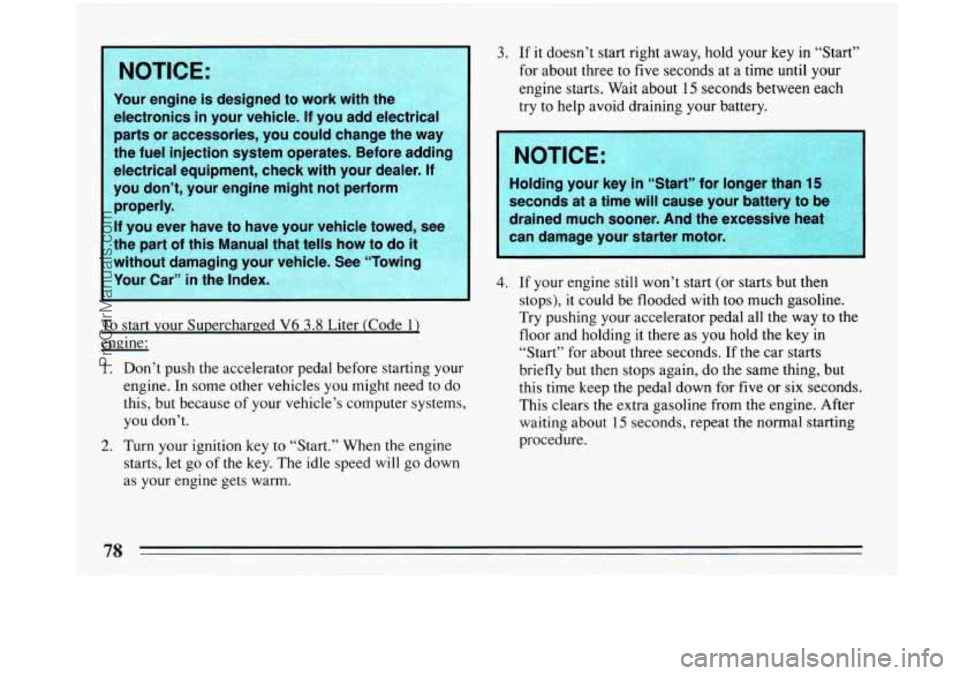
Your engine is designed to work with the
electronics in your vehicle.
If you add electrical
parts or accessories, you could change the way
If you ever have to have your vehicle towed, see
the part
of this Manual that tells how to do it
without damaging your vehicle. See “Towing
Your Car” in the Index.
To start your SupercharEed V6 3.8 Liter (Code 1)
engine:
1.
2.
Don’t push the accelerator pedal before starting your
engine. In some other vehicles you might need to do
this, but because
of your vehicle’s computer systems,
you don’t.
Turn your ignition key to “Start.” When the engine
starts, let go
of the key. The idle speed will go down
as your engine gets warm.
3. If it doesn’t start right away, hold your key in “Start”
for about three to five seconds at a time until your
engine starts. Wait about
15 seconds between each
try to help avoid draining your battery.
4. If your engine still won’t start (or starts but then
stops),
it could be flooded with too much gasoline.
Try pushing your accelerator pedal all the way to the
floor and holding
it there as you hold the key in
“Start” for about three seconds. If the car starts
briefly but then stops again, do the same thing, but
this time keep the pedal down for five or six seconds.
This clears the extra gasoline from the engine. After
waiting about
15 seconds, repeat the normal starting
procedure.
78
ProCarManuals.com
Page 83 of 340
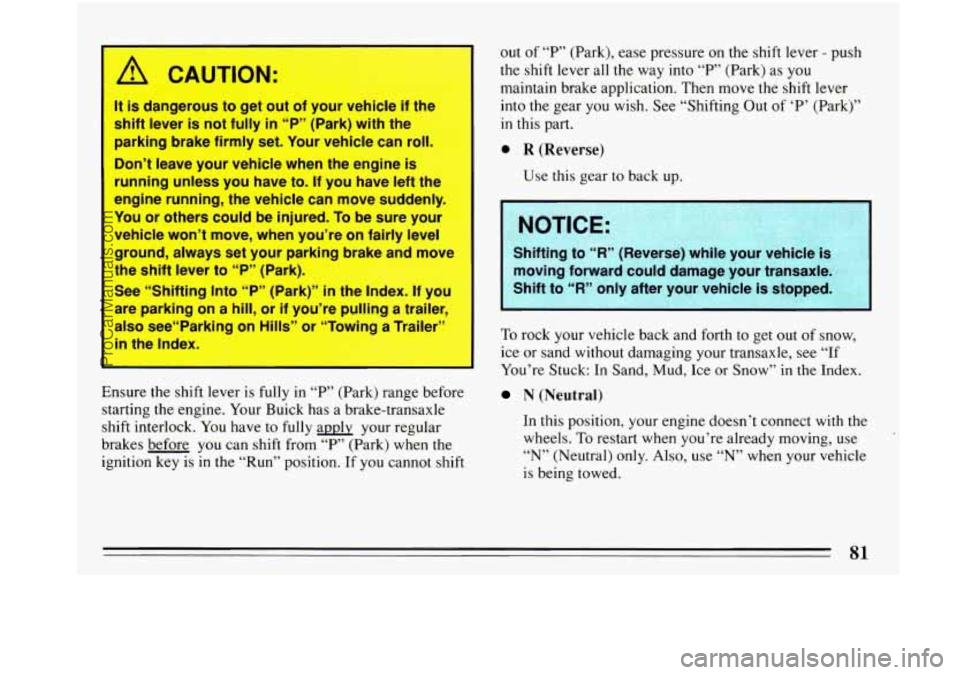
I A CAUTION:
It is dangerous to get out of your vehicle if the
shift lever is not fully
in “P” (Park) with the
parking brake firmly set. Your vehicle can roll.
Don’t leave your vehicle when the engine is
running unless you have to.
If you have left the
engine running, the vehicle can move suddenly.
You or others could be injured. To be sure your
vehicle won’t move, when you’re on fairly level
ground, always set your parking brake and move
the shift lever to “P” (Park).
See “Shifting Into “P” (Park)”
in the Index. If you
are parking on a
hill, or if you’re pulling a trailer
also see“Parking on Hills” or “Towing a Trailer’
in the Index.
Ensure the shift lever is fully in “P” (Park) range before
starting the engine. Your Buick has a brake-transaxle
shift interlock. You have
to fully apply your regular
brakes before you can shift from “P” (Park) when the
ignition key is in the “Run” position. If you cannot shift out
of
“P” (Park), ease pressure on the shift lever - push
the shift lever all the way into
“P” (Park) as you
maintain brake application. Then move the shift lever
into the gear you wish. See “Shifting Out
of ‘P’ (Park)”
in this part.
0 R (Reverse)
Use this gear to back up.
Shifting to ‘W’ (Reverse) while your vehicle is
moving forward could damage your transaxle.
Shift to
“R” only after your vehicle is stoppc
To rock your vehicle back and forth to get out of snow,
ice or sand without damaging your transaxle, see
“If
You’re Stuck: In Sand, Mud, Ice or Snow” in the Index.
N (Neutral)
In this position, your engine doesn’t connect with the
wheels.
To restart when you’re already moving, use
“N” (Neutral) only. Also, use “N” when your vehicle
is being towed.
ProCarManuals.com
Page 86 of 340
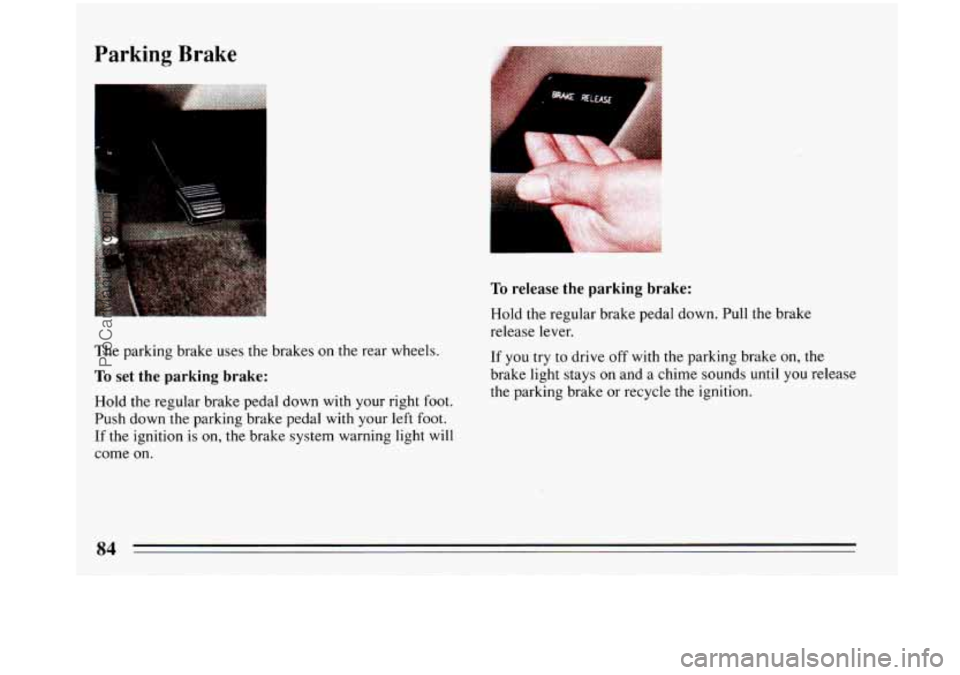
Parking Brake
The parking brake uses the brakes on the rear wheels.
To set the parking brake:
Hold the regular brake pedal down with your right foot.
Push down the parking brake pedal with your
left foot.
If the ignition
is on, the brake system warning light will
come on.
To release the parking brake:
Hold the regular brake pedal down. Pull the brake
release lever.
If you try to drive off with the parking braKe on, the
brake light stays on and a chime sounds until
you release
the parking brake or recycle the ignition.
ProCarManuals.com
Page 88 of 340
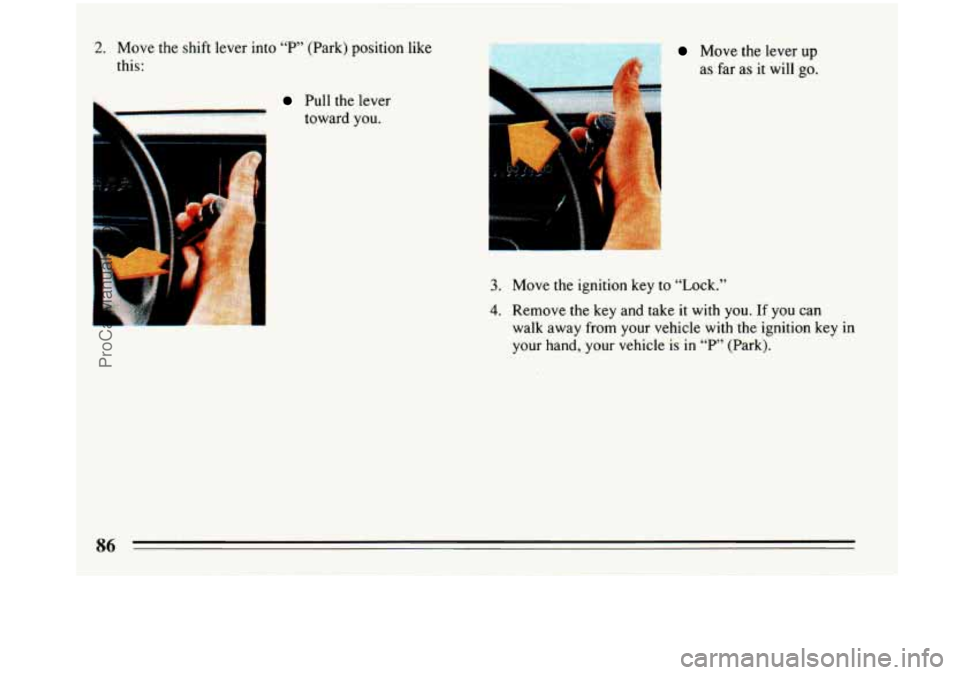
2. Move the shift lever into “P” (Park) position like
this:
Pull the lever
toward
you. L. P.
.= Move the lever up
as
far as it will go.
7.:- .* I .
P
3. Move the ignition key to “Lock.”
4. Remove the key and take it with you. If you can
walk away from your vehicle
with the ignition key in
your hand, your vehicle is in “P” (Park).
ProCarManuals.com
Page 89 of 340
Leaving Your Vehicle With the Engine
Running
I
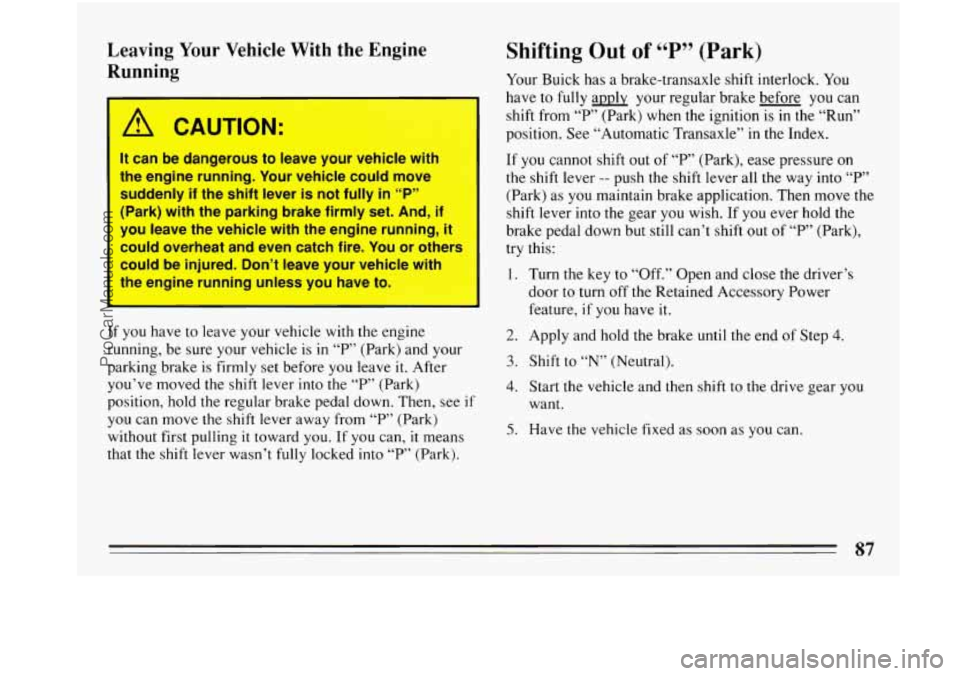
A CAUTION:
It can be dangerous to leave your vehicle with
the engine running. Your vehicle could move
suddenly
if the shift lever is not fully in “P”
(Park) with the parking brake firmly set. And, if
you leave the vehicle with the engine running,
it
could overheat and even catch fire. You or other3
could be injured. Don’t leave your vehicle with
the engine running unless you have to.
If you have to leave your vehicle with the engine
running, be sure your vehicle is in “P” (Park) and your
parking brake is firmly
set before you leave it. After
you’ve moved the shift lever
into the “P” (Park)
position, hold the regular brake pedal down. Then, see if
you can move the shift lever away from “P” (Park)
without first pulling it toward you. If you can, it means
that the shift lever wasn’t fully locked into “P” (Park).
Shifting Out of 46 P $9 (Park)
Your Buick has a brake-transaxle shift interlock. You
have
to fully apply your regular brake before you can
shift from “P” (Park) when the ignition is in the “Run”
position. See “Automatic Transaxle” in the Index.
If you cannot shift out of
“P” (Park), ease pressure on
the shift lever
-- push the shift lever all the way into “P’
(Park) as you maintain brake application. Then move the
shift lever into the gear
you wish. If you ever hold the
brake pedal down but still can’t shift out of “P” (Park),
try this:
I. Turn the key to “Off.” Open and close the driver’s
door to turn off the Retained Accessory Power
feature,
if you have it.
2. Apply and hold the brake until the end of Step 4.
3. Shift to “N” (Neutral).
4. Start the vehicle and then shift to the drive gear you
want.
5. Have the vehicle fixed as soon as you can.
87
ProCarManuals.com
Page 103 of 340
I
I
To Erase Speed Memory
When you turn off the Cruise Control or the ignition, or
shift into
“P” (Park), your Cruise Control ,set speed
memory is erased.
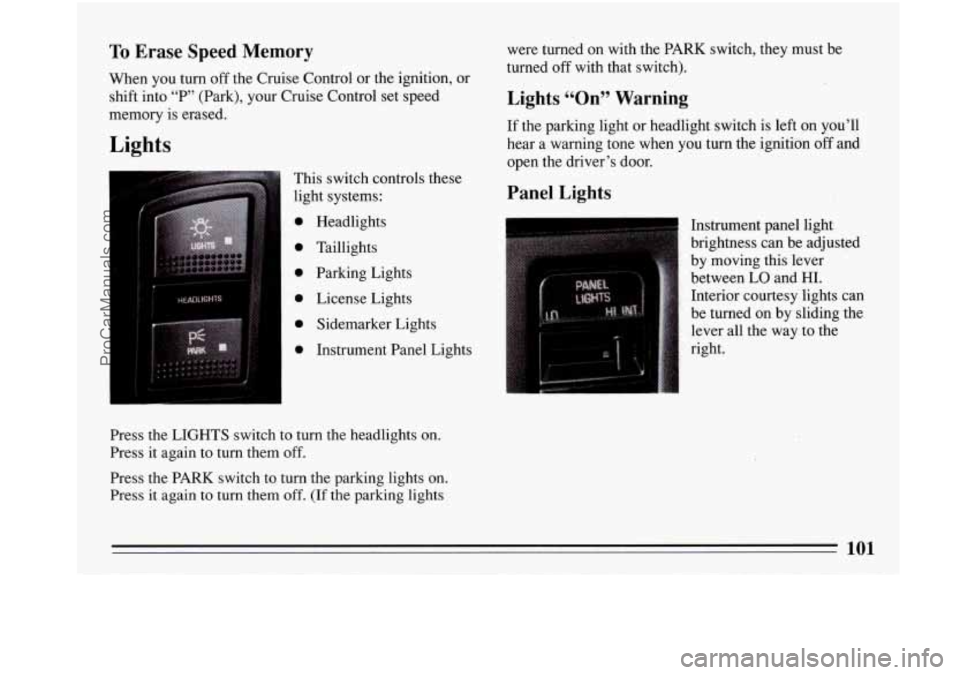
Lights
This switch controls these
light systems:
0 Headlights
0 Taillights
0 Parking Lights
0 License Lights
0 Sidemarker Lights
0 Instrument Panel Lights
Press the LIGHTS switch’to turn the headlights on.
Press it again to turn them
off.
Press the PARK switch to turn the parking lights on.
Press it again
to turn them off. (If the parking lights were turned
on with the PARK switch, they must be
turned
off with that switch).
Lights CCOn” Warning
If the parking light or headlight switch is left on you’ll
hear
a warning tone when you turn the ignition off and.
open the driver’s door.
Panel Lights
Instrument panel light
brightness can be adjusted
by moving this lever
between LO and HI.
Interior courtesy lights can
be turned on by sliding the
.lever all the way to the
right.
101
ProCarManuals.com
Page 105 of 340
Daytime Running Lights (Canada Only)
The Canadian Federal Government has decided that
“Daytime Running Lights” (DRL) are a useful feature,
in that DRL can make your vehicle more visible to
pedestrians and other drivers during daylight hours.
DRL are required on new vehicles sold in Canada.
Your
DRL work with a light sensor on top of the
instrument panel. Don’t cover it up.
The low beam headlights will come on at reduced
brightness in daylight when:
0 The ignition is on
0 The headlight switch is off, and
0 The transaxle is not in “P” (Park). At
dusk, if the Twilight Sentinel feature is turned on, the
exterior lights will come
on automatically and the low
beams will change to
full brightness. At dawn, the
exterior lights will go out and the low beams will
change to the reduced brightness
of DRL (if the
headlight switch is off).
Of course, you may still turn on the headlights any time
you need to.
To idle your vehicle with the DRL off, shift the
transaxle into
“P” (Park). The DRL will stay off until
you shift out of “P” (Park).
To turn
off all exterior lighting at night when you are
parked, move
the twilight sentinel control from ON to
OFF, if it was on from the start. Or, move the control
from OFF to
ON, then back to OFF, if it was off from
the start. The lights will come back
on when you move
the transaxle out
of PARK.
ProCarManuals.com