Page 70 of 324

needs service. If your vehicle does start, the first ignition
key may be faulty. See
your Buick dealer or a locksmith
who can service the PASS-Key
I1 .
If you accidentally use a key that has a damaged or
missing resistor pellet, the starter won’t work and the
security light will flash. But
you don’t have to wait three
minutes before trying one
of the other ignition keys.
See your Buick dealer or a locksmith who can service
the Pass-Key
I1 TM to have a new key made.
If you’re ever driving and
the “SECURITY” light comes
on and stays on,
you will be able to restart your engine if
you
turn it off. Your PASS-Key I1 system, however, is
not working properly and must be serviced by your
Buick dealer. Your vehicle is not protected by the
PASS-Key I1 system.
If you lose or damage a PASS-Key I1 TM ignition key, see
your Buick dealer or
a locksmith who can service
PASS-Key I1
TM to have a new key made.
New Vehicle CLBreak-InSS
Your modern
Don’t drive at any one speed -- f
-- for the first 500 miles i804 km). Don’
make full-throttle starts.
fee
Avoid making hard stops for the first ~UU
miles (322 km) or so. During this time your
I new brake linings aren’t yet broken in. Hard
stops with new linings can mean prematl
wear and earlier replacement. Follow
this
I “breaking-in” guidel’
Page 71 of 324
Ignition Key Positions
I
Your square-headed key operates your ignition lock. This
lock gives you five different positions. Before
you
put the key in, your ignition will be in the “Lock”
position. This position locks your ignition, steering
wheel and transaxle. It’s a theft deterrent feature.
The other positions let you perform these functions:
ACC: Accessory lets you use things like the radio and
the windshield wipers when the engine is
off. To get into
“Acc”, push in the key and turn it toward
you. Your
steering wheel will remain locked, just as it was before
you inserted the key.
69
Page 72 of 324

OFF: This position lets you turn off the engine but still
turn the steering wheel. It doesn’t lock the steering
wheel like
“Lock.” Use “Off’ if you must have your car
in motion while the engine is off.
RUN: This is the position for driving.
START: This position starts your engine.
I
NOTICE:
IT your Key seems stuck In “Lock” and you can-
turn
it, be sure it is all the way in. If it is, then turn
the steering wheel left and right while you turn
the key hard. But turn the key only with your
hand. Using
a tool to force it could break the key
or the ignition switch. If none
your vehicle needs service
Starting Your Engine
Move your shift lever to “P’ (Park) or “N” (Neutral).
Your engine won’t start in any other position
-- that’s a
safety feature.
To restart when you’re already moving,
use “N” (Neutral) only.
n’t try to shift to “P” (Park) if your Buick is
ving.
If you do, Id damage the
nsaxle. Shift to
“ rk) only when you .. . . -
1.
2.
3.
Don’t push the accelerator pedal before starting your
engine. In some other vehicles
you might need to do
this, but because
of your vehicle’s computer systems,
you don’t.
Turn your ignition key to “Start.” When the engine
starts, let go
of the key. The idle speed will go down
as your engine gets warm.
If it doesn’t start right away, hold your key in “Start”
for about three seconds at a time until your engine
starts. Wait about
15 seconds between each try to
help avoid draining your battery.
70
~
Page 75 of 324
PARK RNO321
Automatic Transaxle
r
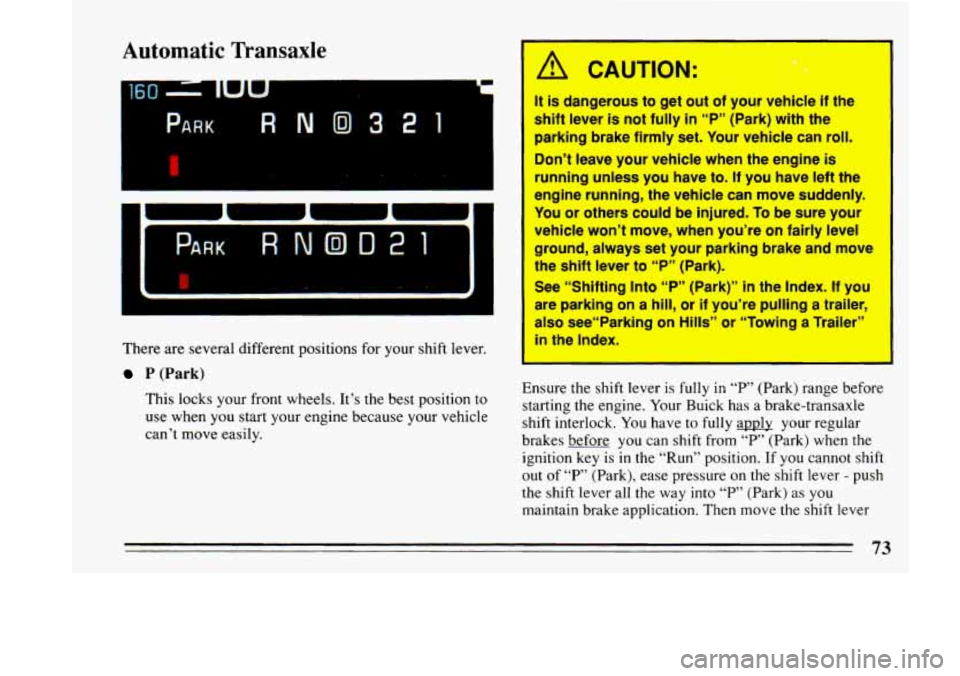
There are several different positions for your shift lever.
P (Park)
This locks your front wheels. It’s the best position to
use when you start your engine because your vehicle
can’t move easily.
A CAUTION: .
a -II
It is dangerous to get out of your vehicle If the
shift [ever is not fully in “P” (Park) with the
parking
brake firmly set. Your vehicle can roll.
Don’t leave your vehicle when ihe engine is
running unless you hsve to. If you have left the
engine
running, the vehicle can move suddenly.
You or others could be Injured. To be sure your
vehicle won’t move, when you’re on fairly level
ground, always set your parking brake and move
the shift lever to V“ (Park).
See “Shifting Into “P” (Park)” in the Index. If you
arb parkfng on a hill, or if you’re pulling a trailer,
also see“Parking on Hills” or “Towing a Trailer”
in’ the Index.
- i
Ensure the shift lever is fully in “F‘” (Park) range before
starting the engine. Your Buick has a brake-transaxle
shift interlock.
You have to fully apply your regular
brakes before
you can shift from “P” (Park) when the
ignition key is
in the “Run” position. If you cannot shift
out of “P” (Park), ease pressure on the shift lever - push
the shift lever all
the way into “P” (Park) as you
maintain brake application. Then move the shift lever
73
Page 78 of 324
NOTICE:
If your front wh
drive. This might happen
if you were stuck i
very deep sand or mud or were up agains
object. You could damage your transaxle.
Also, if you stop when going uphill, don't ho
your vehicle there with
only the accelerator
pedal. This could overheat and damage the
transaxle. Use your brakes or shift into
"P'' Park
to hold your vehicle
in position on a hill.
Parking Brake
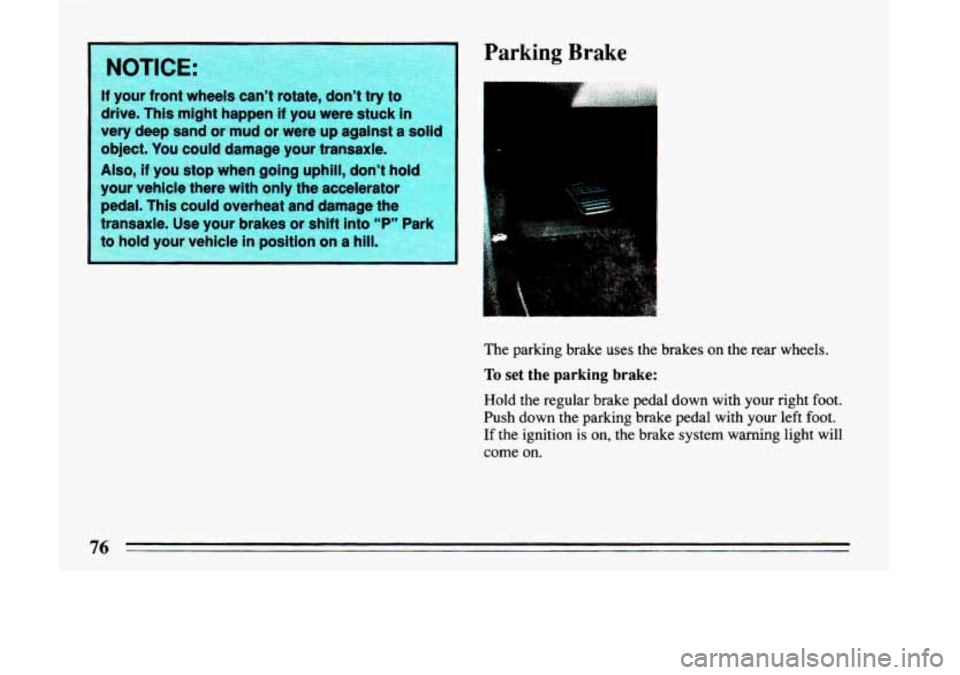
The parking brake uses the brakes on the rear wheels.
To set the parking brake:
Hold the regular brake pedal down with your right foot.
Push down the parking brake pedal with your left foot.
If the ignition
is on, the brake system warning light will
come on.
76
Page 79 of 324
1
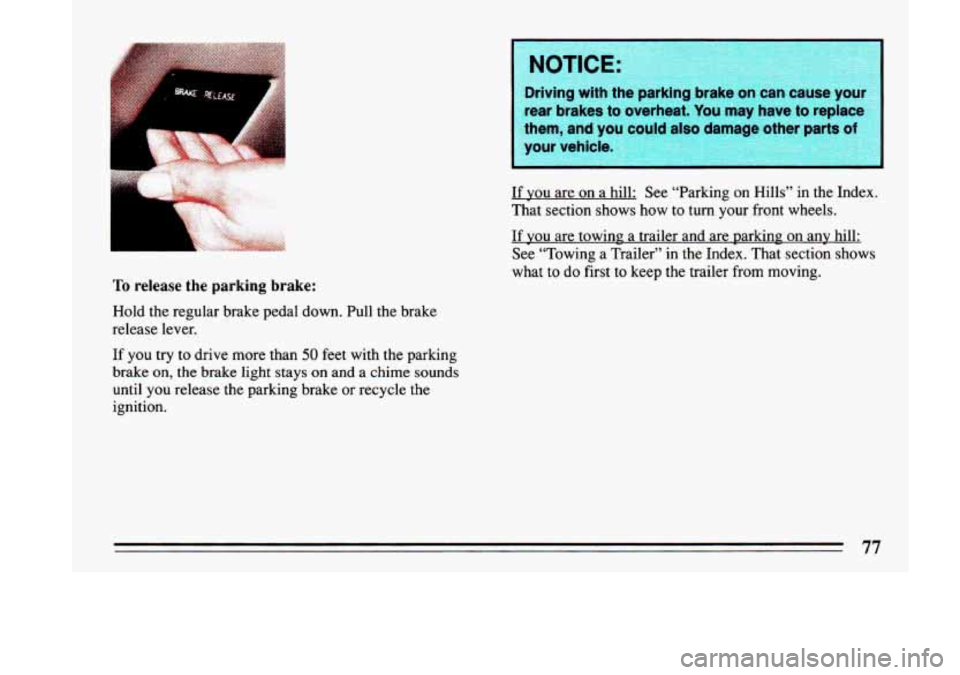
To release the parking brake:
Hold the regular brake pedal down. Pull the brake
release lever.
If you try to drive more than
50 feet with the parking
brake
on, the brake light stays on and a chime sounds
until you release the parking brake or recycle the
ignition.
NOTICE
Driving with t
I
rear brakes to overheat. You may have to replace
them,
and you could also damage other parts
If you are on a hill: See “Parking on Hills” in the Index.
That section shows how to turn your front wheels.
If you are towing a trailer and are parking on any hill:
See “Towing a Trailer” in the Index. That section shows
what
to do first to keep the trailer from moving.
77
Page 81 of 324
Leaving Your Vehicle With the Engine
Running
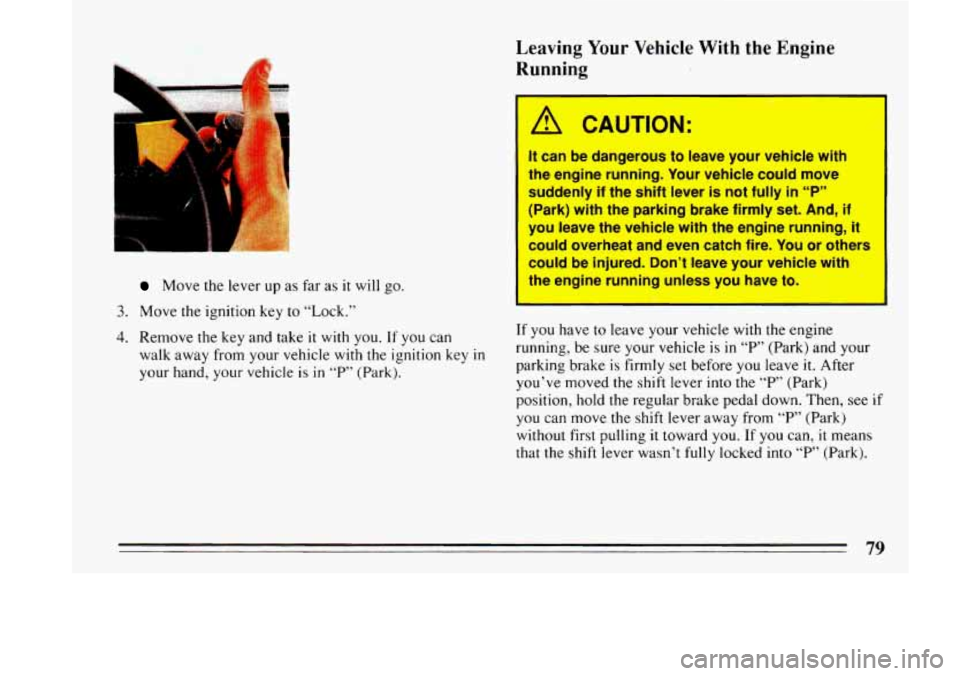
Move the lever up as far as it will go.
3. Move the ignition key to “Lock.”
4. Remove the key and take it with you. If you can
walk away from
your vehicle with the ignition key in
your hand, your vehicle is in “P” (Park).
It can be dangerous to leave your vehicle with
the engine running. Your vehicle could
move
suddenly if the shift lever is not fully in “P”
[Park) with the parking brake firmly set. And, if
you leave the vehicle with the engine running, St
could overheat and even catch fire. You or others
could be injured. Don’t leave your vehicle with
the engine running unless you have to.
If you have to leave your vehicle with the engine
running, be sure your vehicle is
in “P” (Park) and your
parking brake is firmly set before you leave it. After
you’ve moved the shift lever into the “P” (Park)
position, hold the regular brake pedal down. Then,
see if
you can move the shift lever away from
“P” (Park)
without first pulling it toward you. If
you can, it means
that the shift lever wasn’t fully locked into “P” (Park).
79
Page 82 of 324
Shifting Out of ‘‘P” (Park)
Your Buick has a brake-transaxle shift interlock. You
have to fully apply your regular brake before you can
shift from
T“ (Park) when the ignition is in the “Run”
position. See “Automatic Transaxle” in the Index.
If you cannot shift out of “P” (Park), ease pressure on
the shift lever -- push the shift lever all the way into “P”
(Park) as you maintain brake application. Then move the
shift lever into the gear
you wish. If you ever hold the
brake pedal down but still can’t shift out of
“P” (Park),
try this:
1. Turn the key to “Off.”
2. Apply and hold the brake until the end of Step 4.
3. Shift to “N” (Neutral).
4. Start the vehicle and then shift to the drive gear you
want.
5. Have the vehicle fixed as soon as you can.
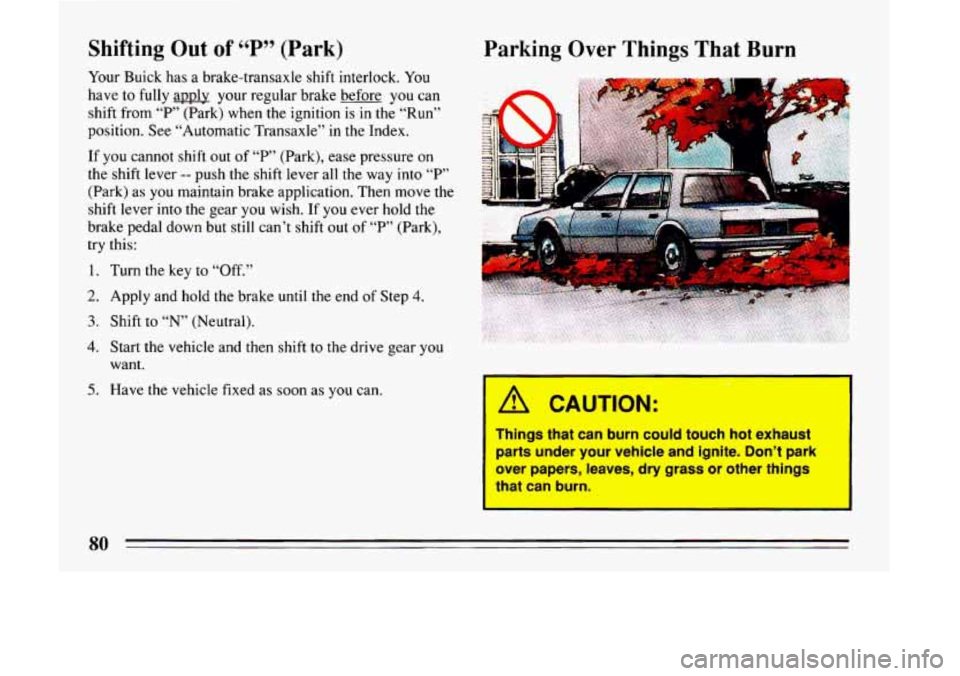
Parking Over Things That Burn
. ”. ..
6& VAU’. ,ON:
I
lings that can burn could touch hot exhaust
parts under your vehicle and ignite. Don’t park
over papers, leaves, dry grass or other things
that can burn.
80