Page 65 of 324

I
-.. . BLK
LSSEMBLY LINE DIAGNOSTIC
NK (ALDL) CONNECTOR I
5. Still keeping the program terminal grounded, repeat
Step
4 with the second transmitter. If you disconnect
the ground wire before completing this step, only the
first transmitter is matched.
If you make a mistake,
disconnect the jumper wire and start over at Step
3.
6. Remove the jumper wire. (Note: The system will not
operate
if the jumper wire is still connected.)
7. Test the operation of both transmitters with the
vehicle.
3. Use a jumper wire with alligator clips at both ends to
ground (Terminal
A) to program (Terminal G).
Grounding the program terminal erases the system
memory and causes the doors
to lock and unlock
once. This means
the system is ready to be matched
to the transmitter.
4. Keeping the program terminal grounded, press the
UNLOCK button on the first transmitter. The door
locks will lock and unlock again to indicate
the
transmitter is now matched. If there is no response,
check the transmitter batteries. If
you do not want to
match a second transmitter, proceed to Step 6.
If the lock control does not work as it should, see your
Buick dealer.
Battery Replacement
Under normal use, the batteries in your key chain
transmitter should last about two years.
You can tell the batteries are weak if the transmitter
won’t work at
the normal range in any location. If you
have to get close to your vehicle before the transmitter
works, it’s probably time to change the batteries.
63
Page 67 of 324
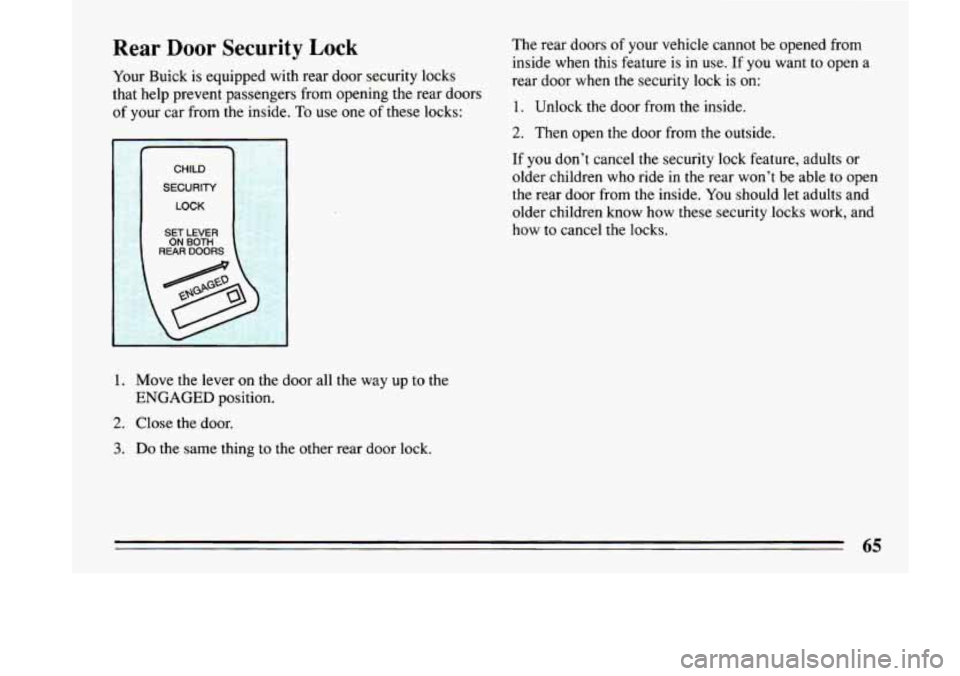
Rear Door Security Lock
Your Buick is equipped with rear door security locks
that help prevent passengers from opening the rear doors
of your car from the inside.
To use one of these locks:
1. Move the lever on the door all the way up to the
2. Close the door.
ENGAGED position.
3. Do the same thing to the other rear door lock. The
rear doors of your vehicle cannot be opened from
inside when this feature is
in use. If you want to open a
rear door when the security lock is on:
1. Unlock the door from the inside.
2. Then open the door from the outside.
If
you don’t cancel the security lock feature, adults or
older children who ride
in the rear won’t be able to open
the rear door from the inside. You should let adults and
older children know how these security locks work, and
how to cancel the locks.
Page 68 of 324

To cancel the rear door lock: Theft
1. Unlock the door from the inside and open the door
from the outside.
I
CHILD
SECURITY
LOCK
SET LEVER
REAR DOORS ON BOTH
2. Move the lever all the way down.
3. Do the same for the other rear door.
The rear door locks will now work normally. Vehicle theft
is big business, especially in
some cities.
Although your Buick has
a number of theft deterrent
features, we know that nothing we put on it can make it
impossible to steal. However, there are ways
you can
help.
Kev in the ignition: If you walk away from your
vehicle with the keys inside, it’s an
easy target for joy
riders or professional thieves
-- so don’t do it.
When
you park your Buick and open the driver’s door,
you’ll hear a tone reminding
you to remove your key
from the ignition and take it with
you. Always do this.
Your steering wheel will be locked, and
so will your
ignition and transaxle. And remember
to lock the doors.
Parking at Night: Park in a lighted spot, close all
windows and lock your vehicle. Remember to keep your
valuables out
of sight. Put them in a storage area, or take
them with you.
Parking Lots:
If you park in a lot where someone will
be watching your vehicle, it’s best
to lock it up and take
your keys. But what if you have to leave your ignition
key? What if you have
to leave something valuable in
your vehicle?
66
Page 69 of 324
e Put your valuables in a storage area, like your trunk
0 Lock the glove box.
Lock all the doors except the driver’s.
Then take the door key with you.
or glove box.
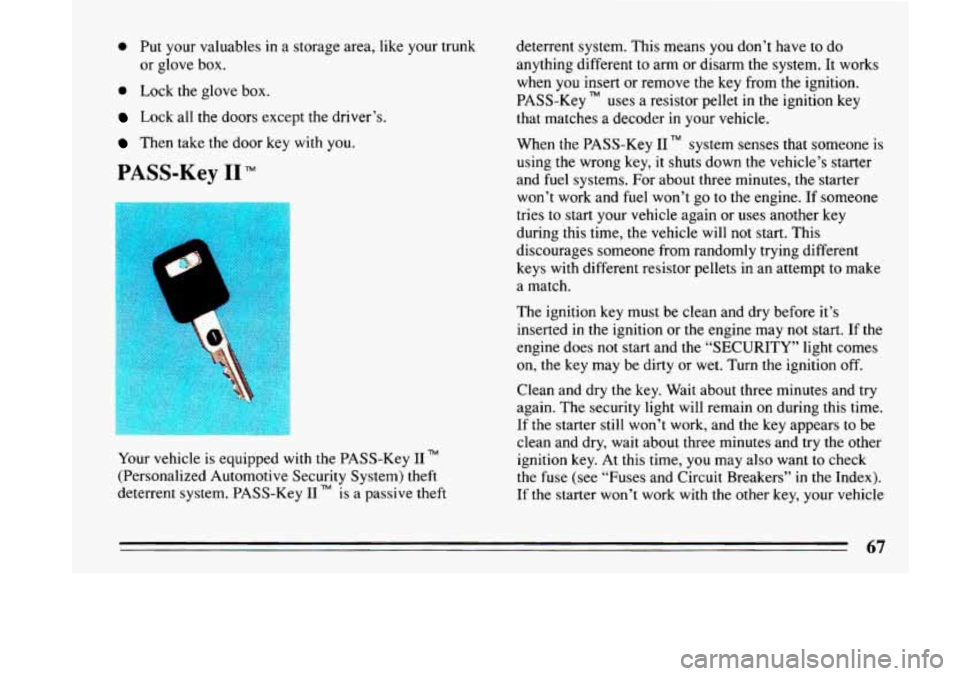
PASS-Key I1 TM
Your vehicle is equipped with the PASS-Key I1 TM
(Personalized Automotive Security System) theft
deterrent system. PASS-Key I1
TM is a passive theft deterrent system.
This means you don’t have to do
anything different
to arm or disarm the system. It works
when you insert or remove the key from the ignition.
PASS-Key uses a resistor pellet in the ignition key
that matches
a decoder in your vehicle.
When the PASS-Key I1
TM system senses that someone is
using the wrong key, it
shuts down the vehicle’s starter
and fuel systems. For about three minutes, the starter
won’t work and
fuel won’t go to the engine. If someone
tries to start your vehicle again or uses another key
during this time, the vehicle will not start. This
discourages someone from randomly trying different
keys with different resistor pellets in an attempt to make
a match.
The ignition key must be clean and dry before it’s
inserted in the ignition or the engine may not start.
If the
engine does not start and the “SECURITY” light comes
on, the key may be dirty or wet. Turn the ignition off.
Clean and dry the key. Wait about three minutes and try
again. The security light will remain on during this time.
If the starter still won’t work, and the key appears to be
clean and dry, wait about three minutes and try the other
ignition key. At this time, you may also want to check
the
fuse (see “Fuses and Circuit Breakers” in the Index).
If the starter won’t work with the other key, your vehicle
67
Page 85 of 324
You may also have a lock out button. Push LOCK to
disable the power window switches. This will prevent
passengers from opening and closing the windows. Push
UNLOCK to allow your passengers to be able to use
their window switches again.
Horn
To sound the horn, press a pad with the horn symbol on
either side
of the steering wheel.
Remote Trunk Release
I! The trunk release switch in
the glove
box must be
“ON” for the “TRUNK”
button to work.
This feature allows
you to secure items in the trunk
when you must leave the ignition key with an attendant.
To secure the trunk, turn OFF the TRUNK RELEASE,
lock the glove box, then take the door key with you.
83
Page 235 of 324
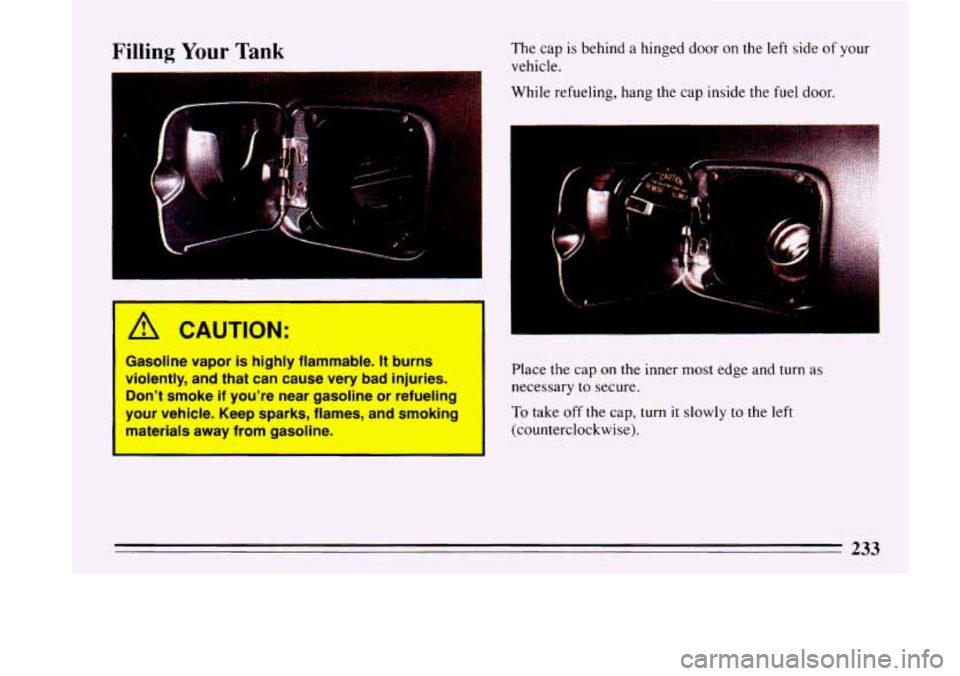
Filling Your Tank
.. .-
The cap is behind a hinged door on the left side of your
vehicle.
While refueling, hang the cap inside the fuel door.
I
A CAUTION:
Gasoline vapor is highly flammable. It burns
violently, and that can cause very bad injuries.
Don’t smoke
if you’re near gasoline or refueling
your vehicle. Keep sparks, flames, and smoking
materials away from gasoline.
Place the cap on the inner most edge and turn as
necessary to secure.
To take off the cap, turn it slowly to the left
(counterclockwise).
233
Page 241 of 324

SAE low-30
As shown in the viscosity chart, SAE low-30 is best
for your vehicle. However, you can use SAE 5W-30
if
it’s going to be colder than 60 F ( 16 C) before
your next oil change. When it’s very cold, below
0 F (- 1 8 C), you should use SAE 5W-30.
These numbers on an oil container show its viscosity, or
thickness,
Do not use other viscosity oils such as SAE
1OW-40 or SAE 20W-50.
Energy Conserving I1
Oils with these words on the container will help
you
save fuel.
This doughnut-shaped logo (symbol) is used on most oil
containers to help
you select the correct oil.
You should look for this on the oil container, and use
only those oils that display the logo.
GM Goodwrench@
oil (in Canada, GM Engine Oil)
meets all the requirements for your vehicle.
Engine Oil Additives: Don’t add anything to your oil.
Your Buick dealer is ready to advise if you think
something should be added.
When to Change Engine Oil: See if any one of these
is true for you:
Then go
to the front of the vehicle and release the
secondary hood release. Lift the hood.
Most trips are less than 4 miles (6 km).
0 It’s below freezing outside and most trips are less
than
10 miles ( 16 km).
0 The engine is at low speed most of the time (as in
0 You tow a trailer often.
0 Most trips are through dusty places.
If any one of these is true for your vehicle, then you
need to change your oil and filter every 3,000 miles
(5 000 km) or 3 months -- whichever comes first.
(See “Change Oil Soon” in the Index.)
If none of them is true, change the oil every
7,500 miles
(12 500 km) or 12 months -- whichever comes first.
Change the filter at the first oil change and at every
other oil change after that. (See “Change Oil Soon”
in the Index.)
Engine Block Heater: An engine block heater can be a
big help if you have to park outside in very cold
weather,
0 F (- 18 C) or colder. If your vehicle has this
option,
see “Engine Block Heater” in the Index.
door-to-door delivery, or
in stop-and-go traffic).
239
Page 291 of 324
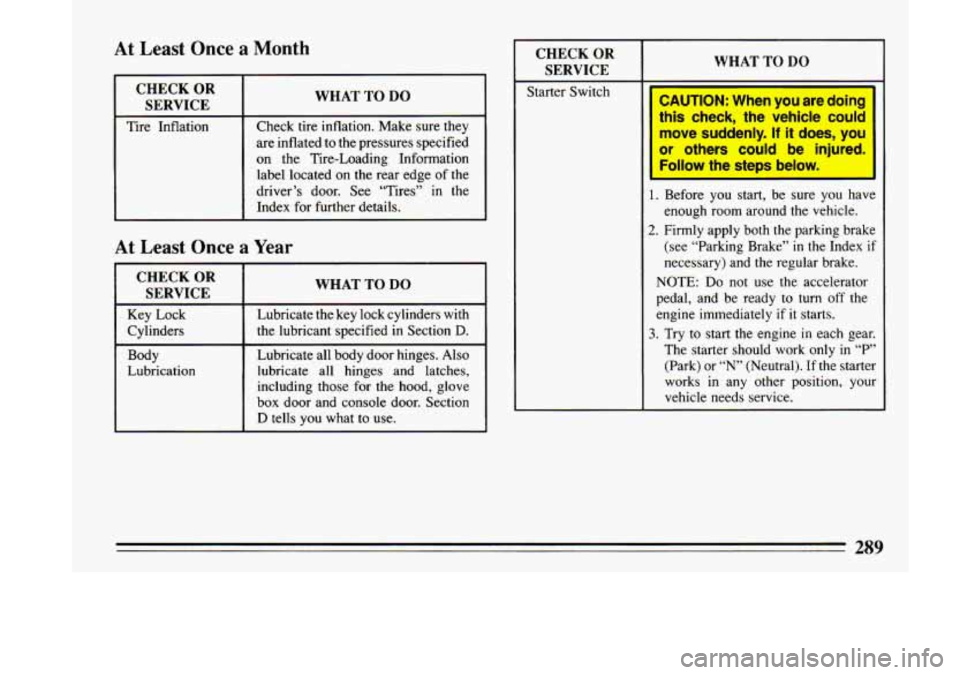
At Least Once a Month
1 CHECKOR SERVICE
I WHAT TO DO
~ ~~~
Tire Inflation Check tire inflation. Make sure
they
are inflated to the pressures specified
on the Tire-Loading Information label located on the rear edge of the
driver’s door. See “Tires”
in the
Index for further details.
At Least Once a Year
CHECK OR
SERVICE
Key Lock
Cylinders
Body
Lubrication
WHAT TO DO
Lubricate the key lock cylinders with
the lubricant specified in Section
D.
Lubricate all body door hinges. Also
lubricate all hinges and latches,
including those
for the hood, glove
box door and console door. Section
D tells you what to use.
CHECK OR
SERVICE
Starter Switch
L
WHAT TO DO
CAUTION: When you are doing
this check, the vehicle could move suddenly.
If it does, you
or others could be injured. Follow the steps below.
1. Before you start, be sure you have
enough room around
the vehicle.
2. Firmly apply both the parking brake
(see “Parking Brake” in
the Index if
necessary) and the regular brake.
NOTE:
Do not use the accelerator
pedal, and be ready to turn
off the
engine immediately
if it starts.
3. Try to start the engine in each gear.
The starter should work only
in “P’
(Park) or “N’ (Neutral). If the starter
works
in any other position, your
vehicle needs service.