1993 BUICK CENTURY heater
[x] Cancel search: heaterPage 78 of 324
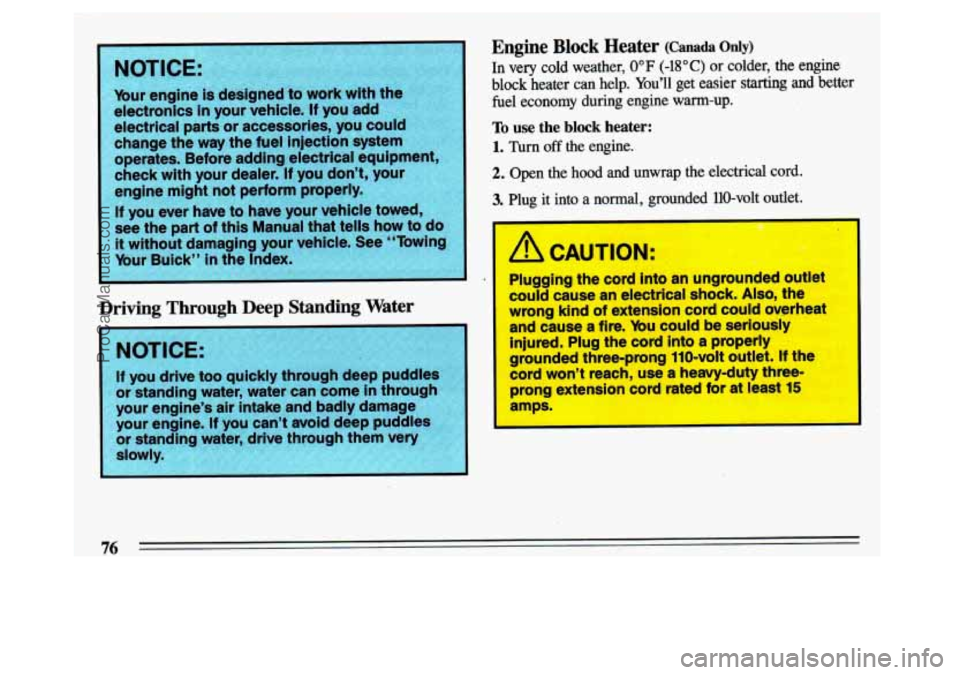
~ Driving T -ough Deep Standing Water
orktanding
water, water can come in through
your engine’s air intake and badly damage your en ine. If ou can’t avoid dee uddles
or stan
slowly.
Engine Block Heatel lada only)
In very cold weather, 0°F (-HOC) or colder, the engine
block
heater can help. You’ll get easier starting and better
fuel economy during engine warm-up.
To use the block heater:
1. Turn off the engine.
2. Open the hood and unwrap the electrical cord.
3. Plug it into a normal, grounded UC olt outlet.
I I
Plugging the cord into an ungrounded outlet I
could cause an electrical shock. Also, the
wrong kind of extension cord could overheat
and cause a fire.
You could be seriously
injured. Plug the cord into a properly
grounded three-prong 110-volt outlet.
If the
cord won’t reach, use a heavy-duty three-
prong extension cord rated for at least 15
amps.
ProCarManuals.com
Page 79 of 324
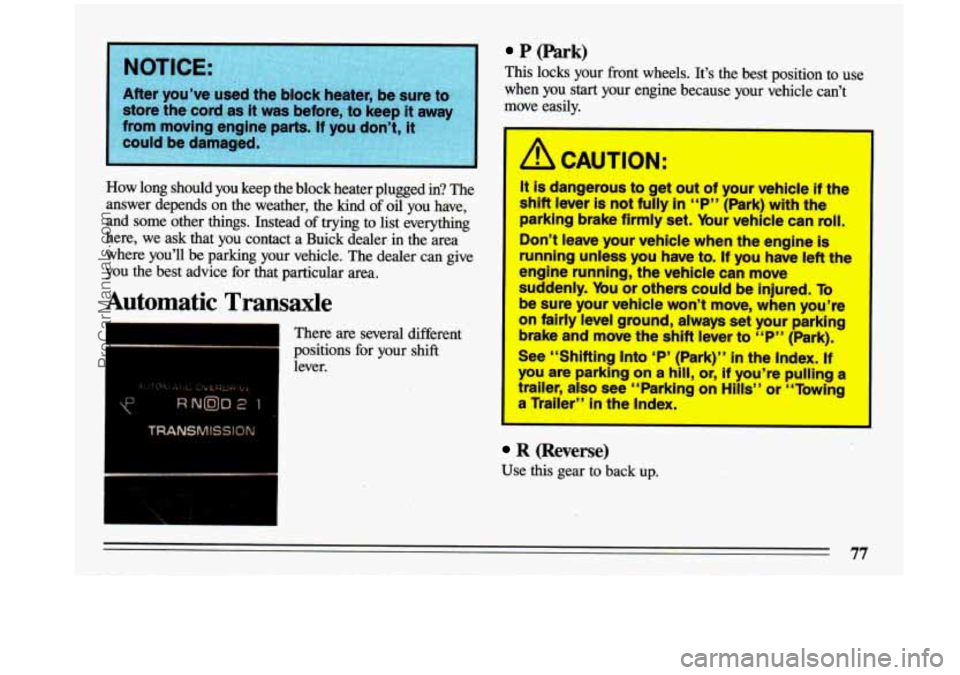
NOTICE:
After you’ve
How long should you keep the block heater plugged in? The
answer depends on the weather, the kind of
oil you have,
and some other things. Instead of trying
to list everything
here, we ask that you contact a Buick dealer, in the area
where you’ll be parking your vehicle. The dealer can give
you the best advice for that particular area.
Automatic .Transaxle
There are several different
positions for your
shift
lever.
P (Park)
This locks your front wheels. It’s the best position to use\
when you
start your engine because your vehicle can’t
move easily.
I- -
I a CAUTION:
It is dangerous to get out of your vehicle if the
shift lever is
not fully in “P” (Park) with the
parking brake firmly set.
Your vehicle can roll.
Don’t leave your vehicle when the engine is
running unless you have to. If you have left the
engine running, the vehicle can move
suddenly. You
or others could be injured. To I
be sure your vehicle won’t move, when you’re
on fairly level
ground, always set your parking
brake and move the shift lever to “P” (Park).
See “Shifting
Into ‘P’ (Park)” in the Index. If
you are parking
on a hill, or, if you’re pulling a
trailer, also see “Parking
on Hills” or “Towing
a Trailer”
in the Index.
R (Reverse)
Use this gear to back up.
ProCarManuals.com
Page 115 of 324
Part 3 Comfort Controls and Audio Systems
In this part you’ll find out how to operate the comfort control systems Ad audio systems offered with your Buick.
Be sure to read about the particular system supplied with your ve\
hicle.
Part 3 includes:
Comfort Control System ............................................................... .114
Airconditioner.. ......................................................................
ventilation ....................................................................... \
.w
Heater and Defroster ................................................................
Rear Wi.ndow Defogger ................................................................ w
Tape Player Contrds. .............................................................. .QO
CDPlayerControls... .................................................,............~3
Care of Cassette Tape Player & Tapes ................................................. .~9
Care of Compact Discs .............................................................. .no
Power Armma Mast Care ........................................................... -131
Audio systems ........................................................................\
. ufj
RadiocOntrOlS.... .....................................,,..............,...........118
ProCarManuals.com
Page 116 of 324
1
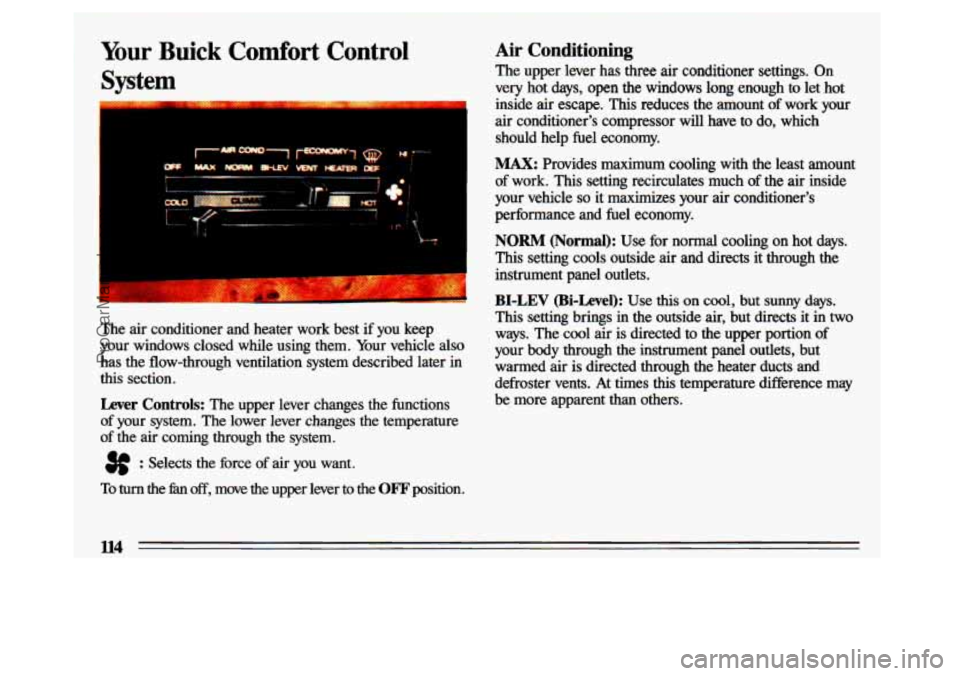
Your Buick Comfort Control
Syst m -
The air conditioner and heater work best if you keep
your windows closed while using them. Your vehicle
also
has the flow-through ventilation system described later in
this section.
Lever Controls: The upper lever changes the functions
of your system. The lower lever changes the temperature
of the air coming through the system.
3f : Selects the force of air you want.
Air Conditioning
The upper lever has three air conditioner settings. On
very hot days, open the windows long enough to let hot
inside air escape.
This reduces the amount of work your
air conditioner's compressor
will have to do, which
should help fuel economy.
MAX: Provides maximum cooling with the least amount
of work. This setting recirculates much of the air inside
your vehicle
so it maximizes your air conditioner's
performance and
fuel economy.
NORM (Normal): Use for normal cooling on hot days.
This setting cools outside air and directs it through the
instrument panel outlets.
BI-LEV (Bi-Level): Use this on cool, but sunny days.
This setting brings in the outside air, but directs it in two\
ways. The cool air
is directed to the upper portion of
your body through the instrument panel
outlets, but
warmed air is directed through the heater ducts and
defroster vents. At times
this temperature difference may
be more apparent than others.
To turn the 5x1 off, move the upper lever to the OF'F position.
ll4
ProCarManuals.com
Page 117 of 324

The air conditioner compressor operates in all AIR COND
positions, and in DEF (Defrost) when the outside
temperature is above about 40°F (4.5"
C).
Ventilation
For mild outside temperatures, when little heating or
cooling is needed, slide the upper lever to
VENT. Air
flow is through the instrument panel outlets. Rotate the
control next to the outlets to turn on, adjust or
turn off
the air flow. Adjust the lower lever on the control panel
to the temperature desired.
Heating
When outside temperatures are cold, sliding the upper
lever to
HEATER and the lower lever to HOT will send
heated air through the heater ducts, and some through the
defroster vents.
VENT and HEAmR are labeled
ECONOMY positions because the air conditioner
compressor doesn't run
in these two settings. This
reduces engine load, resulting
in improved he1 economy.
If either setting fails to keep you comfortable, or causes
your windows
to fog up, slide the upper lever to one of
the
AIR COND positions, or to DEF (Defrost).
Defrosting
The DEF setting directs most of the air through the
defroster vents, and some through the heater ducts.
Defogging Windows with Four Season
Climate Control
To quickly defog the windshield, set the upper lever to
DEF and move the hn switch to HI. Slide the lower
lever
to HOT.
In damp, cool weather (temperatures about 45"-65"F,
7"- 18" C), you can use BI-LEV to defog the side windows.
Set the upper lever to
BI-LEV and the fan switch to HI.
Aim the side vents toward the side windows. For increased
air flow to the side vents, close the center vents.
Rear Window Defogger (Option)
--
The rear window defogger
uses
a warming grid to
remove fog from the rear
window.
In winter, it can
also keep ice from forming
on the rear window.
Press the
ON portion of the
switch. The indicator light
will glow. The rear window
defogger will
turn off
automatically after about
10
minutes of use. You can
also turn
it off by turning
off the ignition or pressing the
OFF portion of the
switch.
ProCarManuals.com
Page 118 of 324
Keep the air path under the front seats clear of objects.
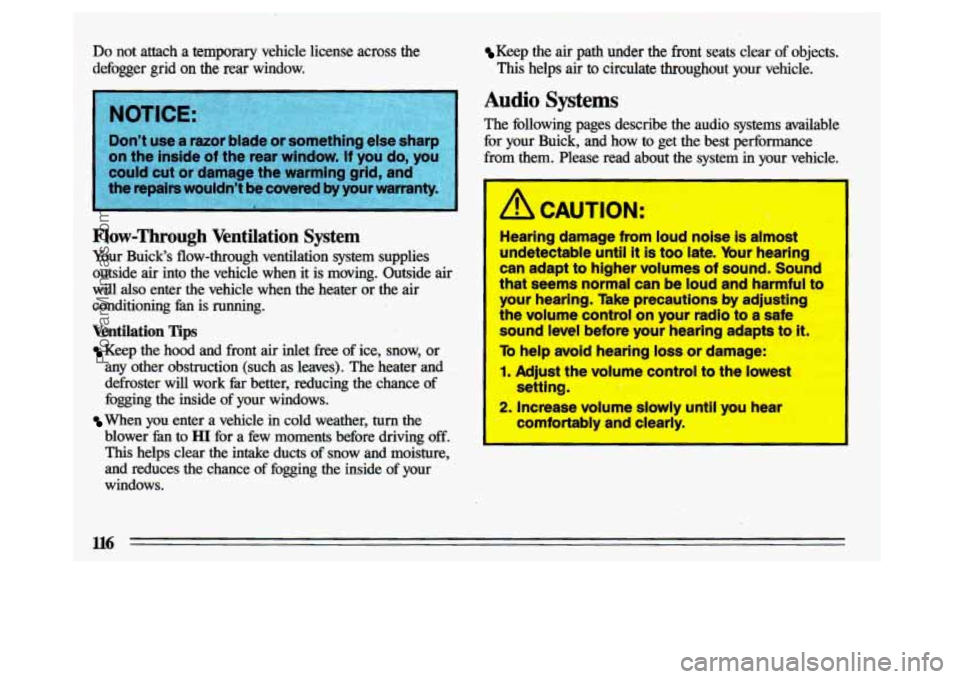
Do not attach a temporary vehicle license across the
defogger grid
on the rear window.
Flow-Through Ventilation System
Your Buick's flow-through .ventilation system supplies outside
air into the vehicle when it is moving. Outside air
will
also enter the vehicle when the heater or the air
conditioning fan is running.
Ventilation Tips
Keep the hood and front air inlet free of ice, snow, or
any other obstruction (such as leaves). The heater and
defroster will work
far better, reducing the chance of
fogging the inside of your windows.
blower fan to
HI for a few moments before driving off.
This helps ,clear the intake ducts of snow and moisture,
and reduces the chance of fogging the inside of your
windows.
When you enter a vehicle in cold weather, turn the This helps
air to circulate throughout your vehicle.
Audio Systems
The
following pages describe the audio systems available
for your Buick, and how to get the best performance
frorr
*hmm Please read about the system in your vehicle.
A CAUTION:
Hearing damage from loud noise is almost
undetectable until
it is too'late. Your hearing
can adapt to higher volumes of sound. Sound
that seems normal can be loud and harmful to
-3ur hearing. Take precautions by adjusting
..re volume control on your radio to a safe
sound level before your hearing adapts to
it.
To help avoid hearing loss or damage:
1. Adjust the volume control to the lowest
-. Increase volume slowly until you hear
setting.
comfortably and clearly.
I
ProCarManuals.com
Page 176 of 324
~ CAUTION (Contlnued)
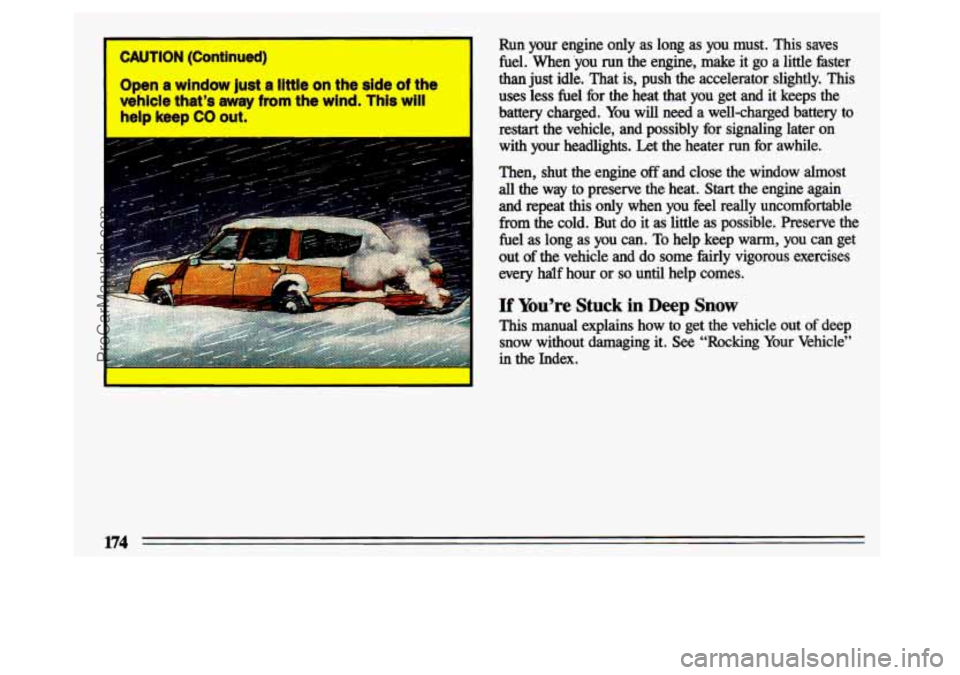
1 Opien a wlndow Just a llttle on the side of the
vehlcie that’s
away fmm the wind. Thls will
help keep CO out.
I
Run your engine only as long as you must. This saves
fuel. When you run the engine, make it go a little faster
than just idle. That is, push the accelerator slightly. This
uses less
fuel for the heat that you get and it keeps the
battery charged. You
will need a well-charged battery to
restart
the vehicle, and possibly for signaling later on
with your headlights. Let the heater run for awhile.
Then, shut the engine
off and close the window almost
all the way to preserve the heat. Start the engine again
and repeat
this only when you feel really uncomfortable
from the cold. But do it as little as possible. Preserve the
fuel
as long as you can. To help keep warm, you can get
out
of the vehicle and do some fhirly vigorous exercises
every half hour or
so until help comes.
If You’re Stuck in Deep Snow
This manual explains how to get the vehicle out of deep
snow without damaging
it. See “Rocking Your Vehicle”
in the Index.
174
ProCarManuals.com
Page 198 of 324
If No Steam Is Coming From Your-Engine:
If you get the overheat warning but see or hear no steam,
the problem
may not be too serious. Sometimes the
engine can get a little too hot when you:
Climb a long hill on a hot day.
Stop after high speed driving.
Idle for long periods in traffic.
Tow a trailer.
If you get the overheat warning with
no sign of steam, try
this for a minute or so:
1. Turn off your air conditioner.
2. Turn on your heater to full hot at the highest fan speed
and open the window as necessary.
3. Try to keep your engine under load (in a drive gear
where the engine runs slower). If you no longer have the overheat warning, you can
drive. Just to be safe, drive slower for about ten minutes.
If the warning doesn’t come back on, you can drive
normally.
If the warning continues, pull over, stop, and park your
vehicle right away.
If there’s still no sign of steam, you can idle the engine\
for two or three minutes while you’re parked, to
see if
the warning stops. But then, if you still have the warning,
TURN OFF THE ENGRVE AND GET EVERYONE
OUT
OF THE VEHICLE until it cools down.
You may decide
not to lift the hood but to get service
help right away.
ProCarManuals.com